


Iran Says Nuclear Facilities Have Been Targeted After Israel Says Attacks ‘Will Escalate and Expand’

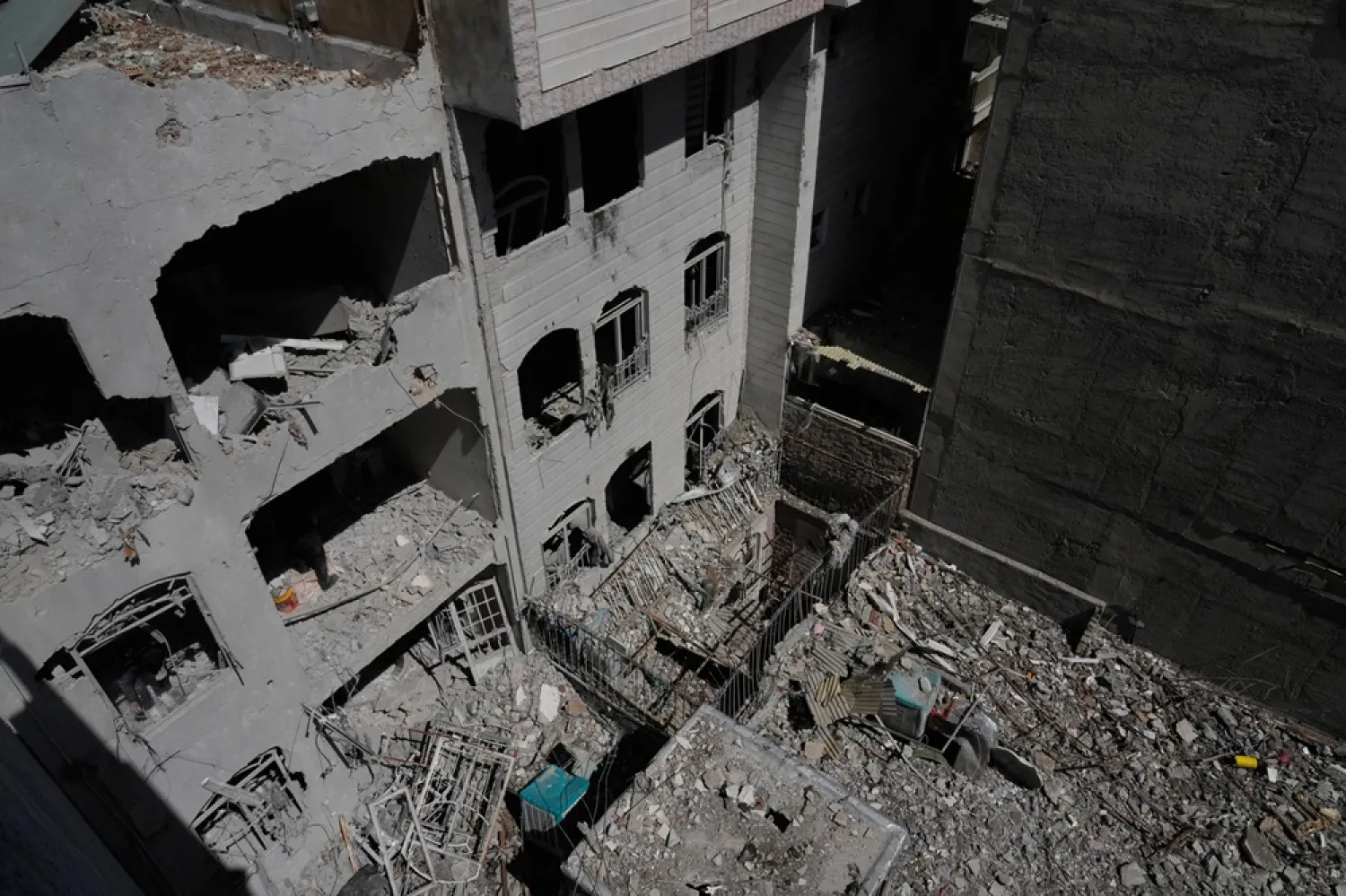
A building is damaged after a nearby residential building was hit in an overnight US-Israeli strike in Tehran, Friday, March 27, 2026. (AP)
TT

Iran Says Nuclear Facilities Have Been Targeted After Israel Says Attacks ‘Will Escalate and Expand’

A building is damaged after a nearby residential building was hit in an overnight US-Israeli strike in Tehran, Friday, March 27, 2026. (AP)

Iran state media says its nuclear facilities were attacked Friday, just hours after Israel threatened to “escalate and expand” its campaign against Tehran. 

IRNA reports that a heavy-water plant and a yellowcake production plant were struck. Yellowcake is a concentrated form of uranium after impurities are removed from the raw ore. Heavy water is used as a moderator in nuclear reactors. 

Word of the attacks came after US President Donald Trump claimed talks on ending the war were going well and gave Tehran more time to open the Strait of Hormuz. Iran has given no sign of backing down. 

With stock markets reeling and economic fallout from the war extending far beyond the Middle East, Trump is under growing pressure to end Iran's chokehold on the strait, a strategic waterway through which a fifth of the world's oil is usually shipped. 

Iran has rejected a 15-point US proposal for a ceasefire that includes it relinquishing control of the strait, but at the same time has ordered thousands more troops to the region — possibly in preparation for a military attempt to wrest the waterway from Iran. 

Trump has said if Iran doesn't reopen the strait to all traffic by April 6, he will order the destruction of Iran’s energy plants. He said Thursday that talks on ending the conflict were going “very well.” Iran maintains it is not engaged in any negotiations. 

Israel targets Iran's weapons production and Lebanese capital  

Air raid sirens sounded in Israel and the military said it has been intercepting Iranian missiles on a daily basis. Defense Minister Israel Katz said Iran “will pay heavy, increasing prices for this war crime.” 

“Despite the warnings, the firing continues," Katz said. "And therefore attacks in Iran will escalate and expand to additional targets and areas that assist the regime in building and operating weapons against Israeli citizens.” 

Israel’s military said its attacks Friday targeted sites “in the heart of Tehran” where ballistic missiles and other weapons are produced. It said it also hit missile launchers and storage sites in Western Iran. 

Smoke rose over Beirut after a pre-dawn strike, and Lebanon's Health Ministry later reported two people were killed. 

Iran launches missiles and drones at Gulf 

Saudi Arabia's Defense Ministry said it shot down missiles and drones targeting the capital, Riyadh. 

Kuwait said its Shuwaikh Port in Kuwait City and the Mubarak Al Kabeer Port to the north, which is under construction as part of China’s “Belt and Road” initiative, sustained “material damage” in attacks. It appeared to be one of the first times a Chinese-affiliated project in the Gulf Arab states has come under assault in the war. China has continued to purchase Iranian crude. 

US stocks fell on opening Friday, in a fifth straight losing week — Wall Street’s longest such streak in nearly four years. The S&P 500 dropped 0.4% in early trading Friday. The Dow lost 0.6%, and the Nasdaq fell 0.6%, breaking the week’s pattern of flip‑flopping gains and losses as hopes for an end to the war vacillated. 

Asian shares also fell Friday over growing doubts about the chances of de-escalation. Oil prices rose again, the Brent crude, the international standard, at $107 a barrel in morning trading, up more than 45% since Israel and the US attacked Iran on Feb. 28 to start the war. 

US pushes diplomatic solution while sending more troops to the region 

Iran's stranglehold on shipping through the Strait of Hormuz has increased concerns of a global energy crisis, and appears part of a strategy to get the US to back down by roiling the world economy. A Gulf Arab bloc said Thursday that Iran has been exacting tolls from ships to ensure safe passage. 

Trump envoy Steve Witkoff said Washington delivered a 15-point “action list" to Iran for a possible ceasefire, using Pakistan as an intermediary. It proposes restricting Iran’s nuclear program and reopening the Strait of Hormuz. 

Iran rejected the US offer and presented its own five-point proposal that included reparations and recognition of its sovereignty over the vital strait. 

Diplomats from several countries have tried to organize a direct meeting between US and Iranian envoys, possibly in Pakistan. 

Egypt's Foreign Ministry said in a statement Friday that Foreign Minster Badr Abdelatty spoke with his Turkish and Pakistani counterparts by phone as part of "intensive efforts" to organize the talks. Abdelatty said they hoped for "gradual de-escalation efforts that would ultimately lead to the end of the war." 

Türkiye's Foreign Ministry confirmed those calls and said Foreign Minister Hakan Fidan also spoke with US officials. 

Meeting in France, the G7 foreign ministers adopted a declaration calling for an immediate halt to attacks against populations and infrastructure. 

Meanwhile, US ships drew closer to the region carrying some 2,500 Marines, and at least 1,000 paratroopers from the 82nd Airborne — trained to land in hostile territory to secure key positions and airfields — have been ordered to the Middle East. 

The UN Security Council will engage in a closed consultation on Iran on Friday, according to two UN diplomats who spoke on condition of anonymity because the meeting is not public. They said Russia requested the meeting and that the US, which holds the Security Council presidency, scheduled it. 

Jan Egeland, secretary general of the Norwegian Refugee Council, said its teams in Iran have reported “countless homes, hospitals and schools have been damaged or destroyed,” and that nearly every neighborhood in Tehran has sustained damage. 

“Civilians are paying the highest price for this war — it must end” Egeland said in a statement. 

The UN's International Organization for Migration said Friday that 82,000 civilian buildings in Iran, including hospitals and the homes of 180,000 people, are damaged. 

“If this war continues, we risk a far wider humanitarian disaster,” Egeland said. “Millions could be forced to flee across borders, placing immense pressure on an already overstretched region.” 

Israel deployed the 162nd Division into southern Lebanon to support efforts to protect its northern border towns from Hezbollah attacks and uproot the militant group, the military said. 

Death toll climbs, primarily in Iran and Lebanon  

Eighteen people have died in Israel, while four Israeli soldiers have been killed in Lebanon. Two Israeli soldiers were severely injured in Lebanon on Friday during an “operational accident,” the military said. 

Authorities said more than 1,100 people have died in Lebanon and over 1,900 people have been killed in Iran. 

At least 13 American troops have been killed and four people in the occupied West Bank and 20 in Gulf Arab states have also died. 

In Iraq, where Iranian-supported militia groups have entered the conflict, 80 members of the security forces have died.’’ 


Trump to Make First Flight on Qatar-Gifted Jet This Week

(FILES) In this February 15, 2025 a Qatari Boeing 747 sits on the tarmac of Palm Beach International airport after US President Donald Trump toured the aircraft on February 15, 2025. (Photo by ROBERTO SCHMIDT / AFP)
TT

Trump to Make First Flight on Qatar-Gifted Jet This Week

(FILES) In this February 15, 2025 a Qatari Boeing 747 sits on the tarmac of Palm Beach International airport after US President Donald Trump toured the aircraft on February 15, 2025. (Photo by ROBERTO SCHMIDT / AFP)

US President Donald Trump will make his first flight on a new Air Force One plane gifted by Qatar later this week, the White House said Monday.

Trump will take the jet on Wednesday to North Dakota for an event marking the 250th anniversary of US independence, a White House official told AFP.

As he unveiled the plane earlier this month, Trump praised the Gulf emirate for being “so nice and providing” the modified Boeing 747, which previously served Qatar's head of state.

Trump has been obsessed since his first term with replacing the aging jets that serve as Air Force One, and he hand-picked the new plane's red, white and blue livery.

But critics have raised a host of ethical, constitutional and security concerns about the gifting of an aircraft worth hundreds of millions of dollars by a foreign power like Qatar.

The US Constitution prohibits presidents and other officeholders from receiving “any present, Emolument, Office, or Title, of any kind whatever, from any King, Prince, or foreign State” unless approved by Congress.

Trump's administration has said the plane is a direct gift to the US Department of Defense -- while stoking further concern by saying the plane would eventually be donated to Trump's presidential library.

The Qatari-gifted plane is meant to be a stopgap until US planemaker Boeing delivers two new 747-8 aircraft to serve as the presidential jet in a program plagued by delays and cost overruns.


Türkiye Must Be ‘Included’ in Europe Security Structures, Says Erdogan

Turkish President Recep Tayyip Erdogan speaks during the opening ceremony of Antalya Diplomacy Forum in Antalya, Türkiye, April 17, 2026. (Reuters)
TT

Türkiye Must Be ‘Included’ in Europe Security Structures, Says Erdogan

Turkish President Recep Tayyip Erdogan speaks during the opening ceremony of Antalya Diplomacy Forum in Antalya, Türkiye, April 17, 2026. (Reuters)

Türkiye must be included in all of Europe's defense structures and defence trade restrictions between NATO members must be removed, President Recep Tayyip Erdogan said Monday ahead of a key NATO summit.

His remarks come as Europe revamps its defenses to counter Russia and the risk of a US pullback from NATO, which is to hold a summit in the Turkish capital Ankara on July 7-8.

"Türkiye's indispensable contributions to European security are sometimes overlooked," Erdogan told parliamentary delegates from all 32 NATO member states in Istanbul. He said Türkiye wanted "to participate in all defense and security initiatives" on the continent.

At issue is Türkiye's access to the European Union's 150-billion-euro ($176-billion) Security Action for Europe (SAFE) initiative, intended to strengthen European defense capabilities.

"We expect your support, lawmakers, for Türkiye's inclusion in the defense and security initiatives announced by the European Union," Erdogan told them.

Within SAFE, firms from non-EU countries such as Türkiye, Britain and the United States can only supply up to 35 percent of the component costs of weaponry funded by the scheme.

If Türkiye wants its companies to be able to tap a bigger part of the funds Ankara needs to sign a security partnership with the EU and then negotiate special access with Brussels -- a process that would require approval from all 27 EU members. Greece has threatened to block such a move.

"Under SAFE, any third country can participate in a defense project up to a level of 35 percent. Any negotiations with a view to potentially increasing or lifting this 35 per cent cap ... would require a bilateral agreement," said Thomas Regnier, a European Commission spokesperson.

"For now, this is not an agreement we have concluded with Türkiye."

- 'Remove the obstacles' -

Erdogan also urged NATO to remove all barriers blocking defense industry trade between alliance members.

"If we want to overcome the challenges we face, we need to remove obstacles to defense industry trade while ensuring a balanced and fair burden-sharing among allies," he said.

Türkiye has the second-biggest army of the alliance after the United States and a burgeoning defense industry which has gone from strength to strength fueled by bilateral defense deals.

But its defense industry has been hit by US sanctions imposed over Ankara's purchase of an S-400 Russian surface-to-air missile defense system. Washington also booted Türkiye out of its F-35 program, in a move that has soured relations between the NATO allies.

Although Washington has expressed a desire to draw a line under the dispute, lifting the sanctions requires Congressional approval. Observers say there is little chance the showdown would be resolved before the summit.

US President Donald Trump has however pledged to give Erdogan something that would make him "very happy" when he flies in next week for the NATO gathering.

Analysts said it was likely to be a delivery of several dozen US-made F110 engines Türkiye needs for its fifth-generation KAAN fighter jets that are under development. Delivery of the engines had been blocked since the imposition of the US sanctions.


Trump Says Iran Requested Meeting to be Held in Doha Tuesday

US and Iran flags are seen in this illustration taken June 18, 2025. REUTERS/Dado Ruvic/Illustration/File Photo
TT

Trump Says Iran Requested Meeting to be Held in Doha Tuesday

US and Iran flags are seen in this illustration taken June 18, 2025. REUTERS/Dado Ruvic/Illustration/File Photo

US President Donald Trump said that Iran has requested a meeting that will be held in the Gulf state of Qatar on Tuesday, despite an earlier denial from Tehran that talks were planned.

"IRAN HAS REQUESTED A MEETING. IT WILL TAKE PLACE TOMORROW IN DOHA!" Trump posted on his Truth Social platform on Monday.

Shortly afterwards, White House spokesperson Karoline Leavitt said US negotiators Jared Kushner and Steve Witkoff would be "flying to Doha for high level meetings this week".

Iran's foreign ministry earlier on Monday denied reports that Iranian and American technical teams will meet this week to discuss the implementation of the deal to end the Middle East war.

Uncertainty over the talks followed renewed tit-for-tat attacks between the United States and Iran in recent days despite an April ceasefire and a memorandum of understanding, brokered by Pakistan and Qatar, aimed at permanently ending the war.

A diplomat with knowledge of the talks confirmed to AFP on Monday that officials from the US and Iran are to meet in Doha to discuss the accord.

"Technical teams working on the implementation of the MoU are scheduled to meet in Doha in the coming days," the diplomat said on condition of anonymity to discuss the sensitive talks.

The diplomat added "communications channels created to de-escalate any incidents are in place," following strikes between the US and Iran.
