

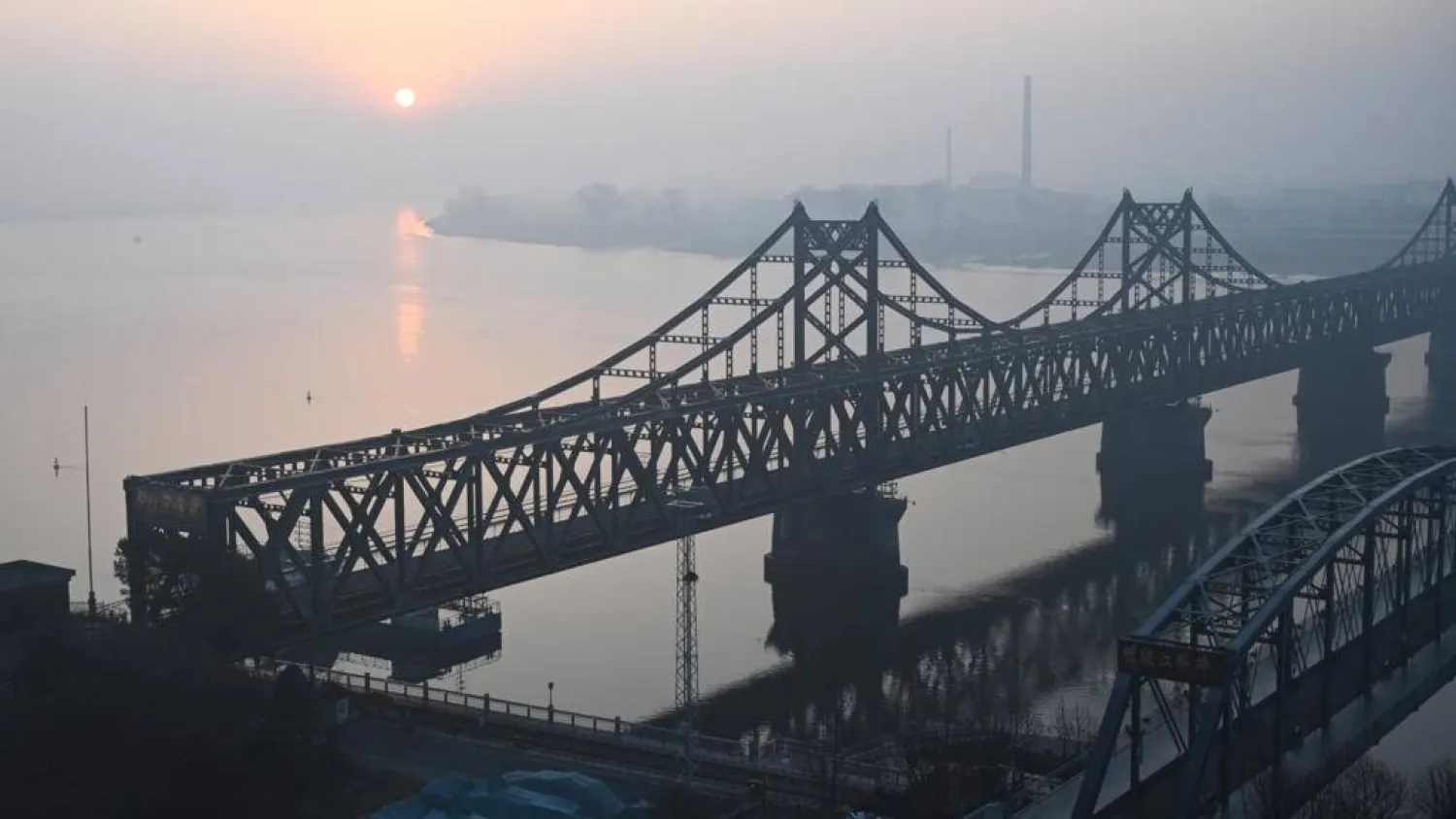

High Hopes at China's Gateway to North Korea as Trains Resume

The sun rises over the North Korean town of Sinuiju, behind the Sino-Korean Friendship Bridge (L) and the Yalu River Broken Bridge (R), as seen from the border city of Dandong, in China's northeast Liaoning province on March 26, 2026. GREG BAKER / AFP
TT

High Hopes at China's Gateway to North Korea as Trains Resume

The sun rises over the North Korean town of Sinuiju, behind the Sino-Korean Friendship Bridge (L) and the Yalu River Broken Bridge (R), as seen from the border city of Dandong, in China's northeast Liaoning province on March 26, 2026. GREG BAKER / AFP

Now retired, Wang Meili wants to see the world -- including North Korea, the reclusive nation that lies across the river from her lifelong home in northeastern China.

North Korea has long kept tight control over foreign visitors, and effectively sealed its borders at the start of the Covid-19 pandemic six years ago, AFP said.

It has since partly reopened and restored daily passenger train services with China this month, but has not yet resumed issuing tourism visas to Chinese citizens, who once made up the bulk of its overseas visitors.

"We'd like to get visas to go. I've already got my passport," said 68-year-old Wang, who grew up in the border city of Dandong.

In another apparent sign of North Korea's reopening, Air China is set to resume flights to Pyongyang on Monday.

But for now, only those with work or study visas can go.

AFP journalists in Dandong, the main gateway for cross-border travel and trade, saw a mostly empty passenger train rattle over a bridge into North Korea this week.

Nearby, tourists on another bridge, partly destroyed by US bombs during the Korean War, posed for photographs and peered through binoculars at the North Korean city of Sinuiju on the opposite shore.

Tour boats took curious sightseers to gaze at North Koreans cycling along the Yalu river separating the two countries or cleaning boats on the bank. Uniformed guards stood at regular points along the boundary.

Li Shuo, the manager of a Dandong-based travel agency, said the resumption of passenger train services had had "no impact" on his business.

Unable to run tours into North Korea, he has been offering trips through border areas so customers can catch glimpses into the secretive state from a distance.

"We can only wait for news" on tourism visas, Li said, adding that they "would be a good thing for domestic tourists".

"Many people want to go," he said.

- 'The people are brainwashed' -

Others were less keen.

One Chinese tourist from the northeastern city of Shenyang told AFP that a peek at North Korea from Dandong was close enough for him.

"It's totalitarian over there, the people are brainwashed," he said, declining to provide his name given the sensitivity of the topic and his public-sector job.

"Actually, there's brainwashing here in China too, but it's not as severe," he said.

AFP also spoke to tourists from outside mainland China -- including Hong Kong, Japan and Australia -- all drawn to Dandong for a rare view of the country it borders.

Louis Lamb, a 22-year-old nurse from Brisbane, told AFP that travelling into North Korea was "a bucket-list item".

"You can see (North Korea) from a certain perspective in what we see from our media," said Lamb, adding that he would like to experience the country for himself.

Although stretches of the opposite riverbank appeared "desolate", he said, "it's a lot more developed than I thought".

China is a major backer for diplomatically isolated North Korea, though Pyongyang has notably drawn closer to Russia since the start of the Ukraine war.

But trade with China, much of it through Dandong, is a key lifeline for North Korea's moribund economy, under UN sanctions because of its nuclear weapons program.

Cross-border shipments swelled to $2.7 billion last year and have nearly rebounded to pre-pandemic levels, according to Chinese customs data.

AFP journalists saw a steady stream of trains and freight trucks hauling cargo from Dandong to Sinuiju.

- 'Going home soon' -

For some in Dandong, North Korea's tentative reopening kindled hope of returning home.

Thousands of North Koreans are thought to reside in the city of two million people, despite sanctions banning them from working overseas.

North Korea's abrupt border closure in 2020 stranded many of them abroad for years, and Pyongyang later beefed up defenses along the frontier to dissuade illegal crossings.

Staff at a North Korean restaurant in Dandong forbade AFP journalists from filming or taking photos of a large screen showing a patriotic music and dance performance.

One waitress from Pyongyang told AFP she had been in China for over six years without returning home.

Western experts say such workers endure miserable living and working conditions, have their movements restricted and see most of their wages commandeered by the North Korean state.

But after a long wait, travel between the two nations now seemed to be getting easier, the waitress said, declining to give her name.

"I'll be going home soon."


Extreme Weather in Afghanistan Leaves 17 People Dead, Authorities Say

Locals inspect a damaged house following floods, landslides and thunderstorms in Kandahar province, Afghanistan, Sunday, March 29, 2026. (AP)
TT

Extreme Weather in Afghanistan Leaves 17 People Dead, Authorities Say

Locals inspect a damaged house following floods, landslides and thunderstorms in Kandahar province, Afghanistan, Sunday, March 29, 2026. (AP)

Severe flooding, a landslide and thunderstorms in parts of Afghanistan left 17 people dead and 26 injured over the last 24 hours, with more heavy rainfall predicted, authorities said Sunday, the latest casualties from extreme weather in the country this season.

The number of casualties could increase as crews from the country’s National Disaster Management Authority survey the affected areas, the authority’s spokesman, Yousuf Hammad, said in a statement. Thirteen of Afghanistan’s 34 provinces, mostly in the western, central and northwestern parts of the country, were affected.

The severe weather also left 147 homes either completely or partially destroyed, wiped out 80 kilometers (about 50 miles) of roads and destroyed agricultural land and irrigation canals and businesses, Hammad said. In all, he said, 530 families were affected.

Heavy rainfall was also forecast to affect eastern and central parts of the country Monday, and Hammad warned flooding was also possible in those areas. The disaster management authority warned residents to avoid river banks and areas at risk of flooding in those regions, and ordered local officials to be on standby to provide assistance.

Earlier this year, heavy snowfall and flash floods left dozens of people dead across the country.

Afghanistan is highly vulnerable to extreme weather events, with snow and heavy rain that trigger flash floods, often killing dozens, or even hundreds, of people at a time. In 2024, more than 300 people died in springtime flash floods.

Decades of conflict, coupled with poor infrastructure, a struggling economy, deforestation and the intensifying effects of climate change have amplified the impact of such disasters, particularly in remote areas where many homes are built of mud and offer limited protection against sudden deluges or heavy snowfall.


Iran Accuses US of Ground Assault Plans as Pakistan Hosts Regional Talks

Members of the media work amid wreckage of vehicles at an auto service center in Tehran, Iran, 28 March 2026. (EPA)
TT

Iran Accuses US of Ground Assault Plans as Pakistan Hosts Regional Talks

Members of the media work amid wreckage of vehicles at an auto service center in Tehran, Iran, 28 March 2026. (EPA)

Iran said it was ready to respond to a US ground attack, accusing Washington on Sunday of preparing a land assault even as the Trump administration sought talks and as regional powers met in Pakistan to try to end the conflict.

The foreign ministers of Pakistan, Saudi Arabia, Türkiye and Egypt met in Islamabad to discuss ways to halt the Iran war, which has killed thousands of people and caused the biggest-ever disruption to global energy supplies.

The ministers exchanged views on the severe economic repercussions of the military escalation in the region, its impact on international navigation, supply chains and food security, as well as its implications for energy security in light of rising oil prices, Egypt's foreign ministry said.

As the conflict entered its second month, Israel's military said it carried overnight strikes on Tehran, targeting what it described as a facility producing critical components for ballistic missiles and a weapons production and storage site.

Iran launched multiple missile salvos at Israel on Sunday, sending millions of people across the country into shelters. Israel's fire and rescue service said a blaze had broken out in an industrial area in the country's south after an "impact".

Chemical manufacturing and industrial plants, as well as a hazardous waste treatment facility, are located in the industrial area. It was not immediately clear ‌if a missile had hit ‌the area, or if the fire was caused by debris from an interception.

Iran's parliament speaker Mohammad Baqer Qalibaf accused the US ‌of sending ⁠messages about possible ⁠negotiations while at the same time secretly planning to send in troops, adding that Tehran was ready to respond if US soldiers were deployed.

"As long as the Americans seek Iran's surrender, our response is that we will never accept humiliation," he said in a message to the nation.

The war, which began on February 28 with US and Israeli strikes on Iran, has spread across the Middle East, with Yemen's Iran-aligned Houthis launching on Saturday their first attacks on Israel since the start of the conflict.

The assault points to a potential new threat to global shipping, already hit by the effective closure of the Strait of Hormuz, previously a conduit for about a fifth of global oil and liquefied natural gas supplies.

US MARINES START ARRIVING IN MIDDLE EAST

Washington has dispatched thousands of Marines to the Middle East, with the first of two contingents arriving on Friday aboard an amphibious assault ship, the US military has said.

The Washington Post quoted US officials as saying the Pentagon was ⁠preparing for weeks of ground operations in Iran, adding that it was not yet clear if President Donald Trump would approve ‌such plans.

Reuters has reported that the Pentagon has considered military options that could include ground forces.

Trump faces a stark choice ‌between seeking a negotiated exit or escalating militarily that risks a protracted crisis, and would likely weigh further on his already low approval ratings.

"President Trump has poor options all around to end ‌the war," said Jonathan Panikoff, former US deputy national intelligence officer for the Middle East.

"Part of the challenge is the lack of clarity related to what a satisfactory outcome would ‌be," Panikoff added.

Pakistan, which along with Türkiye and Egypt has been relaying messages between Washington and Tehran, was hosting four-nation talks and looking for proposals that could bring the two sides together, a Pakistani foreign ministry official said.

The countries meeting in Pakistan have floated proposals to Washington tied to maritime traffic and reopening the Strait of Hormuz, five sources familiar with the matter told Reuters, as part of wider efforts to stabilize shipping flows.

Washington said last week it had offered a 15-point ceasefire plan, with a proposal to reopen the waterway and restrict Iran's nuclear program, but Tehran has rejected the list and put ‌forward proposals of its own.

ISRAEL HITS DOZENS OF TARGETS ACROSS IRAN

An Israeli official said Israel would continue carrying out strikes against Iran on what were described as military targets, adding there was no intention to scale back the campaign ahead of ⁠any possible talks between Washington and Tehran.

Israel said ⁠on Sunday it had targeted Tehran's weapons manufacturing infrastructure, including dozens of storage and production sites the day before.

A building housing Qatar's Al-Araby TV in Tehran was hit on Sunday, the semi-official Mehr news agency reported, with video showing walls and windows blown out of the multi-storey block.

"The missile hit. The ceiling and everything fell on our heads. Unfortunately, we couldn't continue to work. It was a real miracle we survived," said Al Araby camera operator Mohammadreza Shademan. "There was no military target here."

Iran continued attacks on several Gulf states, and air defenses shot down a drone near the residence of the leader of the Iraqi Kurdish ruling party in Erbil early on Sunday, security sources said.

Another drone strike targeted the home of the president of Iraq's Kurdistan region a day earlier, the sources added.

Meanwhile, there is concern over shipping lanes around the Arabian Peninsula and the Red Sea after Yemen's Houthis entered the fray by targeting Israel.

During the Gaza war the Houthis also hit ships in the Bab el-Mandeb Strait, a critical maritime choke point leading to the Suez Canal. Analysts say renewed attacks there would pile further pressure on the world economy.

With US midterm elections due in November, the increasingly unpopular war has weighed on Trump's Republican Party. Demonstrators took to city streets across the US on Saturday in protests against the conflict.

Trump has threatened to hit power stations and other energy infrastructure if Iran does not open the Strait of Hormuz, though he has extended a deadline by 10 days.

A European diplomat warned that any further military escalation could make it harder to bring the two sides together, potentially delaying the possibility by weeks, if not longer.

Iranian threats against ships have kept most oil tankers from attempting the waterway. Iran has agreed to let an additional 20 Pakistani-flagged vessels pass through the strait, with two ships permitted to transit daily, Pakistan's Foreign Minister Ishaq Dar has said.


Pakistan Hosts Saudi, Türkiye, Egypt FMs for Talks on Middle East War

Foreign Ministers Badr Abdelatty of Egypt, Prince Faisal bin Farhan bin Abdullah of Saudi Arabia, Ishaq Dar of Pakistan and Hakan Fidan of Türkiye meet to discuss regional de-escalation, amid the US-Israel conflict with Iran, in Islamabad, Pakistan, March 29, 2026. (Muammer Tan/Turkish Foreign Ministry Handout via Reuters)
TT

Pakistan Hosts Saudi, Türkiye, Egypt FMs for Talks on Middle East War

Foreign Ministers Badr Abdelatty of Egypt, Prince Faisal bin Farhan bin Abdullah of Saudi Arabia, Ishaq Dar of Pakistan and Hakan Fidan of Türkiye meet to discuss regional de-escalation, amid the US-Israel conflict with Iran, in Islamabad, Pakistan, March 29, 2026. (Muammer Tan/Turkish Foreign Ministry Handout via Reuters)

Pakistan, Saudi Arabia, Egypt and Türkiye on Sunday held talks about trying to end the war in the Middle East, as Islamabad acts as a go-between between the United States and Iran.

The four-way meeting between the top diplomats of the Muslim nations lasted several hours in the Pakistani capital, Islamabad.

Pakistan has emerged as a key facilitator between Iran and the United States as their war drags on, relaying messages between the two sides.

It is seeking to capitalize on its longstanding links with Tehran and close contacts in the Gulf, and the personal rapport that Prime Minister Shehbaz Sharif and army chief Asim Munir have struck up with US President Donald Trump.

Foreign Minister Ishaq Dar said the talks, held under tight security at his ministry but without any US, Israeli or Iranian representation, came a "critical moment".

"Our candid and constructive discussions focus on the evolving regional situation and advancing peace and stability, while strengthening our partnership and deepening cooperation," he wrote on X.

Dar, who is also Pakistan's deputy prime minister, held separate bilateral talks with his counterparts -- Badr Abdelatty from Egypt, Hakan Fidan from Türkiye, and Saudi Arabia's Prince Faisal bin Farhan bin Abdullah.

All three visitors also met Munir.

Pakistan and Saudi Arabia have a mutual defense pact and in another meeting, Sharif told Prince Faisal that Riyadh had shown "remarkable restraint" in the crisis.

"While emphasizing the Kingdom's leadership role in the Muslim Ummah (worldwide community), the Prime Minister stressed upon the need to forge unity within the Islamic countries at this critical time," a statement read.

- 'Event planner' -

Tehran has refused to admit to holding official talks with Washington but has passed a response to Trump's 15-point plan to end the war via Islamabad, according to an anonymous source cited by the Iranian Tasnim news agency.

Germany's Foreign Minister Johann Wadephul said on Friday he expected a direct US-Iran meeting in Pakistan "very soon", without revealing his source.

Shuja Nawaz, founder director of the South Asia Center at the Atlantic Council, said Pakistan had taken on a "challenging task" in trying to get Washington and Tehran to agree to talks.

"It could only do this with Saudi blessing," Nawaz, author of "The Battle for Pakistan: The Bitter US Friendship and a Tough Neighborhood", told AFP.

"The real challenge for Pakistan is to bring together a single person in the White House who changes his mind frequently and an Iranian government that is debating whether to fight a long war or find an end to its economy being further devastated.

"Israeli autonomous decision-making will further complicate any Trump decision to claim victory and end a conflict that is hurting his popularity at home. Pakistan has limited leverage over both the US and Iran; none with Israel.

"Will it remain an event planner only?"

Sharif on Saturday said he had a detailed telephone conversation with Iranian President Masoud Pezeshkian lasting over one hour, detailing Pakistan's "ongoing diplomatic outreach".

Dar also said late Saturday that Iran had allowed 20 more Pakistani-flagged vessels -- or two ships daily -- to pass through the Strait of Hormuz, easing fears of an imminent fuel crisis.

"Dialogue, diplomacy, and such confidence-building measures are the only way forward," he wrote on X, tagging US Vice President JD Vance, Secretary of State Marco Rubio, envoy Steve Witkoff and Iran's Foreign Minister Abbas Araghchi.
