


Iran Accuses US of Ground Assault Plans as Pakistan Hosts Regional Talks

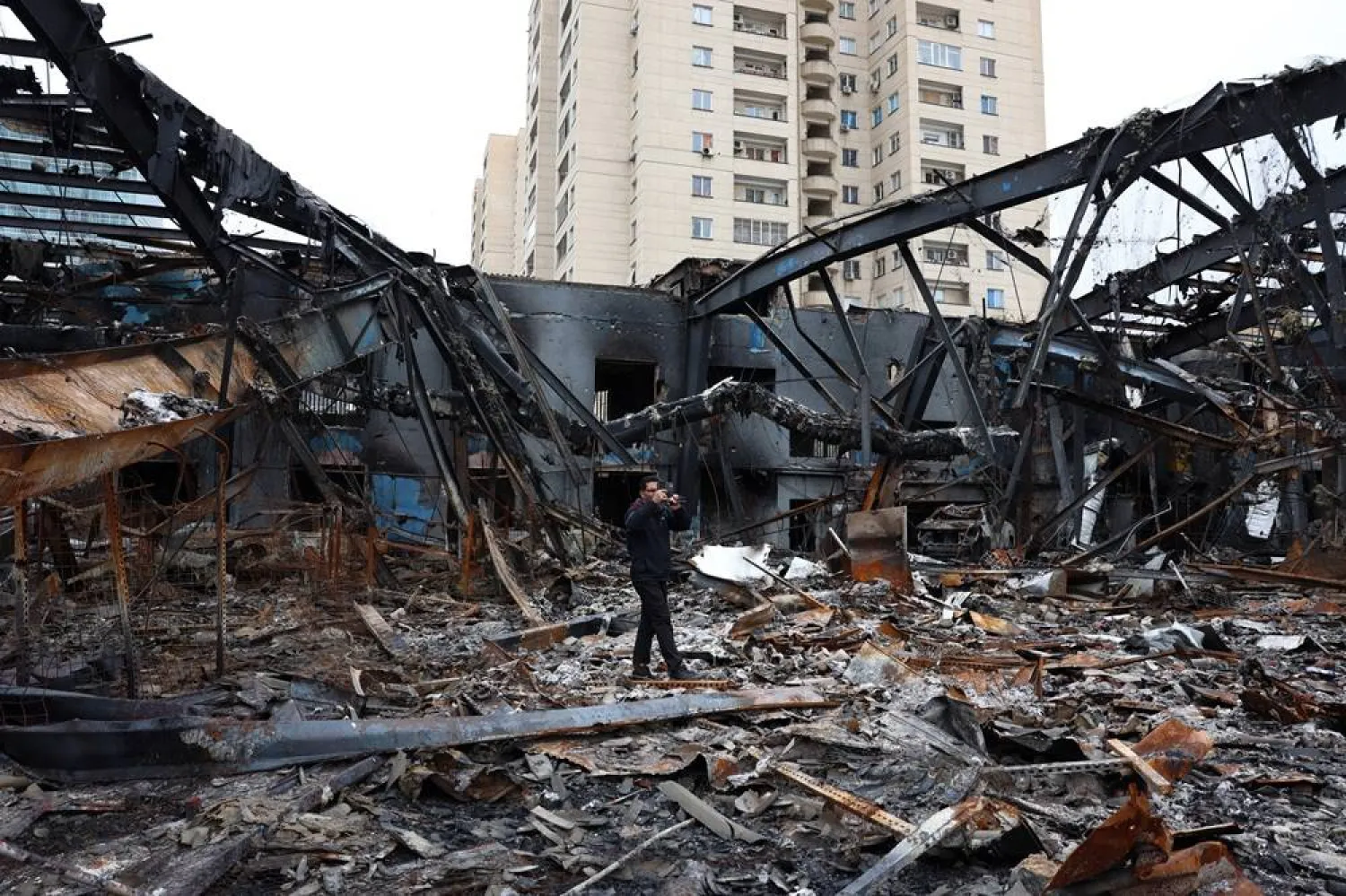
Members of the media work amid wreckage of vehicles at an auto service center in Tehran, Iran, 28 March 2026. (EPA)
TT

Iran Accuses US of Ground Assault Plans as Pakistan Hosts Regional Talks

Members of the media work amid wreckage of vehicles at an auto service center in Tehran, Iran, 28 March 2026. (EPA)

Iran said it was ready to respond to a US ground attack, accusing Washington on Sunday of preparing a land assault even as the Trump administration sought talks and as regional powers met in Pakistan to try to end the conflict.

The foreign ministers of Pakistan, Saudi Arabia, Türkiye and Egypt met in Islamabad to discuss ways to halt the Iran war, which has killed thousands of people and caused the biggest-ever disruption to global energy supplies.

The ministers exchanged views on the severe economic repercussions of the military escalation in the region, its impact on international navigation, supply chains and food security, as well as its implications for energy security in light of rising oil prices, Egypt's foreign ministry said.

As the conflict entered its second month, Israel's military said it carried overnight strikes on Tehran, targeting what it described as a facility producing critical components for ballistic missiles and a weapons production and storage site.

Iran launched multiple missile salvos at Israel on Sunday, sending millions of people across the country into shelters. Israel's fire and rescue service said a blaze had broken out in an industrial area in the country's south after an "impact".

Chemical manufacturing and industrial plants, as well as a hazardous waste treatment facility, are located in the industrial area. It was not immediately clear ‌if a missile had hit ‌the area, or if the fire was caused by debris from an interception.

Iran's parliament speaker Mohammad Baqer Qalibaf accused the US ‌of sending ⁠messages about possible ⁠negotiations while at the same time secretly planning to send in troops, adding that Tehran was ready to respond if US soldiers were deployed.

"As long as the Americans seek Iran's surrender, our response is that we will never accept humiliation," he said in a message to the nation.

The war, which began on February 28 with US and Israeli strikes on Iran, has spread across the Middle East, with Yemen's Iran-aligned Houthis launching on Saturday their first attacks on Israel since the start of the conflict.

The assault points to a potential new threat to global shipping, already hit by the effective closure of the Strait of Hormuz, previously a conduit for about a fifth of global oil and liquefied natural gas supplies.

US MARINES START ARRIVING IN MIDDLE EAST

Washington has dispatched thousands of Marines to the Middle East, with the first of two contingents arriving on Friday aboard an amphibious assault ship, the US military has said.

The Washington Post quoted US officials as saying the Pentagon was ⁠preparing for weeks of ground operations in Iran, adding that it was not yet clear if President Donald Trump would approve ‌such plans.

Reuters has reported that the Pentagon has considered military options that could include ground forces.

Trump faces a stark choice ‌between seeking a negotiated exit or escalating militarily that risks a protracted crisis, and would likely weigh further on his already low approval ratings.

"President Trump has poor options all around to end ‌the war," said Jonathan Panikoff, former US deputy national intelligence officer for the Middle East.

"Part of the challenge is the lack of clarity related to what a satisfactory outcome would ‌be," Panikoff added.

Pakistan, which along with Türkiye and Egypt has been relaying messages between Washington and Tehran, was hosting four-nation talks and looking for proposals that could bring the two sides together, a Pakistani foreign ministry official said.

The countries meeting in Pakistan have floated proposals to Washington tied to maritime traffic and reopening the Strait of Hormuz, five sources familiar with the matter told Reuters, as part of wider efforts to stabilize shipping flows.

Washington said last week it had offered a 15-point ceasefire plan, with a proposal to reopen the waterway and restrict Iran's nuclear program, but Tehran has rejected the list and put ‌forward proposals of its own.

ISRAEL HITS DOZENS OF TARGETS ACROSS IRAN

An Israeli official said Israel would continue carrying out strikes against Iran on what were described as military targets, adding there was no intention to scale back the campaign ahead of ⁠any possible talks between Washington and Tehran.

Israel said ⁠on Sunday it had targeted Tehran's weapons manufacturing infrastructure, including dozens of storage and production sites the day before.

A building housing Qatar's Al-Araby TV in Tehran was hit on Sunday, the semi-official Mehr news agency reported, with video showing walls and windows blown out of the multi-storey block.

"The missile hit. The ceiling and everything fell on our heads. Unfortunately, we couldn't continue to work. It was a real miracle we survived," said Al Araby camera operator Mohammadreza Shademan. "There was no military target here."

Iran continued attacks on several Gulf states, and air defenses shot down a drone near the residence of the leader of the Iraqi Kurdish ruling party in Erbil early on Sunday, security sources said.

Another drone strike targeted the home of the president of Iraq's Kurdistan region a day earlier, the sources added.

Meanwhile, there is concern over shipping lanes around the Arabian Peninsula and the Red Sea after Yemen's Houthis entered the fray by targeting Israel.

During the Gaza war the Houthis also hit ships in the Bab el-Mandeb Strait, a critical maritime choke point leading to the Suez Canal. Analysts say renewed attacks there would pile further pressure on the world economy.

With US midterm elections due in November, the increasingly unpopular war has weighed on Trump's Republican Party. Demonstrators took to city streets across the US on Saturday in protests against the conflict.

Trump has threatened to hit power stations and other energy infrastructure if Iran does not open the Strait of Hormuz, though he has extended a deadline by 10 days.

A European diplomat warned that any further military escalation could make it harder to bring the two sides together, potentially delaying the possibility by weeks, if not longer.

Iranian threats against ships have kept most oil tankers from attempting the waterway. Iran has agreed to let an additional 20 Pakistani-flagged vessels pass through the strait, with two ships permitted to transit daily, Pakistan's Foreign Minister Ishaq Dar has said.



US Denies Iran Struck a Military Vessel during New Effort to Reopen Strait of Hormuz

Vessels in the Strait of Hormuz near Bandar Abbas, Iran, May 4, 2026. Amirhosein Khorgooi/ISNA/WANA (West Asia News Agency) via REUTERS
TT

US Denies Iran Struck a Military Vessel during New Effort to Reopen Strait of Hormuz

Vessels in the Strait of Hormuz near Bandar Abbas, Iran, May 4, 2026. Amirhosein Khorgooi/ISNA/WANA (West Asia News Agency) via REUTERS

The US military on Monday denied claims that Iran struck a Navy vessel as US forces now offer to guide commercial ships through the Strait of Hormuz, where hundreds have been stuck since the Iran war began. Tehran over the past two months has attacked some vessels and blocked others that don’t receive its authorization.

The US military’s Central Command also said two American-flagged merchant ships have “successfully transited through the Strait of Hormuz" and that that Navy guided-missile destroyers in the Arabian Gulf are helping to restore commercial shipping traffic.

The statement on X said the destroyers transited the Strait of Hormuz “in support of Project Freedom” and that the merchant ships are "safely headed on their journey." It did not say when the Navy ships arrived or when the merchant vessels departed.

Meanwhile, Iranian news agencies had earlier claimed that Iran struck a US vessel near an Iranian port southeast of the strait, accusing it of “violating maritime security and navigation norms.” The reports said the vessel was forced to turn back.

Also, Iran's state television reported that the Iranian navy fired cruise missiles, rockets and combat drones near US destroyers crossing the Strait of Hormuz on Monday,

It said the navy had identified US destroyers in the Strait of Hormuz and fired multiple warning shots, adding, "following the Zionist American destroyers' disregard for the initial warning, the Navy issued a warning shot by firing cruise missiles, rockets, and combat drones around the aggressor enemy vessels".


Top EU, US Trade Officials to Meet in Paris after Trump Threat

FILE PHOTO: US President Donald Trump takes questions from media at a press briefing at the White House - April 25, 2026. REUTERS/Jonathan Ernst/File Photo
TT

Top EU, US Trade Officials to Meet in Paris after Trump Threat

FILE PHOTO: US President Donald Trump takes questions from media at a press briefing at the White House - April 25, 2026. REUTERS/Jonathan Ernst/File Photo

The European Union's trade chief Maros Sefcovic will hold talks with his US counterpart on Tuesday in Paris, an EU spokesman said, following President Donald Trump's latest tariffs threat.

Trump said Friday that he will hike US levies on EU cars and trucks from this week to 25 percent, accusing the bloc of not complying with a tariff agreement reached last summer.

US Trade Representative Jamieson Greer told CNBC on Monday that EU officials have not adjusted their tariffs or rules yet despite the pact: "They've moved a tariff bill along in the European Parliament. It's been very slow."

He noted the move also had some amendments that would "limit the deal".

"After discussing this with our European colleagues over many, many months, the president decided that if the Europeans aren't implementing the deal right now, then we don't have to implement all of it either at this time," Greer added.

The EU dismissed the claim and insisted it remained committed to the deal.

"Since day one, we are implementing the joint statement, and we're fully committed to delivering on our shared commitments," EU spokesman Thomas Regnier said.

Sefcovic will meet Greer on the margins of a G7 ministerial meeting in Paris on Tuesday, the spokesman added, as he noted talks between the two sides continued at different levels.

The trade deal struck last summer lowered the US tariff on EU autos to 15 percent, which is below the 25-percent duty that Trump imposed on vehicles from many other trading partners.

The European Parliament has given its conditional approval to the EU-US trade pact, but under EU procedures, before the deal is implemented by the bloc, a final version still needs to be negotiated with member states.

Regnier said the EU kept Washington "fully informed throughout the process" and sought to "reassure the other side of the Atlantic, work is ongoing. Progress is being made".

While the EU has warned it is keeping its options open, Regnier refused to speculate on how the EU would act if the tariffs kick in.

"We will not escalate any threats. We focus on the implementation phase," he said.


Pakistan Facilitates Return of Iranian Crew from US-Seized Ship

 Ships and boats in the Strait of Hormuz, Musandam, Oman, May 1, 2026. (Reuters)
Ships and boats in the Strait of Hormuz, Musandam, Oman, May 1, 2026. (Reuters)
TT

Pakistan Facilitates Return of Iranian Crew from US-Seized Ship

 Ships and boats in the Strait of Hormuz, Musandam, Oman, May 1, 2026. (Reuters)
Ships and boats in the Strait of Hormuz, Musandam, Oman, May 1, 2026. (Reuters)

Pakistan said Monday it had facilitated the transfer of 22 Iranian crew members from a US-seized vessel, describing the move as a "confidence-building measure" amid fragile diplomatic contacts between Washington and Tehran.

The sailors, who had been held aboard the container ship Touska, were flown into Islamabad late Sunday and were due to be handed over to Iranian authorities, according to a statement from Pakistan's foreign ministry.

The handover follows a tense maritime standoff in the Gulf of Oman, where US forces intercepted the Iranian-flagged vessel.

President Donald Trump said the ship carried "a gift from China", an allegation Beijing rejected, insisting it opposed "any malicious association and speculation".

Iran has condemned the seizure as "piracy" and a violation of an April ceasefire, urging the United Nations to intervene.

Pakistan has positioned itself as a mediator for the war in the Middle East, hosting talks aimed at reducing friction between the United States and Iran.

The transfer of the crew was coordinated with both sides, Pakistan said, reflecting a rare instance of practical cooperation despite wider tensions over sanctions, shipping routes and regional security.

The vessel itself is expected to be returned after repairs.

Islamabad said it would continue to facilitate dialogue and diplomacy in pursuit of regional stability, as the Strait of Hormuz remains volatile and indirect US-Iran engagement politically sensitive.