
Post-Strikes… Iran Adapts its Fighting Strategy

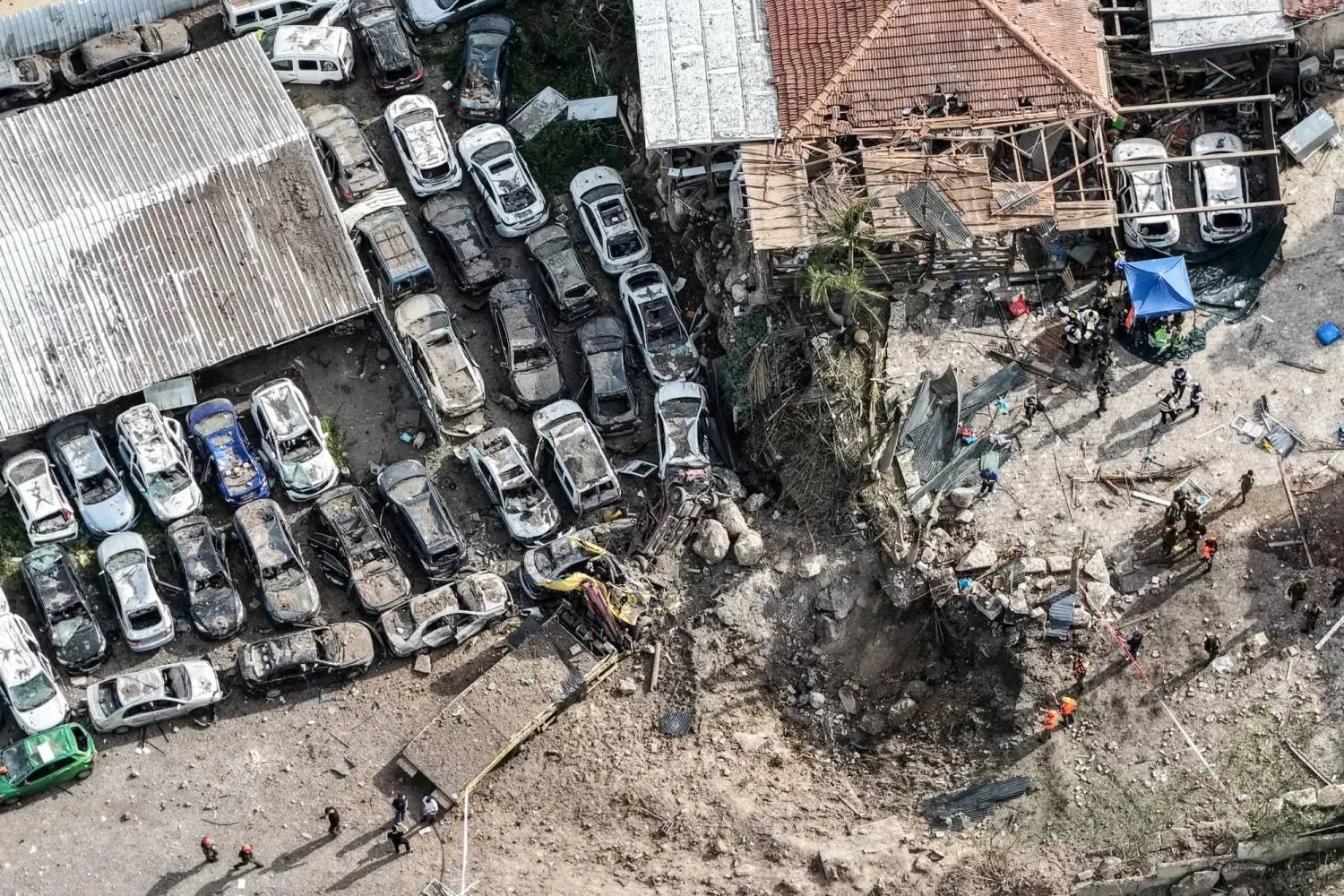
A drone view shows the impact site following Iranian missile barrages as the US-Israeli conflict with Iran continues, near Eshtaol (Reuters)
TT

Post-Strikes… Iran Adapts its Fighting Strategy

A drone view shows the impact site following Iranian missile barrages as the US-Israeli conflict with Iran continues, near Eshtaol (Reuters)

By: Nicholas Kulish, Helene Cooper, Isabel Kershner, Erika Solomon


A wave of strikes across the Middle East in recent days shows that Iran has not lost the capacity to retaliate.

US President Donald Trump has said that the United States has all but obliterated Iranian military abilities, portraying Iran as a defanged adversary.

The US military says that the number of attacks Iran has launched has declined by roughly 90% from the opening days of the war, and the Israeli military says it has rendered roughly 70% of Iran’s hundreds of missile launchers inoperable.

But a series of attacks against Israel and Gulf countries in the past several days is only the latest evidence that Iran retains enough missiles and drones to destabilize the region and inflict a punishing cost on its foes, while signaling that, contrary to Trump’s declarations, it is still very much in the fight.

Millions of Israelis are still rushing into bomb shelters day and night to take cover from Iranian missile fire. The daily routine of sirens and booms sows fear and paralysis.

Seven people were injured in central Israel on Thursday after missile barrages, according to the country’s emergency service. Surveillance video captured footage of two people rushing out of harm’s way before a silver car they were standing near exploded then pinwheeled through the air. On Friday, a Tel Aviv man was killed by a bomblet from a missile with a cluster-munition warhead.

Even when Iranian weapons are intercepted, they can still inflict damage. Two people were killed in Abu Dhabi on Thursday when they were struck by shrapnel falling from an intercepted missile.

The US-Israeli campaign has been very effective in attacking Iran’s leadership, killing many of them and destroying many military installations, and it has almost completely destroyed its air force and navy, said Farzin Nadimi, a security analyst at the Washington Institute who specializes in Iran.

“In terms of optics, a sunken navy, totally obliterated air force is very important as a metric for victory,” he said. “But we all understand that the main metrics of success for Iran is to be able to continue to fire ballistic missiles and drones at Israel, at US bases and Gulf countries. And we know that they have still been able to do that.”

Iran still most likely possesses thousands of Shahed drones and could still have hundreds of ballistic missiles despite American and Israeli strikes over the past four weeks, one US official said.

But the official, who spoke on the condition of anonymity to discuss military capabilities, cautioned that it was impossible to know for sure, as US intelligence on Iranian ability is limited.

Public statements from the American military have been carefully worded. For instance, Adm. Brad Cooper, the commander of the US Central Command, said on Wednesday that “Iran’s drone and missile launch rates are down 90%,” courtesy of American and Israeli strikes. That is not the same thing as saying those strikes have eliminated 90% of Iranian drones and missiles.

Kelly A. Grieco, a senior fellow at the Stimson Center, a foreign affairs research institute in Washington, says the number of strikes may not matter as much as how effectively Iran is using its arsenal.

Grieco has analyzed open-source data on Iran’s salvos and, while cautioning that the numbers are inexact, found that Iran’s hit rate has increased as the war has progressed, more than doubling since March 10.

“Adversaries adapt,” Grieco said. “There are signs here that we don’t have a defeated adversary and that we may have one that’s adapting and learning and doing enough damage to implement its strategy.”

The US military may have mistaken reduced activity for reduced capacity. Iran could have been firing fewer missiles and drones because it was repositioning them, she said, not because they were destroyed. The Iranians may have been slowing their pace of attack as they integrated new intelligence, surveillance and reconnaissance information into their targeting decisions.

“This administration is very fixated on bombs dropped and on how much the strike volume is down for Iran. They love to say the 90% number,” Grieco said. “Is that number obscuring that there has been a shift in Iran’s approach?”

The wave of Iranian strikes showed no signs of letting up this weekend, with missiles and drones causing damage across the Gulf region, disabling a radar at the Kuwait airport and injuring a worker and damaging a crane at the Omani port. And the willingness of the Houthis to strike at Israel on Saturday suggests more firepower will be brought to bear against Iran’s enemies.

While Israel’s military says its air defenses have managed to intercept the vast majority of the ballistic missiles, Iran struck a symbolic blow last weekend when one crashed into the southern desert of Dimona, barely 10 miles from Israel’s nuclear research facility and reactor, one of its most protected sites, injuring dozens.

Iran has also found an apparent chink in Israel’s armor by firing ballistic missiles with cluster-munition warheads at population centers that break open above ground, then disperse dozens of small bomblets across several miles.

The bomblets generally cause much less damage than a missile with a single large explosive charge, though on some occasions they have proved deadly.

The optimal way to neutralize such missiles is to intercept them above the atmosphere, where parts of the wreckage can burn up harmlessly, officials and experts said. Israel’s Arrow 3 interceptors that operate at such high altitudes are costly and in short supply, while lower-tier interceptions may not be able to stop the missiles before their warheads release their payload.

Iran’s capacity for retaliation during this war represents a quick recovery from the 12-day assault that Israel launched against it last June. After that round, Prime Minister Benjamin Netanyahu declared that Israel had achieved “a historic victory” that would “stand for generations.” Iran’s ballistic missile production capability had been “destroyed,” the prime minister said.

If Israel had underestimated anything, analysts said, it was the speed with which Iran had begun to rebuild that capacity.

Like Israel, Iran did not sit idle after the June war, but used the time to prepare for the next conflict.

“They had nine months, like we had, to sit and plan,” said Miri Eisin, a retired Israeli colonel. Iran’s abilities were, and are, being “degraded” and “diminished,” which she said was as much as could be achieved in weeks of combat.

“Even though the US and Israelis have been pounding Iranian missile bases, staging areas, some factories, warehouses, they still have been able to launch missiles at a considerable number — around 20 to 30 missiles” a day, Nadimi of the Washington Institute said of the Iranians. “Some of them are very large liquid fuel or missiles that have a noticeable footprint before they are launched. And they still have been able to do that.”

That suggests, analysts said, that Iran has maintained access to the tunnels that lead to its underground “missile cities” and drone storage warehouses. Or that the Iranians have secret missile bases that have managed to evade detection from US and Israeli intelligence efforts, though Nadimi said he thought that was less likely.

Farzan Sabet, an analyst of Iran and weapons systems at the Geneva Graduate Institute in Switzerland, agreed with Grieco’s analysis that while Iran was launching fewer missiles, they had higher penetration rates than at the beginning of the war. They also appeared to be threatening more sensitive or eye-catching targets, such as the Diego Garcia air base in the Indian Ocean, almost 2,500 miles away, or the strike on Dimona.

Earlier in the war, Iran’s ability to fire large barrages of missiles and drone attacks wreaked havoc on the Gulf and on global energy markets. But once that sense of insecurity and instability has been created, he said, “you don’t need to have, thousands or even hundreds of launches a day. You might be able to do that with dozens of successful penetrations.”


The New York Times


Iran Executes Two More Convicted of Links to Banned Opposition

 A man holds a picture of the late Iranian Supreme Leader Ali Khamenei during a campaign in support of the government at the Enqelab-e-Eslami square in downtown Tehran, Iran, Monday, March 30, 2026. (AP)
A man holds a picture of the late Iranian Supreme Leader Ali Khamenei during a campaign in support of the government at the Enqelab-e-Eslami square in downtown Tehran, Iran, Monday, March 30, 2026. (AP)
TT

Iran Executes Two More Convicted of Links to Banned Opposition

 A man holds a picture of the late Iranian Supreme Leader Ali Khamenei during a campaign in support of the government at the Enqelab-e-Eslami square in downtown Tehran, Iran, Monday, March 30, 2026. (AP)
A man holds a picture of the late Iranian Supreme Leader Ali Khamenei during a campaign in support of the government at the Enqelab-e-Eslami square in downtown Tehran, Iran, Monday, March 30, 2026. (AP)

Iran executed two men on Tuesday convicted of membership in a banned opposition group and plotting to overthrow the Islamic republic, the judiciary said, a day after two others were hanged on similar charges.

"Babak Alipour and Pouya Ghobadi... were executed by hanging on Tuesday after legal procedures were completed and their sentences upheld by the Supreme Court," the judiciary's Mizan Online website said.

The men were found guilty of attempting "rebellion through involvement in multiple terrorist acts", as well as membership of the banned People's Mujahedin of Iran (MEK) and carrying out acts of sabotage aimed at overthrowing the regime.

The executions come with Iran at war with the United States and Israel following strikes on February 28 that triggered a wider regional conflict.

On Monday, Iranian authorities announced the execution of two other men convicted of links to the MEK and attempting to overthrow the regime.

It was not clear when the four men were arrested.

The MEK, which opposed the rule of the shah and initially supported the 1979 revolution before falling out with the leadership in the 1980s, has since been in exile and is designated a terrorist organization by Tehran.

Iran is the world's most prolific executioner after China, according to rights groups.

It has carried out several executions since the war began.

On March 19, Iran executed three men accused of killing police officers during mass protests which peaked in January -- the first executions related to that unrest.

In the same month Iran also executed Kouroush Keyvani, a dual Iranian-Swedish national, on charges of spying for Israel, drawing condemnation from Stockholm and the European Union.


New US Missile Hit Iranian Sports Hall and School, Analysis Shows

FILE - A thick plume of smoke rises from an oil storage facility hit by a US-Israeli strike in Tehran, Iran, March 8, 2026. (AP Photo/Vahid Salemi, File)  
TT

New US Missile Hit Iranian Sports Hall and School, Analysis Shows

FILE - A thick plume of smoke rises from an oil storage facility hit by a US-Israeli strike in Tehran, Iran, March 8, 2026. (AP Photo/Vahid Salemi, File)  

John Ismay and Christiaan Triebert

Washington: On the first day of the war with Iran, a weapon bearing the hallmarks of a newly developed US-made ballistic missile was used in an attack that struck a sports hall and adjacent elementary school near a military facility in southern Iran, according to weapons experts and a visual analysis by The New York Times.

Local officials cited in Iranian media said this strike and others nearby in the city of Lamerd killed at least 21 people.

The Feb. 28 attack occurred the same day as a US Tomahawk cruise missile struck a school in the city of Minab, several hundred miles away, killing 175 people. In the case of Lamerd, though, it involved a weapon that had been untested in combat.

The Times verified videos of two strikes in Lamerd, as well as aftermath footage from the attacks. Times reporters and munitions experts found that the weapon features, explosions and damage are consistent with a short-range ballistic missile called the Precision Strike Missile, or PrSM (pronounced like “prism”), which is designed to detonate just above its target and blast small tungsten pellets outward.

Videos that capture one strike, in a residential area about 900 feet from the sports hall and school, show the weapon in flight, with a distinctive silhouette that matches the PrSM. The missile erupts in a large fireball midair.

Another video, filmed from a security camera directly across from the sports hall, shows the strike on the hall and adjacent school. While the video does not capture an incoming missile, it clearly shows an explosion just above the structure.

Photos of the aftermath show both sites were pockmarked with holes, apparently from the tungsten pellets.

There is an Iranian Revolutionary Guards Corps, or IRGC, compound directly next to the sports hall. It’s not known if it was struck in the attack.

The PrSM completed prototype testing only last year, according to an Army press release. On March 1, US Central Command posted a video of a PrSM launch from the first 24 hours of the war. Days later, Adm. Brad Cooper, who leads Central Command, said the PrSM had been used in combat for the first time.

The military has been touting its debut.

Since the weapon is so new, it’s more difficult to assess whether the PrSM strikes in Lamerd were intentional, stemmed from a design flaw or manufacturing defect, or were the result of improper target selection.

It’s unclear if or how the school or sports hall might be affiliated with the IRGC compound, but according to archival satellite imagery, they have been walled off from the compound for at least 15 years.

The sports hall, at the time of the strikes, was being used by a female volleyball team, according to Amir Saeid Iravani, Iran’s representative to the United Nations.

Photos and videos posted to a social media account linked to the school show the premises were regularly used by children.

The sports hall has also for years been publicly identified as a civilian-use facility on readily available digital mapping platforms, including Google Maps, Apple Maps and Wikimapia, according to a review by The Times.

Ground-level and satellite images of the aftermath show the sports hall with scorch marks and a partly collapsed roof. Footage from inside the school shows blown-out windows, fire damage and splotches of blood.

The PrSM’s intended use is to kill enemy troops and destroy unarmored vehicles, and it can fly more than twice as far as any other missile in the Army’s arsenal.

A US official who spoke to The Times confirmed that the missile used in the Lamerd strike was the PrSM. The official was not authorized to comment publicly about the attack and spoke on the condition of anonymity.

Other experts consulted by The Times also provided an assessment of the weapon.

“While we knew PrSM was fired, this is the first look we’ve gotten at the business end of the system,” Jeffrey Lewis, a nuclear nonproliferation expert at Middlebury College, said after reviewing videos and photos of the incident.

Lewis’s observation was supported by Frederic Gras, another munitions expert.

He said the video showing airburst detonation was very clear, and “the pattern of fragmentation damages are impressive and match with the few technical information available on the PrSM.”

Capt. Tim Hawkins, a spokesman for US Central Command, said in a statement to The Times on Saturday: “We’re aware of the reports and are looking into them. US forces do not indiscriminately target civilians, unlike the Iranian regime.”

Lewis said the missile seen in the video also resembled another ground-launched American weapon — a guided rocket called GMLRS-ER, but since that munition has a range of only 93 miles, versus the PrSM’s 400 miles, it would have had to have been fired from inside Iran, which is highly unlikely.

In addition to the sports hall and school, and nearby residential area, a third location may have been hit in the attack.

The Times verified a video that shows another plume of smoke rising close to the other strikes at the same time. Local Telegram and media reports stated a cultural center had been hit, but that couldn’t be independently verified.

The BBC and public radio program “The World” reported earlier that the missiles used in Lamerd may have been PrSMs, and that the Pentagon was looking into the incident.

The strikes on Iran are being conducted by a joint Israeli-US coalition, but senior American military officials made it clear that in the opening days of the conflict the United States was operating in the southern part of the country, where Lamerd is located.

At least 21 people were killed in the strikes, according to Iran’s state news agency, IRNA.

While that figure has not been independently verified, photos and videos posted online by local media outlets show scenes from a mass funeral the next day, March 1. An additional hundred people were injured, said Amir-Saeid Iravani, Iran’s representative to the UN.

Some of the casualties were volleyball players who were training inside the hall when the missile struck, according to Iravani, and eyewitnesses cited by US-based online media outlet Drop Site News.

Tasnim, a semiofficial Iranian news agency, published the names of the 21 people it said were killed. An Iran-based journalist, Negin Bagheri, wrote about two of the victims: Helma Ahmadizadeh, a 10-year-old fourth-grader, and Elham Zaeri, a fifth-grader, both of whom were at volleyball practice when the missile struck. Khabar-e Jonoub, an Iranian newspaper, reported on the death of a sports coach identified as Mahmoud Najafi.

The PrSM is a short-range ballistic missile designed to replace the Army Tactical Missile System, or ATACMS, in the Army and Marine Corps arsenal.

Developed by Lockheed Martin in Camden, Arkansas, it’s capable of hitting targets at a range of approximately 400 miles.

But additional details about the weapon, including its expected accuracy and the quantity of explosives it carries, remain unknown to the public.

In past wars, the Pentagon has at times deployed developmental weapons like the PrSM to active war zones for what the military calls “combat evaluation,” so long as commanders knowingly accept the attendant risk of using a munition before it has gone through more testing.

The New York Times


Pentagon Denies Hegseth's Broker Looked to Buy Defense Fund before Iran Attack

FILE - Defense Secretary Pete Hegseth listens as President Donald Trump speaks in the Oval Office of the White House, March 24, 2026, in Washington. (AP Photo/Alex Brandon, File)
TT

Pentagon Denies Hegseth's Broker Looked to Buy Defense Fund before Iran Attack

FILE - Defense Secretary Pete Hegseth listens as President Donald Trump speaks in the Oval Office of the White House, March 24, 2026, in Washington. (AP Photo/Alex Brandon, File)

A broker for US Defense Secretary Pete Hegseth attempted to make a big investment in major defense companies in the weeks leading up to the US-Israeli attack on Iran, the Financial Times reported on Monday, citing three people familiar with the matter.

Chief Pentagon spokesman Sean Parnell said on X the story was "entirely false and fabricated" and ‌demanded a ‌retraction.

The FT report said Hegseth's ‌broker ⁠at Morgan Stanley contacted ⁠BlackRock in February, about making a multimillion-dollar investment in the asset manager's Defense Industrials Active ETF, shortly before the US launched military action against Tehran.

According to the FT report, the investment discussed by Hegseth’s broker did not ultimately ⁠go ahead as the fund, ‌which launched in May last ‌year, was not yet available for Morgan Stanley ‌clients to buy. The FT report did not ‌say how much discretion the broker had to make investments on Hegseth's behalf, or whether Hegseth knew what the broker was doing.

"Neither Secretary Hegseth nor ‌any of his representatives approached BlackRock about any such investment," Parnell said.

BlackRock ⁠declined ⁠to comment on the report, while Morgan Stanley did not immediately respond to Reuters' request for comment.

The report on the investment attempt comes amid a wider scrutiny of trades made in financial and prediction markets ahead of US President Donald Trump's major policy decisions. Some of these decisions have been preceded by well-timed bets, leading some experts to raise questions about whether information had somehow leaked ahead of time.