


Trump Threatens to Destroy Iran’s Civilian Infrastructure if a Deal Is Not Reached ‘Shortly’

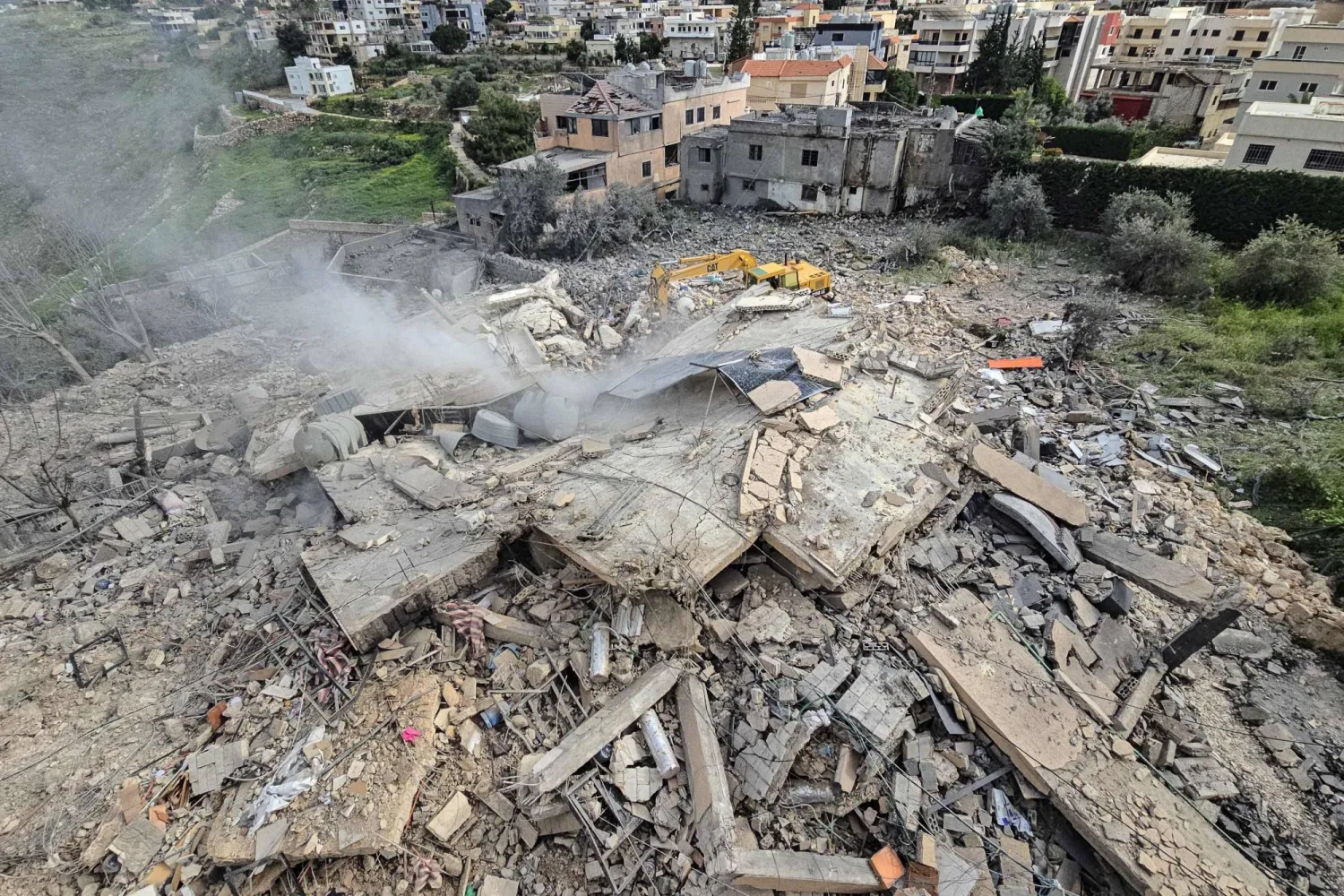
First responders work on the rubble of a building targeted by an Israeli airstrike in the southern Lebanese village of Hanouiyeh, east of Tyre, on March 30, 2026. (AFP)
TT

Trump Threatens to Destroy Iran’s Civilian Infrastructure if a Deal Is Not Reached ‘Shortly’

First responders work on the rubble of a building targeted by an Israeli airstrike in the southern Lebanese village of Hanouiyeh, east of Tyre, on March 30, 2026. (AFP)

US President Donald Trump on Monday threatened widespread destruction of Iran’s energy resources and other vital infrastructure, including desalination plants that supply drinking water, if a deal to end the war is not reached “shortly.”

Iran meanwhile struck a key water and electrical plant in Kuwait, and an oil refinery in Israel came under attack. Israel and the US launched a new wave of strikes on Iran, as the war raged with no end in sight.

Trump’s new threat came in a social media post. Earlier comments to the Financial Times suggested American troops could seize Iran’s Kharg Island oil export hub. Trump has repeatedly claimed to be making diplomatic progress— though Tehran denies negotiating directly — while ramping up his threats and sending thousands more US troops to the Middle East.

It remains unclear where the diplomatic effort facilitated by Pakistan stands. Iran’s continuing attacks on its Gulf neighbors could further complicate any talks.

Trump says diplomacy is going well but threatens major escalation

In a social media post, Trump said “great progress is being made” in talks with Iran to end military operations. But he said if a deal is not reached “shortly,” and if the Strait of Hormuz is not immediately reopened, the US would broaden its offensive by “completely obliterating” power plants, oil wells, Kharg Island and possibly even desalination plants.

The strait is a crucial waterway through which a fifth of the world’s oil is shipped in peacetime.

The laws of armed conflict allow attacks on civilian infrastructure such as energy plants only if the military advantage outweighs the civilian harm, legal scholars say. It’s considered a high bar to clear, and causing excessive suffering to civilians can constitute a war crime.

A 22-year-old resident of Karaj, near Tehran, said his area lost power for several hours overnight following nearby strikes.

“I was really scared. I thought that they’d hit the power plants and that we are not going to have power anymore,” he said, speaking on condition of anonymity out of security fears.

In the FT interview, Trump said his preference would be to “take the oil in Iran.”

“Maybe we take Kharg Island, maybe we don’t,” he said, referring to a terminal through which nearly all of Iran's oil exports pass.

Iran says US demands are ‘excessive, unrealistic and irrational’

The US already has targeted military positions on Kharg.

Iranian Foreign Ministry spokesman Esmail Baghaei said Tehran had received a 15-point proposal from the Trump administration containing “excessive, unrealistic and irrational” demands, while denying there had been any direct talks.

Earlier, Iran’s parliament speaker, Mohammad Bagher Qalibaf, dismissed the talks in Pakistan as a cover while more US troops are brought to the region. He said Iranian forces were “waiting for the arrival of American troops on the ground to set them on fire and punish their regional partners forever,” according to state media.

Twice during Trump’s second term, the US has attacked Iran during high-level diplomatic talks, including with the Feb. 28 strikes that started the current war.

Iran attacks Israel

Sirens sounded at dawn near Israel’s main nuclear research center, a part of the country that has been targeted repeatedly in recent days. Israel’s military also said it had taken out two drones launched from Yemen, where the Iran-backed Houthis entered the war on Saturday with their first missile attack.

Iran kept up the pressure on its Gulf Arab neighbors: Saudi Arabia intercepted five missiles targeting its Eastern province; a fireball erupted over Dubai, United Arab Emirates, as a missile was intercepted; and in Kuwait, an Iranian attack hit a power and desalination plant, killing one worker and wounding 10 soldiers, the state-run KUNA news agency reported.

An Emirati official signaled that the UAE wants more than just a ceasefire.

“An Iranian regime that launches ballistic missiles at homes, weaponizes global trade and supports proxies is no longer an acceptable feature of the regional landscape,” Noura Al Kaabi, a minister of state at the UAE’s Foreign Ministry, wrote in a column published by the state-linked, English-language newspaper The National.

She added: “We want a guarantee that this will never happen again.”

NATO air defenses intercepted a ballistic missile over Türkiye that was fired from Iran, Türkiye’s Defense Ministry said, in the fourth such incident since the start of the war. Iran has denied firing the previous missiles. Türkiye has tried to maintain a neutral position and is taking part in mediation efforts.

Israel launched a new wave of attacks on Iran, saying it was striking “military infrastructure” across Tehran. Explosions were heard in the Iranian capital and Iranian state media reported a petrochemicals plant in Tabriz, in the north, sustained damage in an airstrike.

Peacekeeper killed in Lebanon

In southern Lebanon, which Israel has invaded as it battles the Iran-backed Hezbollah, an Indonesian United Nations peacekeeper was killed and three others were wounded by an exploding projectile.

An Israeli airstrike on a Beirut suburb killed one person and wounded 17, including four children, according to Lebanon's Health Ministry.

Over the weekend, Israeli Prime Minister Benjamin Netanyahu said the military would widen its invasion, expanding the “existing security strip” in southern Lebanon.

In Iran, authorities say more than 1,900 people have been killed, while 19 have been reported dead in Israel.

Two dozen people have been killed In Gulf states and the occupied West Bank. In Lebanon, officials said more than 1,200 people have been killed, and more than 1 million have been displaced. Six Israeli soldiers have died in Lebanon, while 13 US service members have been killed in the war.

Oil prices rise again

Iran’s attacks on the energy infrastructure of the region and its stranglehold on the Strait of Hormuz have threatened global supplies of oil, natural gas and fertilizer. They have sent fuel prices skyrocketing and given rise to growing concerns about an energy crisis.

Trump has said that Iran had agreed to allow 20 oil tankers through the Strait of Hormuz starting Monday as “a sign of respect.” There wasn’t any information on whether those ships were actually moving.

Brent crude oil, the international standard, was trading around $115 Monday, up nearly 60% from when the war started.



‘Get Used to New Regional Order’ Says Head of Iran’s Quds Force

Head of Iran’s Quds Forces Esmail Qaani speaks during an event in Tehran on April 14, 2022. (Reuters)
TT

‘Get Used to New Regional Order’ Says Head of Iran’s Quds Force

Head of Iran’s Quds Forces Esmail Qaani speaks during an event in Tehran on April 14, 2022. (Reuters)

The commander of the foreign operations branch of Iran's Revolutionary Guards issued a rare message on Monday hailing Iranian proxy groups for helping create a "new regional order".

Esmail Qaani became head of the Guards' Quds Force after the killing of Qassem Soleimani in a US strike in Iraq in 2020.

His message, just the second attributed to him since the US-Israeli war against Iran began on February 28, was posted on X under the handle @general_Qaani, although the social media giant then rapidly suspended the account with a note that "X suspends accounts which violate the X Rules."

The message was also widely published by Iranian news agencies and state television.

Qaani said that Israeli Prime Minister Benjamin Netanyahu wanted to create a "security belt across the region" but the actions of Tehran-backed militant groups including Hezbollah in Lebanon and the Houthis in Yemen had "exposed the regime's false promises".

"Get used to the new regional order," he said.

Qaani was reported to have been killed in the 12-day war between Israel and Iran last June, but re-emerged in public.

Intense speculation has since surrounded his whereabouts and standing, amid unconfirmed reports he had come under pressure due to alleged intelligence lapses including the 2024 killing in Lebanon by Israel of Hezbollah chief Hassan Nasrallah.

A dozen key figures in the security apparatus, including supreme leader Ali Khamenei and overall Guards chief Mohammad Pakpour have been killed in airstrikes in the latest war.

But Qaani is one of the most prominent individuals not to have been declared dead.

On March 20, Iranian state media issued the first message of the war in Qaani's name, predicting that Iran would "soon witness the shameful defeat" of its enemies.


Russian Tanker Set to Deliver Oil to Crisis-hit Cuba

A man walks with a bike as an oil tanker ship sails on Matanzas Bay, Cuba on March 30, 2026. (Photo by Yamil LAGE / AFP)
TT

Russian Tanker Set to Deliver Oil to Crisis-hit Cuba

A man walks with a bike as an oil tanker ship sails on Matanzas Bay, Cuba on March 30, 2026. (Photo by Yamil LAGE / AFP)

A Russian oil tanker was set to deliver the first crude shipment to Cuba since January on Tuesday after Washington gave the crisis-hit island a reprieve from an effective fuel blockade.

The Anatoly Kolodkin, a tanker under US sanctions, was on its way to the port of Matanzas, east of Havana, with 730,000 barrels of crude.

US President Donald Trump's decision to let Russia deliver the oil avoids a confrontation with Moscow and provides temporary relief to a country that has endured blackouts, fuel rationing and dwindling public transportation.

"We'll welcome it with open arms. You have no idea how badly we need that oil," said Rosa Perez, a 74-year-old retiree whose home in Matanzas had lost power again.

"Let's see if things improve for us, even just a little... I can't take it anymore," she told AFP, voicing hope that more shipments will follow.

Trump said Sunday that he did not object to Russia or others sending oil to the island because Cubans "have to survive."

The White House denied however that there was any change to US sanctions policy.

"We allowed this ship to reach Cuba in order to provide humanitarian needs to the Cuban people. These decisions are being made on a case-by-case basis," White House Press Secretary Karoline Leavitt said.

Cuba was cut off from oil supplies in January after US forces ousted its main regional ally, Venezuela's socialist leader Nicolas Maduro, and Trump threatened tariffs on countries that send crude to the country.

The US president has mused about "taking" the communist-ruled island, though Cuban President Miguel Diaz-Canel confirmed in March that Cuban and US officials had held talks.

Ricardo Herrero, executive director of the Cuba Study Group, a nonpartisan policy group in Washington, said the aim of restricting oil was to force Havana "to make real concessions at the negotiating table."

"The strategy here is to drive the system to the brink," Herrero told AFP. "But it's not to precipitate a full-blown societal or humanitarian collapse."

"It's all consistent with idea that the US holds all the cards and they'll decide when to hold, when to fold and when they go all in," he said.

Cubans have endured seven nationwide blackouts since 2024, including two in March, and fuel prices have soared.

The blackouts as well as persistent shortages of food and medicine have fueled public frustration and some rare protests.

Analysts said the Russian oil would buy the Cuban economy only a few weeks.

Jorge Pinon, an expert on Cuba's energy sector at the University of Texas at Austin, said the more urgent need is diesel, which could be used for backup power generators or for transportation systems to keep the economy running.

It would take a month to refine the oil and deliver the diesel, which would be enough to cover demand for about two weeks, he said.

Herrero said the shipment was just "another donation" by Cuba's Russian ally, but he doubted that Moscow wanted to subsidize the Cuban economy in the long term.

"This is not going to help the economy recover," he said. "This is just humanitarian aid."


Iran Fires Missiles across Middle East as Trump Threatens Oil Hub

US President Donald Trump walks on the South Lawn of the White House upon his return to Washington, DC, USA, 29 March 2026.  EPA/Yuri Gripas / POOL
US President Donald Trump walks on the South Lawn of the White House upon his return to Washington, DC, USA, 29 March 2026. EPA/Yuri Gripas / POOL
TT

Iran Fires Missiles across Middle East as Trump Threatens Oil Hub

US President Donald Trump walks on the South Lawn of the White House upon his return to Washington, DC, USA, 29 March 2026.  EPA/Yuri Gripas / POOL
US President Donald Trump walks on the South Lawn of the White House upon his return to Washington, DC, USA, 29 March 2026. EPA/Yuri Gripas / POOL

Iran fired missiles across the Middle East on Tuesday as its capital was hit by fresh explosions, after US President Donald Trump threatened the country's key oil export hub, power stations and desalination plants.

Israeli Prime Minister Benjamin Netanyahu, Trump's partner in attacking Iran, said more than half of his military aims had been achieved, but both leaders refused to put a timeline on an operation that has ignited a month-long regional war and jolted global markets.

As sirens rang out in Jerusalem, Israel's military said it had responded to fresh Iranian missiles, while local Iranian media reported new explosions in Tehran that caused "power outages in parts" of the capital, said AFP.

Israel's military also reported Tuesday that four more of its soldiers had been killed in combat in southern Lebanon, where the war has spilled and where they are clashing with Iranian-backed Hezbollah.

Before the latest strikes on Tehran, Israel issued a warning on X to residents of an area in the west of the city saying it would "attack military infrastructure" there.

Iran, meanwhile, fired a new salvo of missiles at Gulf nations.

In Dubai, four people were wounded by falling debris from intercepted projectiles while an Iranian attack sparked a fire at a Kuwaiti oil tanker in the city's port, said authorities in the financial hub whose reputation for stability has been shaken by the conflict.

In Saudi Arabia, authorities said they intercepted eight ballistic missiles.

Trump warned Monday that if Iran did not strike a war-ending deal -- which included reopening the vital Strait of Hormuz shipping lane -- US forces would destroy "all of their Electric Generating Plants, Oil Wells and Kharg Island (and possibly all desalinization plants!)."

But the Wall Street Journal reported he also told aides he was willing to end the war even if the strait remains largely closed --likely strengthening Tehran's control on the waterway.

Refusing to back down, an Iranian parliamentary committee voted to impose tolls on vessels in the strait, the passageway through which one-fifth of global oil passes, and completely ban ships from the United States and Israel.

The strait had been open before the war, but Secretary of State Marco Rubio has recently spoken of building a "coalition" to oppose the Iranian tolling plan.

"It sets an incredible precedent," Rubio told Al-Jazeera of the tolls.

"So this means that nations can now take over international waterways and claim them as their own," Rubio said of the waterway the US president recently called the "Strait of Trump".

- War 'beyond halfway point' -

Trump said the United States was speaking to a "more reasonable regime" in Tehran, which has denied any talks and accused him of lying about negotiations as cover while readying a ground invasion.

For Israel's part, Netanyahu said his military had achieved key objectives including "wiping out" industrial plants in Iran and coming "close to finishing their arms industry".

"It's definitely beyond the halfway point. But I don't want to put a schedule on it," Netanyahu told US broadcaster Newsmax.

The war, and the spiraling price of oil, has been unpopular in the United States, where Rubio again said Monday that it would last "weeks" more and not months.

Egyptian President Abdel Fattah al-Sisi, whose country is feeling the economic pinch of the war, appealed directly to Trump to find an offramp.

"Please, help us to stop the war; you are capable of it," Sisi told a press conference.

Pakistani Foreign Minister Ishaq Dar, whose country is acting as an intermediary between Tehran and Washington, was set to travel to Beijing for talks Tuesday on "global issues of mutual interest" with counterpart Wang Yi.

Dar hosted foreign ministers from Saudi Arabia, Egypt and Türkiye in the Pakistani capital on Sunday, saying Islamabad was ready to host talks between the United States and Iran in the "coming days".

Trump has claimed to be in direct contact with senior Iranian figures whom he has not identified publicly.

But Iranian foreign ministry spokesman Esmaeil Baqaei again denied any negotiations, saying the United States had sent only a request to talk via intermediaries, including Pakistan.

After weeks of strikes, residents of Tehran painted a picture of a city that is still clinging to some routine despite tight security.

"When I make it to a cafe table, even for a few minutes, I can almost believe the world hasn't ended," said Fatemeh, 27, a dental assistant.

"And then I go back home, back to the reality of living through war, with all its darkness and weight."

- Lebanon pounded -

On another front, Israel has relentlessly pounded Lebanon, including central Beirut, as it seeks to deliver a heavy blow to Iranian ally Hezbollah, which fired rockets in response to the killing of Iran's supreme leader, Ali Khamenei.

The UN mission in Lebanon said that two Indonesian peacekeepers were killed when "an explosion of unknown origin destroyed their vehicle", with two other peacekeepers wounded, one seriously. Another Indonesian peacekeeper was killed on Sunday.

The Israeli military said early Tuesday that it had opened an investigation to determine if it or Hezbollah was responsible.

France, a key player in Lebanon, called for an urgent UN Security Council meeting, which was subsequently scheduled for Tuesday at 1400 GMT.

Economy ministers and central bankers from the G7 club of rich countries, meanwhile, met in Paris to discuss the war's consequences, with many countries introducing energy-saving measures.

Market experts warned that any US ground operation or wider Iranian retaliation could send oil prices to levels not seen since the 2008 commodity boom.

Adding pressure, Yemen's Iranian-backed Houthi group over the weekend fired missiles and drones at Israel, posing a threat to shipping on the Red Sea in addition to the Gulf.