


France’s Macron Arrives in Japan for Talks Dominated by Mideast War

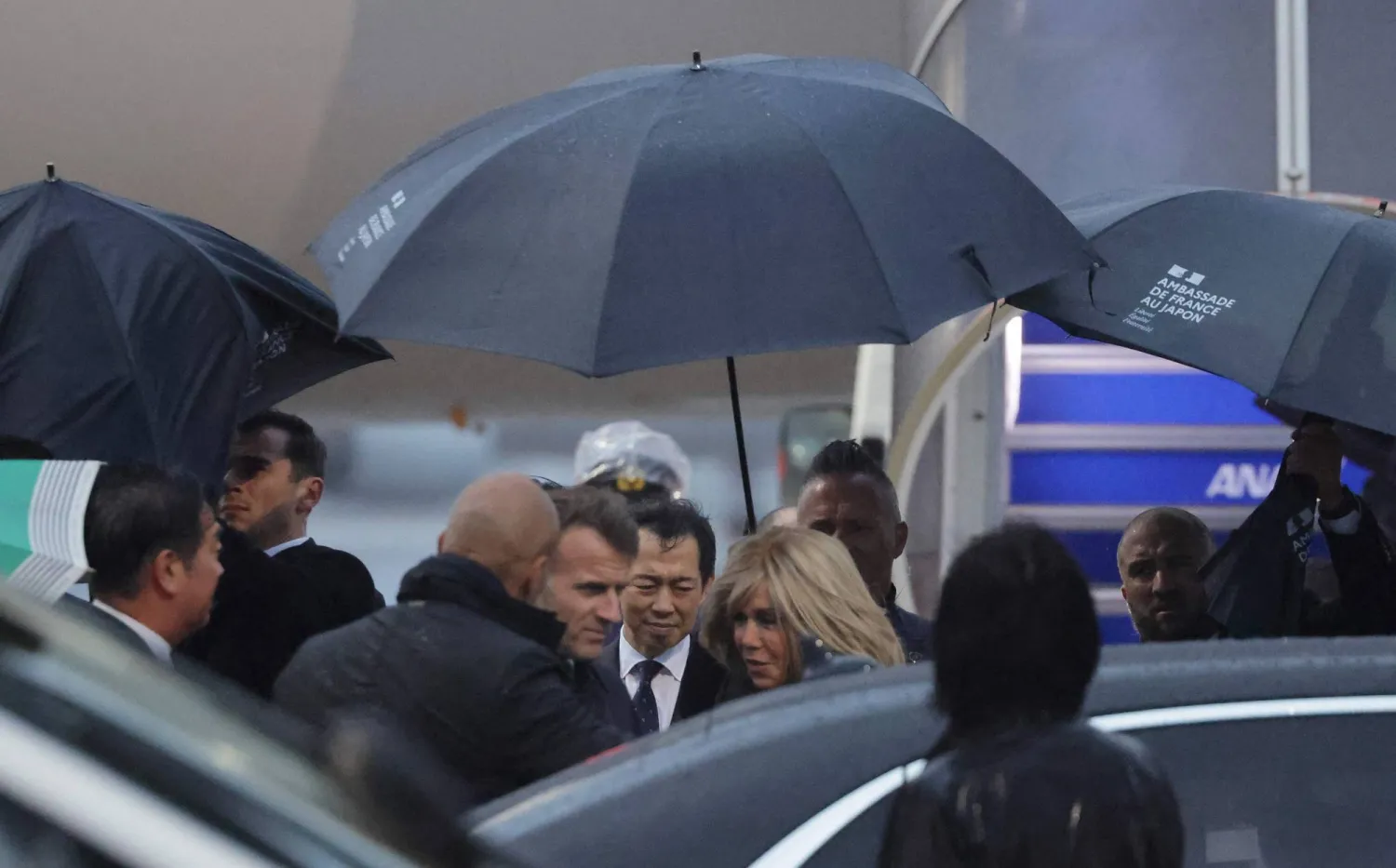
 France's President Emmanuel Macron (center-L) and his wife Brigitte arrives at Tokyo Haneda International Airport in Tokyo on march 31, 2026. (AFP)
France's President Emmanuel Macron (center-L) and his wife Brigitte arrives at Tokyo Haneda International Airport in Tokyo on march 31, 2026. (AFP)
TT

France’s Macron Arrives in Japan for Talks Dominated by Mideast War

 France's President Emmanuel Macron (center-L) and his wife Brigitte arrives at Tokyo Haneda International Airport in Tokyo on march 31, 2026. (AFP)
France's President Emmanuel Macron (center-L) and his wife Brigitte arrives at Tokyo Haneda International Airport in Tokyo on march 31, 2026. (AFP)

French President Emmanuel Macron arrived in Japan on Tuesday for a visit that initially aimed to strengthen partnerships in nuclear energy and space innovation but will now be dominated by the Middle East war.

Macron landed shortly before 5:30 pm (0830 GMT) in rainy and windy Tokyo, ahead of an expected evening meeting with several cultural figures including a renowned kimono painter.

He will then hold talks with Prime Minister Sanae Takaichi on Wednesday, and "the crisis in the Middle East will be at the heart of discussions", the Elysee said ahead of his Asia trip, which will also include a visit to South Korea.

The two leaders will discuss "how we can try to find common solutions", it added.

Japan depends on the Middle East for 95 percent of its oil imports and has had to dip into strategic stockpiles to temper the impact of rising fuel prices since the start of the war.

Iran has virtually closed the vital Strait of Hormuz -- through which a fifth of global crude and gas flows -- since the United States and Israel began striking the country on February 28.

Economy and finance ministers of G7 countries, which include France and Japan, said on Monday they stood ready to take "all necessary measures" to ensure the stability of the energy market as they tackled the economic consequences of the war.

Wednesday will be Macron's "first full-fledged meeting" with Takaichi, according to a Japanese foreign ministry official, though the two met on the sidelines of the G20 summit in November.

Among expectations for the talks was "continued communication" with a view towards the "calming down of the situation in Iran", the official said.

The two countries are also expected to discuss security and partnerships in the space sector, and intend to sign a roadmap on nuclear power in Japan, the Elysee said.

Macron's visit, his fourth to the country, comes as China-Japan ties worsen following Takaichi's suggestion in November that Tokyo might intervene militarily in any Chinese attempt to take Taiwan.

Macron visited China in December.

He and his wife Brigitte are due to have lunch with Emperor Naruhito and Empress Masako on Thursday but a hoped-for viewing of Japan's famous cherry trees in full bloom could be spoiled by rain forecast for the next three days in the Japanese capital.

He will be in Japan until April 2, and he will then visit South Korea at the invitation of President Lee Jae Myung.

"Macron will be the first European leader to make a state visit to South Korea since the launch of (our) new administration," the South Korean presidential office said earlier this month.



Italy Reportedly Refuses US Aircraft Use of Sicily Base for Middle East Operations

In this US Air Force handout photo released by US Central Command public affairs, a US Air Force B-52H Stratofortress bomber aircraft prepares to refuel from a KC-135 Stratotanker aircraft during Operation Epic Fury over the US Central Command area of responsibility on March 20, 2026. (Photo by US Airforce / AFP)
TT

Italy Reportedly Refuses US Aircraft Use of Sicily Base for Middle East Operations

In this US Air Force handout photo released by US Central Command public affairs, a US Air Force B-52H Stratofortress bomber aircraft prepares to refuel from a KC-135 Stratotanker aircraft during Operation Epic Fury over the US Central Command area of responsibility on March 20, 2026. (Photo by US Airforce / AFP)

Italy has denied permission for US military aircraft to land at the Sigonella air base in Sicily before flying to the Middle East, a source close to the matter said on Tuesday, confirming a newspaper report.

Daily Corriere della Sera reported "some US bombers" had been due to land at the base in eastern Sicily ⁠before heading to the Middle ⁠East. It did not say when they had been due to land.

The source, who was not authorized to speak to media and declined to be ⁠identified, also did not specify how many aircraft were involved or when Rome declined to give permission.

Corriere della Sera added that permission was not granted as the US had not sought authorization and Italy's military leadership was not consulted, as required under treaties governing the use of US military ⁠installations ⁠in the country.

The Italian defense ministry had no immediate comment.

Center-left opposition parties have urged the government to block the US use of bases in Italy to avoid involvement in the conflict.

Prime Minister Giorgia Meloni's right-wing government has said it would seek parliamentary authorization should any such requests be made.

Israel’s military spokesperson says 10 soldiers have died fighting in Lebanon since the start of the Israeli invasion, including four deaths announced Tuesday.

As of Friday, the military said 261 troops had been injured, 22 seriously, in fighting since the start of the latest war.


Iran Media Says Strikes Put Desalination Plant on Gulf Island Out of Service

An aerial view of the island of Qeshm, separated from the Iranian mainland by the Clarence Strait, December 10, 2023. (Reuters file)
TT

Iran Media Says Strikes Put Desalination Plant on Gulf Island Out of Service

An aerial view of the island of Qeshm, separated from the Iranian mainland by the Clarence Strait, December 10, 2023. (Reuters file)

Iranian media said Tuesday airstrikes have put a desalination plant on Iran's Qeshm island in the strategic Strait of Hormuz out of service, though the report did not specify when the attack took place.

"One of the desalination plants on Qeshm Island was targeted... and is now completely out of service, as it is not possible to repair it in the short term," the ISNA news agency reported, quoting health ministry official Mohsen Farhadi.

Iran's Foreign Minister Abbas Araghchi had said a strike had taken place there on March 7, accusing the US of a "blatant and desperate crime".

Qeshm is the largest Iranian island in the Gulf, stretching for around one hundred kilometers across the Strait of Hormuz.

It has become a popular tourist destination in recent years for Iranians thanks to its rare UNESCO-listed rock formations and turquoise waters, but is also heavily militarized, analysts say.

There have been several attacks on desalination plants in the ongoing war, sparked by US-Israeli strikes on Iran on February 28.

Bahrain reported an Iranian strike on a facility on March 8, apparent retaliation for the US hit on Qeshm the day before.

Kuwait reported an Iranian attack on a desalination and electricity plant on Monday, which Tehran blamed on Israel.

The Middle East is among the driest regions in the world, with many countries dependent on desalination plants for domestic and industrial water supplies.

US President Donald Trump threatened on Monday to "obliterate" Iran's power infrastructure, oil wells and "possibly all desalinization plants."


Japan Deploys Long-Range Missiles Near China

 The Type-12 land-to-ship missile launcher is shown at the Camp Kengun in the Kumamoto prefecture, western Japan, on March 17, 2026. (Kyodo News via AP)
The Type-12 land-to-ship missile launcher is shown at the Camp Kengun in the Kumamoto prefecture, western Japan, on March 17, 2026. (Kyodo News via AP)
TT

Japan Deploys Long-Range Missiles Near China

 The Type-12 land-to-ship missile launcher is shown at the Camp Kengun in the Kumamoto prefecture, western Japan, on March 17, 2026. (Kyodo News via AP)
The Type-12 land-to-ship missile launcher is shown at the Camp Kengun in the Kumamoto prefecture, western Japan, on March 17, 2026. (Kyodo News via AP)

Japan has deployed long-range missiles in a southwest region near China, its defense minister said Tuesday, at a time when ties with Beijing are at their lowest in recent years.

The missiles were installed in Kumamoto in the southern region of Kyushu, as Japan is attempting to shore up its military capacity as China steps up naval activity in the East China Sea.

"Standoff defense capabilities enable us to counter the threat of enemy forces attempting to invade our country... while ensuring the safety of our personnel," said Defense Minister Shinjiro Koizumi.

"This is an extremely important initiative for strengthening Japan's deterrence and response capabilities," he added.

The surface-to-ship guided missile system has a range of around 1,000 kilometers (620 miles), putting parts of the Chinese mainland within reach -- Shanghai lies about 900 kilometers from Kumamoto.

Koizumi also said a "hyper velocity gliding projectile", designed to defend remote islands from enemy forces, had been deployed in Shizuoka, another coastal area closer to Tokyo which faces the Pacific.

Japan has long had a policy to use its military only for self-defense in its most strict meaning.

But in recent years Tokyo has steadily built its defense capacity as regional neighbors including China, Russia and North Korea increase their military activities in the region.

In 2022 it approved a plan to deploy missiles with counter-attack capability.

"If we continue to rely solely on ballistic missile defense... it will become increasingly difficult to fully address the threat" of missiles with advanced technologies, a defense white paper issued last year said.

China is beefing up its military and is engaged in a number of territorial disputes with other countries in the region, including Japan over the Senkaku Islands, known as the Diaoyu in China.

Japan's ties with Beijing have soured in recent months after Prime Minister Sanae Takaichi hinted in November that Tokyo could intervene militarily in any attack on self-ruled Taiwan.

China views Taiwan as its territory and has not ruled out taking it by force.

Critics of Tokyo's move to deploy missiles could make the area a target of possible enemy attacks.

Earlier this month, local media reported that Japan's ground force delivered a launcher for the missiles to Kumamoto without warning local communities, prompting dozens of opponents to stage a protest in front of a local military base.