


South Korea, France Agree to Deepen Defense Cooperation Amid Middle East Conflict

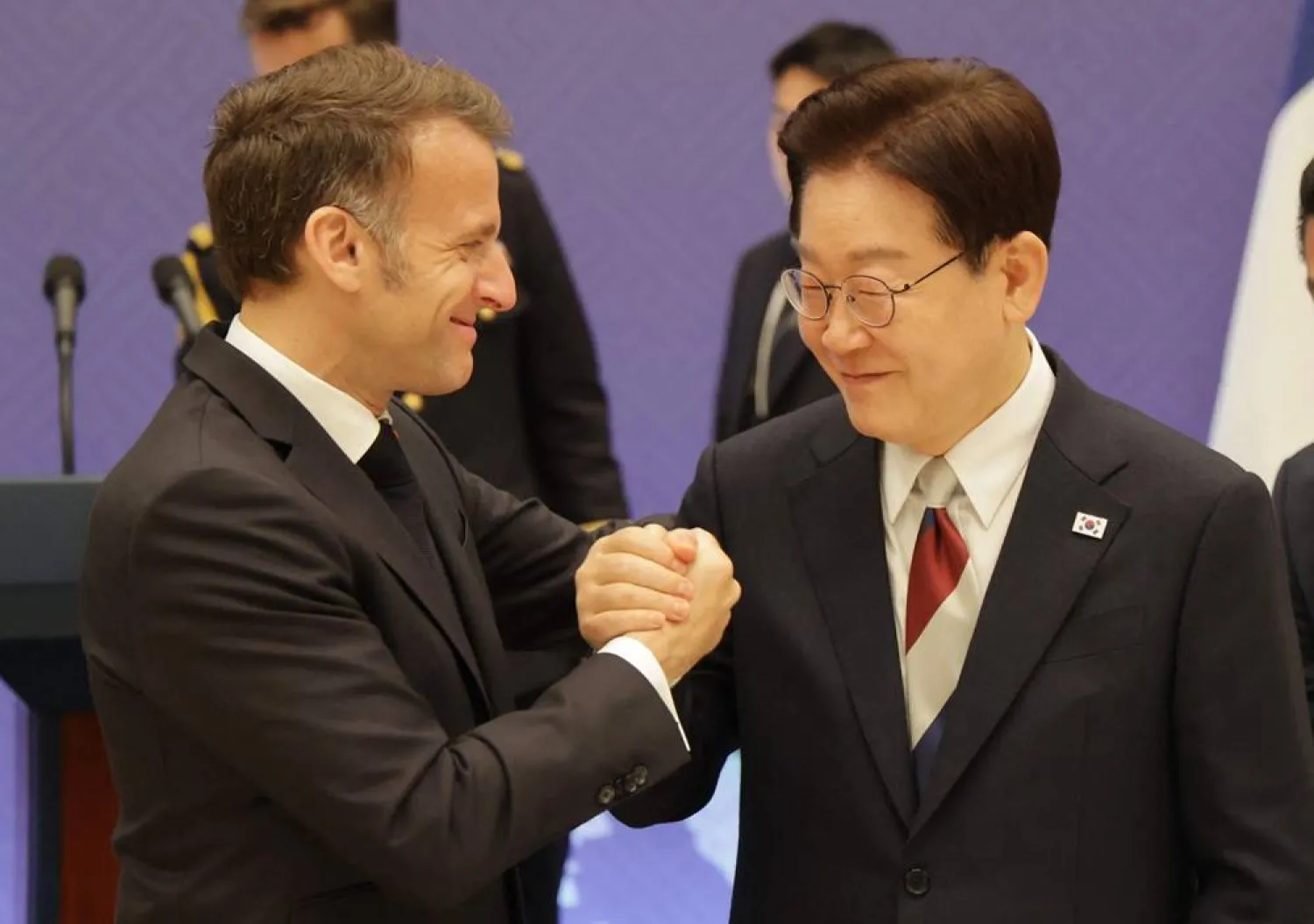
 French President Emmanuel Macron (L) shakes hands with South Korean President Lee Jae-myung (R) prior to a toast during a state lunch in Seoul on April 3, 2026. (AFP)
French President Emmanuel Macron (L) shakes hands with South Korean President Lee Jae-myung (R) prior to a toast during a state lunch in Seoul on April 3, 2026. (AFP)
TT

South Korea, France Agree to Deepen Defense Cooperation Amid Middle East Conflict

 French President Emmanuel Macron (L) shakes hands with South Korean President Lee Jae-myung (R) prior to a toast during a state lunch in Seoul on April 3, 2026. (AFP)
French President Emmanuel Macron (L) shakes hands with South Korean President Lee Jae-myung (R) prior to a toast during a state lunch in Seoul on April 3, 2026. (AFP)

South Korean President Lee Jae Myung and French President Emmanuel Macron said on Friday they planned to boost defense cooperation and work together to address the economic and energy crises triggered by the war in Iran.

Macron arrived in South Korea on Thursday for a two-day state visit after also visiting Japan, and held a summit in Seoul on Friday.

It is the first state visit by a French president since 2015, and French officials have said the trip aims to strengthen France's strategic and economic role in the region at a time of "strong international and regional tensions."

"President Macron and I agreed to share policy-related experiences and strategies in order to jointly address the economic and energy crises triggered by the ‌Middle East war," Lee ‌said after the summit.

The leaders also confirmed their commitment to bolstering energy security ‌including ⁠by collaborating to ⁠secure safe maritime transport routes through the Strait of Hormuz, he said.

Like other Asian economies, South Korea relies heavily on energy imports, including through the Strait of Hormuz. Iran has effectively shut down the waterway in retaliation for US-Israeli attacks that began on February 28, driving up energy prices and stoking fears of a global recession.

Macron said on Thursday that it would be unrealistic to launch a military operation to force open the strait, after US President Donald Trump challenged US allies to work towards reopening it.

DEFENCE TIES

Macron said after Friday's summit that the countries, both major ⁠arms manufacturers, would strive to boost their defense ties.

"What we want to do ‌is give this cooperation a contemporary dimension," Macron said, citing joint ‌exercises and more cooperation in production and in critical military capabilities.

"On both sides, we want to equip ourselves with greater strategic ‌depth in military production."

Lee also said the countries will further expand cooperation in security fields such as ‌aerospace and defense.

South Korea and France are due to sign a number of preliminary agreements to cooperate in sectors including critical minerals, semiconductors, quantum technologies, nuclear energy and wind power, Lee's office said.

The countries also aimed to increase bilateral trade to $20 billion by 2030 from $15 billion in 2025, Lee said.

Lee highlighted memoranda of understanding to be signed between South Korea's state-run ‌Korea Hydro & Nuclear Power and French companies Orano and Framatome, saying this would help secure fuel supplies for Korean nuclear power plants and lay the foundation for ⁠joint entry into the ⁠global nuclear market.

LUNCH AND KPOP

The two leaders will have a lunch after their summit, accompanied by about 140 government officials and business executives from both countries. Felix, a member of the Kpop boy band Stray Kids who has been named an honorary ambassador to France, will also attend, Lee's office said.

On Thursday, a banquet attended by the leaders and their wives was served by chef Son Jong-won, who was on Netflix's popular "Culinary Class Wars", the Blue House said. Signed CDs from top Kpop acts like BTS, Stray Kids and G-DRAGON were also prepared as gifts for France's First Lady Brigitte Macron.

The French president is scheduled to deliver a speech at Yonsei University in Seoul after the summit, and attend a business forum alongside Prime Minister Kim Min-seok, according to the Blue House.

Macron is scheduled to meet the CEOs of Samsung, Naver and Hyundai Motor during the trip as he seeks to boost French exports to South Korea and attract Korean investment into France’s industrial and technology sectors, according to the Elysee.



Vance Says Funds Won’t Be Transferred to Iran in Exchange for Signing Deal to Halt War

US Vice President JD Vance speaks with the media as he arrives at Joint Base Andrews, Maryland, US, May 28, 2026. (Reuters)
TT

Vance Says Funds Won’t Be Transferred to Iran in Exchange for Signing Deal to Halt War

US Vice President JD Vance speaks with the media as he arrives at Joint Base Andrews, Maryland, US, May 28, 2026. (Reuters)

US Vice President JD Vance said on Monday that no funds would be released to Iran in exchange for signing an agreement to halt the war and open the Strait of Hormuz and that text of the framework deal would be shared this week.

In an interview on ABC's "Good Morning America" program, Vance said signing the memorandum of understanding with Iran, expected to take place in Switzerland on Friday, would not trigger the release of frozen assets.

Vance said the agreement was already signed digitally on Sunday and no funds were released.

"There's been no money released, and that won't change," ‌he said.

Vance said ‌Iran would receive money only if it took verified steps ‌to ⁠eliminate its stockpile ⁠of highly enriched uranium.

"If we see the Iranians making, for example, taking action to eliminate their stockpile of enriched material, then yes, sanctions relief will follow. If we see the Iranians taking action to allow the kind of verification regime that we need to see to know that they're not going to build a nuclear weapon, yes, sanctions relief will follow," he said.

"If they don't ⁠do the right things, if they don't allow the verification ‌regime, they're never going to have ‌the money to rebuild their nuclear program to begin with."

In an interview on CNBC on ‌Monday, Vance also said the United States expects the economically vital waterway ‌would be open without tolls.

"Our expectation is that the Strait is going to be opened in a toll-free way for the long-term," he said.

"That's the sort of thing that we're going to figure out in these technical negotiations. You know that there ‌are a lot of very important details to figure out that we're actually going to sit at the table ⁠and discuss together ⁠and figure out a path forward."

The US and Iran said they had agreed terms to end their war and reopen the strait, news that brought relief to markets, although the pact may hinge on an end to hostilities in Lebanon and defers talks on Tehran's nuclear program.

While still a framework, the deal marked the biggest breakthrough toward resolving the conflict that has killed thousands and upended energy markets since it began with joint US-Israeli strikes on Iran in February.

Vance told CNBC that Iran's foreign minister and House speaker will represent Iran at the signing in Switzerland on Friday and many details of the deal are still to be sorted out. He did not say who would represent the US at the signing.


No EU Consensus on Sanctioning Israeli Minister Ben-Gvir, Says Kallas

Israeli National Security Minister Itamar Ben-Gvir waves as people take part in the annual Jerusalem Day march in the Old City of Jerusalem, May 14, 2026. (Reuters)
TT

No EU Consensus on Sanctioning Israeli Minister Ben-Gvir, Says Kallas

Israeli National Security Minister Itamar Ben-Gvir waves as people take part in the annual Jerusalem Day march in the Old City of Jerusalem, May 14, 2026. (Reuters)

The EU's top diplomat, Kaja Kallas, said Monday there is no unanimity in the bloc to impose sanctions on far-right Israeli national security minister Itamar Ben-Gvir, despite pressure from several countries.

"Many member states have also proposed to sanction Minister Ben-Gvir, but no consensus on that was reached today," Kallas said after a meeting of EU foreign ministers in Luxembourg.

Calls to blacklist Ben-Gvir grew after he published video last month of himself mocking bound activists seized by Israeli soldiers on a Gaza-bound aid flotilla.

France in response banned Ben-Gvir from entering the country and called for the EU to impose bloc-wide sanctions.

EU sanctions have to be signed off by all the 27 member states and staunch supporters of Israel had refused to go along with the push.

Meanwhile, Kallas said that the EU would also look to lay out options for restricting trade with Israeli settlements after calls from some countries.

"On the issue of trade with illegal settlements, many member states called for proposals from the European Commission," she said.

She said she would ask the EU's executive to prepare "a list of options for possible trade measures" ahead of a next meeting of EU foreign ministers in July.

Israel has occupied the West Bank since 1967 and since then settlement expansion has been a policy under successive Israeli governments.

But it has accelerated significantly under the current coalition government of Prime Minister Benjamin Netanyahu.

Excluding east Jerusalem, more than 500,000 Israelis now live in the West Bank in settlements that are illegal under international law, among some three million Palestinians.


Iran Executed 18 Protesters in 2026, Says UN

 UN High Commissioner for Human Rights Volker Turk speaks to the media, at the Office of the United Nations High Commissioner for Human Rights (OHCHR) Palais Wilson, in Geneva, Switzerland, Wednesday, June 10, 2026. (Keystone via AP)
UN High Commissioner for Human Rights Volker Turk speaks to the media, at the Office of the United Nations High Commissioner for Human Rights (OHCHR) Palais Wilson, in Geneva, Switzerland, Wednesday, June 10, 2026. (Keystone via AP)
TT

Iran Executed 18 Protesters in 2026, Says UN

 UN High Commissioner for Human Rights Volker Turk speaks to the media, at the Office of the United Nations High Commissioner for Human Rights (OHCHR) Palais Wilson, in Geneva, Switzerland, Wednesday, June 10, 2026. (Keystone via AP)
UN High Commissioner for Human Rights Volker Turk speaks to the media, at the Office of the United Nations High Commissioner for Human Rights (OHCHR) Palais Wilson, in Geneva, Switzerland, Wednesday, June 10, 2026. (Keystone via AP)

Iran has executed at least 40 people, including 18 protesters, on "national security grounds" since the start of 2026, the United Nations said Monday.

UN rights chief Volker Turk said he felt "deeply for the people in Iran, caught between war and cruel repression".

Since the start of the year, the Iranian authorities "have executed at least 40 people on national security grounds... including 18 protesters", he told the UN Human Rights Council.

Iran executes more people annually than any other nation besides China, according to rights groups.

Turk lamented that Tehran had ramped up repression since a deadly crackdown on protests in January, on top of the Middle East war, sparked in February by US and Israeli attacks on Iran.

He welcomed the announcement on Sunday that the United States and Iran had agreed a peace deal, stressing that "it is clear all sides need to exercise maximum restraint and work to implement the agreement reached, quickly and in good faith".

The conflict, he said, "has had a devastating impact on human rights across the region and around the world".

Repression in Iran was dire even before the war.

In late December, a protest movement sparked by economic pains quickly expanded into mass anti-government rallies, which were met by a crackdown that rights groups say killed thousands.

Iranian authorities portrayed the protests as riots backed by the United States and Israel and said the violence killed around 3,000 people.

Rights groups abroad put the toll higher and accused the security forces of firing at demonstrators.

"Since killing thousands of people during the egregious crushing of protests in January, the authorities have intensified their brutal crackdown, arresting thousands and imposing even more severe restrictions on civic space," Turk said.