

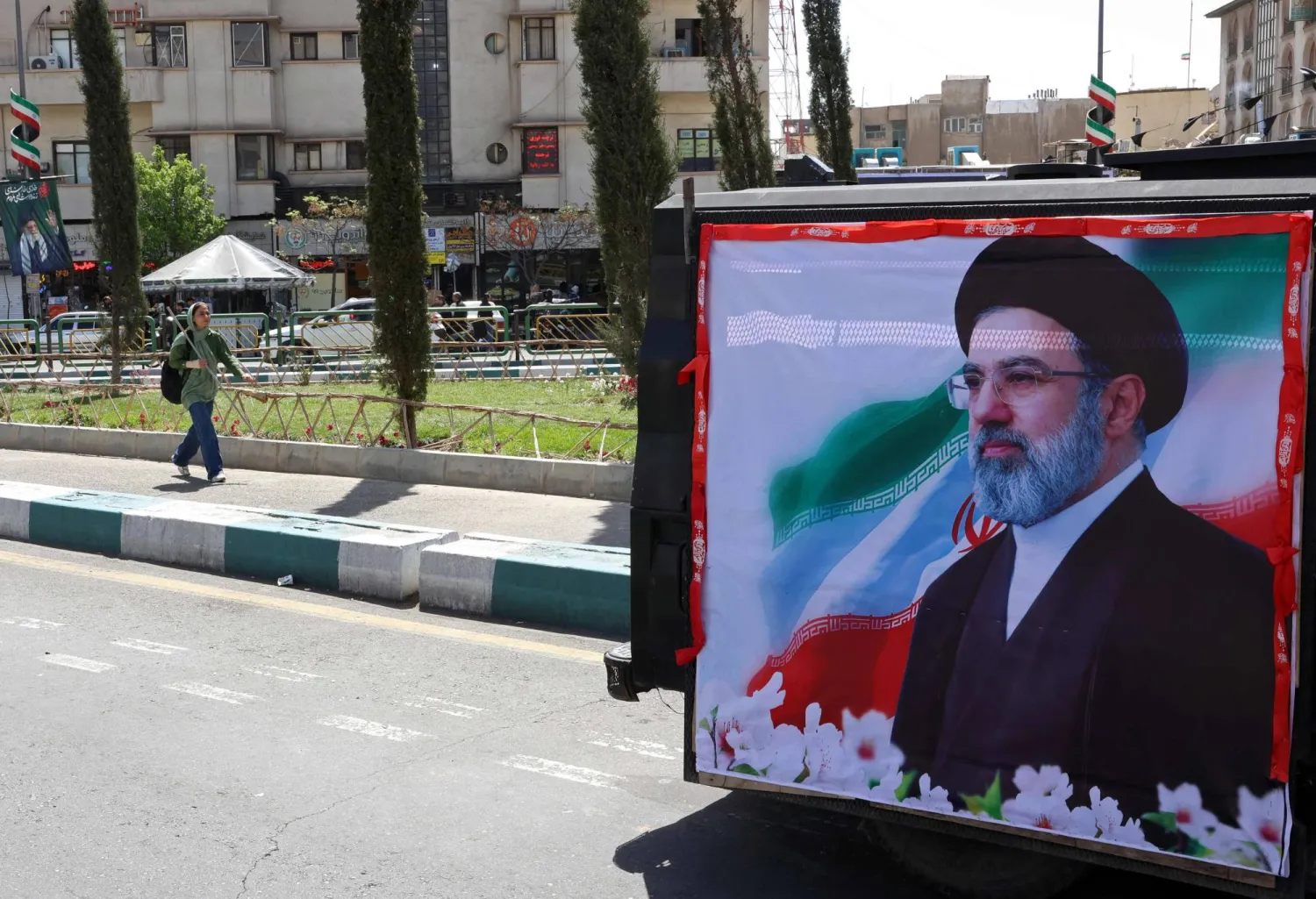

‘Unconscious’, ‘Incapacitated’, ...Report Reveals Mojtaba Khamenei’s Status and Whereabouts

A woman walks past a banner depicting Iran's new supreme leader Mojtaba Khamenei, along a street in Tehran on April 5, 2026.  (Photo by AFP)
A woman walks past a banner depicting Iran's new supreme leader Mojtaba Khamenei, along a street in Tehran on April 5, 2026. (Photo by AFP)
TT

‘Unconscious’, ‘Incapacitated’, ...Report Reveals Mojtaba Khamenei’s Status and Whereabouts

A woman walks past a banner depicting Iran's new supreme leader Mojtaba Khamenei, along a street in Tehran on April 5, 2026.  (Photo by AFP)
A woman walks past a banner depicting Iran's new supreme leader Mojtaba Khamenei, along a street in Tehran on April 5, 2026. (Photo by AFP)

Amid growing ambiguity regarding the health condition of Iranian Supreme Leader Mojtaba Khamenei, questions are mounting over his ability to effectively manage the country's affairs.

Since reportedly sustaining injuries during US-Israeli strikes in late February, he has limited his communications to written statements, with no direct public appearances.

This comes as purported video footage circulating online appears to show him inside a military control room, fueling speculation about the reality of his condition and his actual role in leading Iran during this critical period.

The Times of London has published new details about the health condition of Mojtaba Khamenei, who was reportedly injured in the same US-Israeli airstrike that killed his father.

The newspaper, citing information drawn from a diplomatic memo, reported that Mojtaba Khamenei is incapacitated and receiving medical treatment in the holy city of Qom. He "is being treated in Qom in a severe condition, unable to be involved in any decision making by the regime".

This marks the first time his location has been disclosed. The central city of Qom lies about 87 miles (approximately 140 kilometers) south of Tehran and serves as the hub of Iran’s Shiite religious establishment and a stronghold for its clerical leadership.

The newspaper reported that US and Israeli intelligence agencies had been aware of his location for some time, though this information had remained undisclosed until now.

It also noted that efforts were made to obtain official comment on the contents of the memo, including outreach to the US National Security Agency, as well as Iran’s mission in Washington, which operates out of the Pakistani embassy.

Arrangements for the Burial of Ali Khamenei

According to the memo, preparations are underway for the burial of the late Supreme Leader, Ali Khamenei, in the city of Qom.

The Times also reported that intelligence agencies have monitored efforts to “laying the groundworks needed to build a large mausoleum in Qom” capable of accommodating “more than one grave,” suggesting the possibility that additional family members—potentially including Mojtaba himself—could be buried alongside the late leader.

Iran has confirmed that Khamenei’s son was injured in the same airstrike that killed his father, as well as his mother, his wife Zahra Haddad-Adel, and one of his sons, on the first day of a war that has engulfed the Middle East for more than five weeks.

Since then, only two statements attributed to him have been broadcast on Iranian state television. On Monday, the channel also aired a video produced using artificial intelligence, showing the leader entering a war room and analyzing a map of Israel’s Dimona nuclear facility.

The absence of any audio recording has further reinforced unconfirmed reports that he remains in critical condition.

Who is in Control in Iran?

Despite continued insistence from Iranian officials that Mojtaba Khamenei remains in charge, a stream of leaks and conflicting reports have painted a very different picture. Opposition groups have claimed he has fallen into a coma, while other accounts suggest he sustained severe injuries, including a broken leg and facial trauma.

According to The Times, these divergent narratives have intensified questions about the true state of power within Tehran’s leadership structure—particularly in a system where the Supreme Leader is regarded as the ultimate political and religious authority.

Speculation therefore is mounting that Iran’s Revolutionary Guard Corps (IRGC) may be the party effectively holding the reins of power, while Khamenei appears increasingly as a silent figurehead rather than an active decision-maker, the newspaper reported.



Iran's Top Negotiator Threatens 'Faster, More Intense' Response to US Attacks

People walk past a large anti-US banner with reference to the dropping of the atomic bomb on the Japanese city of Hiroshima, in Tehran on September 2, 2026. (Photo by Atta KENARE / AFP) /
TT

Iran's Top Negotiator Threatens 'Faster, More Intense' Response to US Attacks

People walk past a large anti-US banner with reference to the dropping of the atomic bomb on the Japanese city of Hiroshima, in Tehran on September 2, 2026. (Photo by Atta KENARE / AFP) /

Iran's top negotiator Mohammad Bagher Ghalibaf threatened on Sunday to launch swifter and more forceful responses to US attacks, after Tehran targeted American warships in retaliation for US attacks on tankers.

"The Americans must have understood that the era of proportionate responses has come to an end," said Ghalibaf in a speech carried by state media, adding that "any aggression against Iran's interests and security will receive a faster, more intense and more painful response.”

Iran said Sunday that it struck an unmanned US military boat in the Strait of Hormuz.

US Central Command, which oversees the US military operations in the Middle East, did not confirm the claim or respond to request for comment. It comes one day after the US said it struck Iranian oil tankers in retaliation for Iran launching ballistic missiles at Navy warships.


A Fuel Tanker Explosion in West Iran Kills 11 and Injures 7

A fuel tanker exploded in western Iran, killing 11 people and injuring seven others, according to the state media.(AP)
TT

A Fuel Tanker Explosion in West Iran Kills 11 and Injures 7

A fuel tanker exploded in western Iran, killing 11 people and injuring seven others, according to the state media.(AP)

A fuel tanker exploded in western Iran, killing 11 people and injuring seven others, state media said.

IRNA reported late Saturday that the tanker hit other cars before bursting into flames near a traffic police station close to the Kurdish city of Sanandaj, some 400 kilometers (248 miles) west of the capital, Tehran. The report cited a faulty brake system, The Associated Press said.

The injured were transferred to hospitals.

In 2018, a similar road accident between a fuel tanker and an intercity passenger bus near Sanandaj killed 15 people and injured four.

Road and traffic accidents annually leave more than 17,000 dead in Iran. Experts blame the high fatality rate on unsafe vehicles, disregard for traffic rules, and inadequate emergency services.


Nepali Rescuers Buoyed by Miracle Finds but Tough Conditions Persist

Nepal Army personnel work to build an iron bridge across Tadi Khola river following the deadly flash floods and mudslide, in Devighat, Nuwakot district, Nepal, September 4, 2026. REUTERS/Adnan Abidi
TT

Nepali Rescuers Buoyed by Miracle Finds but Tough Conditions Persist

Nepal Army personnel work to build an iron bridge across Tadi Khola river following the deadly flash floods and mudslide, in Devighat, Nuwakot district, Nepal, September 4, 2026. REUTERS/Adnan Abidi

Nepali rescuers faced challenging conditions on Sunday as search operations after catastrophic floods entered their 12th day, buoyed by the extraordinary rescues of four survivors.

The glacial and mountain collapse on the China-Nepal border has killed at least 1,372 people and left more than 5,500 missing across the two countries, AFP said.

Rescuers found two more people alive on Saturday, joining two saved the day before in what have been described as miraculous tales of survival.

Three of those have been found in hydropower tunnels where the government initially said it believed more than 100 workers could be alive.

"Search and rescue is going on at the tunnels despite geography, adverse weather and lack of connectivity," Energy Minister Biraj Bhakta Shrestha told AFP.

Rescue workers were experiencing "multiple challenges", he said.

The wall of icy water and debris tore through mountain districts on August 26, destroying roads, bridges and other infrastructure.

On Saturday, rescuers pulled a Chinese man alive from deep inside a hydropower tunnel, and a 64-year-old Nepali woman, Chandrika Shrestha, from her mud-covered home.

Prime Minister Balendra Shah said the latter rescue had "given hope to the entire nation".

A day earlier, two Nepali hydropower workers were rescued at the Trishuli 3A tunnel, where searches continue alongside multiple other sites, with at least 12 hydropower projects affected.

Biraj Bhakta Shrestha said work was continuing to restore electricity in several areas.

"Places that have unreachable, we've tried to restore power with solar," he told AFP.

Foreign Minister Shisir Khanal has called the disaster a "Himalayan tsunami" and has warned reconstruction costs could run into the billions of dollars.

The United Nations has said the magnitude of the destruction makes delivering aid an immense challenge, and has launched a $50 million appeal to help more than 84,000 people.

With mortuaries overflowing, Nepal has buried hundreds of bodies in mass graves, after taking DNA samples for future identification, according to the police.

Only around 100 bodies have been identified and handed over to families.

Nepal will hold a national day of mourning on Monday, the 13th day since the disaster, in line with a traditional period of mourning in Hindu rituals.

While the exact cause of the glacial collapse is unclear, climate change is accelerating glacial melting worldwide, increasing the risk of such disasters.

In Nepal, rescuers have retrieved 1,341 bodies, while around 4,996 people remain missing, according to the disaster agency.

Chinese state media report that 31 people have been killed and 531 are missing in Tibet.

The combined toll is 1,372 dead and more than 5,500 missing, including around 800 foreigners, among them tourists and pilgrims.