


Russia and China Veto Watered-Down UN Resolution Aimed at Reopening the Strait of Hormuz

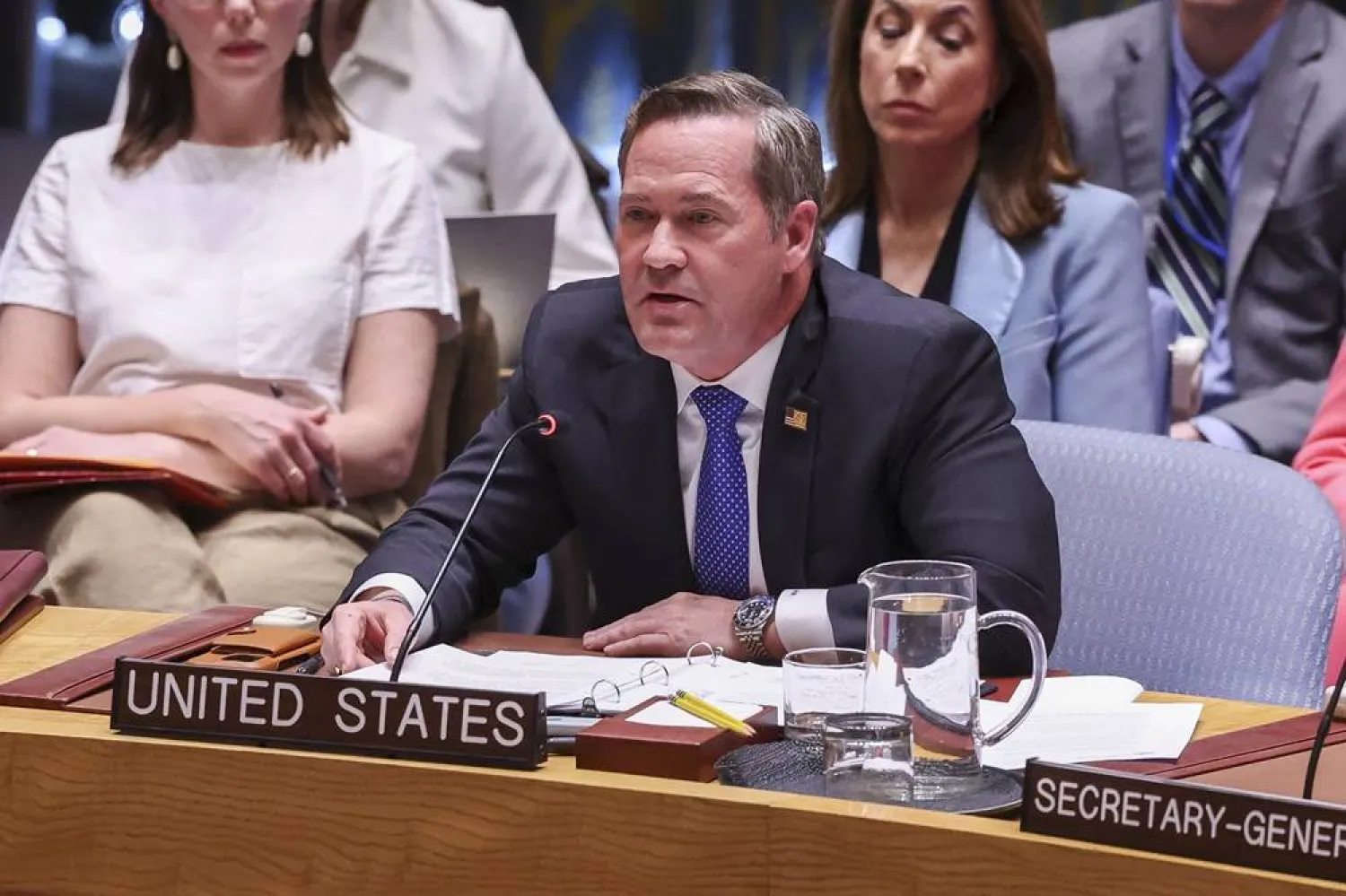
United States Ambassador to the United Nations Michael Waltz speaks during a United Nations Security Council meeting at United Nations Headquarters in New York, New York, USA, 07 April 2026. (EPA)
TT

Russia and China Veto Watered-Down UN Resolution Aimed at Reopening the Strait of Hormuz

United States Ambassador to the United Nations Michael Waltz speaks during a United Nations Security Council meeting at United Nations Headquarters in New York, New York, USA, 07 April 2026. (EPA)

Russia and China on Tuesday vetoed a UN Security Council resolution aimed at reopening the Strait of Hormuz that had been repeatedly watered down in hopes those two countries would abstain.

The vote — 11-2, with two abstentions from Pakistan and Colombia— took place just hours before an 8 p.m. Eastern deadline set by US President Donald Trump for Iran to open the strategic waterway or face attacks on its power plants and bridges.

One-fifth of the world’s oil typically passes through the strait, and Iran’s stranglehold during the war has sent energy prices soaring.

“Failing to adopt this resolution sends the wrong signal to the world, to the people of the world,” Abdullatif bin Rashid Al Zayani, Bahrain's foreign minister, said after the vote — “the signal that the threat to international waterways can pass without any decisive action by the international organization responsible for the maintenance of international peace and security.”

It’s doubtful the resolution introduced by Bahrain, even if it had been adopted, would have impacted the war, now in its sixth week, because it has been significantly weakened to try to get Moscow and Beijing to abstain rather than veto it.

The initial Gulf proposal would have authorized countries to use “all necessary means” to ensure transit through the Strait of Hormuz and deter attempts to close it.

The United States, which had supported the draft from its original form, assailed the countries that objected to the resolution.

“No one should tolerate that they are holding the global economy at gunpoint," Mike Waltz, the US ambassador to the UN, said of Iran, “but today, Russia and China did tolerate it.”

He said in his statement: “They sided with a regime that seeks to intimidate the Gulf into submission, even as it brutalizes its own people during a national internet blackout, for daring to imagine dignity or freedom.”

After Russia, China and France, all veto-wielding countries on the 15-member Security Council, expressed opposition to approving the use of force, the resolution was revised to eliminate all references to offensive action. It would have authorized only “all defensive means necessary.” A vote had been expected on Saturday.

But instead, the resolution was further weakened to eliminate any reference to Security Council authorization — which is an order for action — and limit its provisions to the Strait of Hormuz. Previous drafts had included adjacent waters.

The resolution vetoed Tuesday "strongly encourages states interested in the use of commercial maritime routes in the Strait of Hormuz to coordinate efforts, defensive in nature, commensurate with the circumstances, to contribute to ensuring the safety and security of navigation across the Strait of Hormuz.”

This should include escorting merchant and commercial vessels, and deterring attempts to close, obstruct or interfere with international navigation through the strait, it says.

The resolution also demanded that Iran immediately halt attacks on merchant and commercial vessels and stop impeding their freedom of navigation through the Strait of Hormuz and attacking civilian infrastructure.

In response to the US and Israeli attacks beginning on Feb. 28, Iran has targeted hotels, airports, residential buildings and other civilian infrastructure in more than 10 countries, including its own Gulf neighbors, some of the world’s major exporters of oil and natural gas.

Trump on Monday demanded again that Iran reopen the Strait of Hormuz after heaping praise on the US military for the daring rescue of two crewmen of a fighter jet shot down in Iran. The Republican president warned Iran that the "entire country can be taken out in one night, and that might be tomorrow night.”

He repeated the warning on Tuesday, saying a “whole civilization will die tonight” if Tehran does not meet his deadline to agree to a deal that includes reopening the Strait of Hormuz.

Russia’s UN Ambassador Vassily Nebenzia and China’s UN Ambassador Fu Cong have blamed the US and Israel for starting the war and sparking an expanding global crisis. They told the Security Council last week that the most urgent priority now is to end military operations immediately.

In response to Iran’s strikes against its Gulf neighbors, the Security Council adopted a Bahrain-sponsored resolution on March 11 condemning the “egregious attacks” and calling for Tehran to immediately halt its strikes.

That resolution, adopted by a vote of 13-0 with Russia and China abstaining, also condemned Iran’s actions in the Strait of Hormuz as a threat to international peace and security and called for an immediate end to all actions blocking shipping.



Britain’s King Charles Honors Fallen US Troops on Last Day of Visit

 Britain's King Charles and Queen Camilla take part in a wreath-laying ceremony at the tomb of the unknown soldier in Arlington National Cemetery, in Arlington, Virginia, US, April 30, 2026. (Saul Loeb/Pool via Reuters)
Britain's King Charles and Queen Camilla take part in a wreath-laying ceremony at the tomb of the unknown soldier in Arlington National Cemetery, in Arlington, Virginia, US, April 30, 2026. (Saul Loeb/Pool via Reuters)
TT

Britain’s King Charles Honors Fallen US Troops on Last Day of Visit

 Britain's King Charles and Queen Camilla take part in a wreath-laying ceremony at the tomb of the unknown soldier in Arlington National Cemetery, in Arlington, Virginia, US, April 30, 2026. (Saul Loeb/Pool via Reuters)
Britain's King Charles and Queen Camilla take part in a wreath-laying ceremony at the tomb of the unknown soldier in Arlington National Cemetery, in Arlington, Virginia, US, April 30, 2026. (Saul Loeb/Pool via Reuters)

King Charles III paid respects to fallen US troops at a military cemetery on Thursday, the final day of a state visit aimed at healing ties between Britain and the United States strained by the war in Iran.

By all accounts, the four-day visit has been a success, with President Donald Trump serving as solicitous host-in-chief who kicked off the monarch's stay with a pomp-filled welcome and lavish white-tie banquet at the White House.

"He's a great king -- the greatest king, in my book," Trump told reporters as Charles and Queen Camilla arrived at the White House for a brief farewell ceremony under bright spring sunshine on Thursday morning.

As the royal couple drove off following handshakes and a bit of chat, Trump added: "Great people. We need more people like that in our country."

Charles and Camilla then visited Arlington National Cemetery just outside Washington, where they laid a wreath and flowers at the hilltop Tomb of the Unknown Soldier honoring America's unidentified war dead.

The pair stood solemnly as a bugler played "Taps," before visiting the adjacent display room of military exhibits and artifacts.

Next on the agenda was a "block party" to mark 250 years since American independence from Britain and meetings with Native Americans at a national park, before departing for the British island territory of Bermuda in the Atlantic.

- Light moments -

The centerpiece of the whirlwind trip was Charles's speech Tuesday to the US Congress, the first by a British monarch since Queen Elizabeth II in 1991.

The address was warmly received, even as Charles ranged over subjects from climate change and the need for restraints on presidential power to the importance of NATO and defense of Ukraine -- sensitive issues for Trump's ruling Republicans.

The 77-year-old monarch skirted around tensions between Trump and Prime Minister Keir Starmer over Britain's refusal to join the war against Iran, insisting the partnership between the two countries was "born out of dispute, but no less strong for it."

The royals visited New York on Wednesday, where they stopped at the 9/11 memorial and met leftist Mayor Zohran Mamdani.

Charles, who is passionate about gardening and the environment, later visited an urban sustainable farming project in Harlem, while Camilla celebrated the 100th birthday of Winnie the Pooh at the New York Public Library.

Security has been tight for the royal visit, which came just days after an alleged assassination attempt against Trump at a Washington media gala.

The trip has seen light moments between Charles and Trump, including the US president joking that his Scottish-born mother had a crush on the future king when he was younger.


Pivotal US-Iran War Deadline Approaches with No End in Sight for Conflict

 The US Capitol in Washington, DC, US, April 28, 2026. (Reuters)
The US Capitol in Washington, DC, US, April 28, 2026. (Reuters)
TT

Pivotal US-Iran War Deadline Approaches with No End in Sight for Conflict

 The US Capitol in Washington, DC, US, April 28, 2026. (Reuters)
The US Capitol in Washington, DC, US, April 28, 2026. (Reuters)

US President Donald Trump faces a deadline on Friday to end the Iran war or make the case to Congress for extending it, but the date is most likely to pass without altering the course of a conflict that has lapsed into a standoff over shipping routes.

Ending the war appears highly unlikely.

Instead, analysts and congressional aides said they expect Trump to either notify Congress that he plans a 30-day extension or disregard the deadline, with his administration arguing that a current ceasefire with Tehran marked an end to the conflict.

Like most policies in a bitterly divided Congress, war powers have become deeply partisan, with opposition Democrats calling for Congress to reassert its constitutional right to declare war and Republicans accusing Democrats of trying to use War Powers law to weaken Trump.

Democrats have tried repeatedly since the war began on February 28 to pass resolutions seeking to force Trump to withdraw US forces or obtain congressional authorization. But Trump's Republicans, who hold slim majorities in the Senate and House of Representatives, have voted them down almost unanimously.

Under the 1973 War Powers Resolution, the ‌US president can wage ‌military action for only 60 days before ending it, coming to Congress for authorization or seeking ‌a 30-day ⁠extension due to "unavoidable ⁠military necessity regarding the safety of United States Armed Forces."

The Iran conflict began on February 28, when Israel and the United States began airstrikes on Iran. Trump formally notified Congress of the conflict 48 hours later, as the law requires, starting the 60-day deadline clock that ends May 1.

FRAIL CEASEFIRE

Trump is scheduled to receive a briefing on Thursday on plans for fresh military strikes on Iran to compel it to negotiate an end to the conflict, a US official told Reuters.

If fighting resumes, Trump can tell lawmakers that he has started another 60-day clock, something that presidents from both parties have done repeatedly since Congress passed the War Powers law, over then-President Richard Nixon's veto, in response to the Vietnam War.

That conflict also was not ⁠authorized by Congress.

Iran said on Thursday that if Washington renewed attacks it would respond with "long and ‌painful strikes" on US positions, complicating Washington's hopes for an international coalition to open the ‌Strait of Hormuz.

Opinion polls show that the Iran war is unpopular among Americans, six months before November elections that will determine who controls Congress next year.

Trump's ‌approval rating sank to the lowest level of his current term this month, as Americans increasingly soured on the cost of living ‌and blamed the war for higher prices.

But Trump remains strongly in control of his party and few Republicans have objected to his policies. Additionally, Republicans strongly back Israel, which is also striking Iran, and welcome weakening of Iran, a bitter enemy of the United States.

"It's partisanship, plain and simple," said Christopher Preble, a senior fellow at the Stimson Center think tank in Washington. "Republicans refuse to defy the president, simple as that."

'ACTIVE CONVERSATIONS'

The White House has not said how it ‌plans to proceed, or if it will ask Congress to approve an Authorization for the Use of Military Force against Iran.

"The administration is in active conversations with the Hill on this topic. Members ⁠of Congress who try to ⁠score political points by usurping the Commander-in-Chief’s authority would only undermine the United States Military abroad, which no elected official should want to do," a White House official said on condition of anonymity.

The US Constitution says only Congress, not the president, can declare war, but that restriction does not apply for short-term operations or to counter an immediate threat.

A few Republicans who have voted against war powers resolutions to date said they may reconsider after May 1. Republican Senator John Curtis of Utah published an essay saying he supported Trump's actions but would not support ongoing military action beyond the deadline without congressional approval.

But others said they wanted to wait to act.

Senator John Thune of South Dakota, the Senate's Republican majority leader, said it would be "ideal" if Washington and Tehran could reach a peace agreement, although he told reporters he has not ruled out a potential vote on authorizing the war.

"We're listening, obviously trying to stay dialed in to what's there and getting regular updates from the administration about forward progress," Thune told reporters.

Democratic Senate leader Chuck Schumer of New York has co-sponsored resolutions seeking to end the war.

"Republicans know Trump’s handling of this war has been a disaster. They see how much the American people are hurting right now," he said in a Senate speech, referring to sharp increases in gasoline and other prices.

"How many War Powers Resolutions do Democrats need to put forward before Senate Republicans do what’s right?" Schumer asked.


Israel Defense Minister Says Country May Have to ‘Act Again’ Against Iran

A firefighter stands on the rubble of residential buildings near Niloufar square in Tehran during the ongoing joint US-Israeli military campaign on Iran on March 2, 2026. (AFP via Getty Images)
TT

Israel Defense Minister Says Country May Have to ‘Act Again’ Against Iran

A firefighter stands on the rubble of residential buildings near Niloufar square in Tehran during the ongoing joint US-Israeli military campaign on Iran on March 2, 2026. (AFP via Getty Images)

Israel's defense minister on Thursday said his country may soon have to "act again" against Iran, to ensure the Islamic republic "does not once again become a threat to Israel".

"US President Donald Trump, in coordination with (Israeli) Prime Minister Benjamin Netanyahu, is leading the efforts to achieve the campaign's objectives, to ensure that Iran does not once again become a threat to Israel, the United States and the free world in the future," Israel Katz said during a military ceremony, according to a statement from his office.

"We support this effort and are providing the necessary support, but it is possible that we may soon have to act again to ensure these objectives are met," he added.