


US-Iran Direct Talks Begin in Pakistan as War’s Fragile Ceasefire Holds

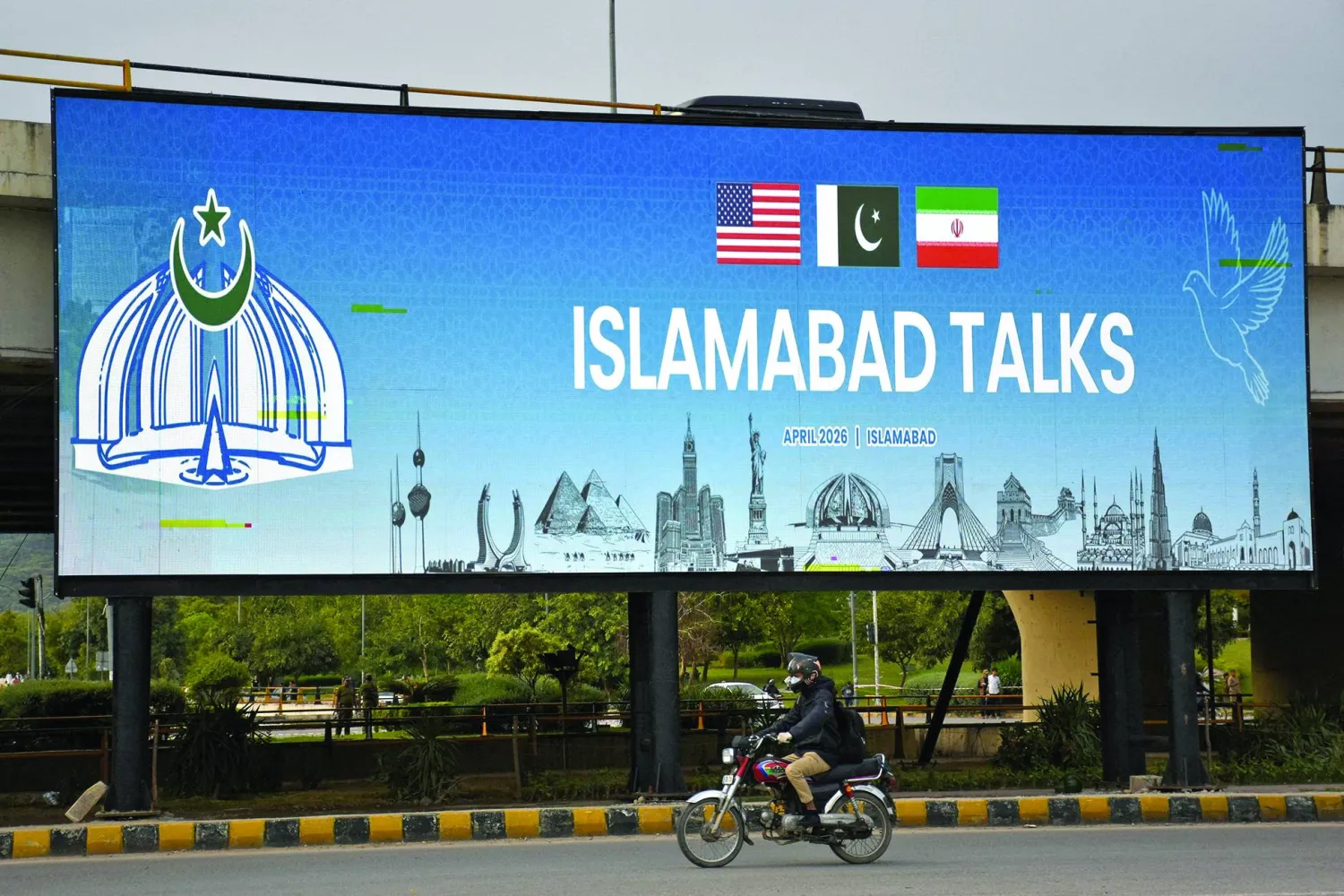
A man rides his motorbike past a billboard installed alongside a road as Pakistan prepares to host the US and Iran for peace talks, in Islamabad, Pakistan, April 10, 2026. REUTERS/Waseem Khan
TT

US-Iran Direct Talks Begin in Pakistan as War’s Fragile Ceasefire Holds

A man rides his motorbike past a billboard installed alongside a road as Pakistan prepares to host the US and Iran for peace talks, in Islamabad, Pakistan, April 10, 2026. REUTERS/Waseem Khan

The United States and Iran began face-to-face negotiations Saturday in Pakistan, days after a fragile, two-week ceasefire was announced, as the war that has killed thousands of people and shaken global markets entered its seventh week. 

The White House confirmed the direct nature of the talks. Iran's state-run news agency said three-party talks had begun after Iranian preconditions, including a reduction in Israeli strikes on southern Lebanon, were met, and after US and Iranian officials met separately with Pakistani Prime Minister Shehbaz Sharif. 

The US delegation led by Vice President JD Vance and the Iranian delegation led by Parliament Speaker Mohammad Bagher Qalibaf were discussing how to advance the ceasefire already threatened by deep disagreements and Israel's continued attacks against the Iranian-backed Hezbollah in Lebanon. 

“I cannot say whether they are sitting in the same room or in separate rooms, but talks have started and are progressing well,” said one Pakistani official with knowledge of the peace efforts, speaking on condition of anonymity because they were not authorized to talk to the media. 

Iran sets ‘red lines’ including compensation for strikes 

Iran doubled down on parts of its earlier proposal, with its delegation telling Iranian state television it had presented some of the plan’s ideas as “red lines” in meetings with Sharif. Those included compensation for damage caused by the US-Israeli strikes that launched the war on Feb. 28 and releasing Iran’s frozen assets. 

The war has killed at least 3,000 people in Iran, 1,953 in Lebanon, 23 in Israel and more than a dozen in Gulf Arab states, and caused lasting damage to infrastructure in half a dozen Middle Eastern countries. Iran's chokehold on the vital Strait of Hormuz has largely cut off the Gulf and its oil and gas exports from the global economy, sending energy prices soaring. 

Reflecting the high stakes, officials from the region said Chinese, Egyptian, Saudi and Qatari officials were in Islamabad to indirectly facilitate the talks. The officials spoke on condition of anonymity to discuss the sensitive matter. 

In Tehran, residents told The Associated Press they were skeptical yet hopeful about the talks after weeks of airstrikes left destruction across their country of some 93 million people. Some said the path to recovery would be long. 

“Peace alone is not enough for our country, because we’ve been hit very hard, there have been huge costs,” 62-year-old Amir Razzai Far said. 

Meanwhile, Israel pressed ahead with strikes in Lebanon after saying there is no ceasefire there. Iran and Pakistan have disagreed. The Lebanese state-run news agency reported at least three people killed. 

Officials posture over key issues ahead of talks  

President Donald Trump ahead of the talks accused Iran of using the Strait of Hormuz, a key artery for global energy supplies, for extortion, and told reporters Friday it would be opened “with or without them.” 

Iran’s closure of the strait has proved its biggest strategic advantage in the war. Around a fifth of the world’s traded oil had typically passed through on over 100 ships a day. Only 12 have been recorded transiting since the ceasefire. 

Iran has floated the idea of charging ships, though the idea has been widely rejected by countries including the United States and Iran’s neighbor Oman. 

On Saturday, Trump said on social media that the US had begun “clearing out” the strait, but it was unclear whether he was referring to the reported use of mines there or Iran’s broader ability to control the area. 

Iranian Foreign Minister Abbas Araghchi had said Tehran was entering negotiations with “deep distrust” after strikes on Iran during previous rounds of talks. Araghchi, part of Iran’s delegation in Pakistan, said Saturday that his country was prepared to retaliate if attacked again. 

Iran and the United States outlined competing proposals ahead of the talks. 

Iran’s 10-point proposal called for a guaranteed end to the war and sought control over the Strait of Hormuz. It included ending fighting against Iran’s “regional allies,” explicitly calling for a halt to Israeli strikes on Hezbollah. 

The United States’ 15-point proposal includes restricting Iran’s nuclear program and reopening the strait. 

Israel and Lebanon will have direct negotiations  

Negotiations between Israel and Lebanon are expected to begin Tuesday in Washington, Lebanese President Joseph Aoun’s office said Friday, after Israel's surprise announcement authorizing talks despite the countries lack of official relations. 

Israel wants the Lebanese government to assume responsibility for disarming Hezbollah, much like was envisaged in a November 2024 ceasefire. But it is unclear whether Lebanon's army can confiscate weapons from the armed group, which has survived efforts to curb its strength for decades. 

Israel’s insistence that the ceasefire in Iran does not include a pause in its fighting with Hezbollah has threatened to sink the deal. The group joined the war in support of Iran in the opening days. Israel followed up with airstrikes and a ground invasion. 

The day the Iran ceasefire deal was announced, Israel pounded Beirut with airstrikes, killing more than 300 people in the deadliest day in Lebanon since the war began, according to the country's Health Ministry. 

Energy pressures grow 

The spot price of Brent crude, the international standard for oil prices, was above $94 on Saturday, up more than 30% since the war started. 

And new pressures emerged in Europe for travelers. 

The head of Airports Council International-Europe, Olivier Jankovec, warned the European Union that a ″systemic jet fuel shortage’’ could come within three weeks because of the blockage of the Strait of Hormuz. 

Jankovec said in a letter obtained by The Associated Press that the crunch could impact the summer travel season and ″significantly harm the European economy.’′ 


US Warships Transit Strait of Hormuz in Mine Clearance Op

A boat is off the coast of Musandam governorate, overlooking the strait of Hormuz, in Musandam governance, in Oman, April 8, 2026. (Reuters)
TT

US Warships Transit Strait of Hormuz in Mine Clearance Op

A boat is off the coast of Musandam governorate, overlooking the strait of Hormuz, in Musandam governance, in Oman, April 8, 2026. (Reuters)

Two US Navy warships have transited the Strait of Hormuz at the start of an operation to clear the strategic waterway of mines laid by Iran, US Central Command said Saturday.

The announcement -- which marks the first such transit since the US-Israeli war with Iran began -- came shortly after President Donald Trump said Washington had started "clearing out" the strait, through which a fifth of the world's crude oil passes.

"Today, we began the process of establishing a new passage and we will share this safe pathway with the maritime industry soon to encourage the free flow of commerce," said CENTCOM commander Admiral Brad Cooper.

The USS Frank E. Peterson and the USS Michael Murphy are the guided-missile destroyers involved in the operation, but CENTCOM said that "additional US forces including underwater drones" could join the effort in coming days.

Earlier, US media outlet Axios reported that the operation was not coordinated with authorities in Tehran.

"We're now starting the process of clearing out the Strait of Hormuz," Trump said on his Truth Social platform, calling it "a favor" to countries such as China, Japan and France that "don't have the Courage or Will to do this work themselves."

He insisted that Iran is "LOSING BIG!" in the conflict, while acknowledging that Iranian mines in the strategic strait still pose a threat.

"The only thing they have going is the threat that a ship may 'bunk' into one of their sea mines," Trump wrote.

The key shipping lane off the coast of Iran has been virtually blocked by Tehran since the United States and Israel started bombing Iran on February 28, though reopening the strait was ostensibly a condition of the shaky ceasefire put in place earlier this week.

Senior Iranian and American officials held face-to-face negotiations in Pakistan on Saturday in a bid to bring an end to a conflict that has plunged the Middle East into violence and sent shockwaves through the world economy.

In an earlier post, Trump said that empty tankers were headed to the United States from around the world to purchase oil, without providing details.


In Fiery Speech, Pope Leo Says ‘Enough to War!’

 Pope Leo XIV presides over a Prayer Vigil and Rosary for Peace, in Saint Peter's Basilica at the Vatican, April 11, 2026. (Reuters)
Pope Leo XIV presides over a Prayer Vigil and Rosary for Peace, in Saint Peter's Basilica at the Vatican, April 11, 2026. (Reuters)
TT

In Fiery Speech, Pope Leo Says ‘Enough to War!’

 Pope Leo XIV presides over a Prayer Vigil and Rosary for Peace, in Saint Peter's Basilica at the Vatican, April 11, 2026. (Reuters)
Pope Leo XIV presides over a Prayer Vigil and Rosary for Peace, in Saint Peter's Basilica at the Vatican, April 11, 2026. (Reuters)

Pope Leo lashed out against warmongers on Saturday while calling on billions of people around the globe to embrace peace and "believe once again in love, moderation and good politics".

In one of his most passionate entreaties yet to end the raging conflict in the Middle East, the American pope said faith was needed "in order to face this dramatic hour in history together".

"Enough of the idolatry of self and money! Enough of the display of power! Enough of war! True strength is shown in serving life," Pope Leo implored in an address during a prayer vigil for peace at St Peter's Basilica.

Uttered in measured tones, as is customary for the soft-spoken head of the world's 1.4 billion Catholics, the comments by the 70-year-old Leo nevertheless marked some of the most pointed criticism yet of the wave of conflicts inflaming the globe.

"Dear brothers and sisters, there are certainly binding responsibilities that fall to the leaders of nations. To them we cry out: Stop! It is time for peace! Sit at the table of dialogue and mediation, not at the table where rearmament is planned and deadly actions are decided!"

As he has done in the past, the Chicago native did not cite politicians by name, and did not call out specific countries.


UN Demands Accountability for Violations of Rules of War in Middle East

Smoke rises from the sites of Israeli airstrikes in Beirut and its southern suburbs on April 8, 2026. (AFP)
TT

UN Demands Accountability for Violations of Rules of War in Middle East

Smoke rises from the sites of Israeli airstrikes in Beirut and its southern suburbs on April 8, 2026. (AFP)

UN agency chiefs on Saturday demanded an end to impunity for widespread international law violations in the Middle East, as casualties pile up six weeks into the war unleashed by US-Israeli strikes on Iran.

In a joint statement, the heads of multiple United Nations agencies said they were "alarmed by the sustained violations of the rules of war and international humanitarian law" in the region.

"Even wars have rules, and these rules must be respected," the statement from the UN Inter-Agency Standing Committee said.

The joint statement -- penned by UN humanitarian chief Tom Fletcher along with the heads of the UN agencies for human rights, health, food, refugees and children among others -- decried the soaring toll since the Middle East war erupted on February 28.

"In just the last month across the Middle East, thousands of civilians have been killed and injured. Hundreds of thousands have been displaced, many multiple times," it said.

"The numbers continue to rise and essential services are increasingly difficult to access.

"Health workers, hospitals and ambulances have been targeted. Schools have been struck. Civilian infrastructure - including bridges, residential buildings, houses, water facilities and power plants - has been destroyed," it said.

The agency chiefs voiced particular concern about the impact on "women and children and others with specific needs", as well as on global supply chains, "with food and fuel prices on the rise."

At the same time, they highlighted that "our humanitarian colleagues have been caught up in hostilities."

Just since the beginning of this year, they said, "14 aid workers have been killed or injured in the Occupied Palestinian Territory, eight in Iran and five in Lebanon."

"This is an alarming toll."

The agency chiefs said they "strongly condemn all attacks on civilians, including humanitarian and health workers, as well as civilian objects."

"We demand that all parties - whether Member States of the United Nations or armed groups - respect their legal obligation to protect civilians, including humanitarian personnel, and civilian infrastructure," they said.

"All violations must be met with accountability."
