


US-Iran Direct Talks Begin in Pakistan as War’s Fragile Ceasefire Holds

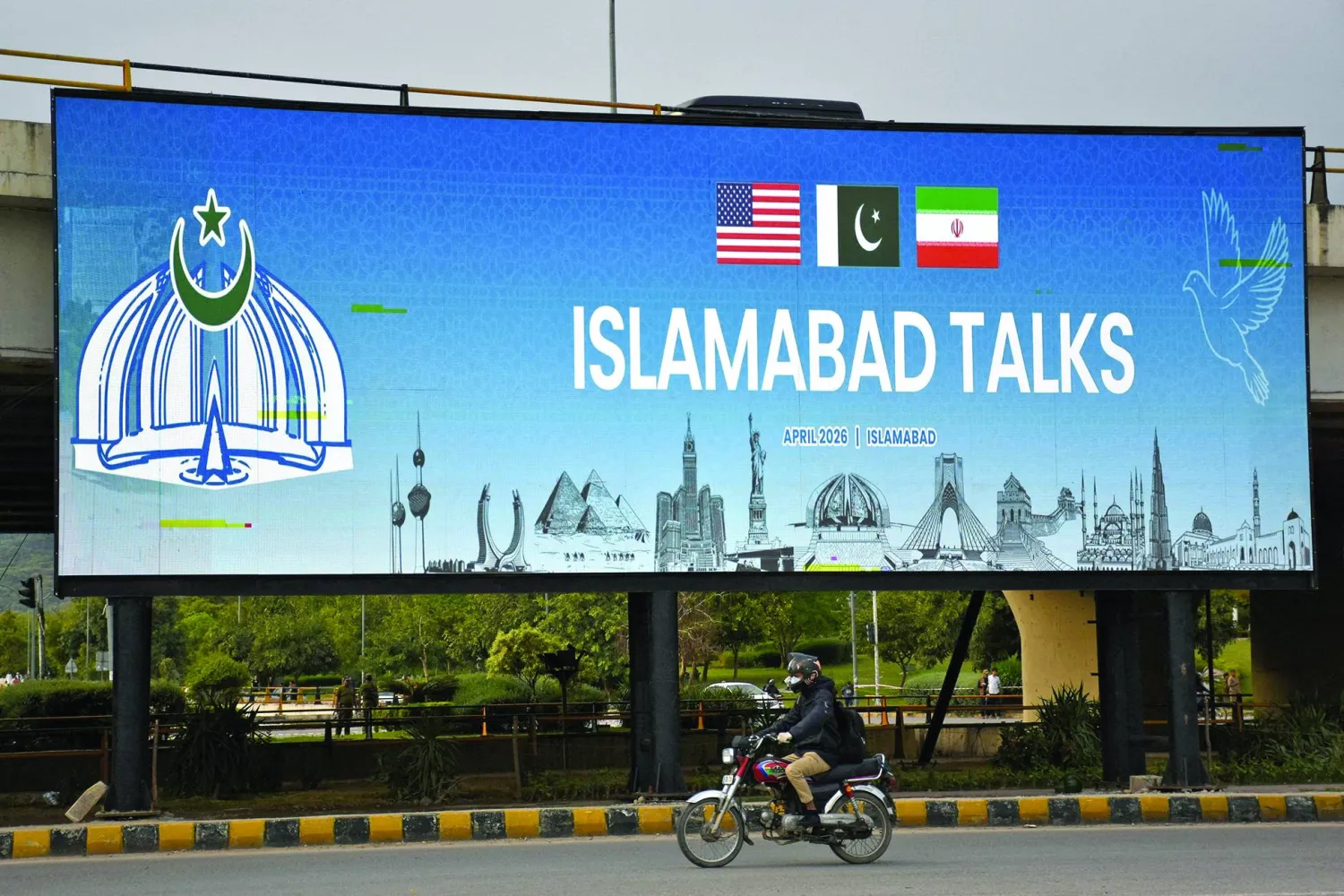
A man rides his motorbike past a billboard installed alongside a road as Pakistan prepares to host the US and Iran for peace talks, in Islamabad, Pakistan, April 10, 2026. REUTERS/Waseem Khan
TT

US-Iran Direct Talks Begin in Pakistan as War’s Fragile Ceasefire Holds

A man rides his motorbike past a billboard installed alongside a road as Pakistan prepares to host the US and Iran for peace talks, in Islamabad, Pakistan, April 10, 2026. REUTERS/Waseem Khan

The United States and Iran began face-to-face negotiations Saturday in Pakistan, days after a fragile, two-week ceasefire was announced, as the war that has killed thousands of people and shaken global markets entered its seventh week. 

The White House confirmed the direct nature of the talks. Iran's state-run news agency said three-party talks had begun after Iranian preconditions, including a reduction in Israeli strikes on southern Lebanon, were met, and after US and Iranian officials met separately with Pakistani Prime Minister Shehbaz Sharif. 

The US delegation led by Vice President JD Vance and the Iranian delegation led by Parliament Speaker Mohammad Bagher Qalibaf were discussing how to advance the ceasefire already threatened by deep disagreements and Israel's continued attacks against the Iranian-backed Hezbollah in Lebanon. 

“I cannot say whether they are sitting in the same room or in separate rooms, but talks have started and are progressing well,” said one Pakistani official with knowledge of the peace efforts, speaking on condition of anonymity because they were not authorized to talk to the media. 

Iran sets ‘red lines’ including compensation for strikes 

Iran doubled down on parts of its earlier proposal, with its delegation telling Iranian state television it had presented some of the plan’s ideas as “red lines” in meetings with Sharif. Those included compensation for damage caused by the US-Israeli strikes that launched the war on Feb. 28 and releasing Iran’s frozen assets. 

The war has killed at least 3,000 people in Iran, 1,953 in Lebanon, 23 in Israel and more than a dozen in Gulf Arab states, and caused lasting damage to infrastructure in half a dozen Middle Eastern countries. Iran's chokehold on the vital Strait of Hormuz has largely cut off the Gulf and its oil and gas exports from the global economy, sending energy prices soaring. 

Reflecting the high stakes, officials from the region said Chinese, Egyptian, Saudi and Qatari officials were in Islamabad to indirectly facilitate the talks. The officials spoke on condition of anonymity to discuss the sensitive matter. 

In Tehran, residents told The Associated Press they were skeptical yet hopeful about the talks after weeks of airstrikes left destruction across their country of some 93 million people. Some said the path to recovery would be long. 

“Peace alone is not enough for our country, because we’ve been hit very hard, there have been huge costs,” 62-year-old Amir Razzai Far said. 

Meanwhile, Israel pressed ahead with strikes in Lebanon after saying there is no ceasefire there. Iran and Pakistan have disagreed. The Lebanese state-run news agency reported at least three people killed. 

Officials posture over key issues ahead of talks  

President Donald Trump ahead of the talks accused Iran of using the Strait of Hormuz, a key artery for global energy supplies, for extortion, and told reporters Friday it would be opened “with or without them.” 

Iran’s closure of the strait has proved its biggest strategic advantage in the war. Around a fifth of the world’s traded oil had typically passed through on over 100 ships a day. Only 12 have been recorded transiting since the ceasefire. 

Iran has floated the idea of charging ships, though the idea has been widely rejected by countries including the United States and Iran’s neighbor Oman. 

On Saturday, Trump said on social media that the US had begun “clearing out” the strait, but it was unclear whether he was referring to the reported use of mines there or Iran’s broader ability to control the area. 

Iranian Foreign Minister Abbas Araghchi had said Tehran was entering negotiations with “deep distrust” after strikes on Iran during previous rounds of talks. Araghchi, part of Iran’s delegation in Pakistan, said Saturday that his country was prepared to retaliate if attacked again. 

Iran and the United States outlined competing proposals ahead of the talks. 

Iran’s 10-point proposal called for a guaranteed end to the war and sought control over the Strait of Hormuz. It included ending fighting against Iran’s “regional allies,” explicitly calling for a halt to Israeli strikes on Hezbollah. 

The United States’ 15-point proposal includes restricting Iran’s nuclear program and reopening the strait. 

Israel and Lebanon will have direct negotiations  

Negotiations between Israel and Lebanon are expected to begin Tuesday in Washington, Lebanese President Joseph Aoun’s office said Friday, after Israel's surprise announcement authorizing talks despite the countries lack of official relations. 

Israel wants the Lebanese government to assume responsibility for disarming Hezbollah, much like was envisaged in a November 2024 ceasefire. But it is unclear whether Lebanon's army can confiscate weapons from the armed group, which has survived efforts to curb its strength for decades. 

Israel’s insistence that the ceasefire in Iran does not include a pause in its fighting with Hezbollah has threatened to sink the deal. The group joined the war in support of Iran in the opening days. Israel followed up with airstrikes and a ground invasion. 

The day the Iran ceasefire deal was announced, Israel pounded Beirut with airstrikes, killing more than 300 people in the deadliest day in Lebanon since the war began, according to the country's Health Ministry. 

Energy pressures grow 

The spot price of Brent crude, the international standard for oil prices, was above $94 on Saturday, up more than 30% since the war started. 

And new pressures emerged in Europe for travelers. 

The head of Airports Council International-Europe, Olivier Jankovec, warned the European Union that a ″systemic jet fuel shortage’’ could come within three weeks because of the blockage of the Strait of Hormuz. 

Jankovec said in a letter obtained by The Associated Press that the crunch could impact the summer travel season and ″significantly harm the European economy.’′ 


US Official Says Parties Can Still Walk Away from Iran Deal, Sequencing Will Be Key

Men ride their mopeds past a map of Iran with the images of some of those killed in the Israeli-US war against the nation, erected on a wall along the highway in Tehran on June 17, 2026. (AFP)
TT

US Official Says Parties Can Still Walk Away from Iran Deal, Sequencing Will Be Key

Men ride their mopeds past a map of Iran with the images of some of those killed in the Israeli-US war against the nation, erected on a wall along the highway in Tehran on June 17, 2026. (AFP)

Both Iran and the US can walk away from the memorandum of understanding they are set to sign on Friday, and upcoming talks are likely to focus on ‌the precise sequencing ‌of the steps ‌previewed ⁠in the preliminary accord, ⁠a senior US official told reporters on Wednesday.

Speaking on condition of anonymity, the official read out the 14-point memorandum that is due ⁠to be formally ‌signed in Switzerland. ‌

They said the upcoming meeting ‌there will be "critical" for ‌ensuring that the memorandum of understanding can evolve into a comprehensive agreement.

"I think the meeting in ‌Switzerland will be quite critical in order to really ⁠see ⁠how we get to the next phase," a senior US official said.

The document, as read out by the official, was similar to the 14-point memorandum that various media outlets had already reported on earlier in the day.

According to the official, the draft agreement includes a new “minimum” standard for downblending of highly enriched Iranian uranium and has provisions to ensure the “territorial integrity” of Lebanon after Israel’s latest attacks against Hezbollah in Lebanese territory.

In return, the US will move to waive, but not eliminate, some wide-ranging sanctions against Iran once the deal is signed.

The US draft of the agreement also secures toll-free passage of the Strait of Hormuz for only 60 days, and it does not preclude fees in future, the officials said.


Trump Says Iran Accord to Be Signed ‘Shortly’, ‘Maybe’ Thursday or Friday

US President Donald Trump attends a press conference at the Hotel Royal during the G7 summit in Evian-les-Bains, France, 17 June 2026. (EPA)
TT

Trump Says Iran Accord to Be Signed ‘Shortly’, ‘Maybe’ Thursday or Friday

US President Donald Trump attends a press conference at the Hotel Royal during the G7 summit in Evian-les-Bains, France, 17 June 2026. (EPA)

US President Donald Trump on Wednesday said he expected the accord with Iran ending the Middle East war to be signed "shortly" but added uncertainty over the exact date. 

"The deal we reached with Iran on Sunday will be signed shortly, tomorrow (Thursday), maybe the next day (Friday)," Trump said at the G7 summit, after previous announcements that it would be signed Friday in Switzerland. 

"We are going to most likely sign a deal," he added. 

Trump told reporters at the final press conference of the G7 that he was prepared to "bomb the hell" out of Iran if they violated the agreement. 

"If they are not behaving they will be hit again," he said. 

But he added: "They don't want to get bombed, they don't want to get hit". 

In a long succession of comments on his dealings with Iran, Trump recalled at length how he had in 2020 issued the order to kill Qassem Soleimani, the head of foreign operations for the Revolutionary Guards. 

Trump also recalled the February 28 air strike that killed supreme leader Ali Khamenei and other senior figures, who he said were "having breakfast" at the time. 

Trump said Washington "did send a copy" of its accord with Iran to end the Middle East war, following reports of tensions with Prime Minister Benjamin Netanyahu.  

Insisting he maintains a good relationship with Netanyahu, Trump reaffirmed his criticism at the G7 summit of Israel's campaign against Hezbollah in Lebanon, saying "they (Israel) could do a much better job". 

Trump was also asked about the deadly strike on an Iranian school in Minab on the first day of the war, which left 155 dead, according to the Iranian authorities. 

Initially describing the question as "strange", Trump said: "Nobody did it on purpose. Mistakes are made, war is nasty." 

"I know it is under investigation," he said, telling the reporter to address the question to Defense Secretary Pete Hegseth instead. 

A US Tomahawk cruise missile hit the elementary school due to a targeting mistake, according to the preliminary findings of a US military investigation reported by The New York Times. 

Trump also thanked China's Xi Jinping and Russia's Vladimir ‌Putin for ‌what he ‌called ⁠their neutrality during the ⁠war with Iran.  

"I just want to thank ⁠them because ‌they ‌made it ‌a lot better," ‌Trump said, adding that both leaders had been "neutral." 


Italy Says to Re-Open Tehran Embassy on Friday

Italian Foreign Minister Antonio Tajani ahead of the European Foreign Affairs Council meeting in Luxembourg, 15 June 2026. (EPA)
TT

Italy Says to Re-Open Tehran Embassy on Friday

Italian Foreign Minister Antonio Tajani ahead of the European Foreign Affairs Council meeting in Luxembourg, 15 June 2026. (EPA)

Italy's embassy to Tehran will re-open on Friday after more than three months of closure because of the Middle East war, the foreign ministry said on Wednesday.

"Our embassy in Tehran will re-open its doors on Friday," Foreign Minister Antonio Tajani told Italy's parliament.

After the US and Israel began the war with air strikes on Iran, Italy in early March decided to temporarily close its embassy and move its staff to neighboring Azerbaijan for security reasons.

"Our ambassador will return to the Iranian capital with all our diplomats and foreign ministry officials," Tajani said.

"In a complex region like the Middle East, caution is essential. But, for the first time, after weeks of war and faltering negotiations, a tangible glimmer of peace is emerging," he said.

The US and Iran this week agreed a framework deal to end the Middle East war.

The agreement is due to be formally signed on Friday in Switzerland.
