China Urges Restraint Over US Blockade of Strait of Hormuz, Backs Talks

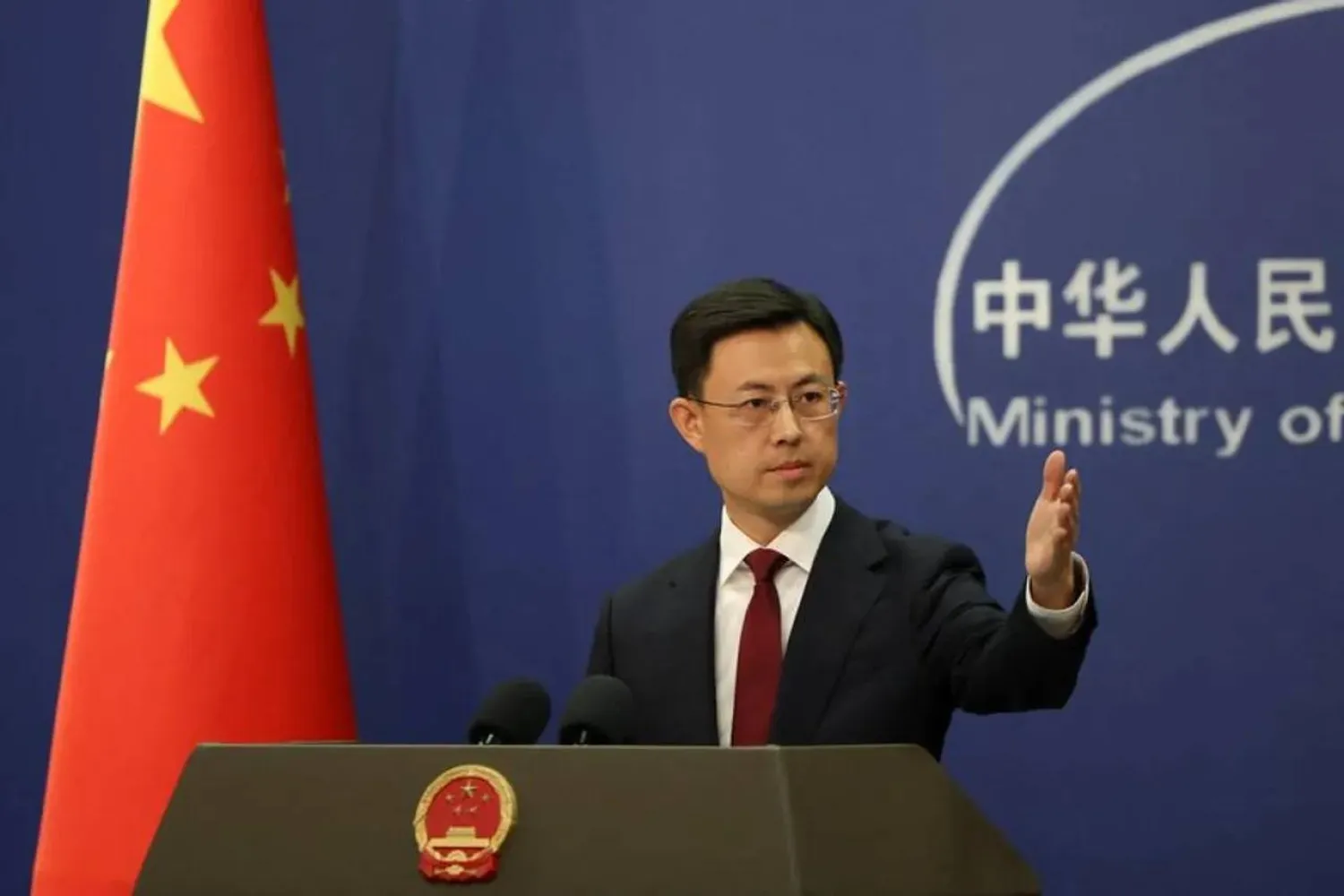
Chinese foreign ministry spokesperson Guo Jiakun answers a journalist's question during a press briefing in Beijing, China, January 7, 2025. (Reuters)
TT

China Urges Restraint Over US Blockade of Strait of Hormuz, Backs Talks

Chinese foreign ministry spokesperson Guo Jiakun answers a journalist's question during a press briefing in Beijing, China, January 7, 2025. (Reuters)

China urged calm and restraint by all sides on Monday, following US President Donald Trump's threat to blockade the Strait of Hormuz after the failure of weekend talks in Islamabad aimed at ending the Iran war. 

Before the war, most Iranian oil exports were shipped to China, the top global importer of crude. 

Keeping the key Strait of Hormuz waterway safe, stable and unimpeded served the interest of ‌the international community, foreign ‌ministry spokesperson Guo Jiakun told ‌a ⁠regular press conference, when ⁠asked about the blockade threat. 

"China hopes the relevant parties will abide by the temporary ceasefire arrangements, remain committed to resolving disputes through political and diplomatic means, and avoid a resumption of hostilities," he said. 

China stood ready to "play a positive and constructive role" in ⁠resolving the crisis, Guo added, calling ‌the opening talks in the ‌Pakistani capital a step in a direction conducive to ‌easing tension. 

After the marathon talks failed, the US ‌Central Command said its forces would begin a blockade of all maritime traffic with Iranian ports from 10 a.m. ET (1400 GMT) on Monday. 

China and Pakistan had backed peace ‌talks in March while urging an immediate ceasefire in the Iran war and restoration ⁠of normal ⁠navigation in the Strait of Hormuz, a conduit for about a fifth of global oil and gas supplies. 

Guo rejected reports that China had plans to supply weapons to Iran as "groundless smears and malicious associations". 

Last week, Trump threatened immediate tariffs of 50%, with no exemptions, on imports from countries supplying Iran with military weapons. 

"China has consistently taken a prudent and responsible approach to arms exports," Guo said, adding that its strict controls were in line with domestic laws and international obligations. 


NATO Allies Refuse to Join Trump's Strait of Hormuz Blockade

FILE PHOTO: A NATO flag flutters at the Tapa military base, Estonia April 30, 2023. REUTERS/Ints Kalnins/File Photo
TT

NATO Allies Refuse to Join Trump's Strait of Hormuz Blockade

FILE PHOTO: A NATO flag flutters at the Tapa military base, Estonia April 30, 2023. REUTERS/Ints Kalnins/File Photo

The United States' NATO allies said on Monday they would not get involved in President Donald Trump's plan to blockade the Strait of Hormuz, further ratcheting up tensions within the increasingly fragile alliance. Trump said the US military would work with other countries to block all maritime traffic in the waterway, after weekend talks failed to reach an agreement to end the six-week conflict with Iran. The US military later specified that the blockade, due to start at 1400 GMT on Monday, would only apply to ships going to or from Iranian ports.

"The Blockade will begin shortly. Other Countries will be involved with this Blockade," Trump said in a post on Truth Social on Sunday.

But NATO allies including Britain and France said they would not be drawn into the conflict by taking part in the blockade, saying instead that it was vital to open the waterway through which one-fifth of the world's oil usually passes, which Iran has effectively closed since the conflict began on February 28. Their refusal to participate is yet another point of friction with Trump, who has threatened to withdraw from the military alliance and is weighing pulling some US troops from Europe after several countries resisted supporting the US campaign against Iran by denying US military planes use of their airspace.

CONSIDERABLE PRESSURE

"We're not supporting the blockade," British Prime Minister Keir Starmer told the BBC.

"My decision has been very clearly that whatever the pressure, and there's been some considerable pressure, we're not getting dragged into the war," he said. NATO Secretary General Mark Rutte told European governments that Trump wants concrete commitments in the near future to help secure the Strait of Hormuz, diplomats told Reuters last week.

NATO could play a role in the strait if its 32 members could agree on the formation of a mission, Rutte said on April 9.

Several European countries have said they're willing to help in the strait but only once there is a durable end to hostilities and an agreement with Iran that their ships will not be attacked.

France will organize a conference with Britain and other countries to create a multinational mission to restore navigation in the strait, French President Emmanuel Macron said on X on Monday.

"This strictly defensive mission, distinct from the belligerents, will be deployed as soon as the situation allows," Macron said.

Britain is working on ways to reduce insurance premiums for ships passing through the strait once the fighting has stopped, according to a senior European official.

The Strait of Hormuz should be reopened by diplomacy, Turkish Foreign Minister Hakan Fidan said on Monday, adding that creating an international force to oversee it would be complicated as he called for NATO to reset its ties with Trump at a summit in Ankara in July.


Netanyahu Says Israel Supports Trump's Iran Naval Blockade

FILE PHOTO: A map showing the Strait of Hormuz is seen in this illustration taken March 23, 2026. REUTERS/Dado Ruvic/Illustration/File Photo
TT

Netanyahu Says Israel Supports Trump's Iran Naval Blockade

FILE PHOTO: A map showing the Strait of Hormuz is seen in this illustration taken March 23, 2026. REUTERS/Dado Ruvic/Illustration/File Photo

Prime Minister Benjamin Netanyahu said Monday that Israel supports US President Donald Trump's decision to impose a naval blockade on Iran, adding that his government is in full coordination with Washington on the matter.

"Iran violated the rules (of the peace talks in Pakistan), President Trump decided to impose a naval blockade," Netanyahu said at a cabinet meeting, according to a video statement released by his office, AFP reported.

"We, of course, support this firm position, and we are in constant coordination with the United States."

The US military said it would begin a blockade of all Iranian ports on Monday after weekend talks with Tehran ended without a deal.

Trump had announced on social media that he would blockade the strategic Strait of Hormuz trade route that he has been demanding Tehran fully re-open, after Vice President JD Vance left the failed negotiations with an Iranian delegation in Islamabad.

The US military said the blockade would begin at 1400 GMT, and apply to all ships leaving or seeking to dock at Iranian ports on either side of the key waterway.

Netanyahu said Tehran had violated the terms of the talks to begin with, saying Vance had briefed him after the negotiations ended in Islamabad.

"The breakdown came from the American side, which could not tolerate Iran's blatant violation of the terms for entering negotiations," Netanyahu told the cabinet.

"The agreement was that there would be a ceasefire, and that the Iranians would immediately open the strait. They did not do so. The Americans could not accept this."

Netanyahu also said Vance had told him the "central issue" for Trump was the removal of all enriched uranium from Iran and "ensuring that there is no further enrichment in the years ahead -- even decades ahead -- no enrichment within Iran".

"That is their focus, and of course it is important to us as well," Netanyahu added.


Iran in Touch with India on Ships Passage through Strait of Hormuz, Iranian Envoy Says

A vessel at the Strait of Hormuz, off the coast of Oman’s Musandam province, April 12, 2026. REUTERS
TT

Iran in Touch with India on Ships Passage through Strait of Hormuz, Iranian Envoy Says

A vessel at the Strait of Hormuz, off the coast of Oman’s Musandam province, April 12, 2026. REUTERS

Iran has "good contact" with the Indian government on passage of the South Asian nation's ships through the Strait of Hormuz and wants to help New Delhi, Iranian Ambassador to India Mohammad Fathali said on Monday.

The US-Israeli war on Iran, which began in February, has restricted shipping through the key route - a conduit for 40% of India's crude imports - impacting trade and squeezing oil supplies.

This came as ⁠the US Central Command said in a note to seafarers seen by Reuters on ⁠Monday that US military will enforce a blockade ​in Gulf of Oman and Arabian Sea east of the Strait of Hormuz and it will ‌apply to ‌all ​vessel ‌traffic regardless ⁠of ​flag.

The advanced note ‌said ‌the blockade ​would ‌come into effect at ‌1400 GMT on Monday.

"Any vessel entering or departing the blockaded ‌area without authorization is subject to interception, ⁠diversion, ⁠and capture," the note said.

"The blockade will not impede neutral transit passage through the Strait of Hormuz to or from non-Iranian destinations."