

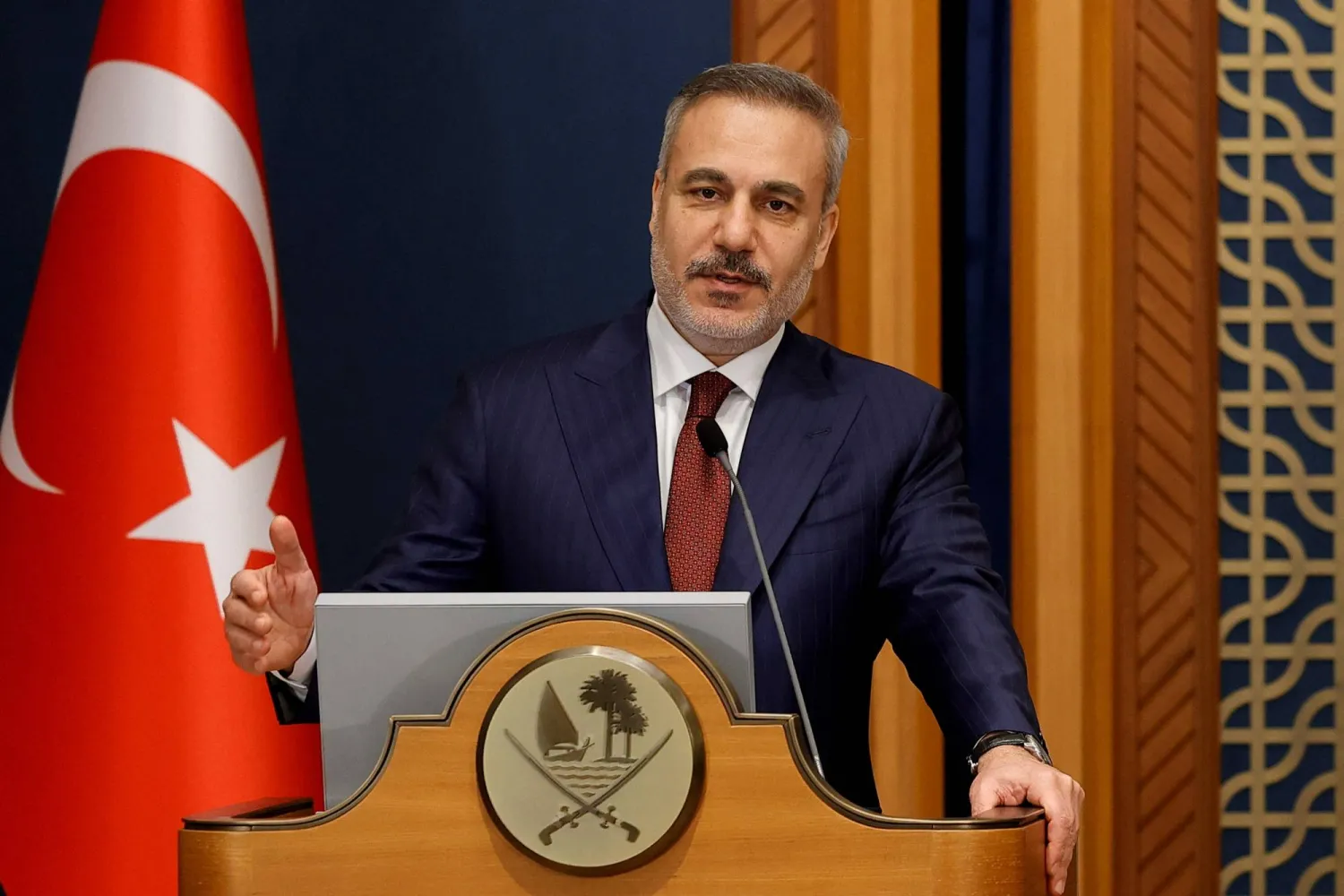

Türkiye FM Says Iran, US 'Sincere' about Ceasefire, Israel Seeks to Declare Türkiye ‘New Enemy'

Türkiye's Foreign Minister Hakan Fidan speaks during a joint press conference with Qatar's Prime Minister and Foreign Minister Sheikh Mohammed bin Abdulrahman Al Thani, in Doha on March 19, 2026. (Photo by Karim JAAFAR / AFP)
TT

Türkiye FM Says Iran, US 'Sincere' about Ceasefire, Israel Seeks to Declare Türkiye ‘New Enemy'

Türkiye's Foreign Minister Hakan Fidan speaks during a joint press conference with Qatar's Prime Minister and Foreign Minister Sheikh Mohammed bin Abdulrahman Al Thani, in Doha on March 19, 2026. (Photo by Karim JAAFAR / AFP)

Türkiye's foreign minister said on Monday he believed both Iran and the United States remain "sincere" about reaching a ceasefire despite the failure of Pakistan-mediated talks on the weekend. 

He also stated that Israel "cannot live without an enemy" and its government is now trying to portray Türkiye as one. 

US President Donald Trump has blamed the Iranian republic's refusal to abandon its nuclear ambitions for the collapse of the talks, AFP said. 

"Both sides are sincere about the ceasefire," Hakan Fidan said in an interview with the official Anadolu news agency, adding that he has been in contact with the parties involved in the negotiations. 

"I am thinking that if the nuclear issue comes down to an all-or-nothing situation especially regarding enrichment, we might face serious obstacles," Fidan said. 

"Hopefully, we will try to overcome this with the support of some mediators," he added. 

Türkiye, while a fierce critic of Israel, joined diplomatic efforts with Egypt and Pakistan to reach a ceasefire in the conflict. 

Fidan continued to say that Israel "cannot live without an enemy" and its government is now trying to portray his country as one. 

Tensions between Türkiye and Israel have steadily escalated since the Gaza war erupted following Hamas's October 7, 2023, cross-border attack in Israel. 

The dispute entered a new phase over the weekend after President Recep Tayyip Erdogan warned his US counterpart Donald Trump of "possible provocations and sabotage" that could jeopardize an initial ceasefire arrangement in the US-Israeli war on Iran. 

Israeli Prime Minister Benjamin Netanyahu vowed on Saturday that Israel would continue to confront Tehran and its regional allies. 

"After Iran, Israel cannot live without an enemy," Fidan said in a televised interview with the state-run Anadolu news agency. 

"We see that not only Netanyahu's administration but also some figures in the opposition -- though not all -- are seeking to declare Türkiye the new enemy," he said. 

"This is a new development in Israel... turning into a state strategy," he added.


Lula: Trump Plans to Impose Hormuz Shipping Fees Will Turn US Into ‘Pirate State’

Brazilian President Luiz Inacio Lula da Silva (EPA) 
TT

Lula: Trump Plans to Impose Hormuz Shipping Fees Will Turn US Into ‘Pirate State’

Brazilian President Luiz Inacio Lula da Silva (EPA) 

Brazilian President Luiz Inacio Lula da Silva said Monday that plans by US President Donald Trump to impose hefty fees on ships transiting the Strait of Hormuz would turn the United States into a “pirate” state.

In a post on Truth Social earlier, Trump said he will impose a 20% levy on all cargo shipped through the waterway.

Speaking at a public event in Sao Paulo state, Lula said: “A major nation like the United States, which I believe has fought against piracy for a long time, cannot now become a pirate,” according to AFP.

For his part, Iran's Foreign Minister Abbas Araghchi has posted a reaction to Trump's announcement that the US will impose a charge on cargo passing through the Strait.

Araghchi wrote, “The US President is absolutely right. Whoever provides secure and safe passage of commercial vessels through the Strait of Hormuz should be compensated for this service. Iran has always been the GUARDIAN of the Strait and will remain so FOREVER. 20% is of course too much. We will be fair.”

On Monday, Trump wrote on Truth Social that he would reinstate a blockade of Iran's ports on the Strait of Hormuz and impose a 20% levy on all cargo shipped through the waterway, saying the revenue would help pay for keeping the strategic shipping route open.

“The Hormuz Strait is OPEN, and will remain OPEN, with or without Iran. We are reinstating the IRANIAN BLOCKADE, so named because it is only stopping Iran’s ships or customers from entering or leaving,” Trump said.

He added that the “US will be reimbursed, at the rate of 20% on all cargo ships, for any and all costs necessary to do the job of providing safety and security to this very volatile section of the world.”

The US President said the process would begin immediately but did not elaborate.

Trump floated the idea earlier in a phone ⁠interview on Fox News' “Fox & Friends” program, saying the US would probably take over the strait and should be reimbursed.

“We're going to keep the strait, and we'll probably run it. We'll become the guardian of the strait. Maybe we'll call it the guardian angel of the strait. And we should be reimbursed for that,” he told the “Fox & Friends” program.

Control of the Strait of Hormuz, a vital route for global oil supplies, has become one of the main battlegrounds of the conflict. Iran's effective blockade of the strait has pushed up energy prices and increased concerns about inflation globally.

Iran's Revolutionary Guards said in a statement on Monday that the only way to restore regular shipping traffic through the strait was to end US military interventions in the waterway, and warned that “continued interference could lead to greater incidents in the global oil and ⁠gas sector.”


UN Shipping Agency Opposes Fees for Any Strait, More Details Sought on Trump Post on Cargo Charge

This picture shows ships sailing near the Strait of Hormuz off the eastern coast of the United Arab Emirates at Khor Fakkan on July 13, 2026. (AFP)
TT

UN Shipping Agency Opposes Fees for Any Strait, More Details Sought on Trump Post on Cargo Charge

This picture shows ships sailing near the Strait of Hormuz off the eastern coast of the United Arab Emirates at Khor Fakkan on July 13, 2026. (AFP)

More details are awaited after US President Donald Trump said in a post that Washington was reinstating a naval blockade on Iran and would be reimbursed 20% on ‌all cargo ‌shipped through ‌the ⁠Strait of Hormuz, ⁠the UN's shipping agency said on Monday.

"We are aware of the post and awaiting more details," ⁠a spokesperson with the ‌UN's ‌International Maritime Organization said.

"We have ‌always been consistent ‌on our stance on fees – IMO stands firmly against charging fees for passage ‌through straits used for international navigation. There ⁠is ⁠no legal basis through which to introduce mandatory tolls simply to transit through a strait."

Trump said in a Truth Social post the process would begin immediately, but did not elaborate.


US Citizen Is Found Guilty of Helping Export Tech to Iran in Violation of Sanctions

People walk near an anti-US mural in Tehran, Iran, July 13, 2026. Majid Asgaripour/WANA (West Asia News Agency) via Reuters
TT

US Citizen Is Found Guilty of Helping Export Tech to Iran in Violation of Sanctions

People walk near an anti-US mural in Tehran, Iran, July 13, 2026. Majid Asgaripour/WANA (West Asia News Agency) via Reuters

A Massachusetts man was found guilty Monday of conspiring to unlawfully export electronic components to Iran in violation of US sanctions.

Mahdi Mohammad Sadeghi, who worked at the global electronics company Analog Devices, was accused of helping an Iranian business associate get around American export control laws. US prosecutors say the business associate’s Tehran-based company makes navigation systems for the military drone program of Iran’s Revolutionary Guard. Authorities say the scheme included the creation of a front company in Switzerland.

The second defendant, Mohammad Abedininajafabadi, called Abedini in court documents, was not on trial. He is believed to be in Iran after an apparent prisoner exchange for an Italian journalist.

Sadeghi was found guilty on three of the five charges. He showed no visible reaction to the verdict, which came early in the fourth day of jury deliberations. He and his lawyers did not comment as they left court, and he will remain free until sentencing Oct. 13.

Sadeghi, a 43-year-old naturalized US citizen, chose not to testify. A father of two, he lost his job at Analog Devices due to the charges. Although he was arrested in December 2024, long before the current war with Iran, his trial has unfolded during the conflict.

“At its core, this case is straightforward. You cannot send goods, especially the goods at issue in this case, to Iran. Period. Full stop,” Assistant US Attorney Alathea Porter told the jury. “The defendant knew that, and conspired with Mr. Abedini to do that.”

Assistant U.S. Attorney Jared Dolan, in his closing remarks, said documents, text messages and photos proved that the illegal acts were the “fruits of this relationship” between Sadeghi and Abedini.

“The evidence established that he knew what Abedini was doing because he told him in writing,” Dolan said. “He helped him anyway.”

Sadeghi's attorney, William Fick, told jurors that the scheme laid out by the prosecution “makes no sense” and was full of holes. He said Sadeghi was only offering advice to a longtime friend about how to get business with the semiconductor company, and wasn’t responsible for procuring the parts for Abedini.

Fick said there was no proof the parts ended up in Iran, and he disputed that the Swiss company was a front.

“If you look at the world through dirty glasses, everything looks dirty,” Fick said. “That is fundamentally what the prosecution is asking you to do here.”

Fick also said prosecutors hadn't shown Sadeghi gained anything from the alleged plan — although the prosecution pointed out that they didn't need to prove a motive.

“He had nothing to gain and everything to lose,” Fick said. “He has lived in the country for decades. He was a well-regarded, respected employee on his way up in the company.”

Prosecutors had hoped to introduce evidence during the trial related to an Iranian drone used in a 2024 attack that killed three US troops at a remote base in Jordan.

However, before the trial, defense attorneys sought to exclude any evidence related to Abedini’s role in drone manufacturing or attacks on American troops.

The judge agreed, ruling that prosecutors could only give general evidence about Abedini’s Iranian company and how its technology had potential military applications, including for drones. During a hearing in February, prosecutors acknowledged they didn’t have evidence that Sadeghi “knew anything” about the technology he was accused of exporting was allegedly used on the drone involved in the Jordan attack.

Both defendants have been charged with export control violations. Abedini is separately charged with conspiring to provide material support to a foreign terrorist organization that resulted in the deaths of three service members.

Abedini was arrested at an airport in Italy on a US warrant in December 2024, but was released a month later and returned to Iran. Three days after his arrest, Italian journalist Cecilia Sala was detained while reporting in Iran. Sala, who was believed held as a bargaining chip for Abedini’s release, returned home in January 2025.
