


Trump Says Iran War Should End 'Soon', Both Sides May Meet at Weekend

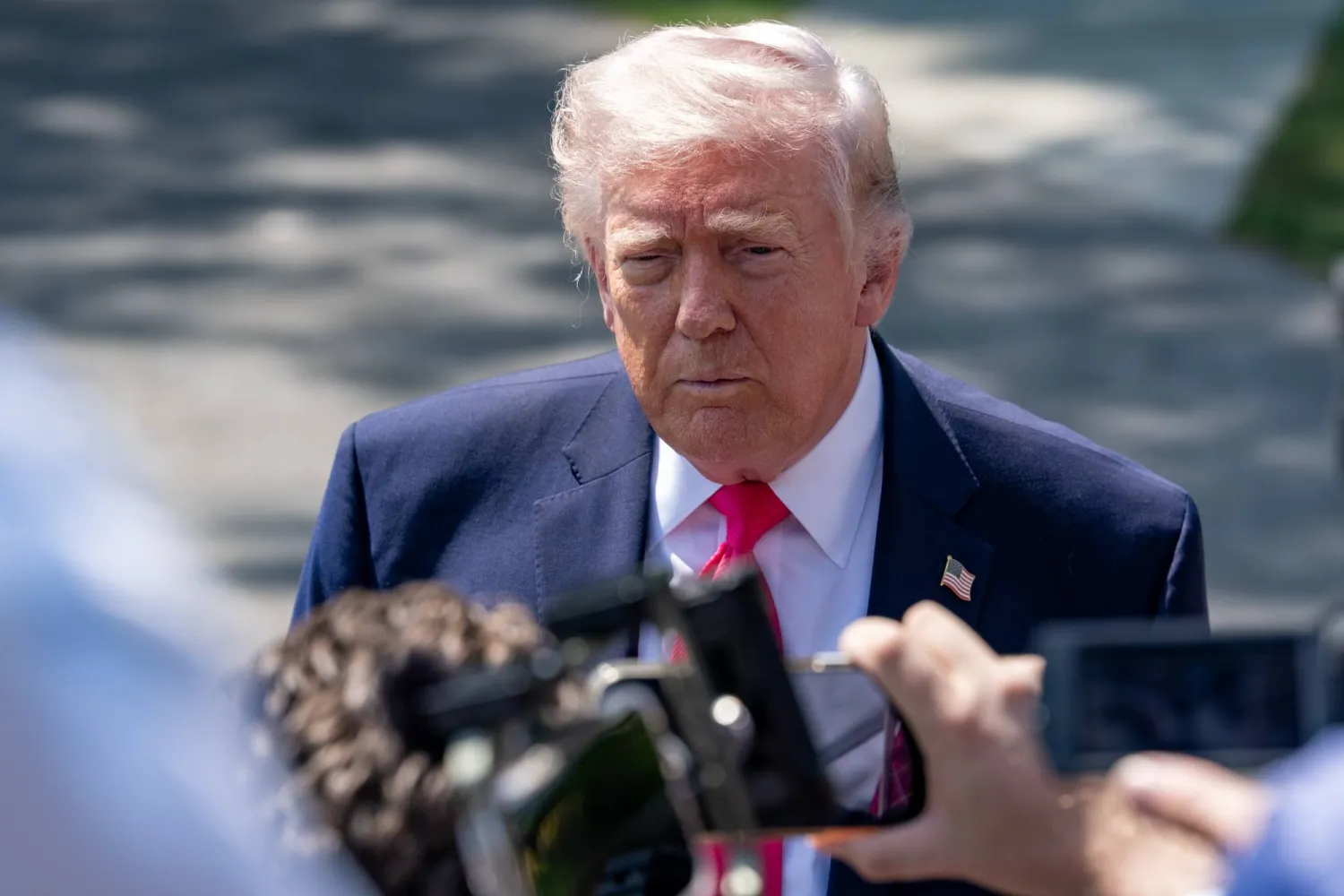
16 April 2026, US, Washington: US President Donald Trump speaks to the media before boarding Marine One from the South Lawn of the White House, for the start of a trip to Las Vegas and Phoenix. Photo: Andrew Leyden/ZUMA Press Wire/dpa
TT

Trump Says Iran War Should End 'Soon', Both Sides May Meet at Weekend

16 April 2026, US, Washington: US President Donald Trump speaks to the media before boarding Marine One from the South Lawn of the White House, for the start of a trip to Las Vegas and Phoenix. Photo: Andrew Leyden/ZUMA Press Wire/dpa

US President Donald Trump expressed confidence that an agreement could soon be reached to end the Iran war and urged the Tehran-aligned Hezbollah group to hold its fire as a 10-day truce went into effect between Lebanon and Israel.

Trump said the next meeting between the United States and Iran could take place at the weekend and an extension of a two-week ceasefire was possible, but may not be needed as Tehran wanted a deal.

"We're going to see what happens. But I think we're very close to making a deal with Iran," he told reporters outside the White House, adding if an agreement was reached and signed in the Pakistani capital Islamabad, he may go there for the occasion.

Hours later while in Las Vegas, Trump went further, saying the war "should be ending pretty soon".

The war with Iran has been unpopular in the United States and has left Trump with a political headache just months before a crucial midterm election at home, Reuters said.

The US-Israeli attack on Iran that started on February 28 has triggered the worst oil price shock in history and led to an International Monetary Fund downgrade of its outlook for the global economy and a warning that prolonged conflict could push the world to the brink of recession.

A Pakistani source involved in mediating between the US and Iran said on Friday there was progress in backdoor diplomacy and that an upcoming meeting between the ‌two sides could result in ‌the signing of an agreement.

The two sides would first sign a memorandum of understanding followed by a comprehensive agreement within ‌60 days, ⁠the source said.

"Detailed agreement ⁠comes later. Both sides are agreeing in principle. And technical bits come later," the source said, speaking on condition of anonymity.

A diplomatic source said the key Pakistani mediator, army chief Field Marshal Asim Munir, had been holding talks in Tehran since Wednesday and had made a breakthrough on "sticky issues".

OIL PRICE FALLS ON DEAL HOPES

Oil prices fell in early trade on Friday and Asian stocks headed for a second week of strong gains on optimism the Middle East conflict could be nearing an end, even though the critical Strait of Hormuz, an artery for a fifth of the world's oil and gas supply, remains effectively closed.

The MSCI's broadest index of Asia-Pacific shares outside Japan was down 0.8% as investors locked in profits after a blistering rally this month, with the index close to its highest since the Iran war broke out.

Japan's Nikkei slipped 1% after hitting a record high on Thursday and almost all stock markets were back to pre-war levels.

Brent crude futures declined to $98.17 a barrel at 0434 GMT while US ⁠West Texas Intermediate crude futures fell to $93.47 a barrel, trimming gains from the previous session.

France and Britain will chair a meeting on ‌Friday of around 40 countries aimed at signaling to the United States that some of its closest allies, many chided by ‌Trump for failing to act, are ready to help restore freedom of navigation in the Strait of Hormuz once conditions allow.

Iran has largely closed the strait to ships other than its own and Washington this ‌week imposed a blockade on ships entering or leaving Iranian ports. Analysts said the blockade could prevent roughly 2 million barrels per day of Iranian crude from reaching its primary ‌buyer China.

Only a trickle of vessels have passed through the strait since the war started, compared to an average 130-plus each day before the conflict.

HOPES FOR 'MEANINGFUL TALKS'

The ceasefire in Lebanon went into effect on Thursday and Trump said he had spoken to Israeli Prime Minister Benjamin Netanyahu and Lebanese counterpart Joseph Aoun and planned to invite them to the White House for "meaningful talks" that could happen over the next week or two.

Iran has insisted that any peace deal should also cover the fighting in Lebanon. The ceasefire was part of an understanding reached with the US and mediated by Pakistan, Iranian media reported, citing a foreign ministry ‌spokesperson.

"May have been a historic day for Lebanon. Good things are happening!!!" Trump said on social media late on Thursday.

In an earlier post, he urged Hezbollah to respect the ceasefire.

"I hope Hezbollah acts nicely and well during this important period of time. It ⁠will be an GREAT moment for them if ⁠they do. No more killing. Must finally have PEACE!" he said.

Conflict between Israel and the Iran-backed Hezbollah in Lebanon was reignited by the US-Israeli war with Iran. Hezbollah opened fire in support of Tehran on March 2, prompting an Israeli offensive in Lebanon that authorities say has killed 2,000 people, 15 months after their last major conflict.

Celebratory gunfire rang out across parts of Beirut as the clock struck midnight on Thursday to mark the start of the truce and witnesses heard explosions from rockets fired in celebration, prompting a safety warning and threat of arrests from the Lebanese Army.

But the pause in hostilities remained fragile, with the army early on Friday reporting that Israel had already violated the ceasefire with intermittent shelling of several southern Lebanese villages.

There was no immediate comment from the Israeli military, which had said earlier that its forces remained deployed in the area, in what a spokesperson said was in response to continued Hezbollah militant activity.

Hezbollah released a lengthy statement on its military operations against Israel throughout Thursday, which listed its last attack as being 10 minutes before the ceasefire took effect.

The truce was "essential, urgently needed and a demand shared by all," senior Hezbollah official Bilal Lakkiss told NBC News ahead of the start of the ceasefire, but said the group would not comply with Israel’s demand that it disarm "except within a framework tied to a broader national security vision".

NUCLEAR AMBITIONS A STICKING POINT

Tehran's nuclear ambitions were a sticking point at talks in Islamabad last weekend, where the US proposed a 20-year suspension of all nuclear activity by Iran. Tehran suggested a halt of three to five years, according to people familiar with the proposals.

Trump on Thursday said Iran had offered not to possess nuclear weapons for more than 20 years.

Iran has demanded that international sanctions be lifted and Washington has pressed for any highly enriched uranium to be removed from Iran.

Two Iranian sources said there were signs of a compromise on the HEU stockpile, with Tehran considering shipping part of it out of the country.



Rubio Says US Will Not Accept Iranian Tolls on Hormuz

 Vessels at the Strait of Hormuz, as seen from Musandam, Oman, June 22, 2026. (Reuters)
Vessels at the Strait of Hormuz, as seen from Musandam, Oman, June 22, 2026. (Reuters)
TT

Rubio Says US Will Not Accept Iranian Tolls on Hormuz

 Vessels at the Strait of Hormuz, as seen from Musandam, Oman, June 22, 2026. (Reuters)
Vessels at the Strait of Hormuz, as seen from Musandam, Oman, June 22, 2026. (Reuters)

Washington's top diplomat insisted Tuesday that the US would not accept any attempt to impose tolls or fees on Strait of Hormuz, the key waterway where the UN said it would begin evacuating thousands of sailors stranded by the Middle East war 

The US and Iran have signed a preliminary deal to halt the war, and concluded a first round of talks in Switzerland as part of a 60-day negotiation period to settle outstanding issues like sanctions relief and the fate of Tehran's nuclear program. 

An Iranian blockade that began early in the conflict choked off maritime traffic through the Hormuz strait -- sending global oil prices surging -- but crossings have begun to rise again since the US-Iran deal was inked. 

Iran has repeatedly maintained it will retain control over the waterway, including on Tuesday, when it and Oman said in a joint statement that they would study the administration of the trade route and the costs to be charged for services provided, insisting on their sovereignty over the strait. 

But US Secretary of State Marco Rubio, kicking off a regional tour, reiterated Washington's position that such an arrangement would be unacceptable. 

"It's an international waterway. No country is allowed to charge tolls or fees on an international waterway," he said from Abu Dhabi, adding that he believed "all the countries in this region would agree". 

Tehran's top negotiator, Mohammad Bagher Ghalibaf, had earlier insisted the Strait of Hormuz "will never return" to the pre-war status quo, despite the foes agreeing to set up communication lines to keep it open. 

- Muscat meeting - 

Oman and Iran agreed on Tuesday to press on with discussions about the future administration of navigation in the Strait of Hormuz. 

In a joint statement issued after talks in Muscat, they said a joint working group involving their foreign ministries ‌would be ‌formed to continue the discussions and ‌that they ⁠would consult other ⁠littoral states and relevant parties.  

The move appears to implement a provision of the memorandum of understanding signed last week that calls for Iran to hold talks with Oman and other states on the future management of ⁠navigation and maritime services in the strait, ‌a vital waterway ‌for global oil supplies.  

The agreement was announced following a ‌visit by Speaker Ghalibaf and Foreign Minister Abbas Araqchi, who met Oman's Sultan Haitham bin Tariq and held talks with Omani Foreign Minister Badr Albusaidi.  

In the statement, Oman and ‌Iran, the two states bordering the strait, reaffirmed their commitment to ensuring ⁠safe ⁠passage through the waterway in accordance with international law while underlining sovereignty over their territorial waters.  

Since the start of the US-Israeli war against Iran in February, the strait has been largely closed to commercial shipping. The United States blockaded Iranian ports after Iran started effectively blocking the strait.  

Oman and Iran reaffirmed their commitment to the strait being a secure and open route for international navigation and to promoting maritime safety, freedom of navigation and regional stability. 

The head of the UN's International Maritime Organization, meanwhile, said it would begin evacuating more than 11,000 sailors stranded by the Hormuz blockade in cooperation with Iran, Oman and the United States, adding it had "secured the necessary safety guarantees". 

Traffic through the strait on Monday reached the highest level since the start of the war, according to two maritime tracking platforms, representing just over 40 percent of the normal peacetime level of about 120 vessels per day. 


Tehran Gets Three-Day Holiday for Ali Khamenei Funeral

An Iranian man walks past a banner depicting slain supreme leader Ali Khamenei at Valiasr Square in Tehran on June 15, 2026. (AFP)
TT

Tehran Gets Three-Day Holiday for Ali Khamenei Funeral

An Iranian man walks past a banner depicting slain supreme leader Ali Khamenei at Valiasr Square in Tehran on June 15, 2026. (AFP)

Iran announced Tuesday three days of public holidays in the capital Tehran for late supreme leader Ali Khamenei's funeral ceremonies, state television reported.

"The farewell ceremony and prayers for the martyred leader's body will be held on Saturday and Sunday, July 4th and 5th, in Tehran's Grand Mosalla, and the funeral will be held on Monday, July 6th, and Tehran province will be off for these three days," Iranian Revolutionary Guards Corps (IRGC) commander Hassan Hassanzadeh, in charge of the ceremonies, was quoted as saying.

Earlier, state media said Tehran would be on holiday on July 4 and 5, while the rest of the country will join it on July 6.

Tehran authorities expect an attendance of around 20 million.

The northern city of Qom will also host a tribute on July 7.

Ali Khamenei will be laid to rest on July 9 in the northeastern city of Mashhad, his birthplace.

These two cities will also observe public holidays.

Neighboring Iraq has scheduled ceremonies for July 8.

The funeral was originally planned for March but was postponed due to the war in the Middle East, which was triggered by the US-Israeli attacks in February that killed Khamenei.

Ali Khamenei's son Mojtaba succeeded his father as supreme leader in early March, becoming the third person to hold the position since the regime was established in 1979.

Mojtaba Khamenei was wounded in the bombing that killed his father and other officials. He has not been seen in public since his appointment and communicates solely through official statements.


China’s Newest Aircraft Carrier Sails Through the Taiwan Strait

In this photo released by Xinhua News Agency, China's third conventionally powered aircraft carrier, the Fujian, conducts a maiden sea trial on May 7, 2024. (Ding Ziyu/Xinhua via AP, File)
TT

China’s Newest Aircraft Carrier Sails Through the Taiwan Strait

In this photo released by Xinhua News Agency, China's third conventionally powered aircraft carrier, the Fujian, conducts a maiden sea trial on May 7, 2024. (Ding Ziyu/Xinhua via AP, File)

China’s newest and most powerful of its three aircraft carriers sailed through the Taiwan Strait on Tuesday, the Taiwanese defense ministry said, a day after Taiwan began a five-day military exercise on responding to a Chinese attack.

The Fujian carrier first sailed through the narrow body of water separating China and Taiwan in a trial run last September. It later transited the strait for the first time as a fully commissioned military vessel in December.

China claims the self-governed island as part of its territory and has not ruled out the use of force to bring it under Beijing's control. China regularly sends navy vessels and war planes towards Taiwan in military exercises that have become more frequent in recent years to where they now occur almost daily.

Taiwan on Monday kicked off its own five-day exercise to support its response in case of a possible Chinese military invasion.

The US Navy sends warships through the strait periodically, as do some of its allies, in a warning to Beijing against any attempt to use force to establish its claim to the island.

The Fujian was commissioned in November 2025. It is world’s largest nonnuclear-powered warship, according to the US Naval Institute, and is considered more advanced than China's other two carriers, the Shandong and the Liaoning.