


US Begins Philippines War Games in Thick of Middle East Conflict

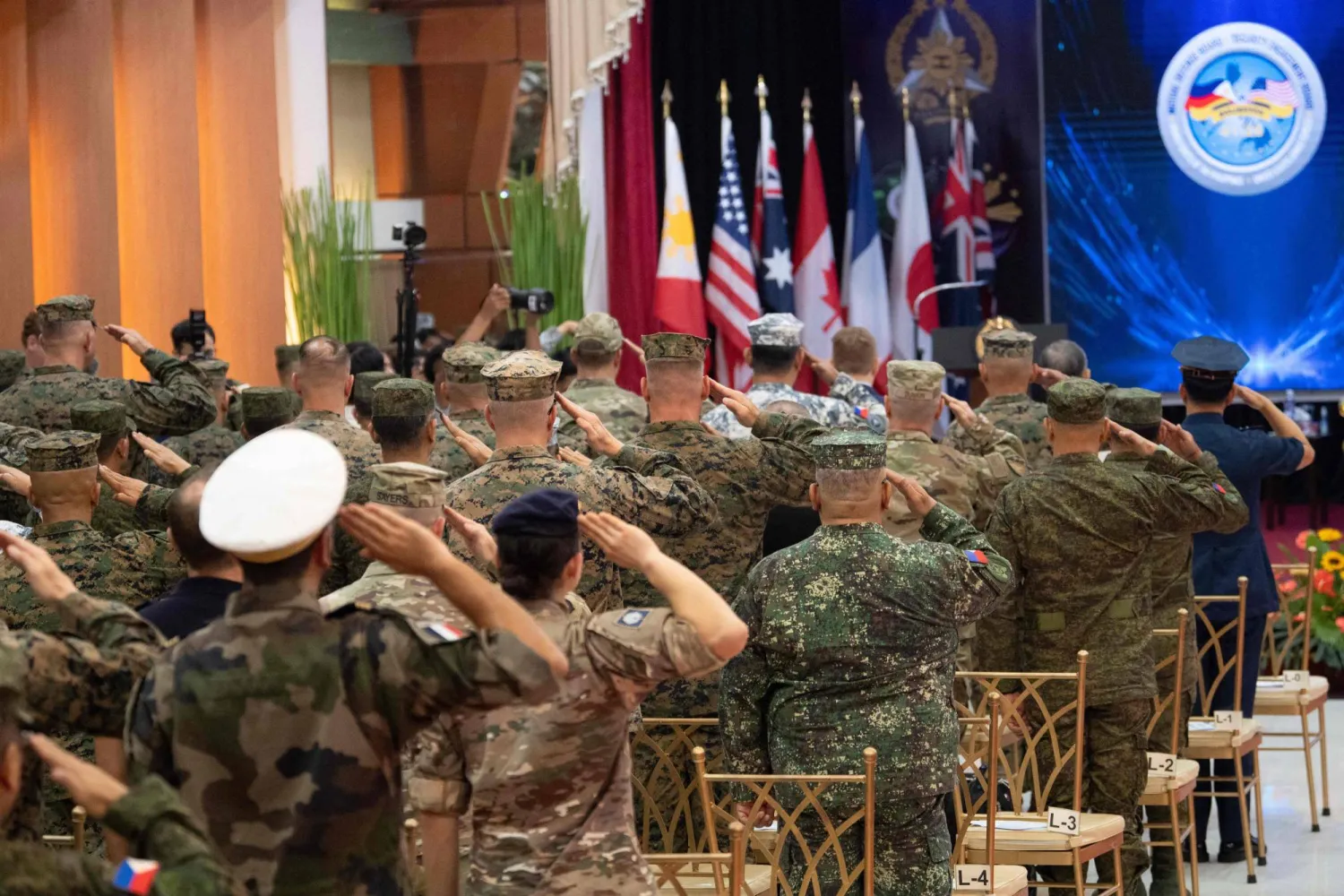
Philippine and US soldiers salute as their national anthems are played during the opening ceremony of the annual Balikatan joint military exercise at Camp Aguinaldo in Quezon city, suburban Manila on April 20, 2026. (AFP)
TT

US Begins Philippines War Games in Thick of Middle East Conflict

Philippine and US soldiers salute as their national anthems are played during the opening ceremony of the annual Balikatan joint military exercise at Camp Aguinaldo in Quezon city, suburban Manila on April 20, 2026. (AFP)

Thousands of American and Philippine troops, joined for the first time by a significant contingent of Japanese forces, began annual military exercises Monday set against the backdrop of the Middle East war.

The war games will feature live-fire exercises in the north of the country facing the Taiwan Strait, as well as a province off the disputed South China Sea, where the Philippines and China have engaged in repeated confrontations.

The Japanese military, which is contributing 1,400 personnel, will use a Type 88 cruise missile to sink a target ship off northern Paoay, Philippine exercise spokesman Colonel Dennis Hernandez said.

More than 17,000 soldiers, airmen and sailors are taking part in the 19-day Balikatan, or Shoulder to Shoulder, exercises -- about the same number as last year's edition -- including contingents from Australia, New Zealand, France and Canada.

"Balikatan... represents an opportunity to showcase our ironclad alliance with the Philippines and demonstrate our commitment to a free and open Indo-Pacific," US exercise spokesman Colonel Robert Bunn said ahead of Monday's opening ceremony.

Bunn added that US troop levels he described as "one of the largest deployments" in years would be unaffected by the ongoing Middle East war his country is waging, while declining to provide specific numbers.

Balikatan comes as Iran and the United States, along with Israel, are just days away from the end of the two-week ceasefire that halted the Middle East war, ignited by surprise US-Israeli strikes on Iran on February 28.

The conflict has sparked a global energy crisis that has left import-dependent Philippines reeling.

The drills also come as Beijing ramps up military pressure around Taiwan, which it considers part of its territory and has threatened to use force to seize.

Philippine President Ferdinand Marcos said last November that given his country's proximity to the self-ruled island and its surrounding waters, "a war over Taiwan will drag the Philippines, kicking and screaming, into the conflict".

In February, US, Japanese and Philippine aircraft patrolled over the Bashi Channel separating the Philippines from Taiwan to test what Manila called their "ability to operate seamlessly together in complex maritime environments".

Marcos considers Manila's 1951 mutual defense pact with Washington a bedrock of national security and has been building up security ties with Western nations to deter China.

Over the past two years, Manila has signed visiting forces or equivalent agreements with Japan, New Zealand, Canada and France, deals aimed at facilitating their participation in joint military exercises in the Philippines.

Bunn said American forces would have the option of firing Tomahawk and NMESIS anti-ship missiles, without confirming they would.

Integrated air and missile defense systems will also be put to the test, including technology for countering drones, Philippine spokesman Hernandez said.

Week-long naval exercises will also take place in so far unspecified waters off the main Philippine island of Luzon, he added.

Japan is deploying a tank landing ship, a destroyer, and a helicopter destroyer, while the US will use a cutter and a dock landing ship.

They will join two Philippine frigates and another from Canada.


Ukraine Says it Received New IRIS-T Launcher from Germany

FILED - 26 May 2023, Baden-Wuerttemberg, Ueberlingen: An Iris-T missile defense system stands on the premises of Diehl Defense in Ueberlingen. Photo: Christoph Schmidt/dpa
TT

Ukraine Says it Received New IRIS-T Launcher from Germany

FILED - 26 May 2023, Baden-Wuerttemberg, Ueberlingen: An Iris-T missile defense system stands on the premises of Diehl Defense in Ueberlingen. Photo: Christoph Schmidt/dpa

Ukraine received a new Iris-T air defense launcher from Germany on Saturday, President Volodymyr ⁠Zelenskiy said on ⁠Sunday, asking for more ⁠provision of air defense ammunition.

"We also need missiles for air defense systems to have sufficient capabilities ⁠to ⁠repel Russian attacks," Zelenskiy said on Telegram.

On Sunday, Ukraine's military said it had struck Russia's Saratov oil refinery overnight, causing ⁠a large fire ⁠to break out at ⁠the facility.

The military said in a post on Telegram that it had also hit the ⁠Lazarevo ⁠oil pumping station in Russia's Kirov region.


Japan Rejects 'New Militarism,’ Accuses China of Rapidly Arming

Shinjiro Koizumi, Japan's defense minister, speaks at the Shangri-La Dialogue security summit in Singapore, May 31, 2026. REUTERS/Caroline Chia
TT

Japan Rejects 'New Militarism,’ Accuses China of Rapidly Arming

Shinjiro Koizumi, Japan's defense minister, speaks at the Shangri-La Dialogue security summit in Singapore, May 31, 2026. REUTERS/Caroline Chia

Japan's Defense Minister Shinjiro Koizumi on Sunday rejected accusations of "new militarism" by Tokyo and criticized China for rapidly expanding its military with little transparency, underscoring mounting tensions between the two countries.

China continues to increase its defense spending at a high level, Koizumi said at the Shangri-La Dialogue in Singapore, adding: "China's external approach and military activities are matters of serious concern for Japan and the international community at the same time."

Rebutting criticism that Japan was embracing new militarism, he said: "Think about it. There's a country that has a huge arsenal of nuclear weapons and strategic bombers. Japan has neither of such ⁠weapons, and yet ⁠Japan is labelled 'new militarism'?"

Koizumi said Japan's record since World War Two "speaks for itself", citing its adherence to international law and commitment to the United Nations Charter, alongside efforts to uphold a "free and open international order."

In May, China's foreign ministry called on Asia-Pacific countries to be vigilant and "jointly resist the reckless actions of Japan's neo-militarism".

At the Singapore forum, Chinese delegate Major General Meng Xiangqing also criticized Japan.

"I deeply doubt whether ⁠a country that has not thoroughly eradicated the toxic legacy of militarism is qualified to talk extensively about defense cooperation on international occasions, and whether it can win the trust of the international community, especially the Asian countries it once invaded," he said.

Ties between Japan and China sank to their worst level in years after Japanese Prime Minister Sanae Takaichi warned in November that a hypothetical Chinese attack on Taiwan could draw a Japanese military response.

China claims Taiwan as its own territory, over the objections of Taipei's government.

Koizumi said he was "sad" he could not meet his Chinese counterpart at the dialogue, Asia's premier defense forum, but insisted Japan remains open to ⁠engagement. "We keep ⁠the door open," he said, reaffirming Japan's commitment to dialogue with China and other regional players to foster stability.

For the second year running, Chinese Defense Minister Dong Jun has given the free-wheeling Singapore security meeting a miss, skipping opportunities to meet his counterparts.

Koizumi said Japan is "determined" to play a new role in defense equipment cooperation in the Asia-Pacific and aims to tangibly strengthen deterrence in the region.

"We seek a region that can stand against coercion. We seek a region that is not misled by falsehoods. We seek a region that is not influenced by pressure," he said.

In April, Tokyo unveiled its biggest overhaul of defense export rules in decades, scrapping restrictions on overseas arms sales and opening the way for exports of warships, missiles and other weapons.


IAEA: Turbine Building at Ukrainian Nuclear Plant Attacked

An image showing part of the Russian-controlled Zaporizhzhia nuclear power plant in southeastern Ukraine (Reuters file photo)
TT

IAEA: Turbine Building at Ukrainian Nuclear Plant Attacked

An image showing part of the Russian-controlled Zaporizhzhia nuclear power plant in southeastern Ukraine (Reuters file photo)

The International Atomic Energy Agency (IAEA) on Saturday said it has been informed by the Zaporizhzhia nuclear power plant in southeastern Ukraine that a drone struck ⁠a turbine building ⁠at the site, reportedly causing a hole in its wall.

IAEA chief ⁠Rafael Grossi expressed serious concern about the reported incident and said "Attacking nuclear sites is like playing with fire."

The IAEA’s team at the Russian-held power ⁠plant ⁠has requested access to examine the affected turbine building first-hand, the agency said in an X post.
