


British PM Starmer Faces Angry Lawmakers Over Mandelson’s Appointment as Ambassador

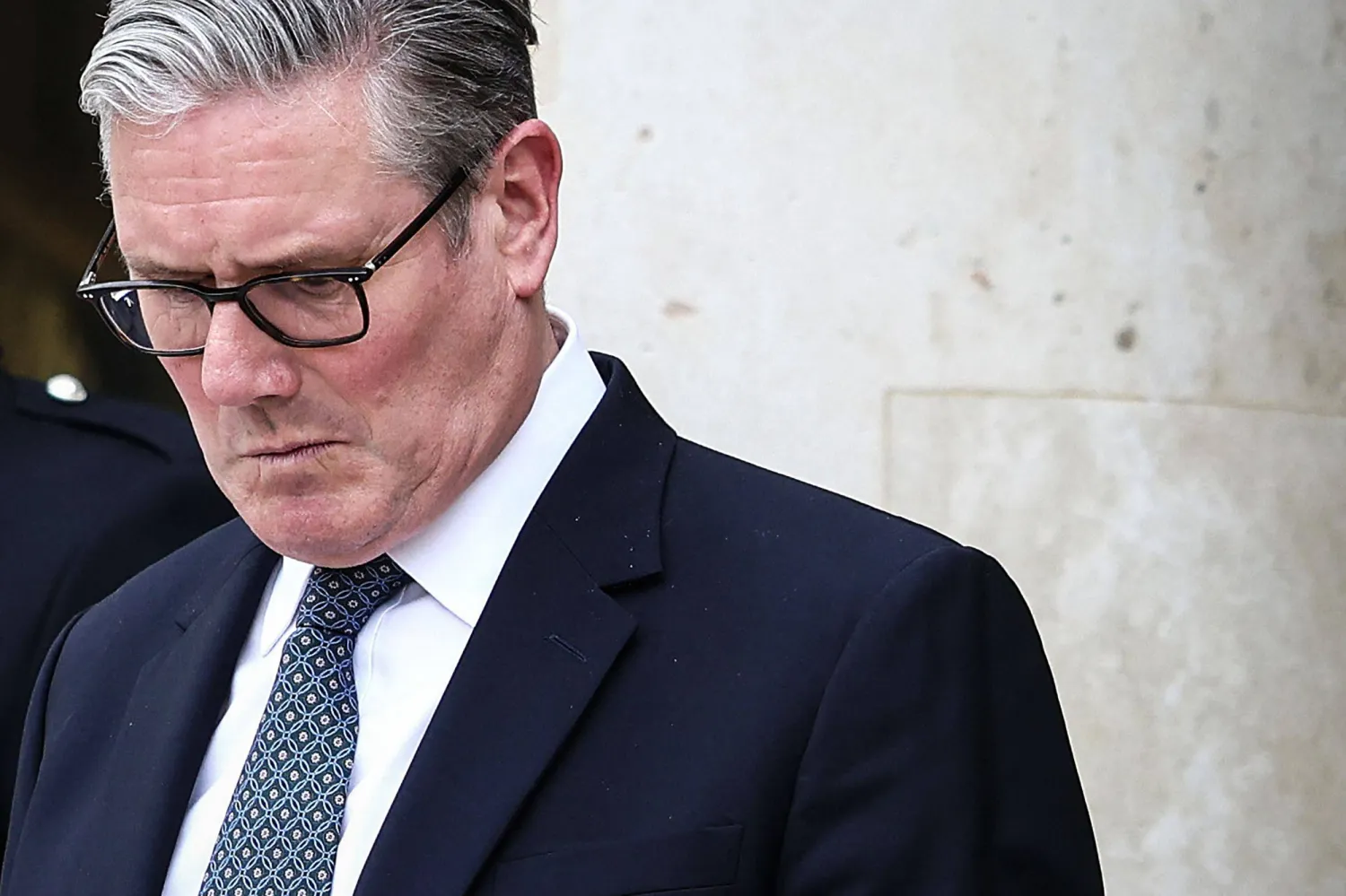
Britain's Prime Minister Keir Starmer reacts as he prepares to leave the Elysee Presidential Palace in Paris on April 17, 2026 following an international summit on efforts to reopen the Strait of Hormuz. (AFP)
TT

British PM Starmer Faces Angry Lawmakers Over Mandelson’s Appointment as Ambassador

Britain's Prime Minister Keir Starmer reacts as he prepares to leave the Elysee Presidential Palace in Paris on April 17, 2026 following an international summit on efforts to reopen the Strait of Hormuz. (AFP)

British Prime Minister Keir Starmer will try on Monday to get a grip on a crisis that has left power slipping from his grasp.

Starmer will face a tough barrage of questions in Parliament when he stands up to explain why Peter Mandelson, a scandal-tarnished politician and friend of Jeffrey Epstein, became Britain’s ambassador to Washington despite failing security checks — and seemingly without Starmer being told about the concerns.

The revelation has left furious opponents calling for Starmer to resign and uneasy allies wondering what else the nation’s leader didn’t know about.

Starmer repeatedly told lawmakers that “due process” was followed when Mandelson was appointed. He now says he’s “furious” that he wasn’t informed that an intensive vetting process had recommended Mandelson not be given security clearance. The Foreign Office, which oversees diplomatic appointments, cleared him anyway.

Starmer fired the department’s top civil servant, Olly Robbins, within hours of the revelation by The Guardian last week. But allies of Robbins say he would never have been able to share sensitive vetting information with the prime minister.

Robbins is expected to give his own version of events to the House of Commons Foreign Affairs Committee on Tuesday.

All the main opposition parties have called on Starmer to resign. Right-of-center Conservative Party leader Kemi Badenoch said in the Mail on Sunday that he had “misled Parliament over Mandelson, misled the country and is taking the public for fools.”

Ed Davey, leader of the opposition Liberal Democrats, said Starmer had “showed catastrophic misjudgment.”

Senior government colleagues have defended the prime minister. Deputy Prime Minister David Lammy said that if Starmer had known about the failed security vetting, “he would never, ever have appointed him ambassador.”

But lawmakers in Starmer’s center-left Labour Party, already anxious about the party’s dire poll ratings, are restive. Starmer has already defused one potential crisis in February, when some Labour lawmakers urged him to resign over the Mandelson appointment.

He could face a new challenge if, as expected, Labour takes a hammering in local and regional elections on May 7, which give voters a chance to pass a midterm verdict on the government.

Critics say the Mandelson appointment is more evidence of a failure of judgment by a prime minister who has made repeated missteps since he led Labour to a landslide election victory in July 2024. Starmer has struggled to deliver promised economic growth, repair tattered public services and ease the cost of living, and has been forced into repeated policy U-turns.

He picked Mandelson for one of Britain’s most important diplomatic jobs despite being warned by his staff that Mandelson’s friendship with Epstein, who died in prison in 2019, exposed the government to “reputational risk.”

Mandelson’s business links to Russia and China also set off alarm bells. But his expertise as a former European Union trade chief and contacts among global elites were considered assets in dealing with President Donald Trump’s administration.

He lasted less than nine months in the job. Starmer fired Mandelson in September 2025 after evidence emerged that he had lied about the extent of his links to Epstein.

A trove of Epstein-related documents released by the US Department of Justice in January included emails suggesting Mandelson had passed on sensitive, and potentially market-moving, government information to Epstein in 2009 after the global financial crisis.

British police launched a criminal probe and arrested Mandelson in February on suspicion of misconduct in public office. Mandelson has previously denied wrongdoing and hasn’t been charged. He does not face allegations of sexual misconduct.



Russia Arrests German Woman in Alleged Bomb Plot

People visit the observation deck at Vorobyovy gory (Sparrow Hills) with the main building of the Ministry of Foreign Affairs of Russia in the background during a spring day in Moscow, Russia, 17 April 2026. (EPA)
TT

Russia Arrests German Woman in Alleged Bomb Plot

People visit the observation deck at Vorobyovy gory (Sparrow Hills) with the main building of the Ministry of Foreign Affairs of Russia in the background during a spring day in Moscow, Russia, 17 April 2026. (EPA)

Russia said Monday it had arrested a German woman found with a homemade bomb in her backpack in what it alleged was a Ukrainian-hatched plot to blow up a security services facility in the south.

Russia has arrested dozens of people throughout the four-year war, mostly its own citizens, on allegations of working for Ukraine to carry out sabotage attacks.

There has been a string of high-profile arrests of Western citizens since Moscow ordered its troops into Ukraine -- typically on espionage charges that are widely seen as baseless, with those detained later swapped in exchange for Russians jailed abroad.

Detentions of Western citizens for carrying out or preparing actual attacks are much rarer.

The FSB security agency said the woman, born in 1969, had been dragged into the alleged plot by a citizen from a Central Asian country, who was working on orders from Ukraine.

She was detained and found with an improvised explosive device in her bag in the Caucasus city of Pyatigorsk, the FSB said.

The FSB said it had "prevented a terrorist attack planned by the Kyiv regime against a law enforcement facility in the Stavropol region, involving a German citizen born in 1969," the agency said in a statement.

The FSB said the device -- which contained an explosive charge equivalent to 1.5 kilograms (three pounds) of TNT -- was supposed to be detonated remotely, killing the German woman.

The blast was prevented by electronic jamming, the FSB added.

- 'Radical ideology' -

A man from an unidentified Central Asian state, born in 1997 and "a supporter of radical ideology", was found and arrested near the targeted site, it added.

The pair face life in prison on terrorist charges.

There was no immediate reaction to the allegations in Kyiv or Berlin.

Video footage of the purported arrest published on state media showed armed Russian security agents approach the woman, who was lying face down dressed in all black in a car park.

Another video showed masked plainclothes agents pulling a man into a station, followed by a controlled explosion of the backpack.

Russia has previously accused Ukraine of working with fundamentalists to carry out terror attacks inside Russia, without providing evidence.

Officials initially alleged that the perpetrators of a 2024 massacre at a concert hall on the outskirts of Moscow that killed 150 people were ISIS members in coordination with Ukraine.

ISIS claimed responsibility for that attack, making no reference of any Ukrainian involvement, for which no evidence was presented by Moscow and which Kyiv denies.


Iran Foreign Ministry Says US Not Serious About Pursuing Diplomacy

An Iranian woman walks next to a wall painting of Iran’s national flag on a street in Tehran, Iran, 20 April 2026. (EPA)
TT

Iran Foreign Ministry Says US Not Serious About Pursuing Diplomacy

An Iranian woman walks next to a wall painting of Iran’s national flag on a street in Tehran, Iran, 20 April 2026. (EPA)

Iran's foreign ministry said Monday that the United States was not serious about pursuing diplomacy, citing what it called "violations" of their two-week ceasefire.

"While claiming diplomacy and readiness for negotiations, the US is carrying out behaviors that do not in any way indicate seriousness in pursuing a diplomatic process," said ministry spokesman Esmaeil Baqaei in a weekly press briefing.

He said a US attack on an Iranian cargo ship early Monday, the US naval blockade on Iranian ports, and delays in implementing a ceasefire in Lebanon were all "clear violations of the ceasefire".

Iran has been at war with Israel and the United States since February 28 when strikes killed supreme leader Ali Khamenei, triggering a conflict that has engulfed the region.

Tehran and Washington have since held a round of negotiations which failed to culminate in a deal to end the war. It took place against the backdrop of a fragile two-week ceasefire which began on April 8.

US President Donald Trump said Sunday he had ordered US negotiators to travel to Pakistan on Monday to hold another round of talks, but Iran has yet to confirm its attendance.

"As of now, while I am at your service, we have no plans for the next round of negotiation, and no decision has been made in this regard," said Baqaei.

Key sticking points include Iran's stockpile of highly enriched uranium and the status of the strategic Strait of Hormuz, which has been largely closed since the outbreak of the war.

"Regarding the issue of transferring enriched uranium, neither during this period of negotiations nor before has transferring it to the United States been discussed," Baqaei said.

"It was never raised as an option for us," he added.


Tsunami Warning as 7.4-Magnitude Quake Hits Northern Japan

A television screen shows a news report on Japan Meteorological Agency's tsunami warning, saying it expected tsunami waves of up to 3 meters (9.84 feet) to reach large coastal areas in northern Japan after an earthquake with a preliminary magnitude of 7.4 struck off the northeastern coast of Japan, in Tokyo, Japan April 20, 2026.(Reuters)
TT

Tsunami Warning as 7.4-Magnitude Quake Hits Northern Japan

A television screen shows a news report on Japan Meteorological Agency's tsunami warning, saying it expected tsunami waves of up to 3 meters (9.84 feet) to reach large coastal areas in northern Japan after an earthquake with a preliminary magnitude of 7.4 struck off the northeastern coast of Japan, in Tokyo, Japan April 20, 2026.(Reuters)

A 7.4-magnitude earthquake struck northern Japan Monday, Japan's Meteorological Agency (JMA) said, issuing a tsunami warning for waves up to three meters (10 feet).

The quake, which hit at 4:53 pm (0753 GMT) in Pacific waters off northern Iwate prefecture, was strong enough to shake large buildings as far as Tokyo, hundreds of kilometers away.

Around 40 minutes later, an 80-centimeter (31-inch) tsunami wave hit a port in Kuji in Iwate, according to the JMA.

"Evacuate immediately from coastal regions and riverside areas to a safer place such as high ground or an evacuation building," it said, warning that damage due to tsunami waves was expected.

"Tsunami waves are expected to hit repeatedly. Do not leave safe ground until the warning is lifted," it said.

Footage from national broadcaster NHK did not show any immediate visible damage around several ports in Iwate.

A JMA official warned in a televised press briefing that more quakes could strike the area.

The prime minister's office said it had set up a crisis management team.

"For those of you who live in areas for which the warnings have been issued, please evacuate to higher, safer places such as higher ground," Prime Minister Sanae Takaichi told reporters, adding that the government was trying to confirm whether there were any casualties or property damage.

Japan is one of the world's most seismically active countries, sitting on top of four major tectonic plates along the western edge of the Pacific "Ring of Fire".

The archipelago, home to around 125 million people, typically experiences around 1,500 jolts every year and accounts for about 18 percent of the world's earthquakes.

The vast majority are mild, although the damage they cause varies according to their location and the depth below the Earth's surface at which they strike.

Japan is haunted by the memory of a massive 9.0-magnitude undersea quake in 2011, which triggered a tsunami that killed around 18,500 people and caused a devastating meltdown at the Fukushima nuclear plant.

In 2024, the JMA issued its first special advisory of a possible "megaquake" along the Nankai Trough.

This 800-kilometer undersea trench is where the Philippine Sea oceanic tectonic plate is "subducting" -- or slowly slipping -- underneath the continental plate that Japan sits atop.

The government has said a quake in the Nankai Trough and subsequent tsunami could kill as many as 298,000 people and cause up to $2 trillion in damage.

The JMA lifted the 2024 advisory after a week but it led to panic-buying of staples like rice and prompted holidaymakers to cancel hotel reservations.

It issued a week-long second "megaquake" advisory in December 2025 after a magnitude-7.5 tremor struck off the northern coast.

The December 8 quake triggered tsunami waves of up to 70 centimeters (28 inches) and injured more than 40 people, but no major damage was reported.