


EU to Gauge Member States’ Willingness to Punish Israel

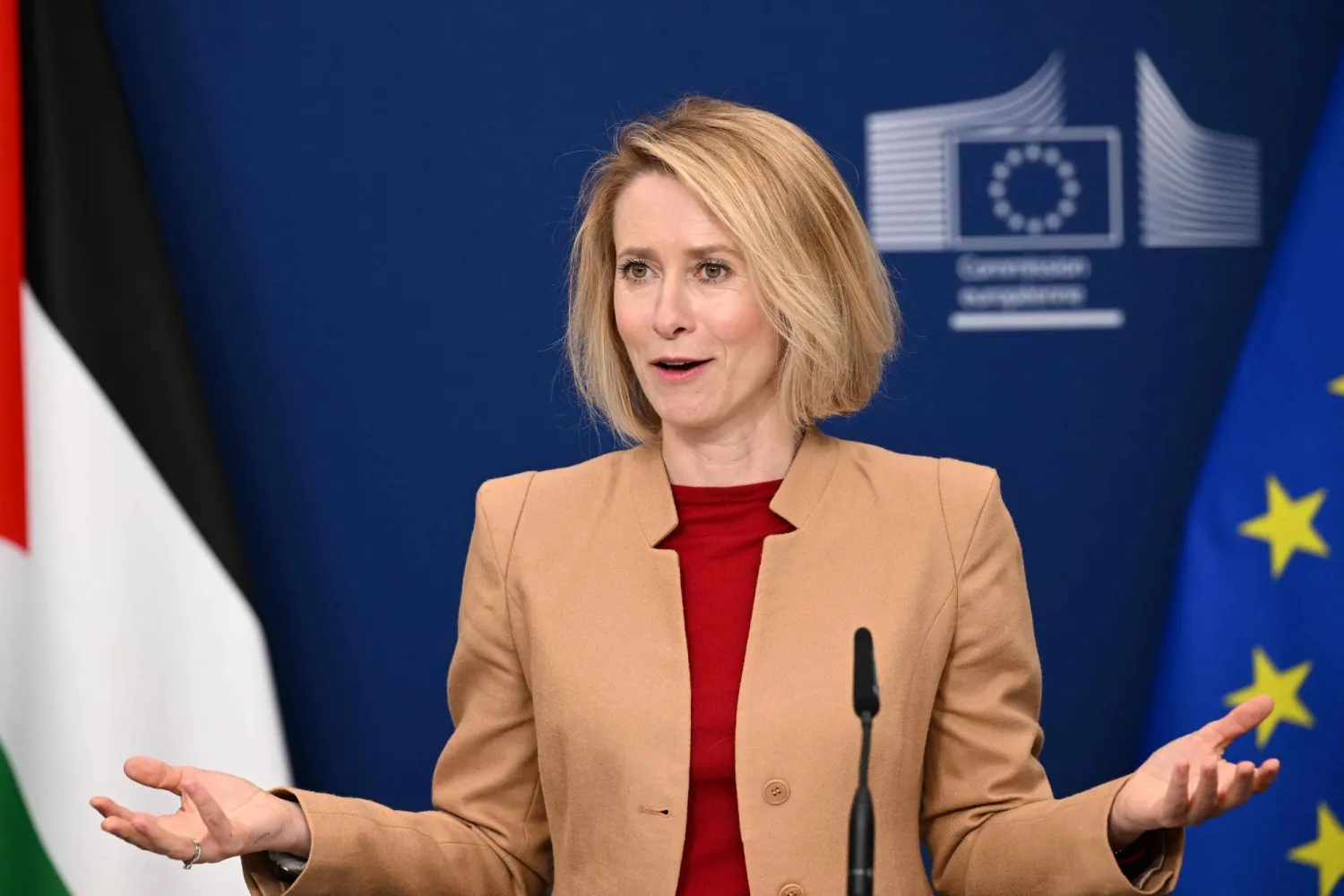
EU High Representative and Vice-President for Foreign Affairs and Security Policy Kaja Kallas speaks during a joint press statement with Norwegian Minister for Foreign Affairs and Palestinian Prime Minister before a Ad Hoc Liaison Committee (AHLC) Ministerial Meeting, in Brussels on April 20, 2026. (AFP)
TT

EU to Gauge Member States’ Willingness to Punish Israel

EU High Representative and Vice-President for Foreign Affairs and Security Policy Kaja Kallas speaks during a joint press statement with Norwegian Minister for Foreign Affairs and Palestinian Prime Minister before a Ad Hoc Liaison Committee (AHLC) Ministerial Meeting, in Brussels on April 20, 2026. (AFP)

The EU's top diplomat said Monday the bloc will gauge the willingness of member states to take measures against Israel, after Spain re-upped demands to suspend a cooperation deal.

Foreign ministers from the 27-nation bloc are expected to discuss the matter at a meeting in Luxembourg Tuesday after a call from Spain's Prime Minister Pedro Sanchez.

Attitudes towards Israel among key EU member states, hardened over its conduct in the war in Gaza, stiffened further after the Israeli invasion of Lebanon and a new law on the death penalty for Palestinians in the occupied West Bank.

Facing alarm at the civilian toll exacted in the Gaza war, the EU last year already put on the table a raft of potential measures to punish Israel including cutting trade ties or sanctioning government ministers.

But so far none of the steps laid out by Brussels has garnered enough support from member states to be put into action.

Suspending the entirety of the EU's cooperation agreement -- as Spain is pushing for -- requires unanimity among the bloc's 27 countries and would almost certainly be blocked by allies of Israel.

More feasible could be suspending the part of the deal facilitating closer trade ties, a move that only requires support from a weighted majority of EU countries.

That would require a shift in position from EU heavyweights such as Germany or Italy. Rome has already signalled a tougher line on Israel by suspending a defence agreement.

"We already have the measures on the table; some of them that require a qualified (weighted) majority," EU foreign policy Kaja Kallas said.

"First, I think it should be assessed whether it's possible to move with those, if the member states have the wish to do so, to put pressure on Israel."

The recent ouster of staunch Israel backer Viktor Orban in elections in Hungary has also added to the likelihood of movement on measures.

A separate proposal for sanctions on "extremist" Israeli settlers in the West Bank had been vetoed by Budapest for months.

Diplomats and EU officials say they hope to get the greenlight for those measures soon but that it could take until Hungary's new government comes to power in May.



Erdogan Vows New Measures After Deadly Türkiye School Shootings

Turkish President Recep Tayyip Erdogan speaks during the opening ceremony of Antalya Diplomacy Forum in Antalya, Türkiye, April 17, 2026. (Reuters)
TT

Erdogan Vows New Measures After Deadly Türkiye School Shootings

Turkish President Recep Tayyip Erdogan speaks during the opening ceremony of Antalya Diplomacy Forum in Antalya, Türkiye, April 17, 2026. (Reuters)

President Recep Tayyip Erdogan said on Monday that his government would introduce sweeping measures, including restrictions on gun ownership, after two school shootings last week that shocked Türkiye.

Eight students aged 10 and 11 and a teacher were killed Wednesday when a 14-year-old student opened fire at a school in the southern province of Kahramanmaras.

Authorities said the attacker, who died at the scene, had brought five firearms and was the son of a former police inspector, who has since been arrested.

A separate attack on Tuesday in southeastern Sanliurfa province involved a former student who opened fire at his old high school before taking his own life when confronted by police.

"We will implement additional legal regulations regarding the limitation of gun ownership," Erdogan said after a weekly cabinet meeting.

Penalties would be increased for firearm owners who fail to properly secure their weapons, particularly in cases where children gain access to them, he added.

Mass shootings are rare in Türkiye, and the incidents have sparked public concern.

"When we look at similar attacks around the world, especially those carried out in the United States, we see that one of the perpetrators' aims is to terrorize society," Erdogan said.

"Such attacks target not only the shedding of innocent blood but also, like terrorist organizations, provoking public outrage and creating anxiety, unease, fear, and distress within society".

School safety would be among the government's top priorities, he added.

He also said the authorities would expand surveillance online, including by making use of artificial intelligence.

The relevant institutions would address what he described as "violence and moral decay" on television screens, he added, calling for greater emphasis on productions that promote family values.

"Portraying perpetrators in productions themed around crime and violence as strong, influential, exempt from punishment, or even respectable undermines our youth's connection to reality," he said.


Russia Urges US-Iran to Keep Ceasefire, Continue Talks

Russian Foreign Minister Sergei Lavrov speaks during a session at Antalya Diplomacy Forum in Antalya, Türkiye, April 18, 2026. (Reuters)
TT

Russia Urges US-Iran to Keep Ceasefire, Continue Talks

Russian Foreign Minister Sergei Lavrov speaks during a session at Antalya Diplomacy Forum in Antalya, Türkiye, April 18, 2026. (Reuters)

Moscow on Monday called for the US-Iran ceasefire to be maintained and for diplomatic efforts to continue, after Foreign Minister Sergei Lavrov spoke with his Iranian counterpart, a close Russian ally.

"The Russian side again emphasized the need to preserve the truce, which must be observed within the parameters initially agreed upon and announced by the Pakistani mediators," the foreign ministry said after the call between Lavrov and Iran's Abbas Araghchi.

Russia is one of Iran's few allies and has repeatedly condemned the United States for launching its bombing campaign at the end of February that triggered the war.

The Kremlin has profited from high oil prices triggered by the conflict but repeatedly called for Washington to back down and for a long-term diplomatic solution to be found.

"The importance was noted of continuing diplomatic efforts aimed at preventing the situation from spinning out of control and averting a relapse into armed confrontation," the ministry added.

Russia criticized what it called Washington's "unlawful naval blockade of the Strait of Hormuz and seizure of an Iranian container ship".

Moscow also said Iran had pledged to do everything it could to ensure the unhindered passage of any Russian vessels and cargo through the Strait.


France's Macron Urges Iran, US to De-Escalate Amid Hormuz Tensions

 French President Emmanuel Macron gestures as he attends a joint press conference with Polish Prime Minister Donald Tusk in Gdansk, Poland, April 20, 2026. (Reuters)
French President Emmanuel Macron gestures as he attends a joint press conference with Polish Prime Minister Donald Tusk in Gdansk, Poland, April 20, 2026. (Reuters)
TT

France's Macron Urges Iran, US to De-Escalate Amid Hormuz Tensions

 French President Emmanuel Macron gestures as he attends a joint press conference with Polish Prime Minister Donald Tusk in Gdansk, Poland, April 20, 2026. (Reuters)
French President Emmanuel Macron gestures as he attends a joint press conference with Polish Prime Minister Donald Tusk in Gdansk, Poland, April 20, 2026. (Reuters)

French President Emmanuel Macron on Monday called for the United States and Iran to de-escalate amid increased tensions over the weekend over the Strait of Hormuz.

"Our position remains the same. We need ‌to settle ‌things through diplomacy. ‌Everyone must ⁠calm down," Macron ⁠said during a joint press conference with Polish Prime Minister Donald Tusk.

The United States has maintained its blockade ⁠of Iranian ports, while Iran ‌lifted ‌and then reimposed its ‌own blockade on the Strait ‌of Hormuz, through which roughly 20% of the world's oil and liquefied gas supply ‌usually passes.

Macron also said that France was ⁠not ⁠specifically targeted in the strait after Iran fired shots on ships on Saturday, including a container ship belonging to the CMA CGM.

CMA CGM had described them as "warning shots" and said at the time the crew was safe.