
Trump Says Iran Violated Truce as Doubt Surrounds Peace Talks

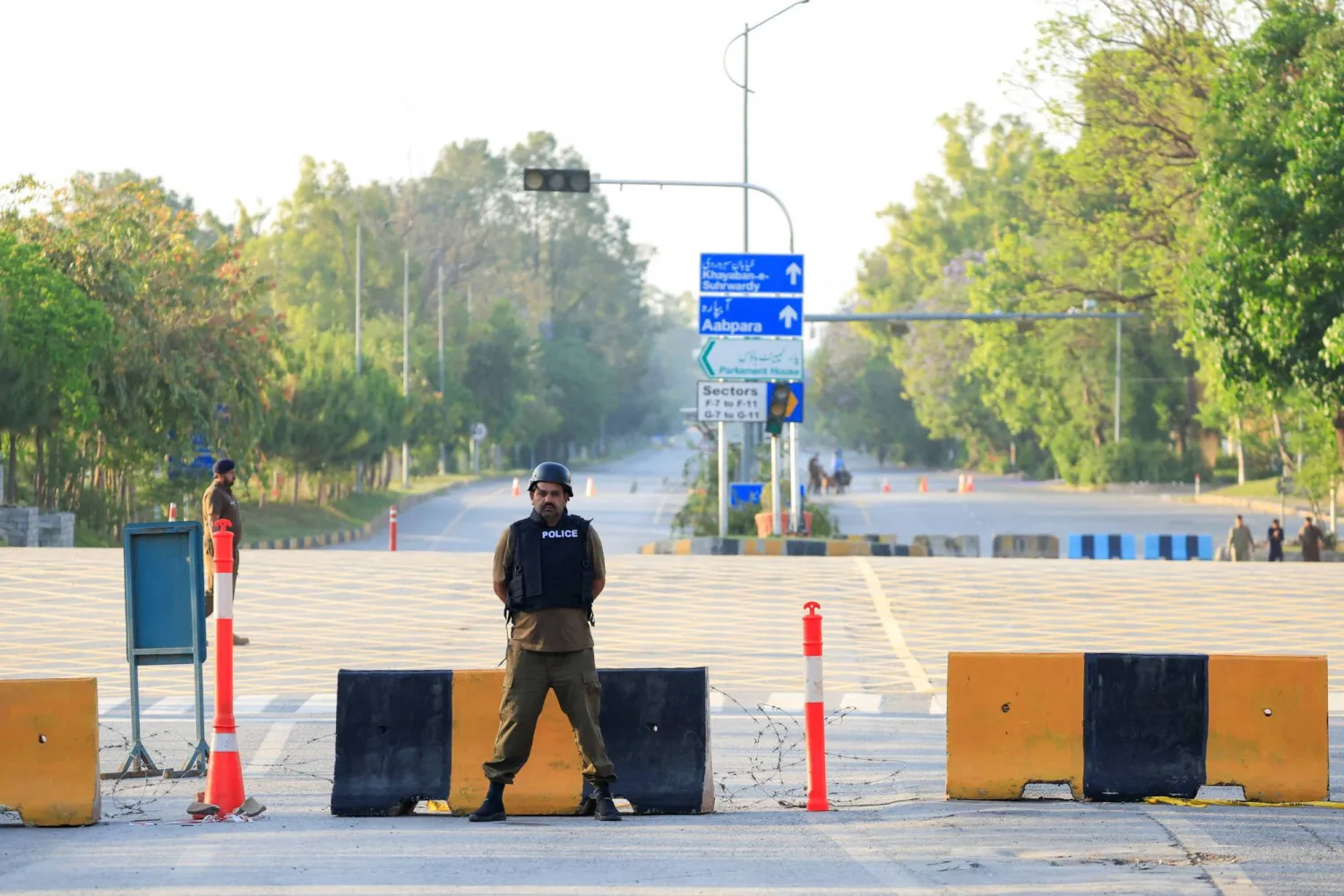
 Police officers stand guard on a road leading to the Serena Hotel, as Pakistan prepares to host the US and Iran for the second phase of peace talks in Islamabad, Pakistan, April 21, 2026. (Reuters)
Police officers stand guard on a road leading to the Serena Hotel, as Pakistan prepares to host the US and Iran for the second phase of peace talks in Islamabad, Pakistan, April 21, 2026. (Reuters)
TT

Trump Says Iran Violated Truce as Doubt Surrounds Peace Talks

 Police officers stand guard on a road leading to the Serena Hotel, as Pakistan prepares to host the US and Iran for the second phase of peace talks in Islamabad, Pakistan, April 21, 2026. (Reuters)
Police officers stand guard on a road leading to the Serena Hotel, as Pakistan prepares to host the US and Iran for the second phase of peace talks in Islamabad, Pakistan, April 21, 2026. (Reuters)

US President Donald Trump on Tuesday accused Iran of having repeatedly violated a temporary truce due to expire soon, with new peace talks mired in doubt after Tehran said it had not yet sent a delegation. 

The US leader also touted Washington's strong negotiating position, even as uncertainty grew over a push to stop open conflict from resuming, with the two-week ceasefire set to end by Wednesday. 

"Iran has Violated the Cease Fire numerous times!" Trump said in a post on his Truth Social platform, without elaborating. 

A US delegation led by Vice President JD Vance was expected to leave soon for Islamabad, which earlier this month hosted a first round of talks that ended without a deal. 

Since those marathon talks Trump has announced a blockade of Iranian ports, while Tehran has closed the Strait of Hormuz again, refusing to send officials for a new round of negotiations that were initially expected on Monday. 

"So far, no delegation from Iran has departed for Islamabad, Pakistan," Iranian state TV said on Tuesday, dismissing reports suggesting otherwise. 

Both sides have accused the other of ceasefire breaches, with the US leader saying Iran fired on ships in the crucial trade route it has choked, and Tehran calling the US blockade and its seizure of a ship violations as well. 

Despite Tehran so far shunning new talks, Trump expressed confidence he could secure an agreement that favored Washington. 

"We're going to end up with a great deal. I think they have no choice... We're in a very, very strong negotiating position," Trump told broadcaster CNBC on Tuesday. 

"Iran can get themselves on a very good footing if they make a deal." 

Pakistan, meanwhile, continued its down-to-the wire mediation efforts to get both sides to its capital. 

Foreign Minister Ishaq Dar urged the warring parties "to consider extending the ceasefire and to give dialogue and diplomacy a chance," according to a Pakistani foreign ministry statement. 

Iranian officials, however, say they feel the Trump administration has not acted in good faith in negotiations and has refused to back down from what they called excessive demands. 

Its parliament speaker said the country would not accept talks "under the shadow of threats" from the US leader, and would "show new cards on the battlefield" if the conflict resumed. 

- 'Bombs start' - 

Residents in the Iranian capital who spoke to Paris-based AFP journalists say life has only got worse despite the truce, squeezed by the government and the war's impact. 

"This cursed ceasefire has broken us. There is no light at the end of the tunnel," said Saghar, 39. 

"The situation is terrible. I don't know anyone around me who is doing well." 

The truce theoretically ends overnight Tuesday, though in comments to Bloomberg, Trump said the end was a day later, on Wednesday evening Washington time, and that it was "highly unlikely" he would extend it. 

Trump told PBS News that Iran was "supposed to be there" at the talks in Pakistan. 

He warned that if the ceasefire expired "then lots of bombs start going off." 

He also said the US blockade of Iran's ports would not end until there was a deal. 

The US Defense Department said Tuesday that its forces intercepted and boarded a "stateless sanctioned" vessel as part of Washington's efforts against networks that provide support to Iran. 

AFP has identified the vessel as one affiliated with Iranian activity. 

Experts said Iran's noncommittal public stance was part of a bid to put pressure on Washington. 

"The current standoff between the United States and Iran is no longer a clash of capabilities but rather a struggle of political endurance and bargaining leverage," Daniel Byman of the Center for Strategic and International Studies wrote in a commentary. 

Despite the ongoing uncertainty, oil prices fell on Tuesday while stocks rose on lingering hopes for a deal to end the conflict. 

- Tight security - 

In Islamabad, heavily armed police and soldiers on Tuesday secured the city's government quarter, which was virtually shut down. 

That included the Serena hotel, which hosted the last round of negotiations and where guests had been asked to vacate the premises in recent days. 

The rest of the city also saw a beefed-up police presence, with offices, businesses and schools braced for shutdown orders. 

In another arena in the war, Israel and Lebanon, which have no diplomatic relations, will hold fresh talks in Washington on Thursday, a State Department official told AFP. 

A separate 10-day ceasefire was agreed between the two nations on Friday and included Hezbollah, whose rocket fire in support of Iran drew Lebanon into the wider Middle East conflict. 

Sporadic violence has continued and Israel's military warned civilians against returning to dozens of villages in southern Lebanon, claiming Hezbollah's activities were violating the truce. 

Israeli attacks on Lebanon have killed at least 2,387 people since the start of the war, a Lebanese government body said in its latest toll. 


NATO Intercepts Russian Military Aircraft Flying Over the Baltic Sea

 In this photo, provided by the French Army on Monday, April 20, 2026, a Russian supersonic Tu-22M3 strategic bomber, right, and an escorting Su-35 Russian fighter jet fly together over the Baltic Sea. (Etat-Major des Armees via AP)
In this photo, provided by the French Army on Monday, April 20, 2026, a Russian supersonic Tu-22M3 strategic bomber, right, and an escorting Su-35 Russian fighter jet fly together over the Baltic Sea. (Etat-Major des Armees via AP)
TT

NATO Intercepts Russian Military Aircraft Flying Over the Baltic Sea

 In this photo, provided by the French Army on Monday, April 20, 2026, a Russian supersonic Tu-22M3 strategic bomber, right, and an escorting Su-35 Russian fighter jet fly together over the Baltic Sea. (Etat-Major des Armees via AP)
In this photo, provided by the French Army on Monday, April 20, 2026, a Russian supersonic Tu-22M3 strategic bomber, right, and an escorting Su-35 Russian fighter jet fly together over the Baltic Sea. (Etat-Major des Armees via AP)

NATO intercepted Russian strategic bombers and fighter jets that flew over the Baltic Sea on Monday, a muscular display of air power on the alliance’s eastern flank away from the spotlight on the Middle East.

French Rafale fighters were deployed from a Lithuanian air base where they are stationed as part of a decades-long NATO air-policing effort. The fighters armed with air-to-air missiles joined jets from Sweden, Finland, Poland, Denmark and Romania. They all took to the skies to inspect and keep watch on the Russian flight, the French detachment said.

The Russian mission included two supersonic Tu-22M3s, as well as about 10 fighters — both SU-30s and SU-35s — that took turns escorting the larger strategic bombers, according to the statement.

The Russian Defense Ministry said the long-range bombers' flight was scheduled and occurred in airspace over the neutral waters of the Baltic Sea. The flight took more than four hours, the ministry said Monday on Telegram.

“At certain stages of the route, the long-range bombers were accompanied by fighters of foreign states,” the ministry said. “Crews of long-range aviation regularly conduct flights over the neutral waters of the Arctic, the North Atlantic, the Pacific Ocean, as well as the Baltic and Black Seas. All flights of Russian Aerospace Forces aircraft are carried out in strict compliance with international rules for the use of airspace.”

The ministry did not immediately respond to a request for comment on Tuesday. It often reports flights by its strategic bombers over the Baltic Sea, including in January — when NATO jets also flew up to meet them — and at least four times last year.

NATO’s Allied Air Command also did not immediately respond to a request for comment on Tuesday.

The military alliance routinely scrambles fighter aircraft to intercept Russian warplanes that approach or fly near NATO airspace. NATO says the Russian planes it intercepts often fail to use their transponders and don't communicate with air traffic controllers or file a flight plan. NATO jets are sent up to identify them.

Many of the Russian flights that NATO monitors with its Baltic air policing mission, in place since Lithuania, Latvia and Estonia joined the alliance in 2004, are to and from the Russian enclave of Kaliningrad. Even before the war in Ukraine, NATO was intercepting Russian planes around 300 times each year, mostly over waters around northern Europe.

A journalist from The Associated Press witnessed the French detachment's response on Monday from the sprawling Šiauliai Air Base in Lithuania. NATO uses the base for fighter patrols that police the skies on the alliance’s eastern flank.

Two French Rafale fighter jets’ two-man crews — a pilot and a navigator — were seen racing in two vans to the planes’ hangars from the headquarters building the French detachment uses during its four-month deployment on the air base.

The crews were already suited up because they’d been on standby, so they would be ready to take to the air within minutes if scrambled.

The two crews quickly took their places in their planes’ cockpits. They were then put on hold, with the planes’ jet engines ignited, until they got the order to take off. Then they taxied out of their hangars and roared off into the clear skies.

Monday's flight was the latest in Russia's maneuvers over the Baltic Sea.

Lithuania's defense ministry said NATO jets were scrambled four times from April 13-19 to intercept Russian aircraft that violated flight rules that included turning off flight transponders and flying without a flight plan.


Iran Arrests More Than 3,600 on Charges Related to War, Says NGO

People walk past a banner with a picture of the late Iranian Revolutionary Guard Corps (IRGC) commander Mohammad Pakpour, in Tehran Bazaar, amid a ceasefire between US and Iran, in Tehran, Iran, April 21, 2026. Majid Asgaripour/WANA (West Asia News Agency) via Reuters
TT

Iran Arrests More Than 3,600 on Charges Related to War, Says NGO

People walk past a banner with a picture of the late Iranian Revolutionary Guard Corps (IRGC) commander Mohammad Pakpour, in Tehran Bazaar, amid a ceasefire between US and Iran, in Tehran, Iran, April 21, 2026. Majid Asgaripour/WANA (West Asia News Agency) via Reuters

Iranian authorities have arrested more than 3,600 people on charges related to the US-Israeli war ranging from sharing videos with media outlets based overseas to possessing Starlink internet terminals, an NGO said on Tuesday.

Norway-based Iran Human Rights (IHR) said the figure, based on state media reports and its own research, represented a minimum given the current internet restrictions in the country, and that the actual number of arrests was "likely much higher".

It said at least 3,646 people had been arrested since the war broke out on February 28, with at least 767 of the cases reported after the start of a ceasefire on April 8.

"The charges levelled against the detainees predominantly include espionage, communicating with foreign intelligence services, transmitting images or coordinates of sensitive locations to foreign-based media, and attempting to establish operational cells or conduct armed activities," it said.

People have also been arrested for using and distributing Starlink satellite-based internet terminals to circumvent internet blackouts, and for alleged cooperation with pro-monarchist groups.

IHR said more than 100 civil society activists were among those arrested, including prize-winning rights lawyer Nasrin Sotoudeh, who was detained on April 2.

Sotoudeh's daughter Mehraveh Khandan wrote on Instagram on Saturday that her mother had telephoned for the first time since her arrest, saying she was being held by the intelligence ministry but was not allowed to disclose where.

Her fellow rights activist and 2023 Nobel Peace Prize winner Narges Mohammadi remains in prison after her arrest in December, which took place before the war and mass protests in January.

Mohammadi on Tuesday turned 54 behind the bars of her prison in the northern city of Zanjan, her foundation said, after warning last week her health was "critical" following a heart attack in March.


US Forces Board a Sanctioned Oil Tanker in the Indian Ocean, the Pentagon Says

 Tankers and bulk carriers anchored in the Strait of Hormuz, Saturday, April 18, 2026. (AP)
Tankers and bulk carriers anchored in the Strait of Hormuz, Saturday, April 18, 2026. (AP)
TT

US Forces Board a Sanctioned Oil Tanker in the Indian Ocean, the Pentagon Says

 Tankers and bulk carriers anchored in the Strait of Hormuz, Saturday, April 18, 2026. (AP)
Tankers and bulk carriers anchored in the Strait of Hormuz, Saturday, April 18, 2026. (AP)

US forces have boarded an oil tanker previously sanctioned for smuggling Iranian crude oil in Asia, the Pentagon said Tuesday, as it puts into place a global warning to track down vessels tied to Tehran.

US forces “conducted a right-of-visit maritime interdiction” and boarded the M/T Tifani “without incident,” the Pentagon said on social media.

The Tifani was captured in the Bay of Bengal — between India and Southeast Asia — and was carrying Iranian oil, according to a US defense official who spoke on condition of anonymity to discuss an ongoing military operation. The US military will decide in the next four days what to do with the vessel, such as tow it back to the US or turn it over to another country, the official said.

It's the latest move in the US war on Iran to stop any ship tied to Tehran or those suspected of carrying supplies that could help its government, from weapons and oil to metals and electronics. The announcement comes ahead of the expiration of an already tenuous ceasefire between the US and Iran, and as Pakistan attempts to broker talks between Washington and Tehran.

It is the second vessel linked to Iran that has been interdicted by the US military. The US Navy attacked and seized an Iranian-flagged cargo ship Sunday that it said had tried to evade its blockade of Iranian ports, with President Donald Trump saying an American destroyer blew a hole in the ship’s engine room.

Targeting Iran-linked ships in international waters The Pentagon on social media described the Tifani as “stateless” despite it being a Botswana-flagged vessel.

“As we have made clear, we will pursue global maritime enforcement efforts to disrupt illicit networks and interdict sanctioned vessels providing material support to Iran — anywhere they operate,” the Pentagon announcement said, echoing previous statements from Trump administration officials. “International waters are not a refuge for sanctioned vessels.”

Gen. Dan Caine, chairman of the Joint Chiefs of Staff, said last week that the enforcement actions would extend beyond Iranian waters and the area under control of US Central Command.

US forces in other areas of responsibility, he told reporters at the Pentagon, “will actively pursue any Iranian-flagged vessel or any vessel attempting to provide material support to Iran.” He specifically pointed to operations in the Pacific and said the US would target vessels that left before the blockade began outside the Strait of Hormuz, a crucial waterway for energy and other shipments.

The military also detailed an expansive list of goods that it considers contraband, declaring that it will board, search and seize them from merchant vessels “regardless of location.” A notice published Thursday says any “goods that are destined for an enemy and that may be susceptible to use in armed conflict” are “subject to capture at any place beyond neutral territory.”

Blockades can be lawful in wartime, expert says

The US military’s actions against Iranian-linked vessels, namely the attack over the weekend on the cargo ship named the Touska, have raised questions about the two-week ceasefire.

The US and Iran are operating in “an awkward space where the law doesn’t give you a clean yes-or-no answer” on whether the ceasefire was violated, said Jason Chuah, a law professor at the City University of London and the Maritime Institute of Malaysia.

“The United States seems to take the line that the conflict never fully switched off — that is there is still a state of armed conflict,” Chuah said. “By saying that, it can keep doing things like enforcing a blockade and even using limited force at sea.”

But Iran is treating the ceasefire as a pause on all hostile acts, Chuah said. Iran’s joint military command has called the armed boarding an act of piracy and a violation of the ceasefire.

The US earlier had instituted a blockade against sanctioned oil tankers linked to Venezuela but had never fired on those vessels.

Blockades and even limited attacks on vessels can be lawful in wartime, with merchant vessels becoming legitimate targets if they contribute to military actions, carry contraband or are incorporated into enemy logistics, Chuah said.

It's harder to prove that a ship such as the Touska is realistically contributing to military action against the US, Chuah said.

“The whole dispute really turns on a deceptively simple question: Did the ceasefire actually suspend the right to use force?” Chuah said. “If it did, then firing on vessels or seizing them is very hard to square with the United Nations Charter.”

Mark Cancian, a retired Marine colonel and a senior defense adviser with the Center for Strategic and International Studies, said a violation is up for interpretation because there were no defined terms.

“Trump announced it. The Iranians agreed. But there’s no formal agreement,” Cancian said. “So whether it broke the ceasefire or not depends on your perspective. ... Nothing was written down.”

Michael O’Hanlon, a defense and foreign policy analyst at the Brookings Institution, said the US did not violate the ceasefire because it was limited to bombing Iran, not the blockade.

“We agreed to stop dropping bombs on them, and that’s the basic thing they wanted,” O’Hanlon said, adding that the US still had to enforce the blockade “if you’re going to make it mean anything.”