Germany, Italy Reject Suspending EU-Israel Cooperation Deal

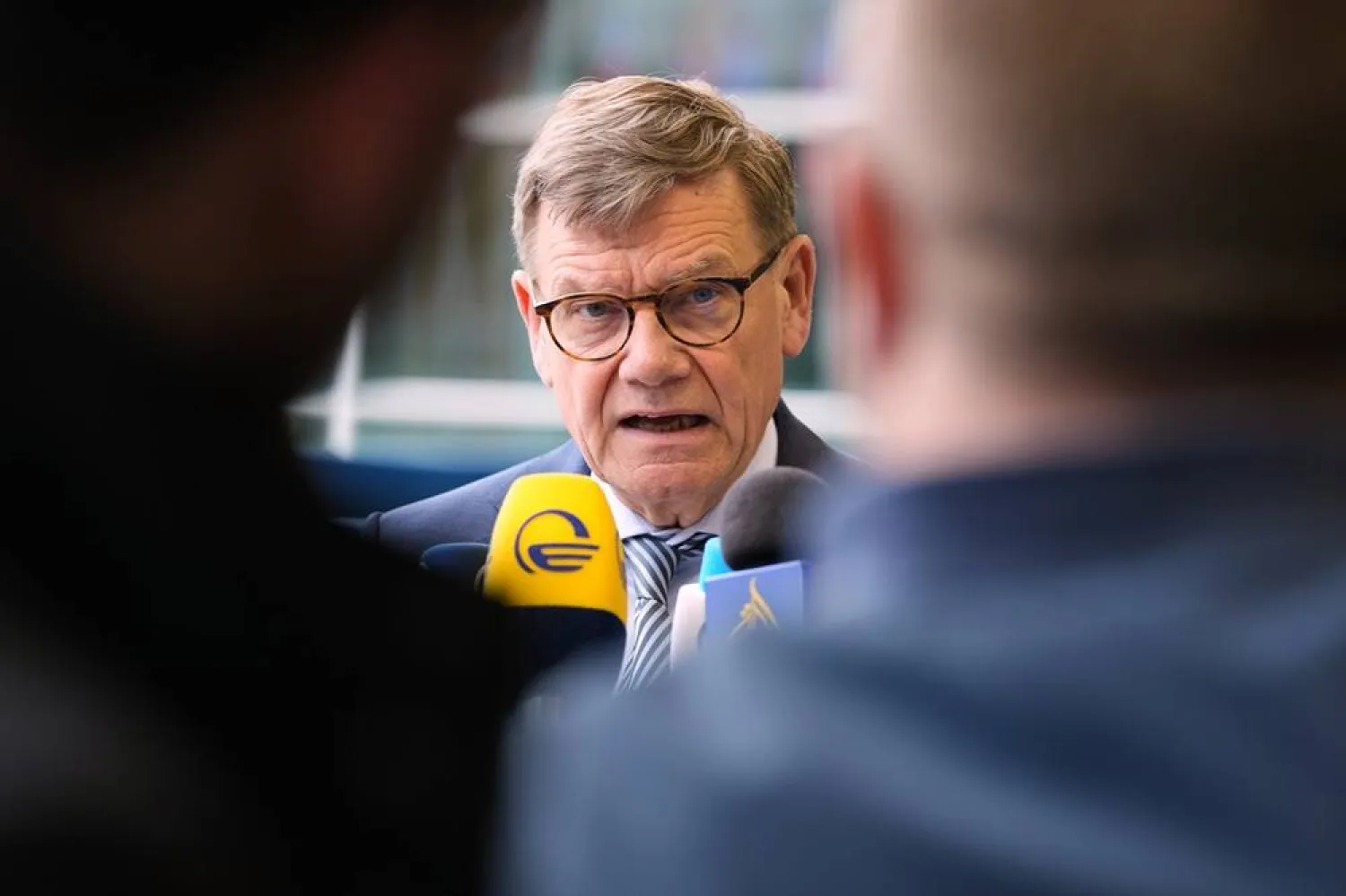
 Germany's Foreign Minister Johann Wadephul speaks with the media as he arrives for a meeting of EU foreign ministers at the European Council building in Luxembourg, Tuesday, April 21, 2026. (AP)
Germany's Foreign Minister Johann Wadephul speaks with the media as he arrives for a meeting of EU foreign ministers at the European Council building in Luxembourg, Tuesday, April 21, 2026. (AP)
TT

Germany, Italy Reject Suspending EU-Israel Cooperation Deal

 Germany's Foreign Minister Johann Wadephul speaks with the media as he arrives for a meeting of EU foreign ministers at the European Council building in Luxembourg, Tuesday, April 21, 2026. (AP)
Germany's Foreign Minister Johann Wadephul speaks with the media as he arrives for a meeting of EU foreign ministers at the European Council building in Luxembourg, Tuesday, April 21, 2026. (AP)

Germany and Italy on Tuesday rebuffed calls to suspend an EU cooperation deal with Israel, despite rising anger over the war in Lebanon and the situation in the West Bank. 

Spain and Ireland had put the issue of halting the June 2000 agreement back on the table at a meeting of EU foreign ministers in Luxembourg. 

German Foreign Minister Johann Wadephul called the proposal "inappropriate". 

"We have to talk with Israel about the critical issues," he said at the start of the meeting, adding: "That has to be done in a critical, constructive dialogue with Israel." 

Italian counterpart Antonio Tajani pushed back as well, saying that "no decision will be taken today". 

Attitudes towards Israel among EU member states, already hardened over its conduct in the war in Gaza, have stiffened further after the Israeli invasion of Lebanon and a new law on the death penalty for Palestinians in the occupied West Bank. 

"We need to act. We need to make sure that our fundamental values are protected," Irish Foreign Minister Helen McEntee said. 

- Reticence - 

Facing alarm at the civilian toll exacted in the Gaza war, the EU last year already put on the table a raft of potential measures to punish Israel, including cutting trade ties or sanctioning government ministers. 

But so far none of the steps laid out by Brussels has garnered enough support from member states to be put into action. 

Suspending the entirety of the EU's cooperation agreement requires unanimity among the bloc's 27 countries and would almost certainly be blocked by allies of Israel. 

More feasible could be suspending the part of the deal facilitating closer trade ties, a move that only requires support from a weighted majority of EU countries. 

But that would require a shift in position from EU heavyweights Germany or Italy. 

Rome had appeared to signal it could be open for a tougher line on Israel after it suspended a defense agreement. 

But EU officials and diplomats said it seemed countries were reticent to move, especially after a ceasefire was agreed in Lebanon. 

Meanwhile, there were efforts to impose smaller measures instead. 

France and Sweden re-upped an earlier call from some other EU countries for the bloc to consider halting the import of goods from Israeli settlements in the occupied West Bank, which are considered illegal under international law. 

A separate proposal for sanctions on "extremist" Israeli settlers in the West Bank had been vetoed by Hungary for months. 

But the recent ouster of staunch Israel backer Viktor Orban in Hungarian elections has raised hopes among other EU countries that those could soon go into force. 


Report: Israel Sent Troops to Azerbaijan During Iran War

Azerbaijan’s capital, Baku (X)
TT

Report: Israel Sent Troops to Azerbaijan During Iran War

Azerbaijan’s capital, Baku (X)

Israel secretly deployed elite military and intelligence units to Azerbaijan during the war with Iran as part of a network of covert sites across the Middle East to facilitate operations against Iran, four sources familiar with the matter told CNN on Friday.

The forces operated out of several locations in southern Azerbaijan, two of the sources said, adjacent to Iran’s northern border and, at its closest point, only about 60 miles from the Iranian city of Tabriz, which Israel struck during the war.

Special commando units were also deployed to the location and carried out intelligence-gathering missions and drone operations, the other two sources said, giving Israel a valuable perch from which to see into northern Iran during the war.

The secret deployment to Azerbaijan, reported by CNN for the first time, was one of several military positions Israel maintained across the Middle East that gave its military unprecedented reach, highlighting the role Iran’s neighbors played in facilitating operations against Tehran and becoming entangled in the conflict.

Together, the deployments described by the sources placed Israeli forces along Iran’s southern, western, and northern periphery during the war, extending the military’s range by hundreds of miles, deep into Iranian territory.

The Azerbaijan operation consisted of several dozen troops, including members of Israel’s special operations forces, its elite heliborne combat and rescue force, and Mossad personnel, one of the sources said.

In return, a spokesperson for the Azerbaijani embassy in the United States said in a statement to CNN, “We firmly reject unfounded claims regarding the alleged use of Azerbaijan’s territory for operations against third countries.”

Israel has long viewed Azerbaijan as a strategic partner in its fight against Iran, and the preparations began weeks before the opening strikes of the war.

In mid-January, as Iran crushed wide-scale protests with the mass killing of demonstrators, Israel prepared a covert mission along the Azerbaijan-Iran border, two of the sources familiar with the plans told CNN.

Israel was planning to execute the operation under cover of what were to be the opening strikes of the war in mid-January. But US President Donald Trump called off the strikes at the last minute, saying that Iran had agreed to stop the killing of demonstrators. Israel proceeded on its own.

The Israeli Air Force used stealth jets and special forces as part of the operation to install the devices, as Israel’s political leadership believed negotiations between the US and Iran were doomed to fail.

The intelligence-gathering site became another means by which Israel could collect information on Iranian military movements and facilities, as well as potentially providing early warning of missile launches.

Joint Operations

One of the key operations launched from Azerbaijan, one of the sources said, was the killing on March 4 of Rahman Moghaddam, who led the Revolutionary Guard Corps’ (IRGC) intelligence division and who Israel said was responsible for planning an assassination attempt against Trump in 2024.

Israel and Azerbaijan maintain close ties around commercial and military interests. Baku provides Israel with a large share of its oil. In return, Israel sells Azerbaijan advanced weaponry.

“Israeli strategy in Azerbaijan remains deliberately low-profile, relying on arms transfers, intelligence cooperation, and long-term technological interdependence in the security sector,” wrote Gershon Kogan, a specialist on Iran at the Begin-Sadat Center for Strategic Studies, before the Iran war began.

The relationship also gives Azerbaijan access to a critical diplomatic resource, according to Joshua Kucera, a senior analyst for the Crisis Group, allowing Baku to utilize Israel’s lobby in Washington, DC.


Iran Ex-PM Hospitalized After Years Under House Arrest

 Pedestrians and vehicles cross an intersection around Tehran's historic Grand Bazaar, Iran, Monday, June 1, 2026. (AP)
Pedestrians and vehicles cross an intersection around Tehran's historic Grand Bazaar, Iran, Monday, June 1, 2026. (AP)
TT

Iran Ex-PM Hospitalized After Years Under House Arrest

 Pedestrians and vehicles cross an intersection around Tehran's historic Grand Bazaar, Iran, Monday, June 1, 2026. (AP)
Pedestrians and vehicles cross an intersection around Tehran's historic Grand Bazaar, Iran, Monday, June 1, 2026. (AP)

Iran's former prime minister Mir Hossein Mousavi, who was the focus of a 2009 mass protest movement and has spent the last 15 years under house arrest, has been hospitalized after his health deteriorated, an advisor said on Friday.

Mousavi, the last person to serve as Iran's premier before the post was abolished, had claimed to be the rightful victor of the disputed 2009 presidential elections.

Most recently, he urged Iran's clerical leadership to step down because of its deadly crackdown on protesters in January in which many thousands were killed.

Last week, "he suffered a health crisis and was transferred to a hospital," his advisor Ardeshir Amir Arjomand, who is based outside Iran, told BBC Persian.

"He is now hospitalized, although his condition has improved since today," he added.

Arjomand said Mousavi's condition had been affected by being moved to a new location when his previous residence in central Tehran was damaged in the US-Israeli strike on February 28 that killed supreme leader Ali Khamenei.

Mousavi, 84, and his wife Zahra Rahnavard, 80, also under house arrest since 2011, had been living on Pasteur Street close to Khamenei's offices.

"They remain in a state of uncertainty and displacement. They were previously under pressure, and now it has increased further," said Arjomand in the interview.

"It is unclear how many more times they must go through such crises before officials realize that they should be released," he added.

The Iranian news site Avash said on Thursday that Mousavi was suffering from a serious heart condition and his family were unhappy over the lack of attention from authorities. Unconfirmed reports on Friday said the health ministry had pledged to closely follow his condition.

Mousavi claimed to have won in 2009 against incumbent Mahmoud Ahmadinejad, arguing that the hardliner's victory was rigged and sparking vast protest rallies in his support known as the Green Movement.

Earlier this year, he said the crackdown on January's protests was a "black page in the history of our nation", a "great betrayal and a crime".

Mousavi was prime minister from 1981 to 1989 under the presidency of Khamenei, who became supreme leader after the death of revolutionary founder Khomeini.

Even in the 80s, Khamenei viewed Mousavi as a rival, with the then-premier regarded as a more moderate figure within the system.


Putin Rejects Zelenskyy’s Offer to Meet, Saying He Sees ‘No Point’ in It

 Russia's President Vladimir Putin attends a plenary session of the St. Petersburg International Economic Forum (SPIEF) in Saint Petersburg, Russia June 5, 2026. (Reuters)
Russia's President Vladimir Putin attends a plenary session of the St. Petersburg International Economic Forum (SPIEF) in Saint Petersburg, Russia June 5, 2026. (Reuters)
TT

Putin Rejects Zelenskyy’s Offer to Meet, Saying He Sees ‘No Point’ in It

 Russia's President Vladimir Putin attends a plenary session of the St. Petersburg International Economic Forum (SPIEF) in Saint Petersburg, Russia June 5, 2026. (Reuters)
Russia's President Vladimir Putin attends a plenary session of the St. Petersburg International Economic Forum (SPIEF) in Saint Petersburg, Russia June 5, 2026. (Reuters)

Russian President Vladimir Putin on Friday rejected a proposal by Ukrainian President Volodymyr Zelenskyy for a face-to-face meeting on the 4-year-old conflict, saying he sees “no point” in it.

Thursday's letter, the first public message Zelenskyy has written directly to Putin since Russia sent troops into Ukraine in 2022, was a sweeping critique of the Russian leader’s 26 years in power as well as some taunts about his age.

Speaking at the St. Petersburg International Economic Forum, Putin described Zelenskyy’s open letter proposing the meeting as “boorish.”

“Is it a way to create conditions for personal meetings and talks, or create an environment which makes any personal meetings impossible?” Putin said at a question-and-answer session at his annual St. Petersburg International Economic Forum. “I think it’s the second.”

Putin added that a Russian businessman whom he didn’t identify traveled to Kyiv last month and met with Zelenskyy to hear his offer of a personal meeting.

However, Putin said that he sees “no point” in such a meeting, especially after a May 22 drone attack by Ukraine on a college dormitory in the Russian-controlled Luhansk region that Moscow said killed 21 and wounded scores of others.

In response to Zelenskyy’s barbs about his age and long stay in power, the 73-year-old Putin pointed at other global leaders who are older, adding that “the main thing isn’t age; the main thing is the ability to work.”

He also mocked Zelenskyy's rocky Oval Office meeting in 2025 and thanked US President Donald Trump for “educating” Zelenskyy “before the eyes of the whole world” and teaching him a proper dress code.

“There is still a lot to be done,” he said.

Zelenskyy acknowledged shifting US priorities, saying it would be wrong to simply wait for the Trump administration to return its attention to ending the fighting in Ukraine while it remains heavily focused on the Iran war.

In Washington, Trump said Thursday it “would be great” if Putin and Zelenskyy meet.

Putin has previously offered for Zelenskyy to come to Moscow for talks, an offer that the Ukrainian leader pointedly rejected. Putin said last month he doesn’t exclude a meeting in a third country, but only when there is a deal to sign.

On Thursday, Putin again rejected Zelenskyy’s push for an immediate ceasefire, arguing that Moscow wants a comprehensive settlement, not a temporary truce.

Putin said Russia is open for a compromise on Ukraine in line with understandings reached at his last year’s summit with Trump in Anchorage, Alaska, adding that Ukraine needs to accept them to make a deal to end the conflict.

“Naturally, the Ukrainian side would like us to suspend the advances made by Russian troops,” he said. “But it would be better to end the war by agreeing to the compromises that were discussed in Anchorage.”

Global turbulence

In a speech earlier Friday at the forum, Putin said developing countries have gained an increasingly important role in the global economy, while the share of output by Western countries has shrunk.

He accused the West of undermining the global economy and finances with unilateral sanctions. By freezing Russian assets abroad through sanctions, Western nations eroded trust in their own currencies, he said.

“The sanctions and blocking of Russia’s sovereign reserves have irreversibly impacted the standing of international currencies, the dollar and the euro,” he said. “Just like Russia, any other country could lose access to their legitimate assets in dollars or euros, as well as Western financial and payment systems.”

He alleged that high state debt had helped undermine global trust in Western institutions.

“The roots of the current global turbulence lie in the transition from a vertical, hierarchical model, which served the interests of a small number of states, to a more complex, distributed and multipolar one,” Putin said. “Russia views global changes not only as a threat but also as immense opportunities. And to capitalize on them, we aim to act swiftly and pragmatically.”

The Russian leader said the world needed a “modern, flexible and responsible financial architecture — free from risks, bans and barriers.”

Putin stresses Russia's macroeconomic stability

Putin played down Russia’s economic slowdown and sought to emphasize its macroeconomic stability. He noted that Russia’s state debt is a fraction of that in Western countries and its budget deficit is considerably smaller, compared with the West.

The forum comes at a time when Russia’s economic outlook has clouded amid the conflict in Ukraine. The government raised taxes and increased domestic borrowing to keep its budget deficit under control.

On Thursday, Putin told heads of international media on the forum's sidelines that it was an exaggeration to say Russia's economy was struggling. He noted that his government had taken deliberate steps to cool the economy to keep inflation under control.

Putin has used the St. Petersburg forum, likened to the World Economic Forum in Davos, Switzerland, to showcase his country’s economic advances and encourage foreign investment. While Western officials and business leaders have stayed away after Putin sent troops into Ukraine in 2022, Russia has sought guests from elsewhere to underline its declared goal of promoting a “multipolar world.”

Hours before the forum opened Wednesday, a Ukrainian drone attack set ablaze an oil terminal in St. Petersburg and also hit a nearby naval base.

Putin declared that Russia was “calmly and resolutely” moving to reach its goals in Ukraine. He acknowledged the damage from Ukrainian drone attacks deep inside Russia and vowed to build up defenses.

“They do inflict a certain damage,” he said. “For us, it means only one thing: we need to strengthen our security, strengthen air defenses, and we will do that.”