


Iran War Means More Orders for US Defense Giants

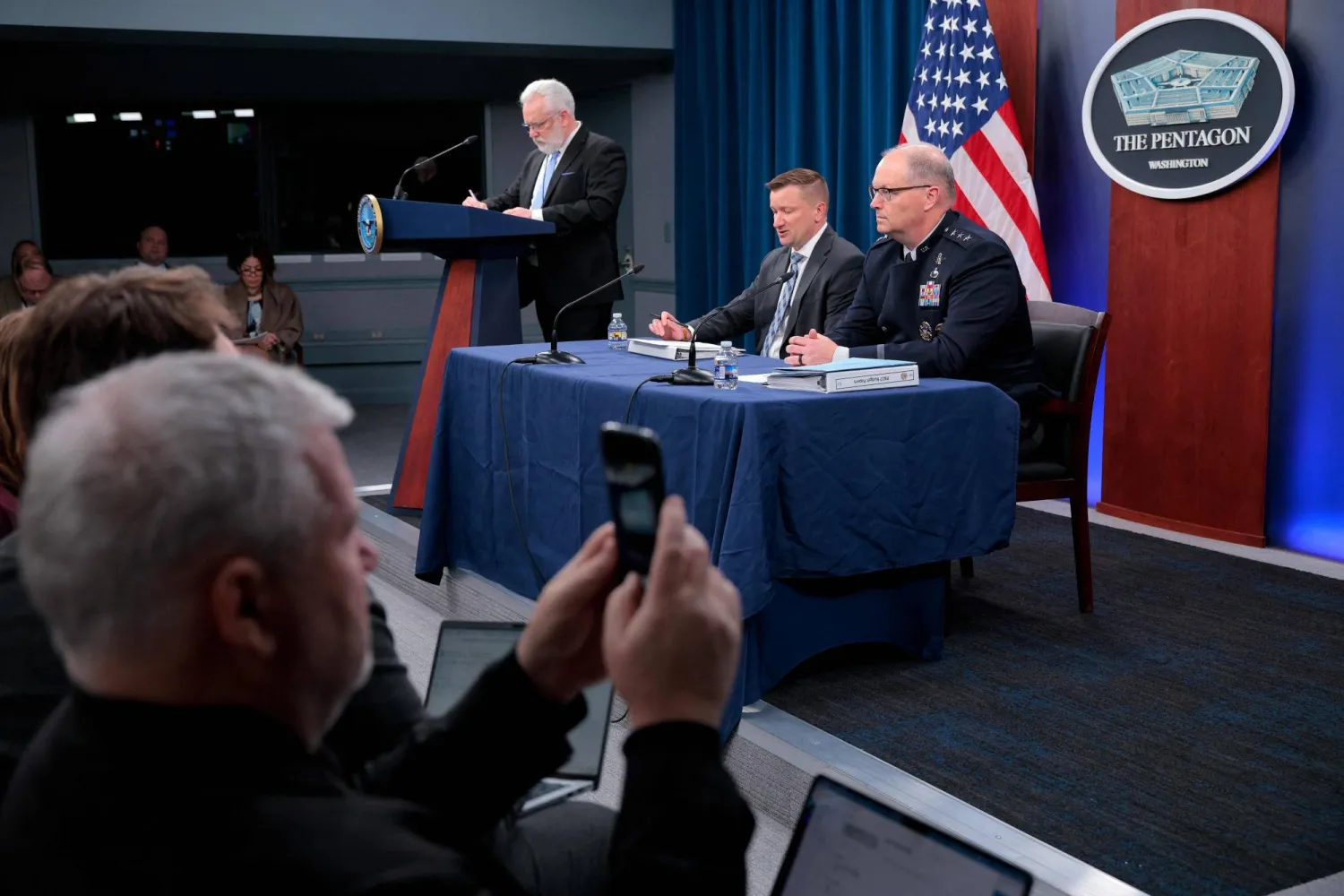
ARLINGTON, VIRGINIA - APRIL 21: Under Secretary of War Jules Hurst III (C) and Director of Force Structures Lt. Gen. Steven Whitney (R) hold a press briefing to discuss the Department of War's FY27 budget request at the Pentagon on April 21, 2026 in Arlington, Virginia. Chip Somodevilla/Getty Images/AFP
TT

Iran War Means More Orders for US Defense Giants

ARLINGTON, VIRGINIA - APRIL 21: Under Secretary of War Jules Hurst III (C) and Director of Force Structures Lt. Gen. Steven Whitney (R) hold a press briefing to discuss the Department of War's FY27 budget request at the Pentagon on April 21, 2026 in Arlington, Virginia. Chip Somodevilla/Getty Images/AFP

US defense companies are reporting a surge in demand for military equipment, as the war in the Middle East prompts fresh orders from governments around the world.

Earnings Tuesday signaled that 2026 will be another strong year after a robust 2025 in the wake of continuing conflicts in Gaza and Ukraine, Russian incursions into European airspace, Chinese maneuverings towards Taiwan and Red Sea tensions.

More governments are ordering military equipment amid rising geopolitical strife. For those who are already in conflict, there is a need to spend more to replenish stocks or maintain machinery.

US defense companies RTX, Northrop Grumman and GE Aerospace all reported increased orders in the first quarter, AFP said.

While hoping for a "sustained resolution" to the Middle East conflict, RTX CEO Chris Calio told a Wall Street analyst call the company was working with the Pentagon "to accelerate munitions production."

US officials have announced new agreements in recent months to increase production of the Tomahawk, Patriot and GEM-T missiles, among other weapons systems.

RTX unit Raytheon previously announced five "landmark" Pentagon agreements that Calio described as "vitally important for national security."

The company has already invested nearly $900 million to expand capacity.

"The current landscape clearly underscores the need for munitions, depth, integrated air and missile defense technology and more advanced capabilities to counter evolving threats," Calio said.

"We're seeing really, really strong demand, both domestically and internationally," he added as the company raised several full-year financial projections.

Similarly, GE Aerospace described its first quarter as "strong," with revenues jumping 25 percent in light of what Chief Executive Larry Culp described as a "dynamic geopolitical landscape."

Culp said on a conference call the company expects the Middle East war and its effects to persist through the summer.

In its defense programs, GE Aerospace continues "to execute with speed against high-priority military needs in support of US and allied warfighters," Culp added.

But the company, which builds engines for Boeing and Airbus, also suffered some ill-effects from the war. Cutbacks in travel in the Middle East hit the company's maintenance business.

At Northrop Grumman, the objective is also to deliver as quickly as possible on orders for weapons systems.

The company has added 20 new manufacturing facilities in the United States over the last two years, according to CEO Kathy Warden.

"Clearly the conflict with Iran has created a heightened sense of urgency," she said.

Calio of RTX said the recent contracts with the Pentagon "will give the kind of long-term visibility that the supply chain will need to invest, which is critically important."

US undersecretary of defense Jules Hurst said President Donald Trump's fiscal 2027 budget requested $1.5 trillion, describing the demand as a "generational investment in the United States military, the arsenal of freedom," he said at a Pentagon briefing.

"This 42 percent increase will supercharge our defense industrial base by expanding production of major weapon systems while strengthening supply chains and supporting tens of thousands of small- and medium-sized businesses," Hurst said.

Boeing, which also has a defense business, will report earnings Wednesday, while Lockheed Martin is set to release results on Thursday.



Denmark: Train Collision Leaves 17 Injured, 5 Are in Critical Condition

Damages at the accident scene after two trains collided between Hillerod and Kagerup at Isteroedvejen, Denmark, 23 April 2026. EPA/STEVEN KNAP
TT

Denmark: Train Collision Leaves 17 Injured, 5 Are in Critical Condition

Damages at the accident scene after two trains collided between Hillerod and Kagerup at Isteroedvejen, Denmark, 23 April 2026. EPA/STEVEN KNAP

Two commuter trains collided head-on near the Danish capital on Thursday injuring 17, of whom five were in critical condition, emergency services said.

"We can't provide any details for now about the cause of the accident," police official Morten Kaare Pedersen told reporters.

He said police were alerted to the accident at 6:29 am (0429 GMT), which occurred about 40 kilometers (25 miles) north of Copenhagen between the towns of Hillerod and Kagerup.

Officials originally said four people were critically injured but revised that figure hours after the crash. It was not immediately clear whether the train's drivers were among the victims.

Investigators are looking into what caused the collision. Photos from the scene show the front ends of the trains smashed, though both remained upright on the tracks.

The mayor of the nearby town of Gribskov, Trine Egetved, in a post on Facebook, said some of the injured were flown to the hospital.

She said the crash occurred on a local rail line that's used by many Gribskov residents, employees and schoolchildren.


Report: Clearing Hormuz Strait Mines Could Take 6 Months

Ships and boats in the Strait of Hormuz, Musandam, Oman, April 22, 2026. REUTERS/Stringer
TT

Report: Clearing Hormuz Strait Mines Could Take 6 Months

Ships and boats in the Strait of Hormuz, Musandam, Oman, April 22, 2026. REUTERS/Stringer

A Pentagon assessment said it could take six months to completely clear the Strait of Hormuz of Iranian-laid mines, which could keep oil prices high, the Washington Post reported on Wednesday.

Iran has all but blocked the vital waterway since the start of a war with the United States and Israel, sharply driving up oil and gas prices and disrupting the global economy.

The strait -- through which one-fifth of the world's oil and gas passes in peacetime -- has remained largely closed during a shaky ceasefire, with the US imposing its own blockade.

Even if hostilities end and the blockade lifts, it could take months to clear the waterway of mines, according to a Pentagon assessment, the Washington Post reported citing officials close to the discussion.

The assessment added that it was unlikely such an operation would begin before the end of the war.

The six-month estimate was shared with members of the House Armed Services Committee during a classified briefing, the Post reported.

Lawmakers were told that Iran may have placed 20 or more mines in and around the strait, some floated remotely using GPS technology which makes them harder to detect, according to the report.

AFP has contacted the Department of Defense for comment.

Pentagon spokesman Sean Parnell told the Washington Post that its information was "inaccurate."

Iran's Revolutionary Guards have warned of a "danger zone" covering 1,400 square kilometers -- 14 times the size of Paris -- where mines may be present.

Iran's parliament speaker said his country would not reopen the strait as long as the US naval blockade remained.

A spokesman for German transportation giant Hapag-Lloyd cautioned last week that shippers needed details on viable routes as they remain fearful of mines.

When the Hormuz strait briefly reopened at the start of the ceasefire this month, only a few ships trickled through amid fears of attacks or mines.

Earlier in April, the US Navy said its ships transited the waterway to begin removing the mines, but that claim was denied by Iran's Revolutionary Guard, which threatened any military vessels attempting to cross the channel.

London hosted talks with military planners from over 30 countries starting Wednesday on a UK and France-led multinational mission to protect navigation in the Strait of Hormuz once hostilities end.

The "defensive" coalition is set to discuss plans to reopen the strait and conduct mine clearance operations.


North Korea, Russia Reportedly Aim to Open New Road Bridge Soon

Officials attend the groundbreaking ceremony for the bridge connecting North Korea and Russia in Rason Municipality, North Korea, April 30, 2025 (Reuters file photo)
TT

North Korea, Russia Reportedly Aim to Open New Road Bridge Soon

Officials attend the groundbreaking ceremony for the bridge connecting North Korea and Russia in Rason Municipality, North Korea, April 30, 2025 (Reuters file photo)

North Korea and Russia aim to open a road bridge connecting the countries across the Tumen River as soon as possible, North Korean state media KCNA said on Thursday, as the neighboring countries forge closer ties.

The project, which began about a year ago, is "an important business" to boost bilateral cooperation including tourism, trade and the movement of people, KCNA said, according to Reuters.

Construction of the 850-meter (2,789-ft) bridge, which will connect to Russia's highway system, was agreed during a ⁠2024 visit to North Korea ⁠by President Vladimir Putin.

Russia and North Korea held a ceremony on Tuesday to mark the joining of the bridge, the Moscow Times reported.

It is being built near the existing "Friendship Bridge,” a rail bridge which was commissioned in 1959 after the Korean War.

KCNA said an opening ceremony would be held soon, without specifying a date. The Russian embassy in ⁠Pyongyang wrote on Telegram that the bridge would be completed on June 19.

Oleg Kozhemyako, governor of the Primorsky region in Russia's Far East, wrote on Telegram that the bridge would increase trade and expand cultural and tourism ties. He said it would cut the distance between Vladivostok and the border city of Rason to 320 kilometers and the crossing would have the capacity to accommodate up to 300 cars per day.

The update came as several Russian delegations visited North Korea this week.

Russian Interior Minister Vladimir Kolokoltsev met Jo Yong Won, chairman of the Standing Committee of North ⁠Korea's Supreme People's ⁠Assembly, on Wednesday in what KCNA described as a "favorable atmosphere."

On Tuesday, Russian Health Minister Mikhail Murashko visited the North Korean city of Wonsan to attend a ceremony celebrating the construction of a hospital symbolizing the "friendship" between the countries, KCNA said.

Russia and North Korea in 2024 signed a "comprehensive strategic partnership treaty" during Putin's visit to Pyongyang.

The pact includes a mutual defense provision, and North Korea has sent thousands of soldiers to fight alongside Russian forces in western Russia's Kursk region after a large Ukrainian incursion.

China has also been seeking to strengthen cross-border infrastructure and rebuild ties with North Korea and last month saw the first passenger train service between the countries resume after a six-year gap.