Heavy Flooding in Southern China Forces Evacuations and Leaves Vehicles Submerged

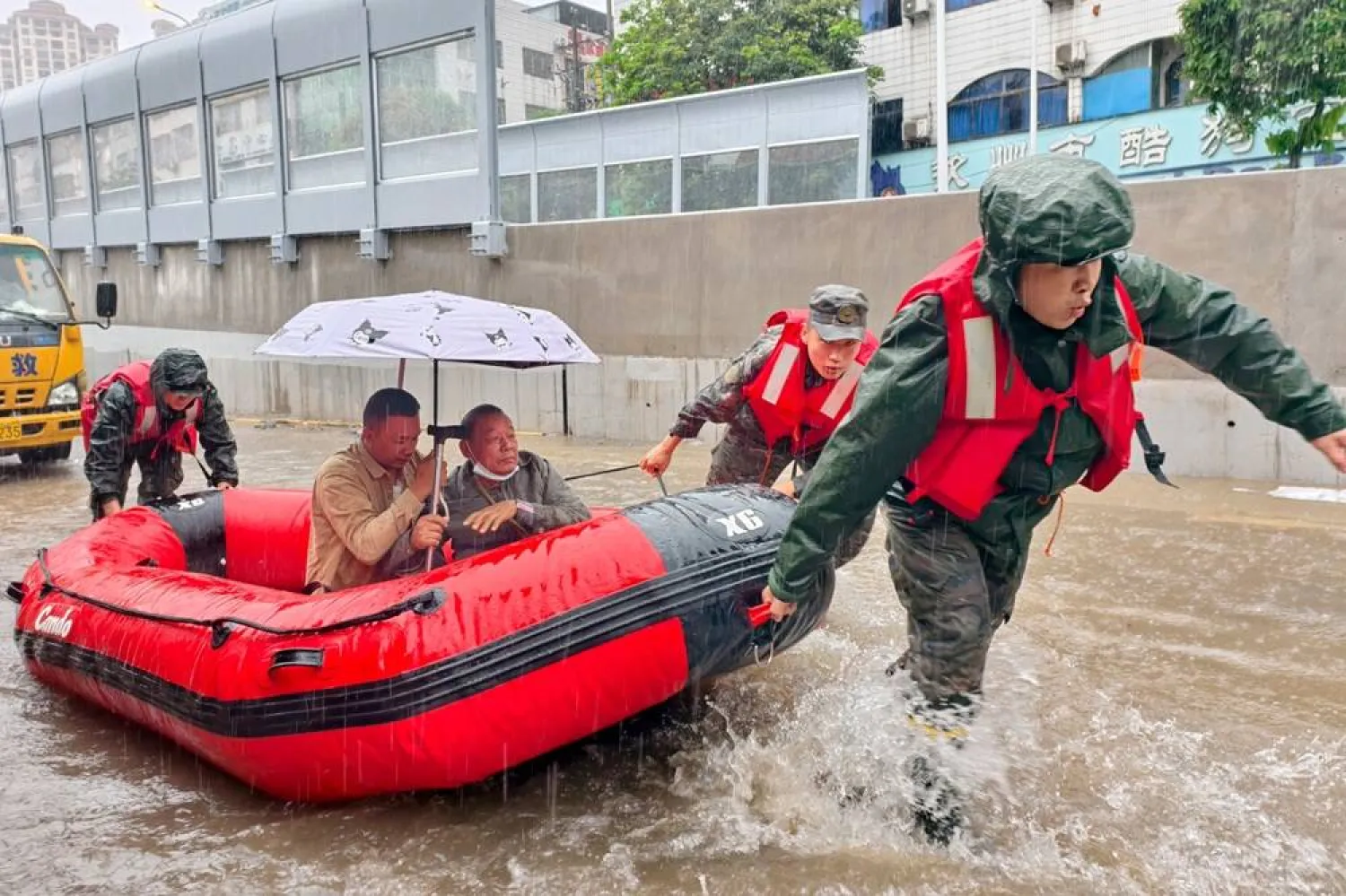
In this photo released by Xinhua News Agency, stranded residents are evacuated on a boat after flooding from heavy rainfall in Qinzhou in southern China's Guangxi Zhuang Autonomous Region on Monday, April 27, 2026. (Ao Shuaichang/Xinhua via AP)
TT

Heavy Flooding in Southern China Forces Evacuations and Leaves Vehicles Submerged

In this photo released by Xinhua News Agency, stranded residents are evacuated on a boat after flooding from heavy rainfall in Qinzhou in southern China's Guangxi Zhuang Autonomous Region on Monday, April 27, 2026. (Ao Shuaichang/Xinhua via AP)

Heavy flooding from torrential rain left cars submerged and forced the evacuation of more than 200 residents in a southern Chinese city, state media reported Tuesday.

Rescue crews deployed inflatable boats to help relocate some residents trapped in their homes in Qinzhou city in Guangxi region, official news agency Xinhua reported. Video footage from Xinhua showed rescuers wading through chest-high water and firefighters carrying elderly residents in their arms.

Qinzhou authorities said the city's meteorological station recorded rainfall of over 270 millimeters (about 10 inches) during a 24-hour period ending at 8 a.m. on Monday. That was the highest amount recorded there on a single day in April.

The authorities quoted meteorological analyst Lin Nan in a WeChat post saying that such intense rainfall in South China’s coastal regions typically occurs only after the arrival of the summer monsoon in mid to late May. It is rare to see such a heavy downpour in late April, Lin said.

On Tuesday morning, schools across the city resumed classes and traffic ran normally in most places, according to a news outlet operated by the Chinese emergency management authorities.


Train Collision Kills 14, Injures Dozens Near Jakarta

 A drone view shows ambulances standing by at the station following a deadly collision between a commuter line train and a long-distance train, in Bekasi, on the outskirts of Jakarta, Indonesia, April 28, 2026. (Reuters)
A drone view shows ambulances standing by at the station following a deadly collision between a commuter line train and a long-distance train, in Bekasi, on the outskirts of Jakarta, Indonesia, April 28, 2026. (Reuters)
TT

Train Collision Kills 14, Injures Dozens Near Jakarta

 A drone view shows ambulances standing by at the station following a deadly collision between a commuter line train and a long-distance train, in Bekasi, on the outskirts of Jakarta, Indonesia, April 28, 2026. (Reuters)
A drone view shows ambulances standing by at the station following a deadly collision between a commuter line train and a long-distance train, in Bekasi, on the outskirts of Jakarta, Indonesia, April 28, 2026. (Reuters)

Indonesia's president ordered an investigation Tuesday after a long-distance train smashed into a stationary commuter train overnight, killing 14 people and injuring dozens.

Officials ended a nearly 12-hour rescue effort near Bekasi Timur station, east of the capital Jakarta, which saw crews prying open mangled carriages following the Monday night collision.

"And this morning... it is all finished," Mohammad Syafii, head of the National Search and Rescue Agency (Basarnas) told a news conference Tuesday. "I am certain there are no more victims to be found."

One survivor described the terror of being trapped inside a crushed carriage.

"I thought I was going to die," Sausan Sarifah, 29, said from her bed at the RSUD Bekasi hospital where she was admitted with a broken arm and a deep cut to one thigh.

She was on her way home from work on Monday night, she said, when her train stopped at the Bekasi Timur station some 25 kilometers (15 miles) from Jakarta.

"It all happened so fast, in a split second," Sausan recounted.

"There were two announcements from the commuter train. Everyone was ready to get off, and then suddenly there was the sound of the locomotive, really loud," she said.

"There was no time to get out, and everyone ended up piled up inside the train, crushed on top of one another. I don't know how the person underneath me is doing."

She said she had feared suffocating to death in the human pile-up, and worried that some pinned underneath didn't make it.

"Thank God I was on top, so I could be evacuated quickly," said Sausan.

State-owned rail operator KAI said on Tuesday morning that the death toll had risen to 14. Another 84 people required medical treatment, it said, without specifying how many remained hospitalized.

According to Franoto Wibowo, a KAI spokesman, a taxi appears to have clipped the commuter train on a level crossing, causing it to come to a standstill on the tracks, where it was hit.

At the station, chaotic scenes unfolded in the aftermath of the crash, with rescue workers shouting for oxygen tanks as ambulances stood by in a snaking queue, lights flashing.

An AFP reporter at the scene witnessed people being carried out of the wreckage on gurneys and loaded into waiting ambulances as hundreds of bystanders looked on, some seemingly in shock.

The military, fire brigade, the national search and rescue agency, and the Red Cross aided in the massive evacuation effort that followed.

President Prabowo Subianto on Tuesday visited hospital patients in Bekasi, offered his condolences to relatives of the deceased, and said he had ordered an "immediate investigation."

He also ordered the construction of an overpass in Bekasi.

"In general, we do see that many railway crossings are not guarded," the president said.

"I have ordered that we immediately repair all these crossings, either by guard posts or by flyovers."

- Rescue efforts -

Jakarta police chief Asep Edi Suheri said the long-distance train had crashed into the last, women-only, carriage of the commuter train.

All the victims were in the commuter train, and all 240-odd passengers on the other train had been evacuated safely, according to Anne Purba, another KAI spokeswoman.

The agency said it would cover all medical expenses for the injured and funeral costs for the deceased.

The collision had caused "significant damage to several train carriages", the Jakarta search and rescue agency said in a statement.

Several people were trapped in the carriages "due to the force of the impact," it added.

The rescue agency would not say Tuesday whether all had been freed.

Eva Chairista, 39, told AFP she had rushed to the RSUD hospital after hearing that her sister-in-law, who she named only as 27-year-old Fira, had been injured in the crash.

She arrived to a frenetic scene of medical triage.

"The doctor told us to be patient, there are many whose condition is worse than my sister-in-law's," she said.

Transport accidents are not uncommon in Indonesia, a vast archipelago nation where buses, trains and even planes are often old and poorly maintained.

The previous major train crash in the Southeast Asian country killed four crew members and injured about two dozen people elsewhere in West Java province in January 2024.

Sixteen people were killed when a commuter train crashed into a minibus on a level crossing in Jakarta in 2015.


US Says Examining Latest Iran Proposal

A boat sails past a tanker anchored on the Strait of Hormuz off the coast Qeshm island, Iran, April 18, 2026. (AP)
TT

US Says Examining Latest Iran Proposal

A boat sails past a tanker anchored on the Strait of Hormuz off the coast Qeshm island, Iran, April 18, 2026. (AP)

The White House said on Monday that it was examining Iran's latest proposal to unblock the Strait of Hormuz, two months after a US and Israeli offensive sent shockwaves through the global economy.

Peace talks between the United States and Iran to end the Middle East war and fully reopen the vital strait have so far proven inconclusive since a ceasefire came into force.

Trump met with top security advisors on Monday to discuss an Iranian proposal after Tehran passed "written messages" to Washington via Pakistan, spelling out its red lines in negotiations, including on nuclear issues and the Strait of Hormuz, the Fars news agency reported.

The proposal was "being discussed," spokeswoman Karoline Leavitt told a White House briefing.

Asked about the terms of Iran's proposal, Secretary of State Marco Rubio told Fox News "it's better than what we thought they were going to submit," but questioned whether it was genuine.

"We have to ensure that any deal that is made, any agreement that is made, is one that definitively prevents them from sprinting towards a nuclear weapon at any point," he said.

Iran's top diplomat blamed Washington on Monday for the failure of peace talks during a visit to Russia, where President Vladimir Putin promised him Moscow's support in ending the war.

"The US approaches caused the previous round of negotiations, despite progress, to fail to reach its goals because of the excessive demands," Iranian Foreign Minister Abbas Araghchi said.

Araghchi was in Saint Petersburg after visiting Oman and Pakistan, the main mediator in the Middle East war.

Islamabad had hosted a first, unsuccessful round of US-Iran talks, and Araghchi's visit had raised hopes for more negotiations over the weekend.

But US President Donald Trump scrapped a planned trip by his envoys Steve Witkoff and Jared Kushner.

Trump told Fox News if Iran wanted talks, "they can call us" -- adding the cancellation does not signal a return to hostilities.

Tehran would first need guarantees Washington and Israel would not attack again if it was to offer security assurances in the Gulf, Iran's envoy to the UN said.

Meanwhile in Saint Petersburg, Putin and Araghchi both voiced their commitment to their countries' "strategic relationship" following their meeting.

Araghchi said the war, which began when the United States and Israel attacked Iran on February 28, showed "Iran's true power" and stability.

But back home in Tehran, the mood was more sober.

"Everything in the country is up in the air right now. I have not worked for a long time," small business owner Farshad told Paris-based AFP journalists.

"The country is in complete economic collapse."

- Feeling the pinch -

Though the US-Iranian ceasefire holds, the war's economic shock waves continue to reverberate.

Tehran resident Shervin, a photographer, said he was feeling the pinch.

"It is the first time that I have reached a point where I was late on my rent. I still don't have any projects," said Shervin, 42.

Iran has blockaded Hormuz, cutting off flows of oil, gas and fertilizer and sending prices soaring.

In response, the United States has imposed a blockade of Iranian ports.

Trump faces domestic pressure to find an off-ramp as fuel prices rise, with midterm elections due in November and polls showing the war is unpopular among Americans.

Iran's Revolutionary Guards say they have no intention of easing their market-rattling chokehold of the strategic waterway.

Ebrahim Azizi, head of the national security commission in Iran's parliament, said a proposed law for managing the strait would make the Islamic republic's armed forces the overseeing authority, with levies to be paid in Iranian rial.

The head of the UN's maritime agency, Arsenio Dominguez, said there was "no legal basis" for imposing transit fees.

Rubio also rejected the idea.

"They cannot normalize -- nor can we tolerate them trying to normalize -- a system in which the Iranians decide who gets to use an international waterway, and how much you have to pay them to use it," he told Fox News Channel's "America's Newsroom."

- 'Playing with fire' -

Violence has continued on the war's Lebanese front, despite a recently extended ceasefire between Israel and Iran-backed Hezbollah, with Beirut's health ministry reporting Israel killed four people in the south.

Fifty-one others were wounded, including three children, the ministry added.

Hezbollah drew Lebanon into the Middle East war by firing rockets at Israel, which responded with strikes and a ground invasion.

The group's leader Naim Qassem on Monday rejected planned direct negotiations between Lebanon and Israel as a "grave sin," vowing to "not back down."

Shortly afterwards, the Israeli military said it had begun hitting Hezbollah targets in Lebanon. Israel maintains that under the terms of the truce, it can act against imminent threats.

Israeli Prime Minister Benjamin Netanyahu said Hezbollah's rockets and drones remained a threat meriting military action.

Israeli Defense Minister Israel Katz warned that "Qassem is playing with fire."

Lebanese President Joseph Aoun, responding to Qassem, said his "goal is to reach an end to the state of war with Israel."

But Israeli army chief of staff Eyal Zamir said 2026 was "likely to be another year of fighting" for Israel on all fronts.


North Korea Sharply Increased Executions During Pandemic Lockdown, Rights Group Says

26 April 2026, North Korea, Pyongyang: A ceremony to open a museum and memorial complex dedicated to the North Korean servicemen who took part in the liberation of Russia's Kursk Region from the Ukrainian Armed Forces. (Vadim Savitsky/TASS via ZUMA Press/dpa)
TT

North Korea Sharply Increased Executions During Pandemic Lockdown, Rights Group Says

26 April 2026, North Korea, Pyongyang: A ceremony to open a museum and memorial complex dedicated to the North Korean servicemen who took part in the liberation of Russia's Kursk Region from the Ukrainian Armed Forces. (Vadim Savitsky/TASS via ZUMA Press/dpa)

North Korea ‌sharply raised the number of executions it conducted after shutting its borders during the COVID-19 pandemic, with the largest share linked to violations of bans on foreign culture and religion, a Seoul-based civic group said on Monday.

A report by the Transitional Justice Working Group documented 60 execution cases in which 148 people were put to death between 2020 and 2024, up from 41 executions over the previous five years.

The findings were based on interviews with 880 North Korean defectors living in South Korea and the ‌group used satellite images ‌to map execution sites. It cautioned, ‌however, ⁠that the report should ⁠not be considered as definitive.

The report said breaches of restrictions on foreign culture and religion, including watching South Korean dramas and movies, accounted for the largest portion of the executions.

Before the pandemic closures, murder was the most frequent reason for an execution.

The number of executions for political crimes also rose to 28 ⁠from four in the corresponding period, the report ‌said, as North Korean leader Kim ‌Jong Un sought to crack down on dissent during the pandemic ‌lockdowns.

Executions tied to cultural violations also occurred in inland areas ‌of the country, not only in border regions with China, suggesting South Korean media content had spread throughout the country, said Hubert Lee, the group's executive director.

North Korea has slowly started reopening the country and approved ‌in 2023 the return of its citizens who had been abroad and recently resumed passenger ⁠train service ⁠with China.

Still, the number of North Korean defectors, an indicator of North Korea's openness to the outside world, remained low at 223 in 2025, compared to 1,275 in 2015, according to South Korean government data.

The anticipated succession of Kim's daughter, known as Ju Ae, could also increase executions, said Lee.

"The number of executions may surge when the time for Ju Ae to succeed is imminent, to remove the inner circle of her father and appoint her people," said Lee.

North Korean embassies in Singapore and London and Pyongyang's permanent UN mission did not immediately respond to requests for comment on the findings of the report.