

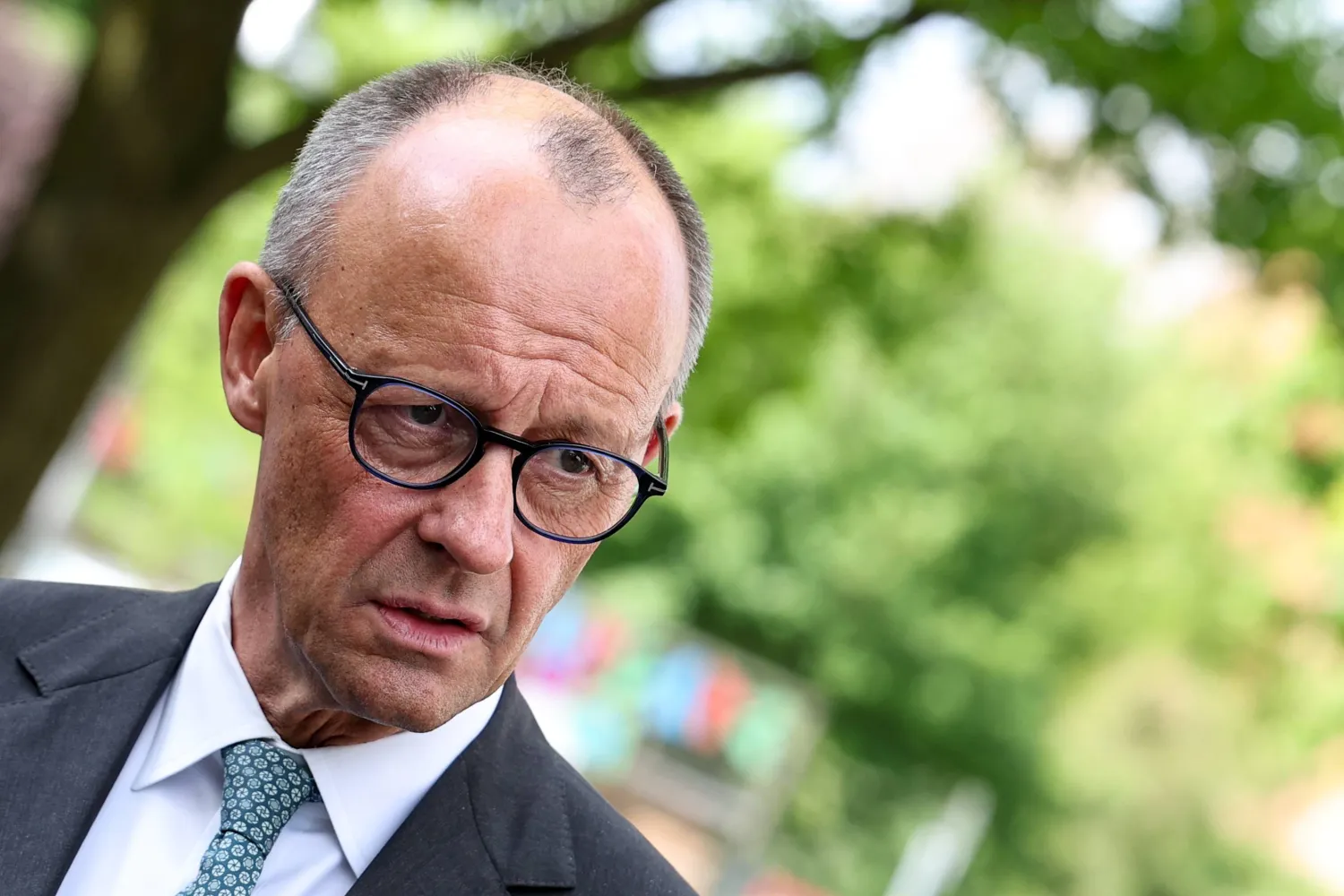

Germany’s Merz Marks a Year in Office Facing Deep Transatlantic Crisis

German Chancellor Friedrich Merz gives a press statement ahead of the Christian Democratic Union (CDU) Executive Committee meeting at the Chabad Synagogue in Berlin, Germany, 04 May 2026. (EPA)
TT

Germany’s Merz Marks a Year in Office Facing Deep Transatlantic Crisis

German Chancellor Friedrich Merz gives a press statement ahead of the Christian Democratic Union (CDU) Executive Committee meeting at the Chabad Synagogue in Berlin, Germany, 04 May 2026. (EPA)

Chancellor Friedrich Merz marks a year in office this week facing the biggest crisis with Washington in decades, after President Donald Trump said he would hit European auto imports with 25% tariffs and pull thousands of troops out of Germany.

The moves, announced on Friday after Trump reacted angrily to criticism by Merz of US strategy in the Iran war, underline the break in transatlantic relations that has become increasingly apparent in Trump's second term and add to an array of problems now facing the German leader.

"We can see what's going on with Donald Trump and the US, and that this is having an impact. We can see that China is getting stronger and stronger," Finance Minister Lars Klingbeil, Merz's deputy and the head of his Social Democrat coalition partners, told Reuters.

"We can see that Europe isn't strong enough. In this regard, a great deal depends on Germany."

MERZ'S CONSERVATIVES TRAILING IN OPINION POLLS

After two years of recession, a timid recovery risks being extinguished by the energy shock from the Iran conflict, a promised package of tax, welfare and health reforms has been overshadowed by coalition wrangling.

Merz's freewheeling communication style, ‌which he himself acknowledges ‌is sometimes impulsive, has also irritated voters. Already squeezed by stifling competition from China, carmakers, the backbone of Germany's ‌industrial ⁠base, now face ⁠a spike in tariffs from 15% to 25% from one of their most important export markets.

In an interview with German public television on Sunday, Merz, who was sworn into office on May 6 last year, acknowledged public doubts, reflected in opinion polls that now put the far-right Alternative for Germany ahead of his conservatives as the country's most popular party.

"The doubts are growing. Not about me, but about the coalition," he said.

For much of his first year, Merz has made up for discontent at home with a relatively assured performance abroad, for a while enjoying a reputation as one of the few European leaders to establish a good personal relationship with Trump.

"He has strengthened key relationships, particularly with France and Poland, and has secured European influence in the context of the war in Ukraine through forums such as the E3," said Oliver Lembcke, a political ⁠scientist at Ruhr University Bochum, adding that Merz's main problem was at home.

"In domestic policy, he's fallen short ‌of expectations – particularly when it comes to leadership."

A fluent English speaker, Merz continues to believe in the US ‌alliance, which he has sought to preserve while Germany rebuilds its own depleted armed forces after decades of neglect.

With the war in Ukraine still raging on the European ‌Union's doorstep, he has also moved carefully to try to persuade Trump not to turn against Kyiv entirely.

But he has repeatedly warned that the era ‌of relying on US forces to protect Europe is over and has become increasingly critical of the US-Israeli conflict with Iran, refusing to send German forces to help clear the strategic Strait of Hormuz until fighting stops and a full international mission is agreed.

MUCH DEPENDS ON GERMANY

The events of the past week, however, have made clear how fine a line there is to tread with a US administration that has made no secret of its disdain for Europe's leaders, even those like Merz or Italian Prime Minister Giorgia Meloni who were ‌once praised by Trump.

German Defense Minister Boris Pistorius downplayed the significance of Trump's decision to withdraw at least 5,000 troops from Germany and withhold the planned deployment of Tomahawk cruise missiles, saying at the weekend that the ⁠move came as no surprise.

Merz denied that ⁠the decision was prompted by his remark to students last week that the US had no exit strategy in Iran and was being "humiliated", despite Trump's angry social media attacks on the chancellor he once called a friend.

Such communication snags have marked Merz's year in office, including when he sparked outrage last year by suggesting that migration had altered the appearance of German towns.

But Trump's impatience with Europe has been abundantly clear throughout his time in office, notably since Vice President JD Vance's stinging attack at last year's Munich Security Conference.

"I think that just sped things up, but it wasn't what set it off," said Roderich Kiesewetter, a member of the parliamentary foreign affairs committee from Merz's conservative CDU party. He said scrapping a Biden-era plan to deploy a US battalion with long-range Tomahawk missiles was more serious for Germany.

"That undermines our deterrent. And it undermines trust in the US. And that is the real bad news," he said.

It remains unclear exactly what troops will be withdrawn from the 40,000 US forces stationed in Germany and how that will affect some of the biggest US military facilities outside the United States, including the sprawling Ramstein air base.

Although polls show Trump is deeply unpopular in Germany and public opinion overwhelmingly backs staying out of the war with Iran, the presence of US troops has become a fixture for Germans in the western part of the country.

In Landstuhl, home to one of the biggest US military hospitals, local resident Maria Raftopoulo said relationships between locals and US personnel had been deep over the years.

"And even though there are fewer Americans now, they still provide jobs, they still rent, they contribute to the region doing as well as it does."



Armenia Hosts a Historic EU Summit as It Charts a Course Away from Russia

Armenia's President Vahagn Khachaturyan, France's President Emmanuel Macron and Armenia's Prime Minister Nikol Pashinyan share a toast during a state dinner in the honour of the French leader at the presidential palace in Yerevan on May 4, 2026. (Photo by Ludovic MARIN / AFP)
TT

Armenia Hosts a Historic EU Summit as It Charts a Course Away from Russia

Armenia's President Vahagn Khachaturyan, France's President Emmanuel Macron and Armenia's Prime Minister Nikol Pashinyan share a toast during a state dinner in the honour of the French leader at the presidential palace in Yerevan on May 4, 2026. (Photo by Ludovic MARIN / AFP)

Armenia hosts its first bilateral summit with the European Union on Tuesday, a landmark diplomatic moment for the Caucasus Mountains nation that has formally declared its ambition to join the bloc and is cautiously loosening its ties with longtime ally Russia.

The EU-Armenia summit in Yerevan follows the eighth gathering of the European Political Community, which brought dozens of European leaders to the Armenian capital. The officials addressed European security issues and the US-Israeli war in Iran in remarks on Monday.

The two meetings underscore how Armenia is seeking to turn westward and shed Russia's influence. Armenia’s relations with Moscow, its longtime sponsor and ally, have grown increasingly strained since 2023, when neighboring Azerbaijan fully reclaimed the Karabakh region and ended the decades-long rule by ethnic Armenian separatists.

Armenian authorities accused Russian peacekeepers who were deployed to the region of failing to stop Azerbaijan’s onslaught. Moscow, busy with its war in Ukraine, rejected the accusations, arguing that its troops didn’t have a mandate to intervene.

The war was “a belated demonstration that Russia is dangerously unreliable as a partner,” Richard Giragosian, director of the Regional Studies Center in Yerevan, told The Associated Press.

Pursuing ties with Europe

Since then, Prime Minister Nikol Pashinyan’s government has pursued closer ties with the West, a move welcomed by the EU.

In remarks to the EPC conference on Monday, EU Council President Antonio Costa thanked Pashinyan for “the courageous political decisions he has taken to bring Armenia closer to the European Union.”

“The direction of travel is unmistakable,” Costa said, stressing that it was “vital to strengthen Armenian democracy and fight external interference and misinformation.”

The opening ceremony of the EU-Armenia summit on Tuesday saw Costa walk the red carpet side-by-side with Pashinyan and European Commission President Ursula von der Leyen, while a military band played against a background of Armenian and EU flags.

In her opening statement, von der Leyen said that Europe was ready to aid Armenia in becoming a regional hub for global trade routes, including the building of physical infrastructure.

“We’re ready to invest in the local energy production and the energy links across the Black Sea, and we are ready to connect your booming digital scene to Europe’s digital market and turn Armenia’s position at the heart of this region into a motor of growth,” she said.

Armenia joined the International Criminal Court in 2023, a move Moscow condemned as an “unfriendly step.” The court has issued an arrest warrant for Russian President Vladimir Putin, accusing him of personal responsibility for the abductions of children from Ukraine.

Armenia also froze its participation in the Moscow-led Collective Security Treaty Organization in 2024. The following year, the Armenian parliament passed a law formally declaring the country’s intention to seek EU membership.

It is the EU, rather than the United States, that has stepped into the vacuum left by Russia, Giragosian said.

“EU engagement is much more prudent and much more productive than the US becoming involved, simply because European engagement is less provocative to Russia over the longer term,” he added.

However, Armenia remains a member of the Russia-led Eurasian Economic Union — a single market allowing the free movement of goods, capital and labor. The organization also includes Belarus, Kazakhstan and Kyrgyzstan — and Putin has made the trade-offs plain.

Speaking at talks with Pashinyan in Moscow earlier this year, Putin warned that Armenia could not simultaneously belong to both the EEU and the EU, noting that Yerevan currently receives Russian natural gas at prices far below European market rates. Pashinyan acknowledged the incompatibility but said Armenia could, for now, combine EEU membership with deepening EU cooperation.

Giragosian described Tuesday's summit as “a focus on deepening the preexisting relationship” rather than a step toward candidacy, referencing the Comprehensive and Enhanced Partnership Agreement that has governed EU-Armenia ties since coming fully into force in 2021.

“The symbolic significance is much greater as a message to Russia,” he said.

Benefits for Armenia and its prime minister

Yet some concrete results are expected, Giragosian said. Financing for domestic reform and military assistance through the European Peace Facility — a fund created primarily to support Ukraine — is among the anticipated announcements. An EU monitoring mission has been deployed along Armenia’s border with Azerbaijan for several years, and a new mission targeting hybrid threats has recently been approved.

Pashinyan, who has been in office since 2018 and faces parliamentary elections in June, stands to benefit politically from the international profile the European meetings confer. Giragosian noted that Pashinyan's government is likely to be returned largely by default, with the opposition unable to offer a credible alternative program.

But Giragosian warned against framing Armenia’s foreign policy as purely a pivot from Russia to the West.

“Armenia is also pivoting beyond the black and white zero-sum game paradigm,” he said, pointing to significant diplomatic investment in Asia, including with Japan, South Korea and China. “This is not about replacing Russia with the West. This is much more innovative, much more sophisticated.”

Heightened tensions

The summit also comes at a moment of heightened tension between Azerbaijan and the EU. Azerbaijan’s Ministry of Foreign Affairs summoned the EU ambassador last week to protest a European Parliament resolution demanding the release of Armenian prisoners of war and criticizing the treatment of Armenians in Karabakh. Lawmakers in Azerbaijan subsequently voted to suspend all cooperation with the European Parliament.

Azerbaijan President Ilham Aliyev, who addressed the EPC conference via video link, accused the European Parliament and the Parliamentary Assembly for the Council of Europe of “double standards” for placing sanctions on Azerbaijan's PACE delegation.

There were also protests outside the EPC summit venue, which was surrounded by tight security. Demonstrators held photos of Armenian prisoners being held in Azerbaijan.

Opposition leader Aram Sargsyan, head of the Democratic Party of Armenia, told the Armenian Press Agency that the European officials were voicing support for Pashinyan ahead of the election and have “forgotten about the Armenians in prison in Azerbaijan.”


A Cruise Ship is Waiting for Help after 3 People Died in a Suspected Hantavirus Outbreak

The MV Hondius cruise ship is anchored at a port in Praia, Cape Verde, Monday, May 4, 2026. (AP Photo/Arilson Almeida)
TT

A Cruise Ship is Waiting for Help after 3 People Died in a Suspected Hantavirus Outbreak

The MV Hondius cruise ship is anchored at a port in Praia, Cape Verde, Monday, May 4, 2026. (AP Photo/Arilson Almeida)

A cruise ship with nearly 150 people aboard was waiting for help off the coast of Cape Verde in the Atlantic Ocean on Monday after three passengers died and at least three other people were left seriously ill in a suspected outbreak of the rare hantavirus, according to the World Health Organization and the ship's operator.

The MV Hondius, a Dutch ship on a weekslong polar cruise from Argentina to Antarctica and several isolated islands in the South Atlantic, had requested help from local health authorities after making its way to the island of Cape Verde, off the West Africa coast. But no one has been allowed to disembark, Netherlands-based operator Oceanwide Expeditions said.

Cape Verde's Health Ministry said Monday that for now, it will not allow the ship to dock because of public health concerns and that it would stay in open waters close to shore, reported The Associated Press.

Hantavirus is a rodent-borne illness spread by contact with rodents or their urine, saliva or droppings. WHO says that while it is rare, hantavirus may spread between people.

It was unclear how an outbreak could have started, and WHO said it was investigating while working to coordinate the evacuation of two sick crew members. Another sick person — a British man evacuated to South Africa on April 27 — tested positive for the virus, authorities said. He is in critical condition and isolated in intensive care, health officials said.

The body of one of the passengers who died — a German — remains on the ship, according to an Oceanwide Expeditions statement. A 70-year-old Dutch man died onboard April 11, and his 69-year-old wife died later in South Africa after leaving the ship, officials said. Her blood later tested positive for the virus, making two confirmed cases, South Africa's health minister said.

Among the 87 remaining passengers, 17 are Americans, 19 are from the UK and 13 from Spain, according to Oceanwide Expeditions. Sixty-one crew members also are onboard.

Cruise operator says 2 ill crew members urgently need care Two sick crew members — one British, one Dutch — have respiratory symptoms and need urgent medical care, Oceanwide said in its statement.

Cape Verde has sent a medical team of two doctors, a nurse and a laboratory specialist to the ship over three trips, said Dr. Ann Lindstrand, a WHO official in Cape Verde.

She told The Associated Press in an interview that they were planning for medical evacuations, in which passengers would be taken from the ship via ambulance to an airport.

“It’s been very tricky for Cape Verdean authorities,” Lindstrand said. “What they have to deal with is a public health event. And of course, they have been thinking about the protection of the population here.”

Oceanwide said it would consider moving to one of the Spanish islands — Tenerife or the port of Las Palmas — if it can't evacuate passengers in Cape Verde.

WHO said it was working with local authorities and Oceanwide on a “full public health risk assessment.”

“Detailed investigations are ongoing, including further laboratory testing, and epidemiological investigations,” WHO said. “Medical care and support are being provided to passengers and crew.”

Lindstrand told AP there was a possible new case on the ship, in a person showing mild fever symptoms, but health workers were still assessing.

The cruise started in Argentina

The ship left Ushuaia in southern Argentina on April 1, according to Argentine provincial authorities. Health officials there said they confirmed no passengers had hantavirus symptoms when the Hondius departed.

But because symptoms can appear up to eight weeks after exposure, “the passengers could have been incubating the disease if they acquired it within the country or elsewhere in the world,” Juan Facundo Petrina, director of epidemiology for Tierra del Fuego province, told AP in an interview from Ushuaia.

He noted that the province hasn't historically seen hantavirus cases, but infections have broken out in other Argentine provinces, leading to 28 deaths nationwide last year, according to the health ministry.

For the rest of the Hondius' trip, Oceanwide Expeditions didn’t specify an itinerary. The company advertises 33-night or 43-night “Atlantic Odyssey” cruises on the vessel.

It has 80 cabins and a capacity of 170 passengers, and it typically travels with about 70 crew members, including a doctor, the company said.

The Dutch man was the first victim, and he presented with fever, headache, abdominal pain and diarrhea, officials said. His body was taken off the vessel nearly two weeks later on the British territory of Saint Helena, some 1,200 miles (1,900 kilometers) off the African coast and was awaiting repatriation.

His wife was transferred to South Africa; she collapsed at a Johannesburg airport and died at a hospital, the South African Department of Health said. On Monday, South African Health Minister Aaron Motsoaledi told national broadcaster SABC that her blood was tested posthumously, with a positive hantavirus result.

The ship sailed on to Ascension Island, an isolated Atlantic outpost about 800 miles (1,300 kilometers) to the north, where the sick British man was taken off the ship and evacuated April 27 to South Africa.

South African officials have started contact tracing but say there's no need to panic There was no information from authorities on a possible source of the suspected outbreak. A previous hantavirus outbreak in southern Argentina in 2019 killed at least nine people. It prompted a judge to order dozens of residents of a remote town to stay in their homes for 30 days to halt the spread.

South Africa’s National Institute for Communicable Diseases was conducting contact tracing to identify whether people were exposed to infected cruise passengers. The 69-year-old woman who died was trying to catch a flight home to the Netherlands at Johannesburg’s main international airport, one of Africa's busiest, when she collapsed.

But the health department urged people not to panic, saying WHO was “coordinating a multicountry response with all affected islands and countries to contain further spread of the disease.”

Hantavirus has no specific treatment or cure, but early medical attention can increase chances of survival.

“While severe in some cases, it is not easily transmitted between people,” Dr. Hans Henri P. Kluge, WHO regional director for Europe, said in a statement Monday. “The risk to the wider public remains low. There is no need for panic or travel restrictions.”


US Military Strike on Alleged Drug Boat Kills 2 in the Caribbean

The ship was targeted in the Caribbean (screenshot from a video published by the US Army Southern Command on X).
TT

US Military Strike on Alleged Drug Boat Kills 2 in the Caribbean

The ship was targeted in the Caribbean (screenshot from a video published by the US Army Southern Command on X).

The US military said it launched another strike on a boat accused of ferrying drugs in the Caribbean Sea, killing two people Monday.

The Trump administration’s campaign of blowing up alleged drug-trafficking vessels in Latin American waters has persisted since early September and killed at least 188 people in total. Other strikes have taken place in the eastern Pacific Ocean, The Assocxiated Press said.

Despite the Iran war, the series of strikes have ramped up again in recent weeks, showing that the administration’s aggressive measures to stop what it calls “narcoterrorism” in the Western Hemisphere are not letting up. The military has not provided evidence that any of the vessels were carrying drugs.

The attacks began as the US built up its largest military presence in the region in generations and came months ahead of the raid in January that captured then-Venezuelan President Nicolás Maduro. He was brought to New York to face drug trafficking charges and has pleaded not guilty.

In the latest attack Monday, US Southern Command repeated previous statements by saying it had targeted the alleged drug traffickers along known smuggling routes. It posted a video on X showing a boat moving along the water before a massive explosion engulfs the vessel in flames.

President Donald Trump has said the US is in “armed conflict” with cartels in Latin America and has justified the attacks as a necessary escalation to stem the flow of drugs into the United States and fatal overdoses claiming American lives. But his administration has offered little evidence to support its claims of killing “narcoterrorists.”

Critics, meanwhile, have questioned the overall legality of the boat strikes.