


Armenia Hosts a Historic EU Summit as It Charts a Course Away from Russia

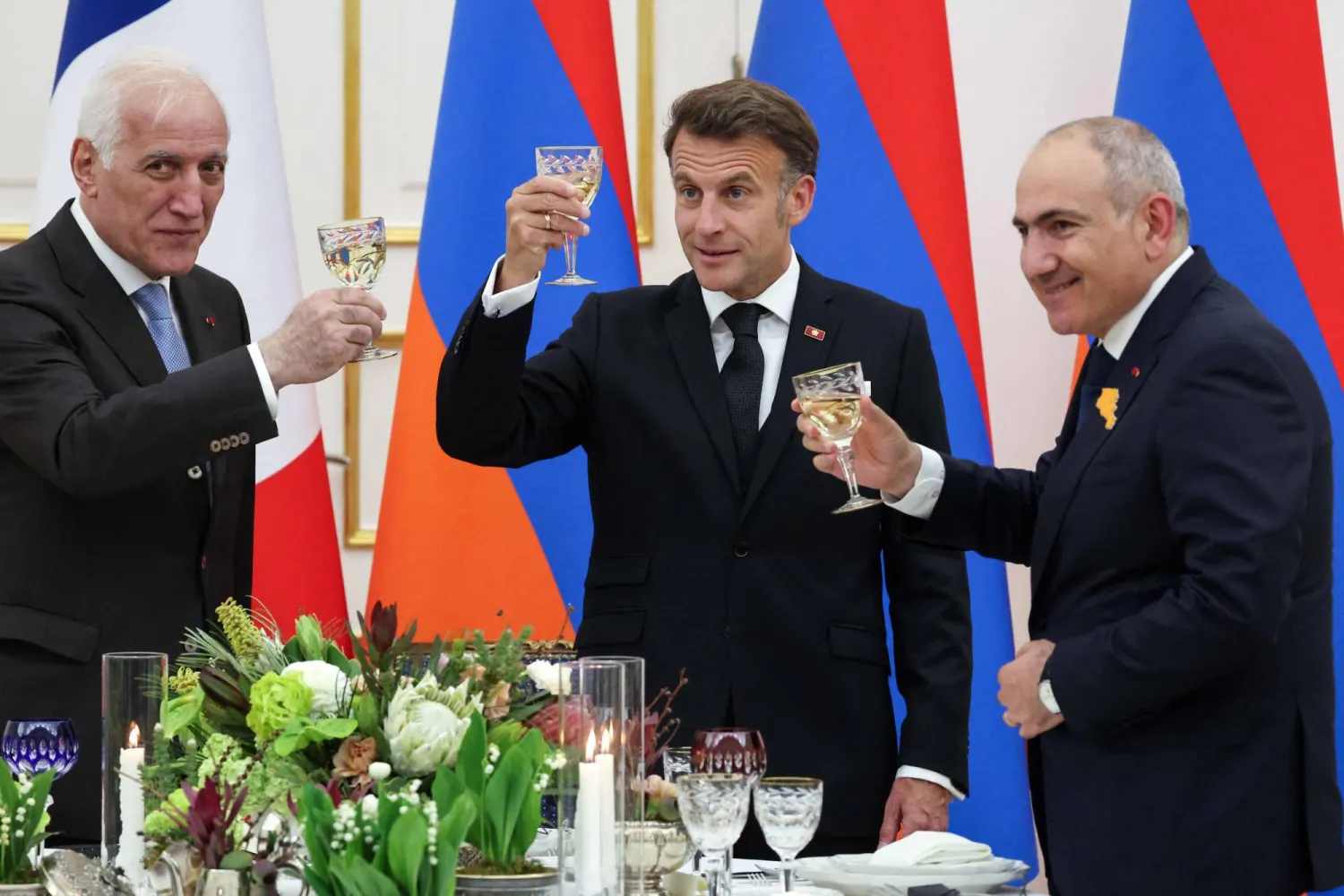
Armenia's President Vahagn Khachaturyan, France's President Emmanuel Macron and Armenia's Prime Minister Nikol Pashinyan share a toast during a state dinner in the honour of the French leader at the presidential palace in Yerevan on May 4, 2026. (Photo by Ludovic MARIN / AFP)
TT

Armenia Hosts a Historic EU Summit as It Charts a Course Away from Russia

Armenia's President Vahagn Khachaturyan, France's President Emmanuel Macron and Armenia's Prime Minister Nikol Pashinyan share a toast during a state dinner in the honour of the French leader at the presidential palace in Yerevan on May 4, 2026. (Photo by Ludovic MARIN / AFP)

Armenia hosts its first bilateral summit with the European Union on Tuesday, a landmark diplomatic moment for the Caucasus Mountains nation that has formally declared its ambition to join the bloc and is cautiously loosening its ties with longtime ally Russia.

The EU-Armenia summit in Yerevan follows the eighth gathering of the European Political Community, which brought dozens of European leaders to the Armenian capital. The officials addressed European security issues and the US-Israeli war in Iran in remarks on Monday.

The two meetings underscore how Armenia is seeking to turn westward and shed Russia's influence. Armenia’s relations with Moscow, its longtime sponsor and ally, have grown increasingly strained since 2023, when neighboring Azerbaijan fully reclaimed the Karabakh region and ended the decades-long rule by ethnic Armenian separatists.

Armenian authorities accused Russian peacekeepers who were deployed to the region of failing to stop Azerbaijan’s onslaught. Moscow, busy with its war in Ukraine, rejected the accusations, arguing that its troops didn’t have a mandate to intervene.

The war was “a belated demonstration that Russia is dangerously unreliable as a partner,” Richard Giragosian, director of the Regional Studies Center in Yerevan, told The Associated Press.

Pursuing ties with Europe

Since then, Prime Minister Nikol Pashinyan’s government has pursued closer ties with the West, a move welcomed by the EU.

In remarks to the EPC conference on Monday, EU Council President Antonio Costa thanked Pashinyan for “the courageous political decisions he has taken to bring Armenia closer to the European Union.”

“The direction of travel is unmistakable,” Costa said, stressing that it was “vital to strengthen Armenian democracy and fight external interference and misinformation.”

The opening ceremony of the EU-Armenia summit on Tuesday saw Costa walk the red carpet side-by-side with Pashinyan and European Commission President Ursula von der Leyen, while a military band played against a background of Armenian and EU flags.

In her opening statement, von der Leyen said that Europe was ready to aid Armenia in becoming a regional hub for global trade routes, including the building of physical infrastructure.

“We’re ready to invest in the local energy production and the energy links across the Black Sea, and we are ready to connect your booming digital scene to Europe’s digital market and turn Armenia’s position at the heart of this region into a motor of growth,” she said.

Armenia joined the International Criminal Court in 2023, a move Moscow condemned as an “unfriendly step.” The court has issued an arrest warrant for Russian President Vladimir Putin, accusing him of personal responsibility for the abductions of children from Ukraine.

Armenia also froze its participation in the Moscow-led Collective Security Treaty Organization in 2024. The following year, the Armenian parliament passed a law formally declaring the country’s intention to seek EU membership.

It is the EU, rather than the United States, that has stepped into the vacuum left by Russia, Giragosian said.

“EU engagement is much more prudent and much more productive than the US becoming involved, simply because European engagement is less provocative to Russia over the longer term,” he added.

However, Armenia remains a member of the Russia-led Eurasian Economic Union — a single market allowing the free movement of goods, capital and labor. The organization also includes Belarus, Kazakhstan and Kyrgyzstan — and Putin has made the trade-offs plain.

Speaking at talks with Pashinyan in Moscow earlier this year, Putin warned that Armenia could not simultaneously belong to both the EEU and the EU, noting that Yerevan currently receives Russian natural gas at prices far below European market rates. Pashinyan acknowledged the incompatibility but said Armenia could, for now, combine EEU membership with deepening EU cooperation.

Giragosian described Tuesday's summit as “a focus on deepening the preexisting relationship” rather than a step toward candidacy, referencing the Comprehensive and Enhanced Partnership Agreement that has governed EU-Armenia ties since coming fully into force in 2021.

“The symbolic significance is much greater as a message to Russia,” he said.

Benefits for Armenia and its prime minister

Yet some concrete results are expected, Giragosian said. Financing for domestic reform and military assistance through the European Peace Facility — a fund created primarily to support Ukraine — is among the anticipated announcements. An EU monitoring mission has been deployed along Armenia’s border with Azerbaijan for several years, and a new mission targeting hybrid threats has recently been approved.

Pashinyan, who has been in office since 2018 and faces parliamentary elections in June, stands to benefit politically from the international profile the European meetings confer. Giragosian noted that Pashinyan's government is likely to be returned largely by default, with the opposition unable to offer a credible alternative program.

But Giragosian warned against framing Armenia’s foreign policy as purely a pivot from Russia to the West.

“Armenia is also pivoting beyond the black and white zero-sum game paradigm,” he said, pointing to significant diplomatic investment in Asia, including with Japan, South Korea and China. “This is not about replacing Russia with the West. This is much more innovative, much more sophisticated.”

Heightened tensions

The summit also comes at a moment of heightened tension between Azerbaijan and the EU. Azerbaijan’s Ministry of Foreign Affairs summoned the EU ambassador last week to protest a European Parliament resolution demanding the release of Armenian prisoners of war and criticizing the treatment of Armenians in Karabakh. Lawmakers in Azerbaijan subsequently voted to suspend all cooperation with the European Parliament.

Azerbaijan President Ilham Aliyev, who addressed the EPC conference via video link, accused the European Parliament and the Parliamentary Assembly for the Council of Europe of “double standards” for placing sanctions on Azerbaijan's PACE delegation.

There were also protests outside the EPC summit venue, which was surrounded by tight security. Demonstrators held photos of Armenian prisoners being held in Azerbaijan.

Opposition leader Aram Sargsyan, head of the Democratic Party of Armenia, told the Armenian Press Agency that the European officials were voicing support for Pashinyan ahead of the election and have “forgotten about the Armenians in prison in Azerbaijan.”



Police in Eastern German State Defuse 21 Explosive Devices Found Near Power Grid

A burned vehicle sits at a construction site on the ground of a substation, as police is investigating a fire at the transformer substation, further raising security concerns over a series of sabotage attacks on Germany's power grid, in Berlin, Germany, September 7, 2026. Sign reads "No entry to the construction site". (Reuters)
TT

Police in Eastern German State Defuse 21 Explosive Devices Found Near Power Grid

A burned vehicle sits at a construction site on the ground of a substation, as police is investigating a fire at the transformer substation, further raising security concerns over a series of sabotage attacks on Germany's power grid, in Berlin, Germany, September 7, 2026. Sign reads "No entry to the construction site". (Reuters)

Prosecutors in the eastern German state of Saxony said on Monday that authorities had found a total of 21 explosive devices as part of their investigations into attacks on the electricity grid that have kept authorities on high alert for days.

Investigators discovered nine additional homemade explosive devices over the weekend near high-voltage power ‌lines south ‌of the Graustein substation in the ‌eastern ⁠German district of Goerlitz, ⁠taking the total number discovered to 21, police and prosecutors said in a joint statement.

Germany has been the focus of European fears about the vulnerability of critical infrastructure, as it experienced a series of sabotage incidents ⁠on the power grid last week ‌after a drone attack ‌in August at Leipzig/Halle for which the ‌government formally blamed Russia.

German police said on Friday ‌they were searching for a man who sent letters claiming responsibility for a series of sabotage attacks on the power grid last week after ‌they found what appeared to be explosives at his home. The man ⁠is ⁠still at large.

Initial findings into a fire at a transformer substation in Berlin earlier on Monday, which police had said was being investigated, showed the incident was caused by a technical fault, Spiegel reported citing Police Commissioner Barbara Slowik Meisel.

Separately, Bild newspaper reported that police in the western city of Wesel have launched major assessment operations after the security fence around another transformer substation was found to be cut open.


Kremlin Says It Does Not Rule Out Restart of Peace Talks with Ukraine and US

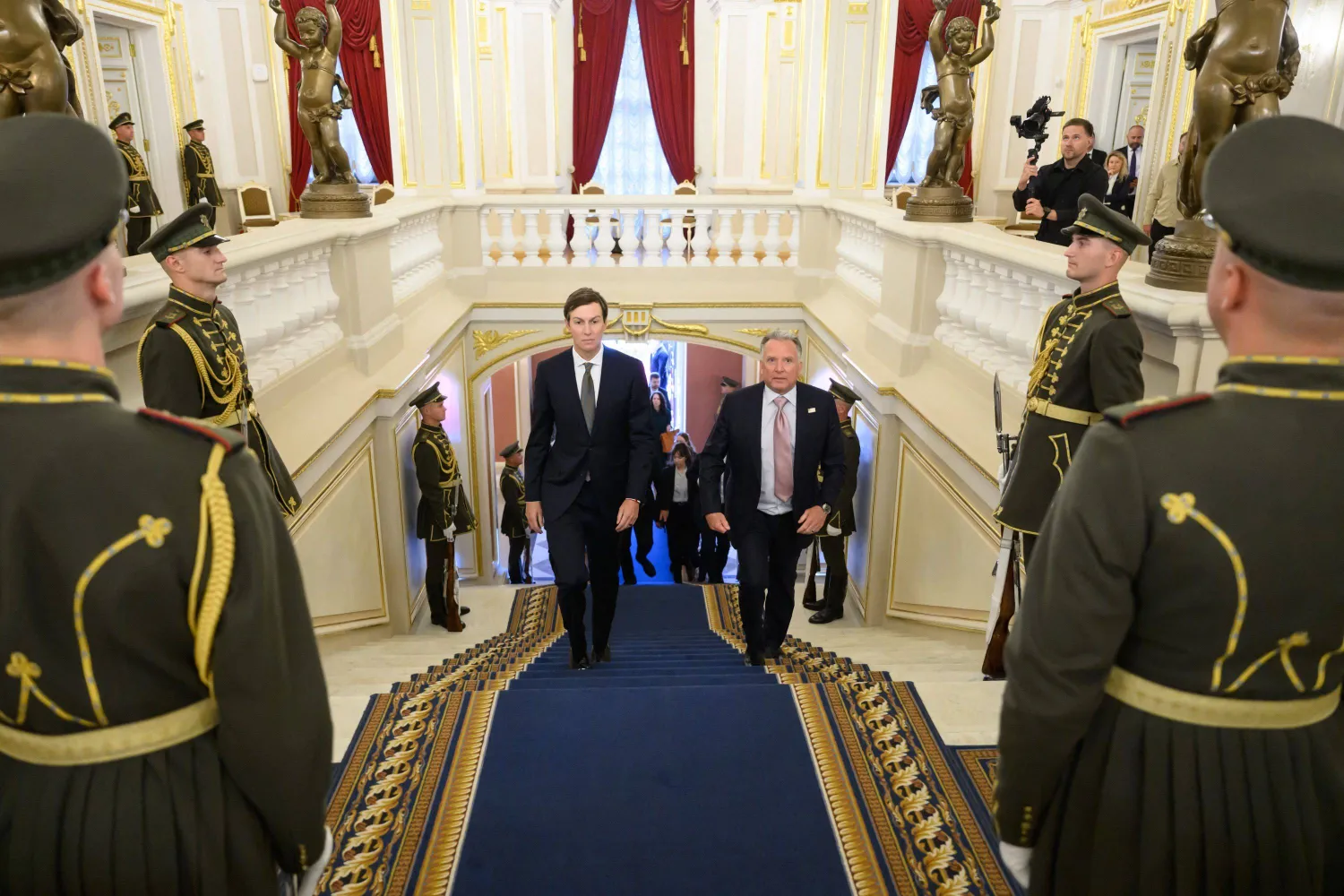
In this handout photograph taken and released by the Ukrainian Presidential Press Service on September 6, 2026, US Special Envoy Steve Witkoff (R) and US President Donald Trump's son-in-law Jared Kushner (L) arrive for talks with Ukrainian president in Kyiv, amid the Russian invasion of Ukraine. (Handout / Ukrainian Presidential Press Service /AFP)
TT

Kremlin Says It Does Not Rule Out Restart of Peace Talks with Ukraine and US

In this handout photograph taken and released by the Ukrainian Presidential Press Service on September 6, 2026, US Special Envoy Steve Witkoff (R) and US President Donald Trump's son-in-law Jared Kushner (L) arrive for talks with Ukrainian president in Kyiv, amid the Russian invasion of Ukraine. (Handout / Ukrainian Presidential Press Service /AFP)

The Kremlin said on Monday that it did not rule out the resumption of peace talks between Russia, Ukraine and the United States, but said it was too early to say when and where such talks might take place. 

Kremlin spokesman Dmitry Peskov made the comments when asked about a weekend visit to Moscow and Kyiv by US envoys Steve Witkoff and Jared ‌Kushner who ‌are trying to breathe new ‌life into ⁠stalled talks designed ⁠to find a way to end the war in Ukraine. 

"As for the resumption of the trilateral format, you heard the statement from Kyiv yesterday. Mr. Kushner made such statements. We, too, do not rule out the resumption of this trilateral format, but ⁠it is still too early to ‌speak of the venue ‌and exact dates,” Peskov told reporters when asked if three-way ‌peace talks would resume. 

Peskov, who declined to ‌discuss in detail the content of the latest US peace proposals or what the hardest outstanding issues to solve are, said the Kremlin did not rule out ‌a phone call between Russian President Vladimir Putin and US President Donald Trump to ⁠discuss ⁠the US envoys' trip. 

"Undoubtedly, any attempts...represent a small step towards peace, and we truly hold the peace-building efforts of the American negotiators in very high regard," Peskov told reporters. "President Putin himself has said that he holds President Trump’s efforts in high regard, and that he is grateful to President Trump for his commitment to this path towards peace.” 

Moscow had not yet received any information about contacts between the US envoys and Ukrainian officials in Kyiv on Sunday, Peskov said. 


Majority of Spaniards Unhappy with Government's Handling of Ceuta Crisis, Poll Shows

Migrants rest along a street in the Spanish North African enclave of Ceuta, 04 September 2026. EPA/LAURA RINCON
TT

Majority of Spaniards Unhappy with Government's Handling of Ceuta Crisis, Poll Shows

Migrants rest along a street in the Spanish North African enclave of Ceuta, 04 September 2026. EPA/LAURA RINCON

Nearly nine in ‌10 Spaniards blame Morocco for the mass migrant crossings into Ceuta in late July, while a majority rate Prime Minister Pedro Sanchez's handling of the crisis as "bad" or "very bad", according to an opinion poll released on Monday that also showed a drop in support for Sanchez's party, Reuters said.

The 40dB poll of 2,000 people for El Pais newspaper and radio station SER also recorded an increase in voting ‌intentions for the ‌conservatives and the anti-immigration, far-right Vox party, ‌in ⁠line with several ⁠other polls conducted after the deadly border surge into Spain's North African enclave.

* For 89% of respondents, Morocco bore the most responsibility for the crisis, followed by human-trafficking groups (75%), the spread of disinformation on social media (74%), the migrants who decided ⁠to cross (73%) and the Spanish government (72%), the ‌40dB poll found.

* Only ‌14.2% rated Sanchez's handling of the crisis positively, with ‌two-thirds of those surveyed saying his response was too ‌slow.

* The combined voting intentions for the conservative People's Party and Vox hit 50.2%, leading their potential right-wing alliance to breach the 50% mark for the first ‌time in an opinion poll during this legislature. The center-left bloc fell to 36.1%.

* ⁠The ⁠PP rose to 32.4%, from 32% in the previous 40dB poll in July, and Vox to 17.8% from 17.2%, while Sanchez's Socialist Party dipped to 27.6% from 28%.

* About 27% of respondents named Vox as the most capable party on the issue of immigration, ahead of the Socialists at 18.4% and the PP at 13.9%.

* Seven out of 10 chose tighter border controls over protecting vulnerable migrants and 82% backed increasing fences and surveillance at Spain's borders.