


Report: Trump Administration Prepares to Seek Raúl Castro Indictment as It pressures Cuba

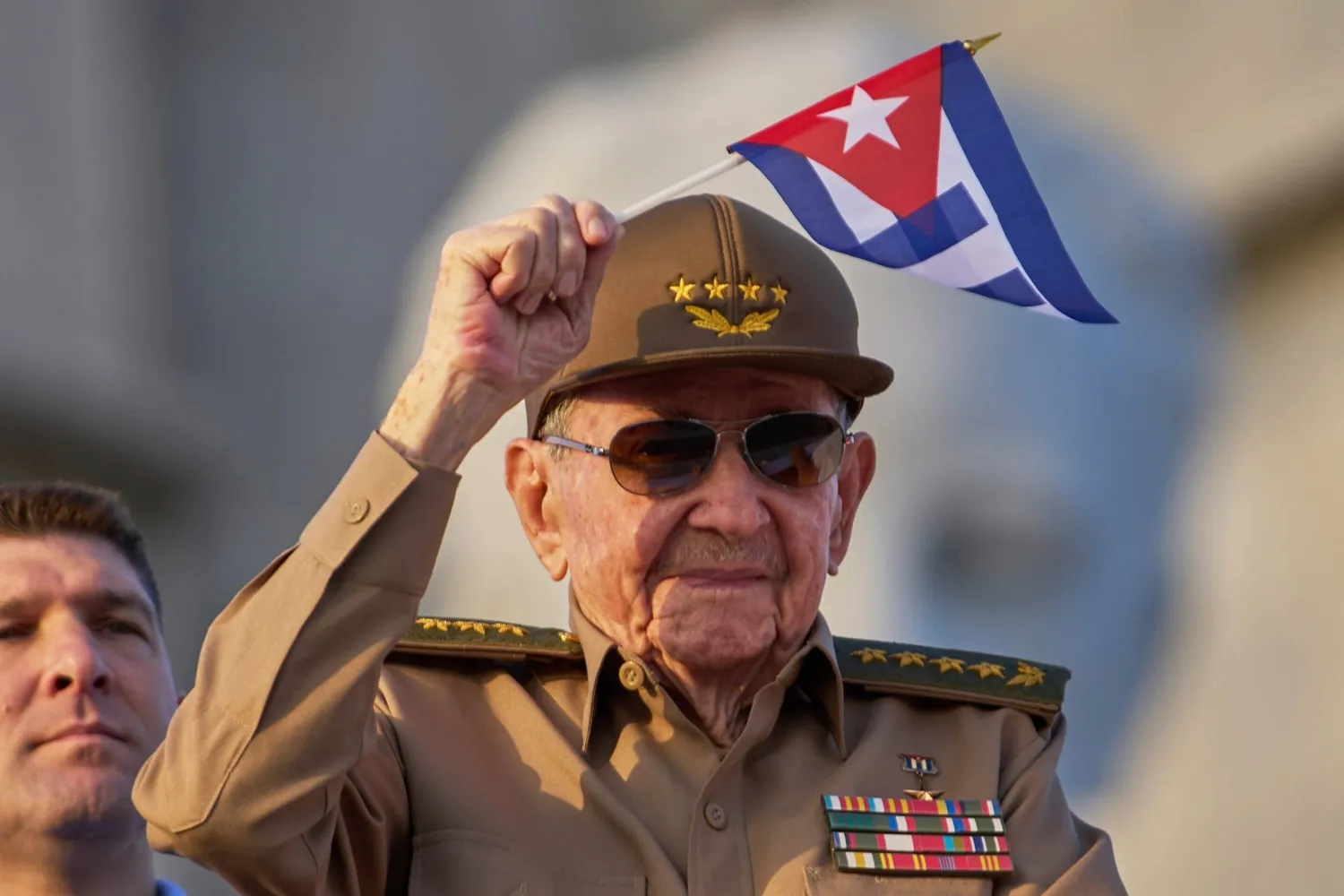
FILE - Raul Castro waves a Cuban national flag during a May Day parade at Revolution Square in Havana on May 1, 2025. (AP Photo/Ramon Espinosa, File)
TT

Report: Trump Administration Prepares to Seek Raúl Castro Indictment as It pressures Cuba

FILE - Raul Castro waves a Cuban national flag during a May Day parade at Revolution Square in Havana on May 1, 2025. (AP Photo/Ramon Espinosa, File)

The Justice Department is preparing to seek an indictment against former Cuban President Raúl Castro, three people familiar with the matter told The Associated Press on Friday, as President Donald Trump threatens possible military action against the communist-run island.

One of the people told the AP that the potential indictment is connected to Castro's alleged role in the 1996 shootdown of four planes operated by the Miami-based exile group Brothers to the Rescue. Castro was defense minister at the time.

All three people spoke on the condition of anonymity because they weren't authorized to discuss an ongoing investigation. The Cuban government did not respond to a request for comment on the potential indictment, which was reported earlier by CBS.

Any criminal charge against Castro, which would need to be approved by a grand jury, would dramatically escalate tensions with Havana and ramp up expectations of US military action in Cuba like the one carried out in January in Venezuela to bring President Nicolàs Maduro to New York on drug trafficking charges.

Following Maduro’s ouster, the Trump administration quickly turned its attention to his ally Cuba and ordered an economic blockade that choked off fuel shipments to Cuba, leading to severe blackouts, food shortages and a collapse in economic activity across the island.

Iran war gave Cuba a breather

The US war in Iran appeared to have given Cuban leaders something of a reprieve from US talk of regime change.

As Trump seeks to wind down that conflict, speculation has been growing that he may soon turn his attention back to Cuba after pledging earlier this year a “friendly takeover” of the country if its leadership didn’t open up its economy to American investment and kick out US adversaries.

Richard Feinberg, a professor emeritus specializing in Latin America at the University of California-San Diego, said that any indictment of Castro will play well with voters in south Florida but is unlikely to persuade career war planners in the Pentagon to pursue a second war of choice — this time just 90 miles from Florida.

“There’s no easy Venezuela copy,” said Feinberg. “There's no clear line of succession and it's hard to imagine regime change without US boots on the ground.”

The AP reported in March that the US Attorney in Miami had created a special working group of prosecutors and federal law enforcement to build cases against top Cuban officials amid calls by several south Florida Republicans to reopen its investigation into Castro’s alleged role in the 1996 shootdown.

Trump calls Cuba ‘a declining country’

Trump declined to discuss a potential indictment on Friday, deferring to the Justice Department.

“But they need help, as you know, and you talk about a declining country — they are really a nation or a country in decline, so we’re going to see,” Trump told reporters aboard Air Force One. “We have a lot to talk about on Cuba, but not maybe for today.”

CIA Director John Ratcliffe met with Cuban officials, including Castro’s grandson, during a high-level visit to the island on Thursday.

Castro, 94, took over as president from his ailing brother, Fidel Castro, in 2011, and then handed power to a handpicked loyalist, Miguel Díaz-Canel, in 2019.

While he largely has avoided the spotlight since retiring in 2021 as head of the Cuban Communist Party, he is widely believed to wield power behind the scenes, a fact underscored by the prominence of his grandson, Raúl Guillermo Rodríguez Castro, who previously met secretly with US Secretary of State Marco Rubio.

Florida straits shootdown a watershed moment in Cuba-US relations Cuba's shootdown in 1996 of two Cessna aircraft operated by the Brothers to the Rescue was a watershed moment in decades of hostilities between the two countries.

At the time, President Bill Clinton had been cautiously exploring ways to reduce tensions with a Cold War adversary but faced stiff opposition from exiles who organized publicity-seeking flyovers of Havana, dropping anti-Castro leaflets, and aiding Cuban rafters fleeing economic deprivation and single-party rule.

The Cubans had warned the US government for months that it was prepared to defend against what it considered deliberate provocations. But those calls went unheeded and on Feb. 26, 1996, missiles fired by Russian-made MiG-29 fighter jets downed two unarmed civilian Cessna planes just beyond Cuba's airspace, according to an investigation conducted by the International Civil Aviation Organization. A third plane, carrying the organization’s leader, narrowly escaped.

“With hindsight, it appears the Castros' motive was to slow down the Clinton outreach because they needed the US as an external enemy to justify their national security posture,” said Richard Fienberg, who worked on Cuban issues at the National Security Council at the time.

They succeeded beyond their wildest dreams, said Feinberg.

Shortly after the shootdown, Congress passed what became known as the Helms-Burton Act, which codified a US trade embargo enacted in 1962 and made it far more complicated for successive US presidents to engage with Cuba.

To date, the US has convicted only a single person of conspiracy to commit murder in connection with the Brothers to the Rescue shootdown. Gerardo Hernández, the leader of a Cuban espionage ring dismantled by the FBI in the 1990s, was sentenced to life in prison but was released by President Barack Obama during a prisoner swap in 2014 as part of an attempt to normalize relations with Cuba.

Two fighter jet pilots and their commanding officer have also been indicted but are outside the reach of US law enforcement while living in Cuba.

Castro previously investigated for drug trafficking Castro has been under US criminal investigation before. In 1993, federal prosecutors in Miami considered charging him and several other senior Cuban military officials with cocaine trafficking based on testimony from Colombian traffickers that emerged in the drug trial of former Panamanian leader Manuel Noriega, the AP reported in 2006.

But an indictment never followed amid concerns about the witness’ credibility as well as fears that it could risk US intelligence operations and derail Clinton’s tentative outreach.



Police Made 1,314 Arrests in France’s Protests, Says Govt

A pedestrian walks past a broken window, a day after a demonstration in favor of purchasing power, the protection of public services, and fiscal and social justice, in Paris on October 25, 2026 as part of a nationwide call for mobilization bringing together former members of the Yellow Vest movement, labor unions, high school and university students. (AFP)
TT

Police Made 1,314 Arrests in France’s Protests, Says Govt

A pedestrian walks past a broken window, a day after a demonstration in favor of purchasing power, the protection of public services, and fiscal and social justice, in Paris on October 25, 2026 as part of a nationwide call for mobilization bringing together former members of the Yellow Vest movement, labor unions, high school and university students. (AFP)

Police arrested 1,314 people in weekend protests across France, the interior ministry said Sunday, adding that 53 officers were hurt in clashes.

The arrests occurred as violence broke out on the margins of mass demonstrations in major cities on Saturday over the high cost of living.

It was the second consecutive weekend of unrest in France, which is heading to presidential elections in April and May to choose a successor to Emmanuel Macron, who is reaching his two-term limit.

The interior ministry said police responded to 75 fires during Saturday's protests, adding that 24 shops were looted.

"Several investigations have been opened," it said in a statement, without giving details. It said that the rest of Saturday night, after the clashes had died down, was "calm".

The ministry statement on Sunday did not say how many protesters were hurt.

Late Saturday, Interior Minister Laurent Nunez spoke of two serious injuries among protesters: one in Toulouse and one in Clermont-Ferrand.

- Protesters hurt -

The Toulouse prefecture, which reports to the interior ministry, told AFP that a 20-year-old man was seriously hurt with a wound to his hand.

A street medic who tended demonstrators told AFP, on condition of anonymity, that the man had "several fingers" blown off his right hand.

The prefecture covering Clermont-Ferrand said a man there also had a hand hurt, but did not suffer the loss of any fingers.

A French regional daily, La Nouvelle Republique, reported that a man in Poitiers was hurt in his left eye, showing a photo of a man holding his face.

The newspaper's photographer told AFP he was a 19-year-old who was wounded during a charge by riot police firing stun grenades and tear gas.

There have been several instances in recent weeks, during student protests in France, of people being maimed by police stun grenades or tear gas grenades.

It was not known if the injuries reported from Saturday were from those police weapons. Officials said investigations had been opened in at least some of the cases.


Far-right Leader Le Pen Kicks Off Tilt at French Presidency amid Nationwide Protests

26 September 2026, France, Paris: Jordan Bardella and Marine Le Pen arrive at Place de la Concorde ahead of Pope Leo XIV's Mass in Paris. Photo: Pierre Teyssot / Agf/AGF via ZUMA Press/dpa
TT

Far-right Leader Le Pen Kicks Off Tilt at French Presidency amid Nationwide Protests

26 September 2026, France, Paris: Jordan Bardella and Marine Le Pen arrive at Place de la Concorde ahead of Pope Leo XIV's Mass in Paris. Photo: Pierre Teyssot / Agf/AGF via ZUMA Press/dpa

Marine Le Pen, France's far-right candidate to succeed President Emmanuel Macron in elections in six months, was to give her first campaign speech on Sunday, a day after protests sweeping the country again flared into violence.

Le Pen -- the frontrunner according to surveys -- is seen benefiting from the convulsions France has been going through for weeks, punctuated by mass rallies and violent clashes on Saturday and a week earlier, said AFP.

More than 400,000 people marched in major French cities on Saturday to protest the rising cost of living, with groups of masked youths breaking away to provoke police, who responded with tear gas and water cannon. Police made more than 1,000 arrests.

Officers faced "an extremely elevated level of violence" from black-clad "ultra-left" extremists who had trailed in the demonstrations, Interior Minister Laurent Nunez said late Saturday.

A week earlier, on October 17, similar nationwide marches took place, also against rising inflation sent surging by the war in the Middle East. They, too, degenerated into street violence, with public buildings vandalized and hundreds of shops looted.

The mass rallies were fed by four weeks of student protests across France, over classroom conditions and access to university places, which at times also descended into clashes.

Unions and Yellow Vest protesters have vowed to keep up their street marches in the weeks ahead, pointing to a febrile period as the elections draw near.

- Anger at Macron -

Le Pen, who will address 10,000 members of her National Rally (RN) party in the city of Orleans, has accused Macron's centrist government of being soft on violent protesters and lacking authority.

Police were on Sunday filtering traffic going into Orleans, after thousands of counter-protesters opposed to Le Pen and her anti-immigration, nationalist RN marched in the city on Saturday chanting anti-fascist slogans.

Police put their numbers at 13,000, while organizers estimated the turnout at twice that.

If Le Pen wins the two-stage presidential elections in April and May, she has vowed to cut the cost of living through capped household energy bills, reduced taxes and trimming France's contribution to the European Union.

She is also critical of NATO, and of France's support of Ukraine as it battles Russia's invasion.

The RN, which portrays itself as a party of law and order, has also sided strongly with the police in the current unrest.

The head of Le Pen's party, Jordan Bardella, whom she intends to make prime minister if she becomes president, has visited police stations to underline that credential.

French voters, angry over Macron's perceived detachment over his two terms and his recent orders to curb the protests, are turning to more extremist politics, polling shows.

An Ipsos survey published Saturday suggested Le Pen would score 32 to 34 percent of the vote in the first round of the election, with a far-left rival, Jean-Luc Melenchon, getting 17 percent. Centrist candidates from mainstream parties trailed them.

Asked about the protest violence, a majority of the 1,500 people questioned in the survey -- 58 percent -- said they felt anger.

It found 81 percent believed the government was "responsible for this situation", while 79 percent thought radical political groups were, 62 percent blamed the left, and 52 percent blamed the police.

- No money -

Whoever wins the presidency will find limited room to throw money around to placate various clamoring interest groups.

France's public debt and budget deficit have climbed well beyond the ceilings EU member countries are meant to stick to.

Macron's government is trying to get a cost-cutting budget adopted, but faces headwinds from both the sustained protests demanding more spending and the political jockeying by parties eyeing power.

As Macron sees out the final months of his presidency, he has to tread a line between cracking down on street violence and opening dialogue with unions, students and other groups to attempt to restore order.

Although the French president has not invoked a state of emergency, he has ordered bans on non-union demonstrations deemed "illegitimate", and officials under him have imposed bans on protests in city centers and localized curfews in certain zones.

Many protesters on Saturday raged against the measures, describing them as an assault on the French right to protest.

The Yellow Vest movement, which challenged Macron eight years ago with street disruptions, has called for another day of protests next Saturday.

And the powerful CGT union, prominent in the demonstrations, is urging a campaign of strikes starting from November 5.


Iran Parliament Speaker Calls for Cutting Gas Consumption by 10 Percent as Winter Nears

 Traffic moves past an installation depicting butterflies forming the Iranian national flag in Tehran on October 21, 2026. (AFP)
Traffic moves past an installation depicting butterflies forming the Iranian national flag in Tehran on October 21, 2026. (AFP)
TT

Iran Parliament Speaker Calls for Cutting Gas Consumption by 10 Percent as Winter Nears

 Traffic moves past an installation depicting butterflies forming the Iranian national flag in Tehran on October 21, 2026. (AFP)
Traffic moves past an installation depicting butterflies forming the Iranian national flag in Tehran on October 21, 2026. (AFP)

Iran's parliament speaker Mohammad Bagher Ghalibaf on Sunday called for a campaign to cut gas consumption by at least 10 percent, with officials anticipating shortages as winter approaches.

While a major producer, Iran has long suffered shortages of natural gas, essential for powering heating systems, which have been exacerbated by war with the United States and Israel that began in February.

During the most intense phase of the fighting, which lasted nearly 40 days, the two countries struck key Iranian infrastructure including natural gas refineries, according to Tehran.

Winter in Iran often sees temperatures drop below freezing, especially in the country's north.

"To get through the approaching winter, a nationwide effort is essential ... to reduce gas consumption by at least 10 percent," said Ghalibaf in a video carried by Iranian media.

"Anyone who saves gas, regardless of the amount, will immediately receive the corresponding proceeds in their bank account, allowing everyone to see the tangible impact of those savings on their household budget."

Earlier in October, First Vice-President Mohammad Reza Aref said the government anticipated a daily "gas shortfall of 100 million to 250 million cubic meters during the cold season because of the damage caused by the war," according to the official IRNA news agency.

He added that he hoped to restore the supply of around 100 million cubic meters by the start of winter.

An April ceasefire brought an end to the initial phase of intense bombardment, but the two sides have continued to vie for control over the Strait of Hormuz, through which around a fifth of the world's oil and liquefied natural gas used to travel.

Iran has claimed control over the strait since the outbreak of the war and has regularly targeted vessels that attempt crossings without its authorization.

In response, Washington has imposed a counter-blockade on Iranian ports and in August announced what it called an "economic asphyxiation" campaign on Iran aimed at strangling its already battered economy.