

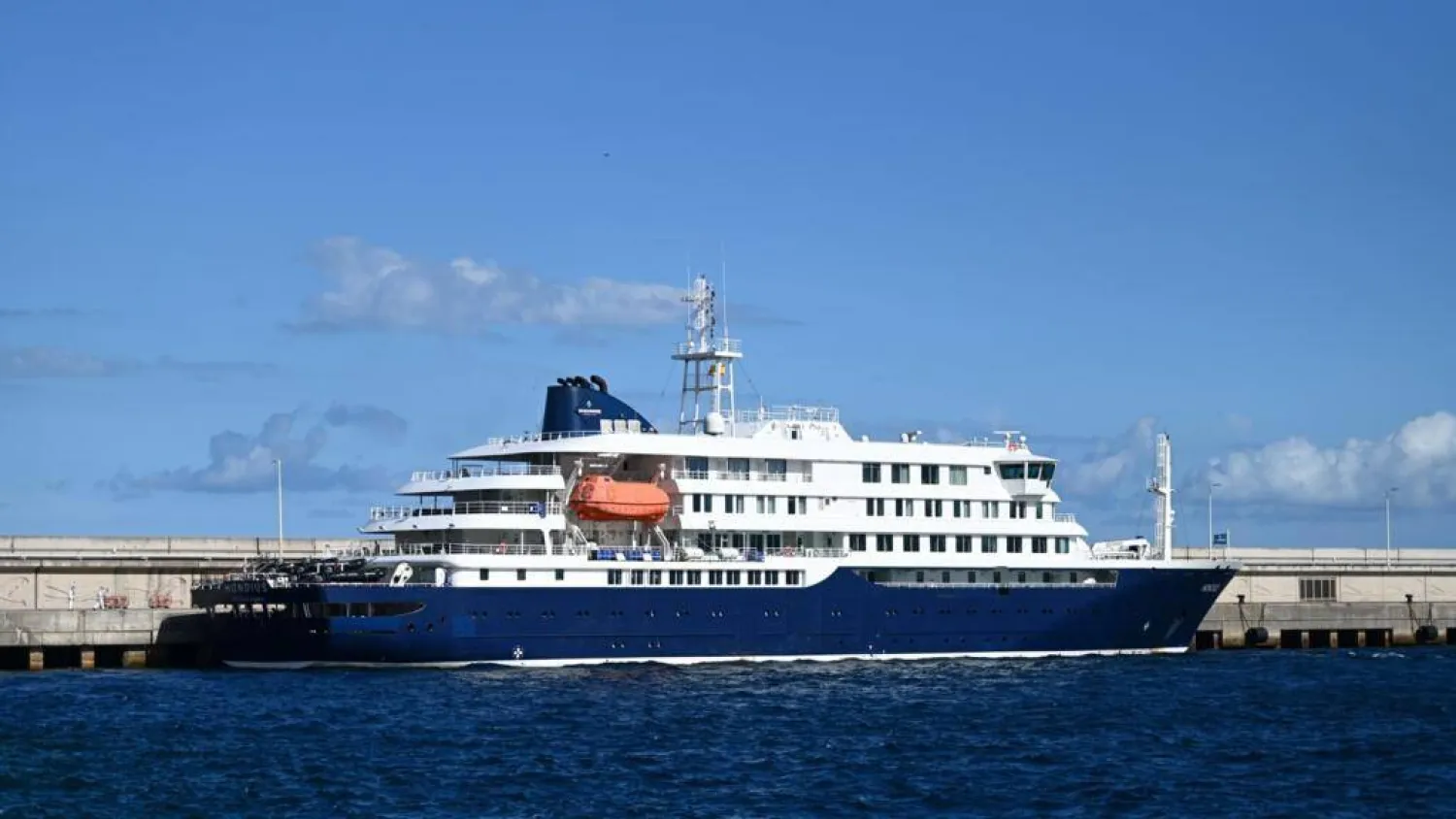

Hantavirus-Hit Cruise Ship Ends Deadly Voyage

The MV Hondius sparked global alarm after the outbreak of hantavirus. JORGE GUERRERO / AFP
TT

Hantavirus-Hit Cruise Ship Ends Deadly Voyage

The MV Hondius sparked global alarm after the outbreak of hantavirus. JORGE GUERRERO / AFP

A cruise ship that sparked global alarm after a deadly outbreak of hantavirus ended its voyage by docking in Rotterdam harbor Monday, with the skeleton crew facing weeks of quarantine. 

Twenty-five crew and two medical staff had been left on board, some of whom could be seen wearing blue hard hats and white face masks as the ship made its final approach into port for disembarkation and disinfection. 

A first group disembarked hours later, dressed in white hazmat gowns and clutching bags and boxes of belongings. 

The ship, operated by Dutch company Oceanwide Expeditions, made headlines after three passengers died from hantavirus -- a rare virus for which no vaccines nor specific treatments exist. 

The World Health Organization has scrambled to reassure the world that the outbreak was not a repeat of the Covid pandemic, stressing that contagion was very rare. 

However, the virus has an incubation period of several weeks, meaning more cases from the ship's occupants could emerge in the future, the WHO has warned. 

Hantavirus has been confirmed in seven patients, with one other probable case, according to an AFP tally from official sources. 

The most recent positive test came from Canada in a patient who was on the Hondius, officials said late Sunday. 

- Hospitalizations - 

After arriving in the Canary Islands on May 10, more than 120 passengers and crew were evacuated from the ship, either to their home countries or to the Netherlands, which has a special responsibility as the ship is Dutch-flagged. 

A 65-year-old French woman became symptomatic on the repatriation flight and ended up in critical condition in a Paris hospital with a confirmed case of hantavirus. 

Two people, one Dutch and one British, were also urgently evacuated from the ship to the Netherlands and rushed to hospital. 

Both are in stable condition and the Briton is well enough to return home for self-isolation, according to Dutch officials. 

All others evacuated to the Netherlands from the ship have tested negative for the virus. Some are in quarantine in the Netherlands, others have already flown home. 

Everyone still on board is asymptomatic, according to Oceanwide Expeditions, and being closely monitored by two medics on board. 

Late Sunday, the WHO said it was maintaining its assessment of the hantavirus outbreak as "low risk". 

- Andes strain - 

The people disembarking on Monday comprise 17 from the Philippines, four from the Netherlands (two crew and the two medical staff), four from Ukraine, one from Russia and one from Poland. 

Some of them will stay in quarantine facilities at the port, while others will self-isolate at home. 

Those in quarantine in Rotterdam will be housed in mobile homes near the port, local health official Yvonne van Duijnhoven told AFP. 

They will be tested for the hantavirus but also receive mental health treatment if needed. 

"We are really going to monitor that, because it's really impactful what they already have experienced in the past few weeks," she said. 

Also on board is the body of a German woman who died during the voyage. She will be cremated in the Netherlands in line with the family's wishes, said van Duijnhoven. 

After docking, the ship will undergo days of cleaning and disinfection procedures. 

The MV Hondius's voyage began on April 1 in Ushuaia, Argentina, taking in remote islands in the South Atlantic Ocean before steaming north to Cape Verde. 

The trip was supposed to finish there, but the ship eventually sailed to Tenerife in the Canary Islands for the evacuations by plane. 

The MV Hondius presented diplomatic challenges as different countries negotiated over who would receive it and treat its passengers. 

Cape Verde refused to take the ship, which remained anchored offshore of the capital Praia as three people were evacuated to Europe by air. 

Spain allowed the vessel to anchor off its Canary Islands for the evacuation of passengers and crew but the Atlantic archipelago's regional government fiercely opposed the measure. 

Hantavirus spreads from the urine, feces and saliva of infected rodents and is endemic in Argentina, where the voyage began. 

Those infected have the Andes virus -- the only strain of hantavirus that can spread between people. 

Kiki Hirschfeldt, a spokeswoman for the operator, said it was too early to say what impact the outbreak could have on the appetite for cruises. 

"I mean, for as far as we know right now, the virus was brought on board and that can happen in a hotel, in an airplane, in a boat," she told AFP. 


5 Killed in Russian Strikes on Ukraine as Putin Warns Europe Against Sending Troops

Ukrainian rescuers work amid the rubble at the site of a Russian strike on a multi-story residential building in Odesa, southern Ukraine, 12 September 2026, amid the ongoing Russian invasion. EPA/IGOR MASLOV
TT

5 Killed in Russian Strikes on Ukraine as Putin Warns Europe Against Sending Troops

Ukrainian rescuers work amid the rubble at the site of a Russian strike on a multi-story residential building in Odesa, southern Ukraine, 12 September 2026, amid the ongoing Russian invasion. EPA/IGOR MASLOV

Russian strikes killed five civilians and wounded dozens in Ukraine, local officials said Saturday, after Russian President Vladimir Putin warned that sending European troops into Ukraine would amount to direct conflict with Russia.

Ukraine is under mounting pressure from Russia’s intensifying air campaign that uses ballistic missiles and jet-powered drones to pierce defenses. Moscow’s attacks have targeted Ukraine’s power grid ahead of winter in what officials say is meant to demoralize civilians.

Two people were killed and one wounded when Russian drones struck a residential area overnight in the Ukrainian city of Zaporizhzhia, regional head Ivan Fedorov said Saturday.

One person died and three others were wounded in strikes on Kryvyi Rih, according to local officials.

In the Black Sea port of Odesa and the surrounding area, 35 people were wounded overnight in what regional head Oleh Kiper called a “massive attack.” Among the buildings hit was a residential high-rise, whose upper floors were completely destroyed.

Later on Saturday, two people were killed in a Russian attack on a grocery store in Ukraine's Zhytomyr region, local officials said.

Meanwhile, Ukrainian President Volodymyr Zelenskyy said Ukrainian forces struck two chemical industry facilities in Russia, one in Samara and one in Perm. The governors of the regions did not immediately comment, but Russian independent online news outlet Astra reported drone attacks on chemical plants in both regions.

Putin, speaking to reporters at a summit of the BRICS group of emerging economies in India on Friday, said that if European governments send troops into Ukraine, it will mean “a war with Russia.”

“Now they’re talking about how they’re considering sending troops into Ukraine. That means a war with Russia,” The Associated Press quoted him as saying.

Some European leaders have pledged their commitment to a potential peacekeeping force, a prospect that Moscow has repeatedly described as unacceptable.

Putin also denied Russia posed any threat to Europe, saying “there is no such threat and never has been.”

“We do not threaten, nor do we intend to threaten, European countries,” he said.

Polish Prime Minister Donald Tusk said Thursday that two incidents along Ukraine’s borders with Poland and Moldova this week were a preview of potential intensified Russian provocations at Ukraine’s border crossing points with Europe.

Two people died when Russian drones hit the Starokozache border crossing between Ukraine and Moldova on Tuesday night, while a “direct threat” to a Polish-Ukrainian crossing point on Wednesday night was only avoided thanks to cooperation between Warsaw and Kyiv, he said.

Meanwhile, Zelenskyy told Deutsche Welle, in an interview published Saturday, that he would meet Putin if both leaders were invited to the Group of 20 summit of rich and developing nations in December in Miami.

Putin’s foreign policy adviser, Yuri Ushakov, said Saturday that the possibility of Putin attending the summit had not yet been discussed.

The Kremlin in the past has said that Zelenskyy can come to Moscow if he wants a meeting with Putin, a proposal Kyiv has rejected.

“If he really wants to meet with Putin, Putin has already said that he could fly to Moscow,” Kremlin spokesman Dmitry Peskov said Saturday.

Russian Foreign Minister Sergey Lavrov affirmed Saturday that Russia is “ready for negotiations,” but that the so-called “special military operation,” as Moscow refers to its war in Ukraine, “will not be suspended during this period of negotiations.”


BRICS Nations Call for 'Maximum Restraint' in Middle East War

A handout photo made available by India’s Ministry of External Foreign Affairs shows BRICS leaders planting trees during the 18th BRICS Leaders' Summit in New Delhi, India, 12 September 2026. EPA/INDIAN MINISTRY OF EXTERNAL FOREIGN AFFAIRS/HANDOUT
TT

BRICS Nations Call for 'Maximum Restraint' in Middle East War

A handout photo made available by India’s Ministry of External Foreign Affairs shows BRICS leaders planting trees during the 18th BRICS Leaders' Summit in New Delhi, India, 12 September 2026. EPA/INDIAN MINISTRY OF EXTERNAL FOREIGN AFFAIRS/HANDOUT

Members of the 11-nation BRICS group including China, Russia, Iran and India called for calm in the Middle East at a summit in New Delhi on Saturday.

Chinese President Xi Jinping, who joined Russian, Iranian, Indian and other leaders in India's capital, told the summit that the Middle East war "does not serve the common interests of the international community.”

Leaders issued a statement on Saturday after intense diplomatic efforts by host India, as the bloc seeks to bolster its global influence and address conflict, trade turbulence and energy security.

"We express deep concern over the continued escalation of tensions in Middle East/West Asia," the joint statement said, according to AFP, adding the countries "call for exercising maximum restraint, as well as avoiding actions that could further aggravate the situation.”

BRICS was created in 2009 as a forum for major emerging economies seeking greater influence in institutions dominated by Western powers.

"We have to transform this pyramid of privilege into a platform of partnership," Indian Prime Minister Narendra Modi told Xi, Russian President Vladimir Putin, Iranian President Masoud Pezeshkian and other leaders as he opened the two-day summit.

Modi said BRICS nations "represent 50 percent of the world's population, 40 percent of global GDP and more than 25 percent of global trade.”

But finding balance in the bloc is a tough diplomatic task.

India maintains cordial relations with both Iran and US ally Israel, but is also careful to strike a delicate balance in its ties with Washington.

Iran's Pezeshkian attended the summit shortly after warning that the Middle East does not need the United States to be a "regional policeman,” with the two countries at war and tensions threatening the vital Strait of Hormuz.

India has navigated the energy crisis caused by the US-Iran war in part by turning to Russia, despite Moscow's war in Ukraine and pressure from Washington and other Western capitals.

Modi embraced Putin before talks on Friday. The Russian president, who last visited India in December 2025, is one of New Delhi's most important strategic partners.

Xi's participation is also being closely watched because it is his first visit to neighboring India since 2019, and the biggest step yet in a cautious thaw between the nuclear-armed rivals.

Xi was given a red-carpet welcome, with an honor guard of soldiers and traditional dancers in colorful dresses.

"Although our two countries are different in many respects, they are fully capable of complementing each other's strengths, supporting one another, achieving mutual success and advancing together," Xi said as he met Modi, in a video released from New Delhi.

His visit comes six years after a deadly military clash along the disputed Tibetan border between China and India, with ties gradually improving through restored flights, visas and high-level contacts.

The underlying territorial dispute remains unresolved, and both sides retain heavy military deployments along their roughly 3,500-kilometer high-altitude border.

India's foreign ministry said in a statement after the meeting that "the two leaders expressed commitment to a fair, reasonable, and mutually acceptable resolution of the boundary question.”

Modi "underlined the need for both sides to observe existing agreements and understandings on border related issues," the foreign ministry added.

Deep mistrust remains, with their contested Himalayan frontier, a widening trade deficit and strategic rivalry continuing to complicate ties.

"Both sides should... work hand-in-hand to promote high-quality major financial cooperation, advocate an equal and sustainable global order, and foster an economic globalization that is open and inclusive," Xi said.


Pezeshkian Says Middle East Has No Need for US 'Policeman'

Indian Prime Minister Narendra Modi, right, greets Iranian President Masoud Pezeshkian upon his arrival for the BRICS summit in New Delhi, India, Saturday, Sept. 12, 2026. (Indian Foreign Ministry via AP)
TT

Pezeshkian Says Middle East Has No Need for US 'Policeman'

Indian Prime Minister Narendra Modi, right, greets Iranian President Masoud Pezeshkian upon his arrival for the BRICS summit in New Delhi, India, Saturday, Sept. 12, 2026. (Indian Foreign Ministry via AP)

Iran's President Masoud Pezeshkian said on Saturday that the Middle East does not need the United States to be a "regional policeman,” with the two countries at war and vying for control of the Strait of Hormuz.

"We do not need a regional policeman," he said on the sidelines of a BRICS summit in India during a meeting with Malaysian Prime Minister Anwar Ibrahim.

"The territorial integrity and security of the region can only be guaranteed by its main players and the countries that comprise it," he added, according to the Iranian presidency.

Iran has been at war since February 28, when US-Israeli strikes killed its supreme leader.

Tehran retaliated with attacks across the region and blockaded the Strait of Hormuz, through which one-fifth of the world's oil previously flowed.

Iran and the US have since been vying for control of the strategic waterway.

The strait was free to transit before the war, but Iran now requires vessels to obtain permission and is considering a mechanism to impose service fees.

Ships that do not comply are regularly targeted by Iranian strikes, while the US periodically bombs the Iranian coastline to challenge the country's control of the strait.

More than six months into the Middle East war, the blockade continues to drive up oil prices, which soared past $100 a barrel this week.

"Despite all the injustices suffered by our people, we neither desire war nor its continuation. Peace remains our priority," Pezeshkian added.
