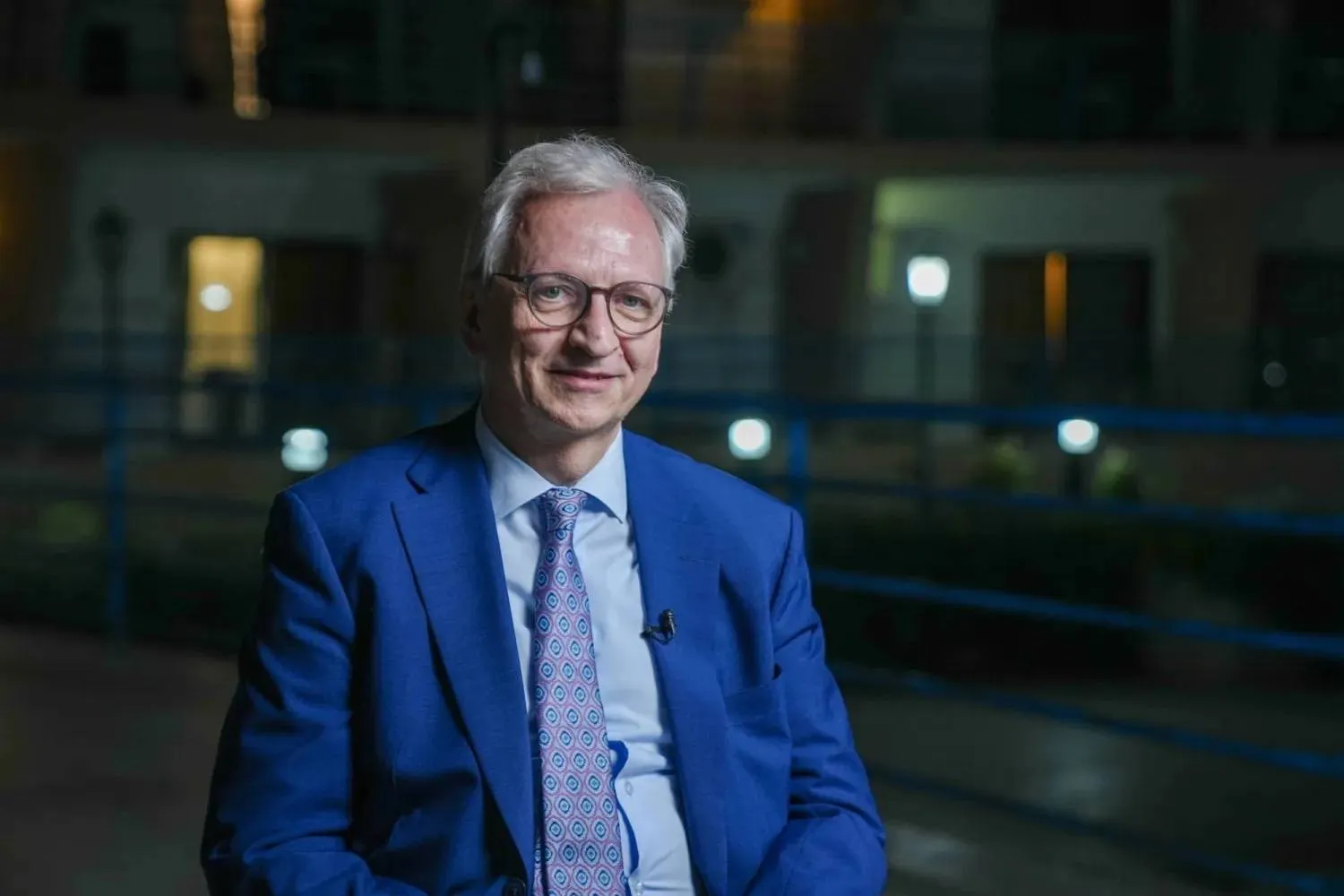

Hours before leaving Marib, German Ambassador to Yemen Thomas Schneider was still taking in the scenes from his first visit to the governorate: camps for displaced people, humanitarian project sites, meetings with officials and tribal sheikhs.
At every stop, one image seemed to follow him: the smile.
In a governorate that has taken in millions of displaced people and spent years on the front line of Yemen’s war, Schneider found a reality different from the one suggested by headlines of conflict and humanitarian crisis. Here, hardship was unmistakable, but so was optimism and a stubborn insistence on life.
Inside the Sabaean-style Belqis Hotel, built in the 1980s in central Marib, Schneider spoke to Asharq Al-Awsat shortly before leaving the governorate about a visit that appeared, at first, humanitarian and developmental. But it also revealed to him a political and social dimension he sees as important to Yemen’s future.
The German ambassador said the visit was meant to express solidarity with the people of Marib and with Yemenis more broadly as the country endures difficult conditions. The German delegation, he said, wanted to visit humanitarian projects and camps for displaced people and refugees, see residents’ needs firsthand and assess the impact of programs supported by Germany and its international partners.
Yet what struck him most, he said, was the relationship that has taken shape in Marib between local authorities, international organizations and UN agencies.
“We saw a positive model of cooperation between the Yemeni government and donor countries, and, more importantly, close cooperation between the local authorities in the governorate and UN agencies and organizations,” he said.
For Schneider, the importance of that experience lies not only in the number or scale of projects carried out, but in the partnership it has created among those working on the ground. That, he said, has made Marib a model that could be useful elsewhere.
“This partnership is an extremely important point, and we sensed that Marib’s experience represents a successful model that can be followed by all parties involved in humanitarian and development work,” he said.
Over the years of war, Marib has become Yemen’s largest hub for displaced people, absorbing successive waves of families fleeing the fighting. Schneider said the way the governorate’s people have handled that burden stands out as one of Yemen’s most important success stories during the conflict.
“Marib has received large numbers of displaced people from across Yemen, as well as refugees from other countries, and this reflects the generosity of its people and their humanitarian spirit. We saw very positive examples of how these challenges are being handled,” he said.
During the visit, the German delegation met displaced people and listened to their stories and needs. It also held meetings with UN representatives and local authorities, reinforcing Schneider’s belief that coordination and continuous communication among the various parties remain the most important factors in responding to complex humanitarian challenges.
But perhaps the most distinctive stop was the meeting with tribal sheikhs in Marib. In a country where tribes are often viewed through a security or traditional lens, Schneider came away with a different impression. He saw Yemen’s tribes as a wide social network whose role goes beyond local customs, helping preserve social cohesion, stability and the future of the country as a whole.
“Sitting with the tribal sheikhs was a very important experience. I felt that they do not only play a social role, but also have a clear political awareness of the challenges facing Yemen,” he said.
He said the discussions revealed important visions and ideas about the country’s future, stressing that tribes would be an essential party in any serious political process aimed at achieving peace.
“I believe the tribes will play a central role in any path leading to peace in Yemen. I came away from this visit with a firm conviction that they represent a real national asset and an important element that can be built upon to strengthen stability,” he said.
Between the political and humanitarian messages, Schneider’s strongest personal impression remained tied to the people of Marib themselves. Despite years of war, economic pressure and the burden of displacement, he said he found, everywhere he went, an optimistic spirit and a positive view of the future.
“I saw a smile everywhere in Marib despite the difficult conditions people are living through. This optimistic spirit and warm welcome made the visit a very important experience for me,” he said.
He said he would carry that image back to his children and family, to his ministry in Berlin, and to his partners in the European Union and international organizations. What he saw in Marib, he said, offers an important lesson in resilience and overcoming crises.
At the end of the interview, I asked the ambassador to sum up Marib in just three words. He did not hesitate long before smiling and answering: “The smile, coffee and welcome.”
The words seemed to capture a city standing on the edge of war, yet still determined to greet its guests with a smile, serve coffee and believe Yemen’s future can be better.