


WHO Kicks off Annual Assembly Amid Hantavirus, Ebola Crises

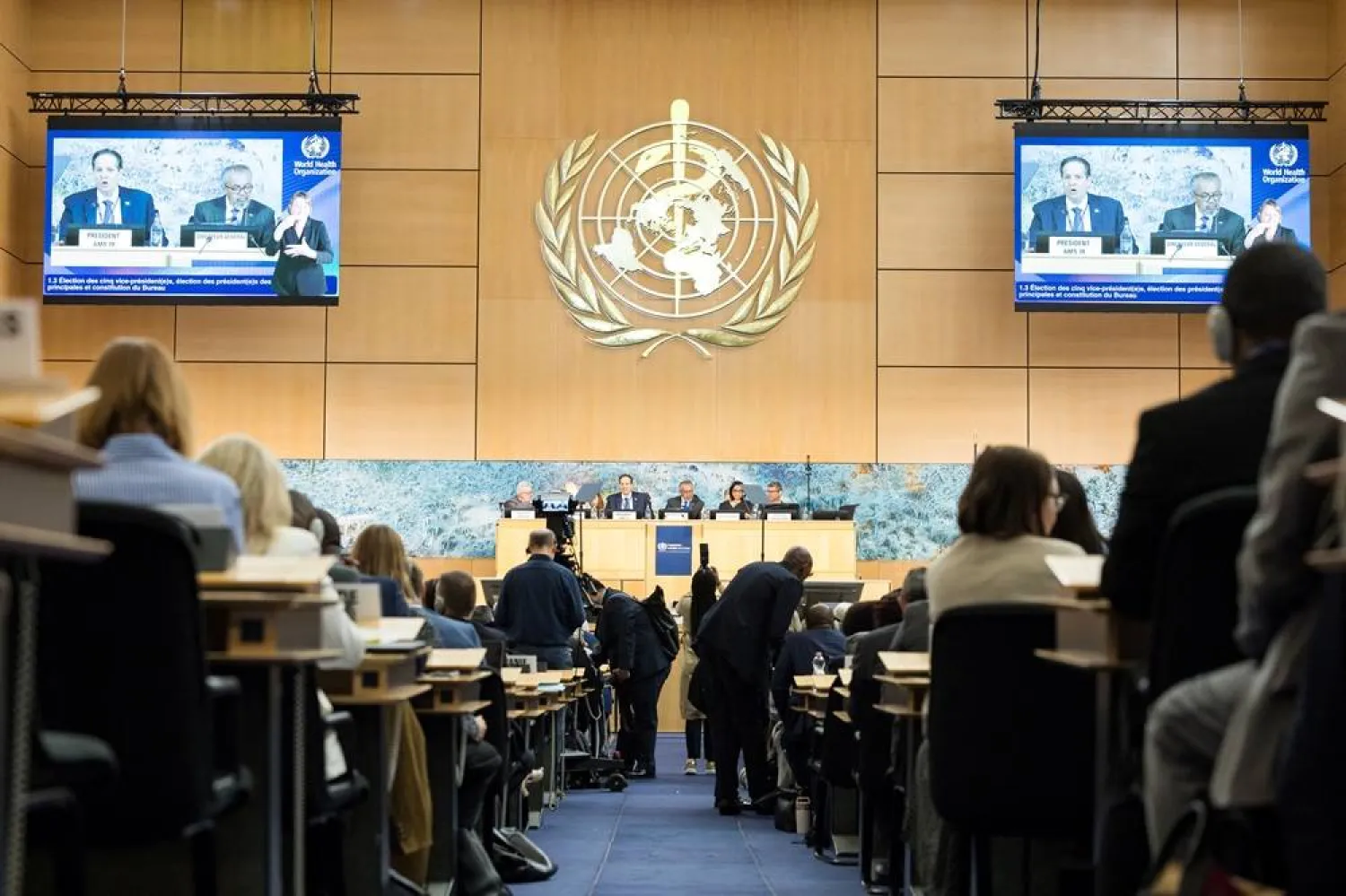
 Delegates attend the 79th World Health Assembly of the World Health Organization (WHO) in Geneva, Switzerland, May 18, 2026. (Reuters)
Delegates attend the 79th World Health Assembly of the World Health Organization (WHO) in Geneva, Switzerland, May 18, 2026. (Reuters)
TT

WHO Kicks off Annual Assembly Amid Hantavirus, Ebola Crises

 Delegates attend the 79th World Health Assembly of the World Health Organization (WHO) in Geneva, Switzerland, May 18, 2026. (Reuters)
Delegates attend the 79th World Health Assembly of the World Health Organization (WHO) in Geneva, Switzerland, May 18, 2026. (Reuters)

World Health Organization member states gather for their annual meeting in Geneva Monday amid concern over deadly hantavirus and Ebola outbreaks and uncertainty over announced US and Argentinian withdrawals.

While the rare hantavirus outbreak on a cruise ship that has gripped global attention is not officially on the agenda, it is expected to feature prominently in the discussions, as is the fresh Ebola outbreak in the Democratic Republic of Congo.

A diplomatic source, who asked not to be identified, said it would be interesting to see how such outbreaks are used by WHO "to promote other things", including "to pressure (the United States and Argentina) not to go".

The meeting of the WHO's annual decision-making assembly, which runs through Saturday, comes after a difficult year for the organization. It has been weakened by the announced US withdrawal and by funding cuts that have forced it to slash its budget and staff numbers.

"We are stable now and moving forward," WHO chief Tedros Adhanom Ghebreyesus insisted at the end of April.

Diplomats and observers agreed.

The situation is "still fragile, but they've been successful in mobilizing most of the funds" required for the next two years, Surie Moon, co-director of the Global Health Centre at the Geneva Graduate Institute, told AFP.

And the hantavirus crisis provided "a clear illustration of why the world needs an effective, trusted, impartial, reliably-funded WHO", she added.

- US, Argentina withdrawals -

But significant divisions persist.

Continued disagreement between wealthy and developing nations has for instance blocked progress on the key missing piece of the WHO's landmark 2025 pandemic treaty, with negotiations now expected to be extended for another year.

It also remains unclear what, if anything, would be decided on the US and Argentinian announced withdrawals.

US President Donald Trump, on his first day back in office in January 2025, handed the WHO his country's one-year withdrawal notice, with Argentina soon following suit.

The WHO, whose constitution does not include a withdrawal clause, has not confirmed either withdrawal.

The United States reserved the right to withdraw when it joined the WHO in 1948 on condition of giving one year's notice and meeting its financial obligations in full for that fiscal year.

While the notice period has expired, Washington has still not paid its 2024 or 2025 dues, owing around $260 million.

When WHO's executive board met in January, Israel submitted a resolution to approve Argentina's withdrawal -- something countries are expected to discuss during the assembly -- but not a word was said about the US leaving.

Diplomats and observers indicated there was broad agreement that it would be better to maintain a grey zone around whether the US was effectively out.

"We hope that it will go past quietly on the US," a European diplomat said on condition of anonymity.

- Election campaign -

The assembly will take place as the process towards next year's election of a new WHO chief heats up.

No one has yet declared their candidacy, but announcements are possible this week ahead of the nomination deadline of September 24.

A number of sensitive resolutions are also on the table, including on Ukraine, the Palestinian territories and Iran, which could spark heated debate.

Much of this week's discussions will center on whether to launch a formal reform process for the so-called "global health architecture" -- a mishmash of organizations that do not always work together and often overlap.

"Among the issues to be explored are what is best done at the global and regional levels... and what is a national responsibility?" Helen Clark, co-chair of The Independent Panel for Pandemic Preparedness and Response and a former New Zealand prime minister, told AFP.

Canadian Health Minister Marjorie Michel told AFP that "this current crisis, with the departure of key players, also allows ... the WHO to re-examine its strategy with its members".

A key focus will be to ensure the process does not see "controversial" issues, such as climate and sexual and reproductive health rights, sacrificed in the context of dwindling international aid funding.

"The objective is to ensure better coordination among health actors, so that no activities or populations are left behind," said a diplomatic source, who asked not to be named.

But Thiru Balasubramaniam of the Knowledge Ecology International NGO, told AFP the WHO had already "scaled down some of their activities, including in terms of sexual and reproductive health".

Report: 4 Dead, 8 Hurt as Gunman Opens Fire in Southern Türkiye

The shooting occurred near Tarsus, about 40 kilometers (25 miles) northeast of Mersin, prompting a widespread police manhunt to locate the shooter. (Reuters file)
TT

Report: 4 Dead, 8 Hurt as Gunman Opens Fire in Southern Türkiye

The shooting occurred near Tarsus, about 40 kilometers (25 miles) northeast of Mersin, prompting a widespread police manhunt to locate the shooter. (Reuters file)

Four people were killed and another eight wounded when a gunman opened fire near the southern Turkish city of Mersin on Monday, the DHA and IHA news agencies reported.

At least two people were killed when the assailant opened fire at a restaurant, with the two others killed elsewhere and the assailant fleeing in a car, DHA said.

The shooting occurred near Tarsus, about 40 kilometers (25 miles) northeast of Mersin, prompting a widespread police manhunt to locate the shooter that also involved helicopters, it said.

There was no immediate comment from police or other officials.

DHA said the shooter was a 17-year-old armed with a shotgun.

Among those killed in the shooting were the restaurant owner and one of his employees, IHA said, identifying the other two as a young man grazing livestock and a truck driver.

The violence came a month after two shooting attacks by teenagers rocked Türkiye.

In the first incident, 16 people were injured, while the second attack claimed 10 lives, most of them young schoolchildren.


Romanians Stabbed Journalist in London at Behest of Iran, UK Court Told

Nandito Badea and George Stana, two Romanian men accused of stabbing the Iran International journalist Pouria Zeraati near his home in Wimbledon in March 2024, appear at Woolwich Crown Court in London, Britain, May 18, 2026, in a courtroom sketch. (Reuters)
TT

Romanians Stabbed Journalist in London at Behest of Iran, UK Court Told

Nandito Badea and George Stana, two Romanian men accused of stabbing the Iran International journalist Pouria Zeraati near his home in Wimbledon in March 2024, appear at Woolwich Crown Court in London, Britain, May 18, 2026, in a courtroom sketch. (Reuters)

A team of Romanian men, acting as proxies for the Iranian government, carried out a knife attack on a journalist working for a Persian-language media organization in London, prosecutors told a British court on Monday.

Pouria Zaratifoukolaei, known as Pouria Zeraati, a British journalist of Iranian origin who works for Iran International, was stabbed in the leg three times as he was attacked near his home in Wimbledon, southwest London, in March 2024.

At the start of the trial of two of the three men accused of carrying out the stabbing, prosecutor Duncan Atkinson said ‌they had targeted ‌Zeraati, whose TV employer is critical of Iran's government.

'DELIBERATE, PLANNED VIOLENCE'

"This was no robbery, no fight that got out of control, it was deliberate, planned violence to achieve what it did, that is serious injury to its target," Atkinson told London's Woolwich Crown Court.

They had "committed a planned attack preceded by reconnaissance, and which was ordered by a third party acting on behalf of the Iranian state," the prosecutor said.

Iran has denied any involvement in ⁠the incident.

Nandito Badea, 21, and George Stana, 25, both ‌deny charges of wounding with intent and unlawful ‌wounding. The third man accused of involvement, David Andrei, was arrested in Romania but is not ‌involved in the trial.

Atkinson said Zeraati was an "obvious and readily identifiable target for ‌violence to be inflicted by proxies" acting for Iran. He said posters had been put up in Tehran in November 2022 featuring pictures of journalists including Zeraati, under the heading "Wanted: dead or alive".

"In recent years, since 2005, Iran has turned less to its ‌own operatives and increasingly to use proxies such as criminal gangs to meet their threatened violence on their behalf," Atkinson ⁠said.

"That has included ⁠attacks on persons in this country who have become targets of Iranian intimidation and, effectively, terror."

Atkinson said Zeraati had been subject to "extensive reconnaissance", and a year before Stana had been arrested in the garden of his apartment with another man, in possession of latex gloves, scissors and a mask.

On the day of the attack, Badea and Andrei confronted Zeraati as he crossed the street from his home to his car, the prosecutor said. Andrei held him, while Badea stabbed him at the top of his thigh before they fled to a getaway car driven by Stana, the prosecutor added.

The men, who were motivated by money, dumped the car and some clothing, and then took a taxi to Heathrow Airport from where they flew to Geneva, Atkinson said.

The trial, which is expected to last more than two weeks, continues.


Iran Arrests Over 4,000 on Charges Related to War, Says Rights Group

An Iranian woman walks next to an anti-Israeli mural on a street in Tehran, Iran, May 18, 2026. Majid Asgaripour/WANA (West Asia News Agency) via Reuters
TT

Iran Arrests Over 4,000 on Charges Related to War, Says Rights Group

An Iranian woman walks next to an anti-Israeli mural on a street in Tehran, Iran, May 18, 2026. Majid Asgaripour/WANA (West Asia News Agency) via Reuters

Iranian authorities have made more than 4,000 arrests on charges related to the US-Israeli war against the country in a mass crackdown, a US-based rights group said on Monday.

The Human Rights Activists News Agency (HRANA) said it had documented at least 4,023 arrests between February 28, when the war started, and May 9.

Charges included espionage, threats to national security and communicating or sharing content related to the conflict with foreign media, it said.

"Iranian authorities have used the conflict to intensify national security narratives and justify arrests, restrictions on freedom of expression, and violence against civilians," it said.

Meanwhile, Iran's national police chief Ahmad Reza Radan had said Sunday that more than "6,500 traitors and spies" linked with the "enemy" had been arrested since anti-government protests peaked in January.

The authorities described the demonstrations as riots and put them down with a crackdown that left thousands dead, according to rights groups.

"The process of identifying and arresting elements associated with the enemy continues, and the police have not stopped their actions in the field of confronting rioters," Radan said, quoted by the IRNA news agency.

There has also been growing alarm over executions in Iran.

Rights groups have said that since the start of the war, Iran has executed 26 men seen as "political prisoners" -- 14 men charged over January protests, one more over 2022 demonstrations and 11 accused of links to banned opposition groups.

Six men have been hanged by Iran on charges of spying for Israel since the war began, according to reports in Iranian official media.

HRANA said it had also documented at least 3,636 fatalities, including 1,701 civilians, due to US-Israeli attacks on Iran in the war, which is currently on hold with an uneasy ceasefire.
