


Russia Announces Three-Day Nuclear Drills

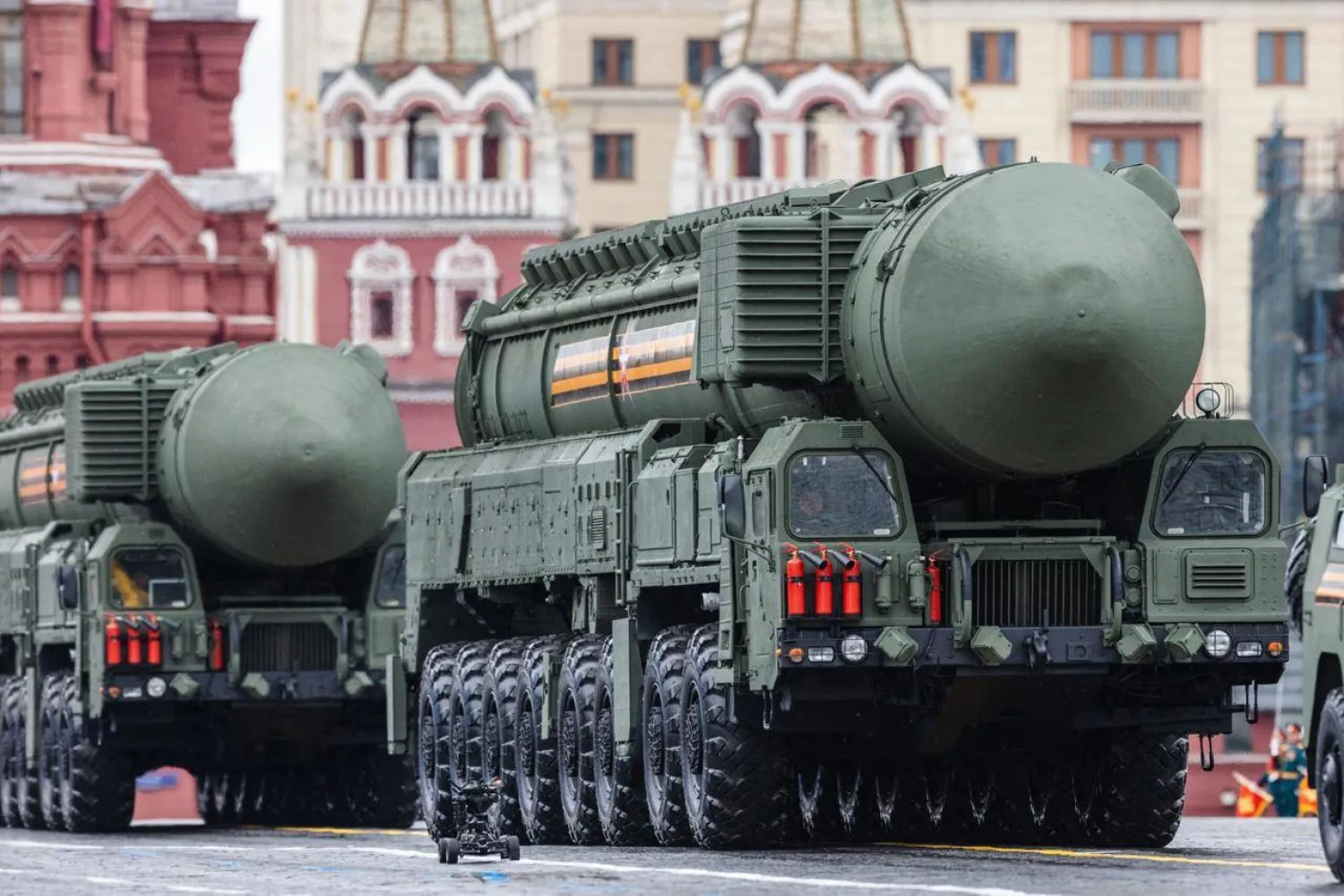
Russian Yars RS-24 intercontinental ballistic missile systems move through Red Square during the Victory Day military parade in Moscow, Russia on May 9, 2021. (AFP)
TT

Russia Announces Three-Day Nuclear Drills

Russian Yars RS-24 intercontinental ballistic missile systems move through Red Square during the Victory Day military parade in Moscow, Russia on May 9, 2021. (AFP)

Russia's army on Tuesday began three days of nuclear weapons drills involving thousands of troops across the country, as Kyiv escalates its drone attacks and with President Vladimir Putin headed to China.

Throughout its more than four-year offensive in Ukraine Moscow has flaunted its possession of nuclear weapons and repeatedly threatened to use them.

The drills also come months after the last nuclear arms pact between Russia and Washington broke down and amid a fresh spate of comments from Putin touting the prowess of Moscow's atomic forces.

"From May 19 to 21, 2026, the Armed Forces of the Russian Federation are conducting an exercise on the preparation and use of nuclear forces in the event of a threat of aggression," the defense ministry said.

The ending of the New START agreement with Washington in February formally released the world's two largest nuclear powers from a raft of restrictions.

The drills will involve more than 65,000 troops and 7,800 types of equipment and weapons, including more than 200 missile launchers, the defense ministry said. Aircraft, ships, submarines and nuclear submarines will all take part.

The ministry said it would also test-launch ballistic and cruise missiles.

"The exercise will also address issues related to the joint training and use of nuclear weapons deployed on the territory of the Republic of Belarus," the ministry added.

Russia has deployed a nuclear-capable missile, the Oreshnik, to its ally Belarus, which borders NATO.

Moscow announced the start of the drills hours before Putin was due in China for a two-day visit.



Ebola Cases in Congo Exceed 5,000

People wearing protective clothing prepare for the burial of a man at Nyamurongo Cemetery in Bunia, Democratic Republic of the Congo, 18 August 2026. EPA/DIEUDONNE DIROLE
TT

Ebola Cases in Congo Exceed 5,000

People wearing protective clothing prepare for the burial of a man at Nyamurongo Cemetery in Bunia, Democratic Republic of the Congo, 18 August 2026. EPA/DIEUDONNE DIROLE

The number of confirmed Ebola cases in the Democratic Republic of Congo now exceeds 5,000, government data showed late on Tuesday, as health officials warn that response efforts are failing to contain the deadly disease.

Congo's 17th Ebola epidemic turned into the biggest in the country's history ⁠in terms of ⁠number of cases in late July and over the weekend the death toll hit 2,378, the public health institute said, surpassing the previous worst outbreak ⁠in 2018-2020.

The institute has so far logged 5,021 cases, according to its latest situation report, making it the second-worst outbreak globally, behind only the 2014 to 2016 epidemic in West Africa in both infections and deaths.

The ongoing outbreak is caused by the Bundibugyo species of Ebola, ⁠which ⁠has no approved vaccines or treatments.

It has gained momentum since it was declared on May 15, as weak health infrastructure, community resistance, instability and protests by response workers hinder efforts to identify and respond to cases.


Mystery Shrouds Leadership of Iran’s Intelligence Agencies

Questions mount over the identity of Iran’s deputy intelligence minister months after Esmail Khatib’s death (Iranian Presidency)
TT

Mystery Shrouds Leadership of Iran’s Intelligence Agencies

Questions mount over the identity of Iran’s deputy intelligence minister months after Esmail Khatib’s death (Iranian Presidency)

Six months into Supreme Leader Mojtaba Khamenei’s rule, Iran has reshuffled its military and security leadership after a war that killed two cabinet ministers and a string of senior Revolutionary Guards commanders.

Yet two of the country’s most sensitive posts remain shrouded in secrecy: who is running the Intelligence Ministry, and who now commands the Guards’ powerful intelligence arm.

Defense Minister Aziz Nasirzadeh was killed on Feb. 28 in the opening strikes targeting the leadership, including the office of former Supreme Leader Ali Khamenei in Tehran’s heavily fortified Pasteur district.

On March 2, Iranian President Masoud Pezeshkian appointed Majid Ben Reza as deputy defense minister. He is expected to be formally nominated to parliament to take over the ministry.

Pezeshkian announced the death of Intelligence Minister Esmail Khatib on March 18. Since then, Iranian authorities have not disclosed who is serving as acting minister.

The government-affiliated news outlet reported last week that the deputy intelligence minister had sent separate congratulatory messages to Supreme National Security Council Secretary Mohsen Rezaei and newly appointed military commanders, pledging the ministry’s cooperation with the new leadership on priorities set by the supreme leader for the armed forces.

Deadline to name two ministers

Pezeshkian is under pressure from close reformist allies over the delay in naming a new intelligence minister, one of five cabinet posts that require the supreme leader’s approval.

In practice, the intelligence minister is usually chosen with the supreme leader’s direct involvement.

The minister also sits on the 12-member Supreme National Security Council, giving the officeholder a direct role in Iran’s main security decision-making body.

Abbas Goudarzi, a lawmaker and spokesman for parliament’s presiding board, said this week that Mojtaba Khamenei had given the government a deadline to submit nominees for the intelligence and defense ministries.

“Under the authorization obtained from the supreme leader, the government has one and a half months from Aug. 20 to submit its proposed ministers for intelligence and defense to the Iranian parliament,” Goudarzi said.

But naming a new intelligence minister may first require a change in the law.

Current legislation requires the minister to have attained the religious rank of ijtihad, a senior scholarly qualification that sharply narrows the pool of candidates to clerics who meet the requirement.

“The idea was raised that ijtihad should not be a requirement for the intelligence minister,” Goudarzi said. “Since the current law conflicts with this proposal, the law must be amended. It was therefore decided that the government would submit a bill to parliament on the matter.”

Legacy of security breaches

Khatib served as intelligence minister under former President Ebrahim Raisi and kept the job when Pezeshkian formed his government two years ago, despite mounting criticism of the security services over a series of breaches attributed to Israel’s Mossad.

Those criticisms intensified after Israeli intelligence reached military commanders and officials involved in the nuclear program who were killed during the war.

The next minister will inherit an agency battered by a string of security breaches and assassinations targeting military, nuclear and security officials, as well as the legacy left by successive ministers who ran the institution.

Fresh questions over the security surrounding senior intelligence officials were raised by Khatib’s son.

In an interview published by the state-run IRNA news agency on Aug. 10, he said his father had faced four assassination attempts before he was killed, including two during the June 2025 war.

He said Khatib was later killed at the home of his second wife despite tight security surrounding his movements.

Cultural Heritage Minister Reza Salehi Amiri is among the names being considered for the intelligence portfolio.

Salehi Amiri, previously known as Reza Fallah, worked at the Intelligence Ministry during the 1980s and 1990s and was one of the agency’s leading interrogators before gradually moving into political and government posts.

He later held positions at strategic research centers affiliated with the Iranian presidency and the Expediency Council.

Under President Hassan Rouhani, he served for a year as deputy minister of sports and youth before becoming a presidential adviser and head of the National Library and Archives.

He also served for a year as culture minister at the start of Rouhani’s second term before returning to government after Pezeshkian became president.

Vacuum in Revolutionary Guards intelligence

The picture is even murkier inside the Revolutionary Guards’ intelligence organization and its protection unit after several senior commanders were killed in the war.

On April 6, the Revolutionary Guards confirmed that Brigadier General Majid Khademi, head of its intelligence organization, had been killed in an Israeli-US attack, hours after Israeli Defense Minister Israel Katz first announced his death.

Khademi had previously headed the Guards’ protection organization before becoming intelligence chief on June 19, 2025, succeeding Mohammad Kazemi.

Before that, he oversaw the unit responsible for protecting political figures and sensitive sites, including key state institutions and nuclear facilities.

Kazemi was killed in Israeli strikes on June 15, 2025, three days after dozens of Revolutionary Guards commanders were killed in the opening strikes of the 12-day war.

That attack also killed Mohammad Reza Nasir Bagban, known by the alias Mohsen Bagheri, head of the Quds Force intelligence unit, and Brigadier General Hassan Mohaghegh, one of the Guards’ most prominent intelligence commanders and a figure with close ties to current Supreme Leader Mojtaba Khamenei.

Tehran has yet to disclose who now leads the Revolutionary Guards’ intelligence organization, its deputy command, or the Quds Force intelligence unit.

Hossein Taeb, however, who spent 13 years at the helm of Guards intelligence, has returned to a senior security role as commander of the Basij, tasked with expanding the “popular intelligence network.”


Colombia Estimates Quake Damage at $9.6 Billion

A view of the damage to the Carrasquilla Industrial Educational Institution, as seen during a visit by singer Shakira, in Quibdo, Colombia, 17 August 2026. (EPA)
TT

Colombia Estimates Quake Damage at $9.6 Billion

A view of the damage to the Carrasquilla Industrial Educational Institution, as seen during a visit by singer Shakira, in Quibdo, Colombia, 17 August 2026. (EPA)

The powerful earthquake that killed hundreds of people in western Colombia caused $9.57 billion in economic losses, President Abelardo de la Espriella said on Tuesday, issuing a preliminary estimate.

The 7.4-magnitude tremor, which struck on August 10, was the most powerful in Colombia in nearly half a century.

The death toll stands at 289, with a further 4,187 injured and 143 missing.

Nearly 27,000 homes were destroyed, leaving many people sleeping in the streets or in public parks.

Dozens of hospitals and schools also collapsed or were damaged.

"Imagine the scale of the disaster," said De la Espriella, a political novice who took office just three days before the disaster.

The crisis has been a baptism of fire for De la Espriella, a right-wing lawyer and business magnate who was elected on a promise to flush out the drug-trafficking rebels that control part of Colombia.

He said Tuesday he had tasked his housing minister with launching a "miracle" reconstruction plan, with the backing of the private sector.

But the minister, Jaime Andres Beltran, has been under fire for taking a Caribbean holiday in the immediate aftermath of the quake.