Trump Says Negotiations with Iran in Final Stages, Warns of Attacks if Deal Fails

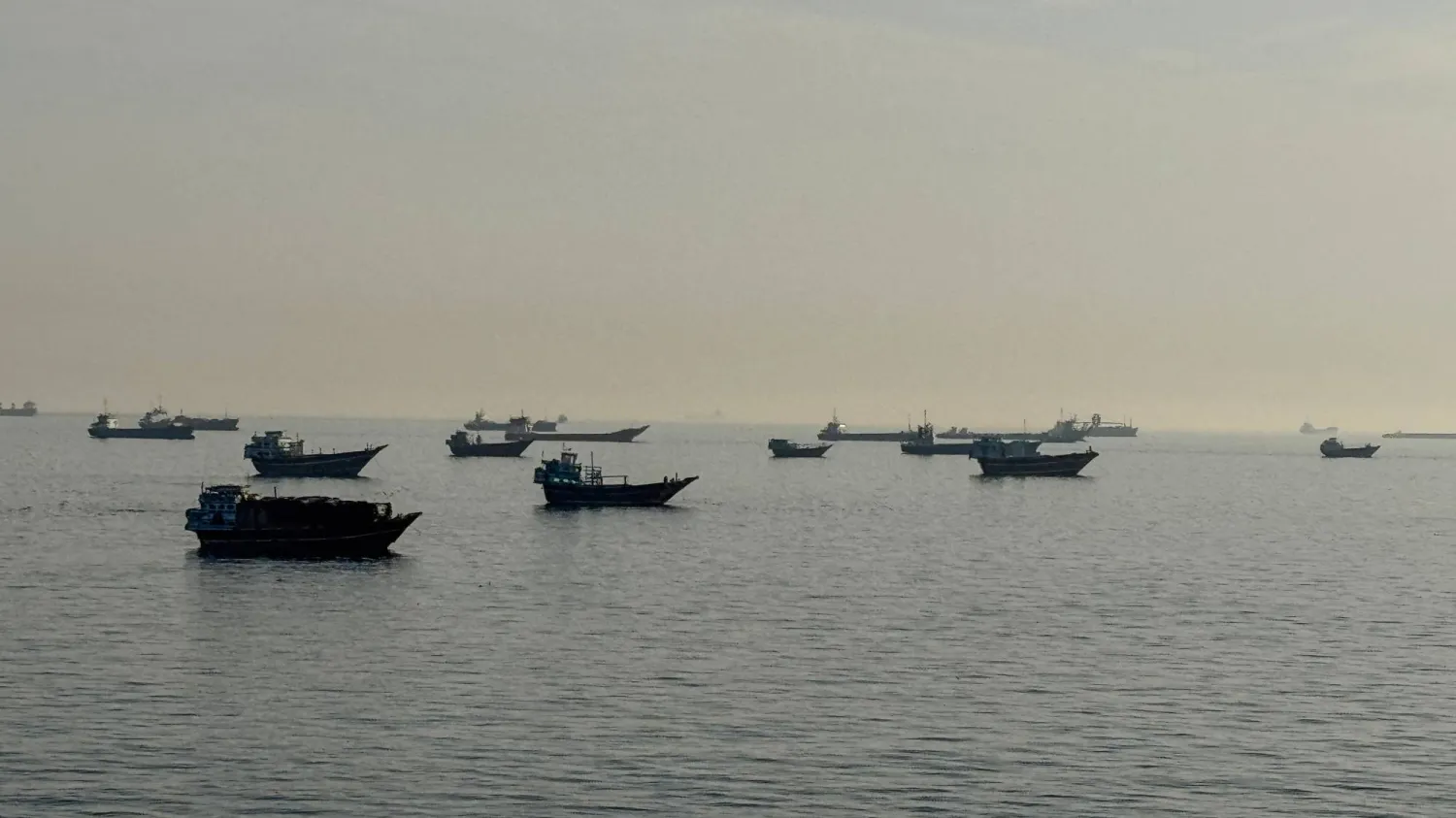
Vessels are seen anchored in the Strait of Hormuz, off the port city of Khasab on Oman's northern Musandam Peninsula on May 17, 2026. (AFP)
TT

Trump Says Negotiations with Iran in Final Stages, Warns of Attacks if Deal Fails

Vessels are seen anchored in the Strait of Hormuz, off the port city of Khasab on Oman's northern Musandam Peninsula on May 17, 2026. (AFP)

US President Donald Trump said on Wednesday that negotiations with Iran were in the final stages, while warning of further attacks unless Iran agrees to a deal. 

Six weeks since Trump paused Operation Epic Fury for a ceasefire, talks to end the war have shown little progress so far. Trump has said this week he came close to ordering more attacks, but held off to allow more time for negotiations. 

"We're in the final stages of Iran. We'll see what happens. Either have a deal or we're going to do some things that are a little bit nasty, but hopefully that won't happen," he told reporters on Wednesday. 

"We're going to give this one shot. I'm in no hurry," Trump said. "Ideally I'd like to see few people killed, as opposed to a lot. We can do it either way." 

Tehran, for its part, accused Trump of plotting to restart the war, and threatened to retaliate for any strikes with attacks beyond the Middle East. 

"If aggression against Iran is repeated, the promised regional war will extend beyond the region this time," the Revolutionary Guards said in a statement. 

Parliament Speaker Mohammad ‌Baqer Qalibaf, Iran's ‌top negotiator at peace talks, said in an audio message released on social media that "obvious and hidden moves by ‌the enemy" ⁠showed the Americans were ⁠preparing new attacks. 

PAKISTANI MINISTER IN TEHRAN IN LATEST DIPLOMATIC PUSH 

In the latest diplomatic push, the interior minister of Pakistan - which hosted the only round of peace talks so far and has since been the conduit for messages between the sides - was in Tehran on Wednesday. 

Iran submitted a new offer to the United States this week. Tehran's descriptions of the proposal suggest it largely repeats terms previously rejected by Trump, including demands for control of the Strait of Hormuz, compensation for war damage, lifting of sanctions, release of frozen assets and the withdrawal of US troops from the area. 

Trump has said he called off attacks this week at the last minute in response to requests from several of Iran's Gulf neighbors. On Tuesday he said he had been an hour away from ordering strikes. 

Saudi Arabia's Foreign Minister Prince Faisal bin Farhan bin Abdullah welcomed what he said ⁠was a decision by Trump to allow more time for diplomacy. 

CHINESE TANKERS CROSS STRAIT 

Iran has largely shut the Strait ‌of Hormuz to all ships apart from its own since the US-Israeli campaign began in February, causing ‌the biggest disruption to global energy supplies in history. The United States responded last month with its own blockade of Iran's ports. 

Iran says its aim is to reopen the ‌strait to friendly countries that abide by its terms to use it. That could potentially include fees for access, which Washington says would be unacceptable. 

Two giant Chinese ‌tankers laden with a total of around 4 million barrels of oil exited the strait on Wednesday. Iran had announced last week, while Trump was in Beijing for a summit, that it had reached agreement to ease rules for Chinese ships. 

South Korea's foreign minister said on Wednesday a Korean tanker was crossing the strait in cooperation with Iran. 

Shipping monitor Lloyd's List said at least 54 ships had transited the strait last week, around double the number from the week before. Iran said 26 ships had crossed in the ‌past 24 hours, still only a fraction of the 140 or so each day that typically crossed before the war. 

PRESSURE TO END WAR 

Trump is under pressure to end the war, with soaring energy prices hurting his Republican ⁠Party ahead of congressional elections in November. Since ⁠the ceasefire, his public comments have veered from threats to restart bombing to declarations that a peace deal was at hand, sometimes in the same breath. 

The fluctuating US stances have sent oil prices bouncing from hour to hour and day to day, though on a clear upward trend week by week. Benchmark one-month Brent crude futures eased about 2.75% on Wednesday morning to near $108 a barrel. 

"Investors are keen to gauge whether Washington and Tehran can actually find common ground and reach a peace agreement, with the US stance shifting daily," said Toshitaka Tazawa, an analyst at Fujitomi Securities. 

The US-Israeli bombing killed thousands of people in Iran before it was suspended in a ceasefire in early April. Israel has also killed thousands more and driven hundreds of thousands from their homes in Lebanon, which it invaded in pursuit of the Iran-backed Hezbollah party. Iranian strikes on Israel and neighboring Gulf states have killed dozens of people. 

This week saw a new volley of drones launched at Saudi Arabia and the UAE, which said they came from Iraq where armed factions allied to Iran operate. Jordan reported shooting down a drone on Wednesday. 

Trump and Israeli Prime Minister Benjamin Netanyahu said when they launched the war that their aims were to curb Iran's support for regional proxies, dismantle its nuclear program, destroy its missile capabilities and make it easier for Iranians to topple their rulers. 

But Iran has so far retained its stockpile of near-weapons-grade enriched uranium, and its ability to threaten neighbors with missiles, drones and proxy groups. Its clerical rulers, who put down a mass uprising at the start of the year, have faced no sign of organized opposition since the war began. 


COP31 Opens as Climate and Geopolitical Pressures Mount

A man walks past the COP31 logo inside the venue at the Antalya Expo Center on November 8, 2026, ahead of the opening of the UN climate conference. (Photo by Ozan KOSE / AFP)
TT

COP31 Opens as Climate and Geopolitical Pressures Mount

A man walks past the COP31 logo inside the venue at the Antalya Expo Center on November 8, 2026, ahead of the opening of the UN climate conference. (Photo by Ozan KOSE / AFP)

The UN's annual climate talks kick off Monday in Türkiye as rising temperatures heighten the urgency of action, with financial constraints and geopolitical tensions complicating efforts to secure global cooperation.

More than 100,000 people are expected to attend COP31 in a sprawling expo center in the Mediterranean seaside city of Antalya over the next two weeks, reported AFP.

Negotiators from nearly 200 countries are facing tough discussions over how to accelerate the energy transition and provide funds to help developing nations cope with the worsening climate emergency.

But observers say few major breakthroughs are expected as countries grapple with an oil price shock and geopolitical tensions fueled by the US war with Iran and Russia's conflict in Ukraine.

The climate emergency, meanwhile, continued to wreak havoc this year as punishing heatwaves baked Europe, wildfires raged in Indonesia and a glacier collapse triggered devastating floods in Nepal.

An exceptionally strong El Nino climate phenomenon is forecast to peak later this year, adding to extreme weather and possibly helping to make 2026 or 2027 the hottest year on record.

The outlook is bleak: the United Nations warned in September that global temperatures were on course to exceed 1.5C above preindustrial levels, breaching the most ambitious threshold set by the Paris Agreement.

"Global leaders must pull us back from the brink and commit to rapidly transitioning away from fossil fuels and expanding renewable energy, an imperative reinforced by the current energy affordability crisis," said Rachel Cleetus, climate program director at the Union of Concerned Scientists.

- 'Clean' electrification? -

Türkiye is presiding over COP31, with Australia leading negotiations under an unusual arrangement that settled a dispute over who would host the conference.

The partners have branded the summit as the "implementation COP", focusing on turning commitments into concrete action after years of pledges and ambitious announcements.

Türkiye is promoting an "action agenda" alongside the formal negotiations that encourages countries to support non-binding pledges on issues from artificial intelligence to waste management.

Its centerpiece is an "electrification" drive to raise the share of global energy demand met by electricity from around 20 percent today to 35 percent by 2035.

But the initiative could become a source of friction.

The European Union has called for "clean" electrification, a term that could spark debate over the role of fossil fuels in the Turkish proposal.

Countries committed to transition away from fossil fuels in a landmark pact at COP28 in Dubai in 2023 but have struggled to agree on how to turn that pledge into action.

COP30 ended with a deal that made no explicit mention of fossil fuels after oil-producing countries opposed the language.

Instead, Brazil produced a voluntary "roadmap" with proposals for phasing out fossil fuels that each country can tailor to their circumstances.

- Finance fight -

The EU, for its part, and other developed countries are under pressure from the developing nations to fulfil promises to provide funds they need to adapt to climate impacts and recover from extreme weather disasters.

A senior EU official warned that there would be "no political will" for extra funding pledges.

African countries are pushing for the COP31 agenda to include discussions on the tripling of adaptation finance, which aims to help poorer nations pay for measures such as building sea walls or planting drought-resistant crops.

Climate diplomacy is still missing a major player as President Donald Trump pulled the United States out of the Paris Agreement and has not sent officials to COP31.

A US congressional delegation, however, will come to Antalya, with Democrats beaming after last week's historic US midterm election win.

While negotiations are facing two weeks of grueling talks, "the mood is very good", Azerbaijan's chief negotiator Yalchin Rafiyev told AFP.

Countries need to turn "this positive spirit of being in a favorable environment into concrete, successful results", he said.


G7 Ministers Meet on Efforts to End Ukraine Conflict, Halt New Iran War

EVIAN-LES-BAINS, FRANCE - JUNE 17: US President Donald Trump (C) is joined by (L-R) US Trade Representative Jamieson Greer, US Commerce Secretary Howard Lutnick, US Secretary of State Marco Rubio and US Treasury Secretary Scott Bessent as he speaks at a press conference during the G7 Leaders' Summit on June 17, 2026 in Evian-les-Bains, France. Anna Moneymaker/Getty Images/AFP (Photo by Anna Moneymaker / GETTY IMAGES NORTH AMERICA / Getty Images via AFP)
TT

G7 Ministers Meet on Efforts to End Ukraine Conflict, Halt New Iran War

EVIAN-LES-BAINS, FRANCE - JUNE 17: US President Donald Trump (C) is joined by (L-R) US Trade Representative Jamieson Greer, US Commerce Secretary Howard Lutnick, US Secretary of State Marco Rubio and US Treasury Secretary Scott Bessent as he speaks at a press conference during the G7 Leaders' Summit on June 17, 2026 in Evian-les-Bains, France. Anna Moneymaker/Getty Images/AFP (Photo by Anna Moneymaker / GETTY IMAGES NORTH AMERICA / Getty Images via AFP)

Foreign ministers of the G7 group meet in Paris from Monday for two days of talks expected to see European powers press the United States to seek a fair settlement for Ukraine in the war against Russia and deter Washington from further military action against Iran.

Ministers from the leading industrialized nations of Britain, Canada, France, Germany, Italy, Japan and the United States will be gathering with preoccupations strikingly similar to those of the last such meeting in March, said AFP.

Russia's war against Ukraine following the February 2022 full-scale invasion of its neighbor is grinding towards its fifth anniversary. And Washington is still not ruling out new attacks against Iran even after the defeat of President Donald Trump's Republicans in the midterms.

All eyes will be on US Secretary of State Marco Rubio who is due to attend both days, unlike the March meeting where he only came for one.

This G7 ministerial meeting, one of the final acts of the French G7 presidency that saw President Emmanuel Macron host Donald Trump for the leaders' summit this summer in the lakeside resort of Evian, had long been scheduled to be held in the southern port city of Marseille.

But at the last minute the event was moved to Paris, with only scheduling reasons given for the change.

The visit by Rubio -- seen by US media as a potential candidate to succeed Trump -- will be his first abroad since the midterms. Washington will also in 2027 take over the G7 presidency from France.

- 'Europeans will be represented' -

The meeting coincides with US-mediated talks with Moscow and Kyiv in Abu Dhabi scheduled for Tuesday and Wednesday on ending the Ukraine war, with Europe concerned Kyiv must not be forced to accept disadvantageous conditions.

French Foreign Minister Jean-Noel Barrot told RTL radio that on this occasion "Europeans will be represented and France will be in Abu Dhabi to participate in these talks".

Trump stoked fears of a US pivot toward the Kremlin by predicting a "very big" deal with Russia involving not only the Ukraine war but "all of Europe".

Jared Kushner, the US president's envoy and son-in-law, said the United States was working on "a broader European security architecture that can help establish the conditions for lasting peace", a concept met with skepticism in the past by Europe.

On Iran, Trump has not ruled out new strikes, including at so-called Pickaxe Mountain, a suspected nuclear site which Tehran denies is such a facility. Europeans, however, are eager to see a resolution and shipping traffic return to normal in the Strait of Hormuz energy transit hub.

"We're dealing with them now," Trump said of the Iranians Friday. "They want to make a deal very badly."

The sidelines of the meeting will also see the French finance ministry hosting on Monday a donor conference to raise funds to repair the dome protecting the nuclear reactor that exploded in Ukraine's Chernobyl in 1986 after it was damaged in a Russian strike last year.

Around 500 million euros is required but only just over half has been raised so far with a target date of spring 2027 to muster the rest of the funds, the French finance ministry told AFP.

Even though the meeting was moved to Paris, Marseille will still host the launch of a network of 14 global ports uniting to combat drug trafficking, which has become a major scourge in the southern city, Barrot said.

As he addressed reporters while preparing to leave for France, Rubio declined to comment directly on Trump's and the Republicans' crushing loss in the US midterm elections.

"It is not uncommon to have a division of power in this country," Rubio told reporters, alluding to the fact that Trump will now see both houses of Congress controlled by the Democrats.

Asked about widespread protests in France, Rubio added that he was not worried and trusted US counterparts on the ground who advised him it is safe to attend the G7 meeting.


Iran FM Says No Negotiations Since ‘Shock’ of US Midterms

25 September 2026, US, Bronx: Iranian Foreign Minister Abbas Araghchi delivers a statement during a press conference at Security Council encounter at UN Headquarters in New York. (dpa)
TT

Iran FM Says No Negotiations Since ‘Shock’ of US Midterms

25 September 2026, US, Bronx: Iranian Foreign Minister Abbas Araghchi delivers a statement during a press conference at Security Council encounter at UN Headquarters in New York. (dpa)

Iranian Foreign Minister Abbas Araghchi said on Sunday that mediators striving for a peace deal between the US and Iran had not travelled at all since the "shock" of the US midterm elections.

"We now have to see how long it will take for them to digest these results, in order to determine how we are going to move forward," the top Iranian diplomat told state TV following the elections in which the Republican Party of US President Donald Trump suffered heavy losses.

Various regional powers, including Qatar and Pakistan, have been trying for months without success to bring a definitive halt to the war launched by the United States and Israel in late February.

Outright fighting has largely subsided, but Iran continues in its efforts to blockade the Strait of Hormuz, vital to global energy supplies, while the US Navy maintains its own counterblockade of Iranian ports.

"For the past few days, there has been no more travel (by mediators), and the reason for this is the shock that the election results in the United States have caused to everyone."

He said it would "take some time before the atmosphere is favorable for the resumption of mediator travel" and called for patience.

Earlier, Aragchi posted on X: "American voters have made their choice. Time for the White House to make its own."

He called on Washington to accept previously articulated Iranian demands or "choose war, and see our alert and battle-hardened warriors rain down hell".

In September, Iran proposed a seven-day plan to reopen the strait, with demands including ending the war on all fronts, unfreezing Iranian assets, lifting oil sanctions and ending its counter-blockade of Iranian ports.

It later proposed doing so in just two days, an offer Araghchi repeated in his X post on Sunday.