

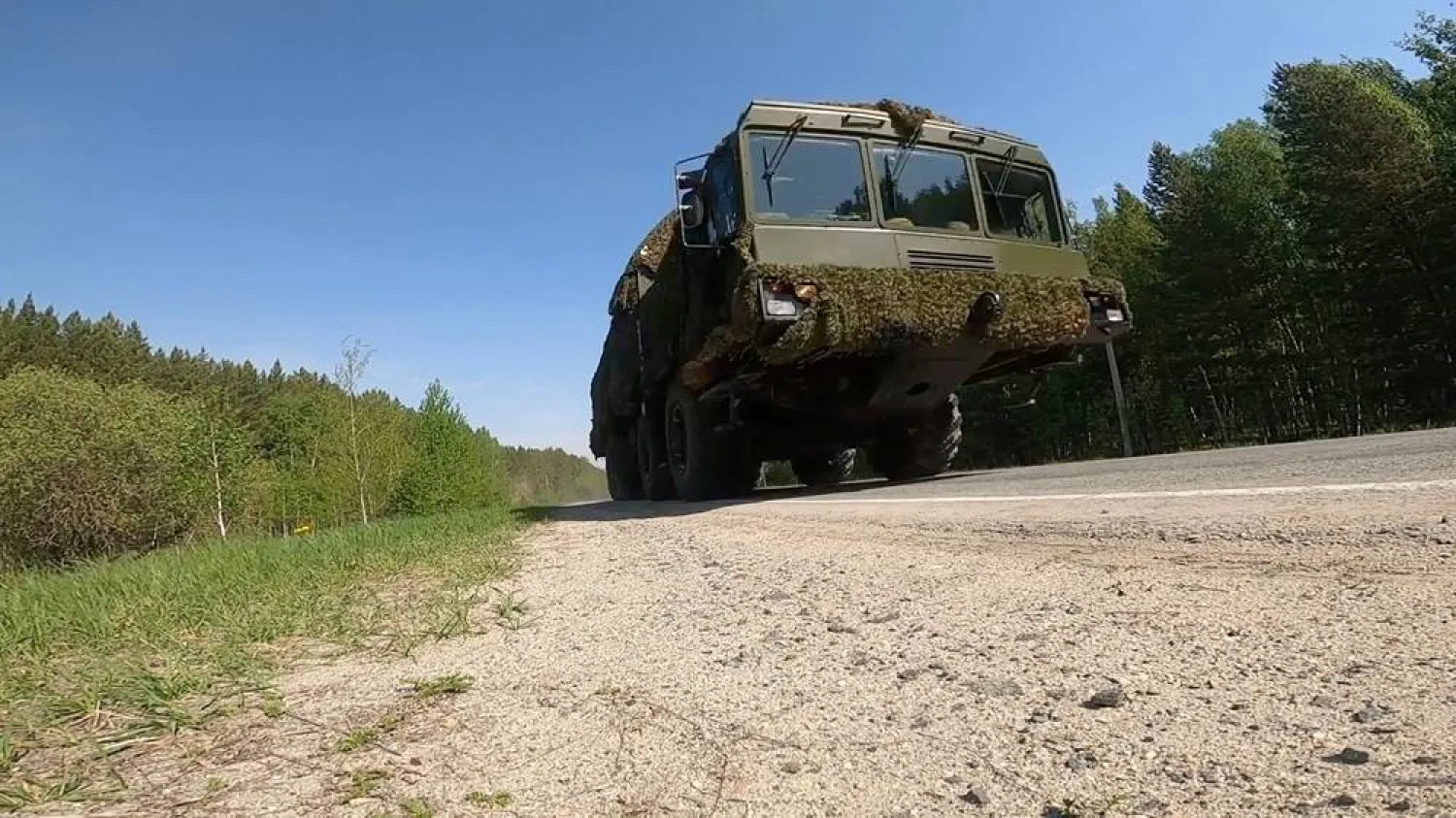

Russia Shows Troops Moving Nuclear Warheads in Major Exercise

A Russian Iskander-M missile launcher drives during a nuclear forces exercise at an unidentified location in Russia, in this still image taken from handout footage released on May 20, 2026. (Russian Defense Ministry/Handout via Reuters)
TT

Russia Shows Troops Moving Nuclear Warheads in Major Exercise

A Russian Iskander-M missile launcher drives during a nuclear forces exercise at an unidentified location in Russia, in this still image taken from handout footage released on May 20, 2026. (Russian Defense Ministry/Handout via Reuters)

Russia on Wednesday showed what it said was footage of troops delivering nuclear warheads to mobile Iskander-M launch systems, loading them and moving them undetected to launch sites as part of a major nuclear exercise.

In a statement released to state media, the Defense Ministry said ‌its forces ‌had practiced bringing units ‌to "the ⁠highest levels of combat readiness ⁠for the use of nuclear weapons".

The three-day exercise, which started on Tuesday and is taking place across Russia and Belarus, comes at a time when Moscow is locked ⁠in what it says is ‌an existential ‌struggle with the West over Ukraine and tensions ‌with NATO and Europe over ‌the war are running high.

The Defense Ministry said on Tuesday that the drills, which involve 64,000 military personnel, over 200 missile ‌launchers, 140 aircraft, 73 surface ships and 13 submarines, would ⁠include rehearsing ⁠launch procedures for Russian tactical nuclear weapons based in Belarus.

Video of the training element showed Russian nuclear forces moving in convoy through a heavily forested area, camouflaging their vehicles, and raising a launch tube into firing position.

With a range of up to 500 km (310 miles), the Iskander-M can carry both nuclear and conventional warheads.



Iran Threatens War 'Beyond the Region' if US Attacks

People walk near a billboard with an image of the late Iranian Supreme Leader Ali Khamenei, in Tehran, Iran, May 19, 2026. Majid Asgaripour/WANA (West Asia News Agency) via REUTERS
TT

Iran Threatens War 'Beyond the Region' if US Attacks

People walk near a billboard with an image of the late Iranian Supreme Leader Ali Khamenei, in Tehran, Iran, May 19, 2026. Majid Asgaripour/WANA (West Asia News Agency) via REUTERS

Iran threatened on Wednesday to spread war beyond the Middle East if the United States attacks again, after President Donald Trump said he had come within an hour of restarting the military campaign.

Six weeks since Trump paused Operation Epic Fury for a ceasefire, talks to end the war have largely stalled.

Iran submitted a new offer to the United States this week, but its public accounts of it repeat terms previously rejected by Trump, including demands for control of the Strait of Hormuz, compensation for war damage, lifting of sanctions, release of frozen assets and the withdrawal of US troops from the area.

Trump said on Monday, and again on Tuesday, that he had come close to ordering a new bombing campaign but had put it off at the last minute to give more time for diplomacy.

"I was an hour away from making the decision to go today," Trump told reporters at the White House on Tuesday.

Iran has repeatedly threatened to retaliate for any new attacks by striking countries in the Middle East that house US bases. On Wednesday it suggested it would also hit targets further afield.

"If aggression against Iran is repeated, the promised regional war will extend beyond the ⁠region this time," ⁠the Revolutionary Guards said in a statement carried on state media.

Iran has largely shut the Strait of Hormuz to all ships apart from its own since the US-Israeli campaign began in February, causing the biggest disruption to global energy supplies in history. The United States responded last month with its own blockade of Iran's ports.

Two giant Chinese tankers laden with around 4 million barrels of oil exited the strait on Wednesday, the latest signal that Iran is willing to ease its blockade for countries it considers friendly. Iran had announced last week, while Trump was in Beijing for a summit, that it had reached an agreement to ease rules for Chinese ships.

South Korea's foreign minister said on Wednesday a Korean tanker was crossing the strait ⁠in cooperation with Iran.

Shipping monitor Lloyd's List said at least 54 ships had transited the strait last week, around double the number from the week before. But that is still only a tiny fraction of the 140 or so each day that typically crossed before the war.

Trump is under pressure to end the war, with soaring energy prices hurting his Republican Party ahead of congressional elections in November. Since the ceasefire in late April, his public comments have veered from threats to restart bombing to declarations that a peace deal was at hand, often in the same breath.

On Tuesday he said the war would be over "very quickly". Vice President JD Vance, who led the US delegation last month at the only round of peace talks so far, also talked up progress: "We're in a pretty good spot here," Vance told a White House press briefing.


Schools Evacuated as Magnitude 5.6 Quake Hits Eastern Türkiye

People are seen in front of a Turkish national flag hanged on a wall to mark the 101th anniversary of the Turkish Republic’s foundation a head of the Republic Day, in Istanbul, Türkiye, October 28, 2024. (Reuters)
TT

Schools Evacuated as Magnitude 5.6 Quake Hits Eastern Türkiye

People are seen in front of a Turkish national flag hanged on a wall to mark the 101th anniversary of the Turkish Republic’s foundation a head of the Republic Day, in Istanbul, Türkiye, October 28, 2024. (Reuters)

Eastern Türkiye was struck by a magnitude 5.6 earthquake Wednesday, emergency services said.

It hit the Battalgazi district of Malatya province at 9 a.m. and the depth was 7 kilometers (4.3 miles), according to the Disaster and Emergency Management Presidency.

There were no immediate reports of damage, but TV images showed schools being evacuated and residents rushing outside.

Türkiye sits on top of major fault lines and earthquakes are frequent.

In 2023, a magnitude 7.8 earthquake killed more than 53,000 people in Türkiye and destroyed or damaged hundreds of thousands of buildings in 11 southern and southeastern provinces. Another 6,000 people were killed in the northern parts of neighboring Syria.


Taiwan Leader Says ‘Foreign Forces’ Cannot Decide Island’s Future

 Taiwan's President Lai Ching-te speaks at a news conference on the second anniversary of his taking office, at the presidential building in Taipei, Taiwan May 20, 2026. (EPA)
Taiwan's President Lai Ching-te speaks at a news conference on the second anniversary of his taking office, at the presidential building in Taipei, Taiwan May 20, 2026. (EPA)
TT

Taiwan Leader Says ‘Foreign Forces’ Cannot Decide Island’s Future

 Taiwan's President Lai Ching-te speaks at a news conference on the second anniversary of his taking office, at the presidential building in Taipei, Taiwan May 20, 2026. (EPA)
Taiwan's President Lai Ching-te speaks at a news conference on the second anniversary of his taking office, at the presidential building in Taipei, Taiwan May 20, 2026. (EPA)

Taiwanese President Lai Ching-te said Wednesday that "foreign forces" cannot decide the future of the democratic island, which relies heavily on US security backing to deter a potential Chinese attack.

Lai's remarks came days after US President Donald Trump suggested arms sales to Taiwan could be used as a bargaining chip with China, which claims the island is part of its territory and has threatened to seize it by force.

"Taiwan's future cannot be decided by foreign forces, nor can it be held hostage by fear, division, or short-term interests," Lai said in a speech to mark the second year of his presidency.

Trump's comments in an interview with Fox News and on board Air Force One followed a state visit to Beijing last week where Chinese President Xi Jinping pressed the US leader not to support Taiwan.

Since then, Lai's government has been on the offensive, insisting that US policy on Taiwan has not changed and that Trump made no commitments to China on arms sales to the island.

Taipei says China is the "root cause" of regional instability and US arms sales are a legal commitment to the defense of the island democracy.

In his remarks on Wednesday, Lai said his government was increasing defense spending to "prevent a war", not to start one, and noted that "threats are greater than ever before".

"Taiwan must have the capability to protect itself and to uphold peace and stability in the Taiwan Strait," Lai said.

Lai said Taiwan is willing to "engage in healthy and orderly exchanges with China" on an equal footing, but insisted "we will not sacrifice our sovereignty and democratic way of life."

China's Taiwan Affairs Office said Lai's speech was "full of lies and deception, hostility and confrontation", Xinhua reported.

- 'Status quo' -

Since Trump took office, Taiwan has been under intense pressure to spend more on its own protection and increase investment in the United States.

Taiwan has pouring billions of dollars into upgrading its military and developing its own defense industry, but the island remains heavily reliant on US sales of high-tech weaponry that it would need in a conflict with China.

Taiwan's parliament recently approved a $25 billion defense spending bill that will be used for US weapons.

Lawmakers have said the funds will cover nearly $9 billion of the $11.1 billion arms package announced by Washington in December and a second phase of arms sales -- not yet approved by the United States -- worth around $15 billion.

Trump has said China and Taiwan need to "cool down", and that he will decide on arms sales "over the next fairly short period of time".

Lai said Wednesday that if he has the chance to speak to Trump, who has raised the possibility of a call between the two leaders, he will emphasize that his government "upholds the status quo" and it's China "undermining" peace and stability.

Washington switched recognition from Taipei to Beijing in 1979. A conversation between Lai and Trump would be a major break in US diplomatic policy and risk a rupture with Beijing.