



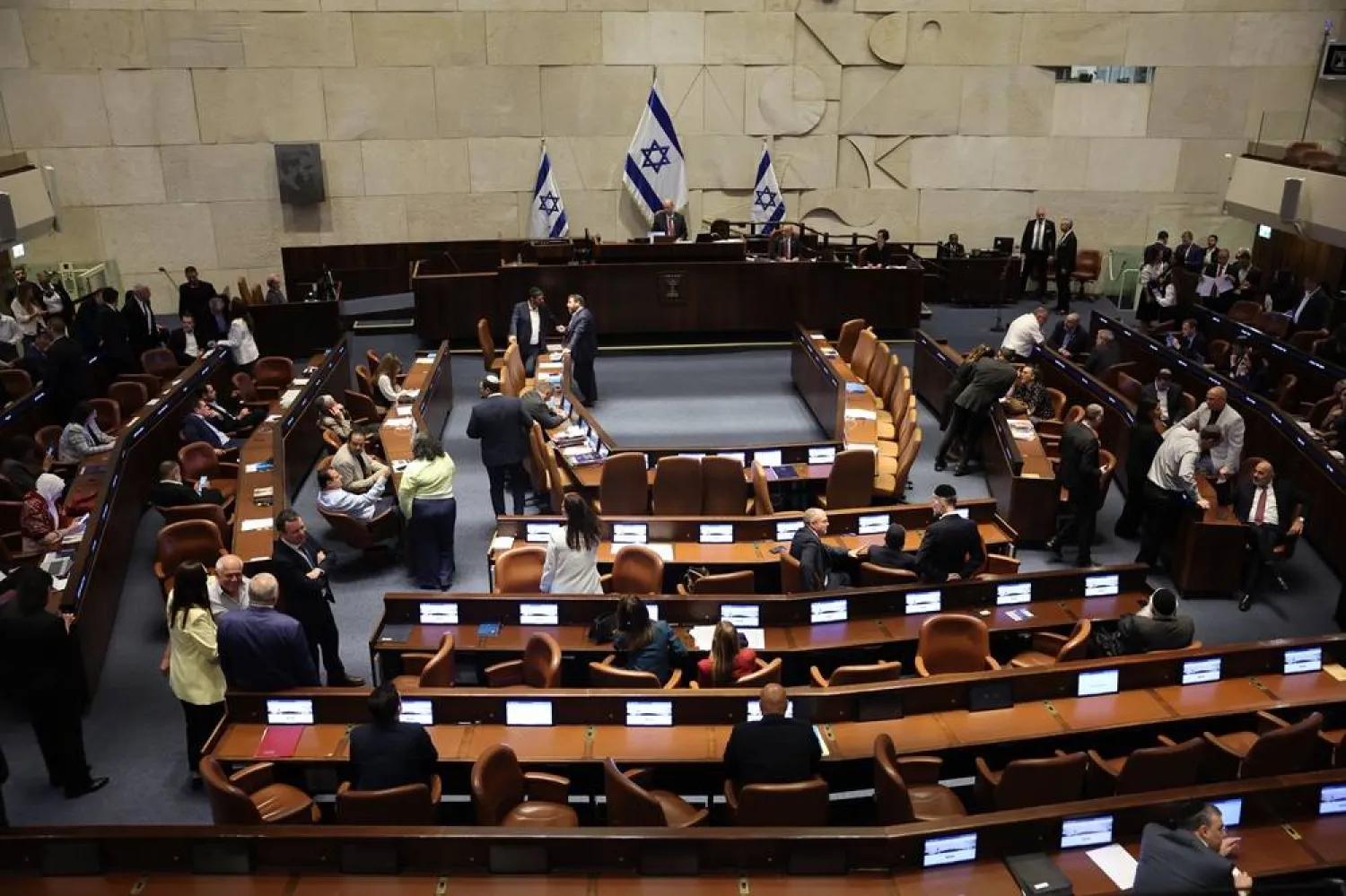

Israeli lawmakers voted on Wednesday to advance a bill submitted by the ruling coalition of Prime Minister Benjamin Netanyahu which would dissolve parliament and pave the way for early elections.
In a preliminary reading, 110 out of 120 lawmakers voted in favor and none against, while the rest did not cast their vote.
The bill will now pass to a committee before three more parliamentary readings.
If the bill is ultimately approved, it would automatically trigger elections to be held after 90 days. Polls are currently scheduled to take place by the end of the legislative term on October 27.
Netanyahu is under mounting pressure from ultra-Orthodox parties, while his fractious right-wing coalition appears to be facing possible collapse.
Ultra-Orthodox parties accuse Netanyahu of failing to deliver on his promise to pass legislation that would permanently exempt young men of their community from compulsory military service if they are studying in yeshivas, or religious seminaries.
"The dissolution of the Knesset, approved in a preliminary reading this Wednesday, could still be suspended if the exemption (for ultra-Orthodox students) passed beforehand," said Myriam Shermer, an Israeli political columnist specializing in elections.
"All of this could once again be turned upside down if military operations resumed in Iran, suspending the electoral calendar. But in the meantime, Benjamin Netanyahu's coalition seems to be seriously faltering," Shermer told AFP.
Sensing an opportunity amid the turmoil, several opposition parties announced earlier this month that they intended to introduce their own bills to dissolve the Knesset.
On Wednesday, coalition chairman Ofir Katz said: "This coalition has completed its days."
"This is the only opposition that caused the coalition to grow. In this term we passed nine budgets and 520 laws," he added.
The bill does not set a date for elections, which would be fixed during the committee stage.
- 'Election campaign has begun' -
Netanyahu "doesn't want elections to be close to October 7", said Gideon Rahat, political science professor at Hebrew University, referring to the date when Hamas attacked Israel in 2023.
"The agenda would be on his huge failure there, so he prefers to have it before," Rahat told AFP.
"Also in Israel you don't have snap elections, you need about 90-100 days to get ready... so I would say that it was quite predictable that he would have the elections around September."
Opposition figures have already been shaping the agenda around the October 7 attacks.
"These are the October 7 elections, the elections in which the Israeli public will send home the government of negligence that brought upon us the greatest disaster in the state's history," Yair Golan, head of the left-wing Democrats party, wrote on X.
Netanyahu, a political survivor often described as the phoenix of Israeli politics, is 76 years old and has confirmed he intends to run for office again.
He recently revealed that he had undergone surgery for prostate cancer.
Netanyahu has governed Israel longer than any other prime minister -- more than 18 years in total since 1996.
He is seeking another term despite facing a long-running corruption trial.
Many Israelis blame Netanyahu for the security failure that enabled the unprecedented attack by Hamas.
A poll by Israel's public broadcaster KAN published this month put his Likud party in first place in voting intentions, with a narrow lead over Beyahad -- the joint list of opposition leader Yair Lapid and former prime minister Naftali Bennett.
However, neither bloc appears capable of forming a government, given the fragmented electorate.
"I have two words to say to the outgoing prime minister: It's over, you can let go," Bennett said at a Beyahad meeting.
"The election campaign has begun today," Lapid said at the same event.
"These will be elections to choose between hope and fear. Between those who serve and those who shirk, between integrity and corruption, between those who take responsibility and those who merely shift the blame onto others."


