


US Pressures Palestinian UN Envoy to Drop General Assembly Vice Presidency Bid

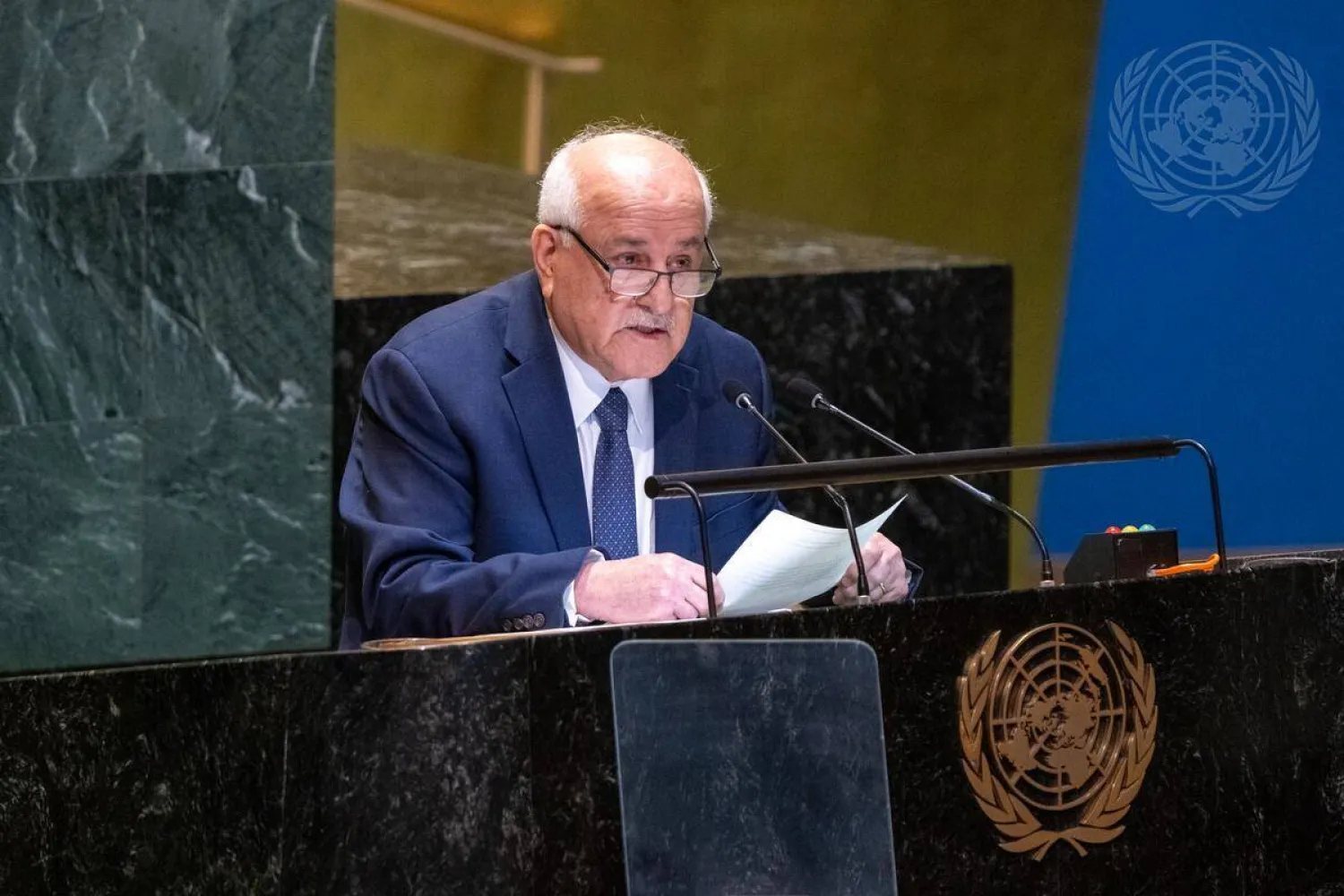
Palestinian Permanent Representative to the United Nations, Riyad Mansour, speaking at the UN General Assembly (UN)
TT

US Pressures Palestinian UN Envoy to Drop General Assembly Vice Presidency Bid

Palestinian Permanent Representative to the United Nations, Riyad Mansour, speaking at the UN General Assembly (UN)

President Donald Trump's administration threatened to revoke the visas of the Palestinian delegation to the United Nations if the Palestinian ambassador refuses to end his candidacy for the vice presidency of the UN General Assembly, according to an internal State Department cable seen by Reuters.

In a cable dated Wednesday, US diplomats in its embassy in Jerusalem are instructed to deliver the message that Palestinian ambassador to the UN Riyad Mansour's general assembly bid "fuels tensions", risks to undermine Trump's Gaza peace plan and would therefore face consequences from Washington if it went ahead.

"To be clear, we will hold the PA responsible if the Palestinian delegation does not withdraw its ⁠VPGA candidacy," the cable, ⁠marked sensitive but unclassified, said, referring to the Palestinian Authority which exercises limited self-rule in the West Bank.

Among the talking points provided in the cable to US diplomats, the State Department's September 2025 decision to waive visa sanctions for Palestinian officials assigned to the Palestinian UN mission in New York was noted.

"It would be unfortunate to have to revisit any available options," the cable, which was first reported by NPR, said.

The Palestinian mission at UN did not ⁠immediately respond to a request for comment.

"We take seriously our obligations under the UN Headquarters Agreement," a State Department spokesperson said. "Due to visa record confidentiality, we have no comment on Department actions with respect to specific cases."

Trump's plan for Gaza, shattered after more than two years of war, has been held up by a refusal by Hamas to lay down their weapons and by continued Israeli attacks in Gaza that have undermined an October ceasefire.

Israeli forces still occupy more than half of Gaza's territory, where they have demolished most remaining buildings and ordered all residents out.

Mansour had already withdrawn his candidacy for the presidency of the General Assembly as a result of US lobbying in February, the cable said, but added ⁠that if elected ⁠to the lower-profile vice presidency, he could still get to preside over General Assembly sessions.

"Therefore, there is still a risk that the Palestinians could preside over GA sessions during UNGA81 unless they withdraw from the race," the cable said, referring to the UN General Assembly's 81st annual high-level week due to be convened in September.

"In a worst-case scenario, the next PGA might assist the Palestinians in presiding over high-profile sessions related to the Middle East or during UNGA81 high-level week," it said.

The election of the UN General Assembly president and the 16 delegations that will serve as vice presidents will be held on June 2.

The Palestinian Authority, which represents the Palestinian people at the United Nations, where the delegation is officially known as the State of Palestine, is not a full member and has no vote in the 193-member General Assembly.

They are an observer state, holding the same status as the Holy See (Vatican).


Pakistan Army Chief Due in Iran as Trump Says Talks on 'Borderline'

TOPSHOT - A woman walks past mockups of Iranian missiles along Valiasr Square in Tehran on April 6, 2026.  (Photo by ATTA KENARE / AFP) /
TOPSHOT - A woman walks past mockups of Iranian missiles along Valiasr Square in Tehran on April 6, 2026. (Photo by ATTA KENARE / AFP) /
TT

Pakistan Army Chief Due in Iran as Trump Says Talks on 'Borderline'

TOPSHOT - A woman walks past mockups of Iranian missiles along Valiasr Square in Tehran on April 6, 2026.  (Photo by ATTA KENARE / AFP) /
TOPSHOT - A woman walks past mockups of Iranian missiles along Valiasr Square in Tehran on April 6, 2026. (Photo by ATTA KENARE / AFP) /

Pakistan's army chief was due in Iran Thursday, Iranian media reported, with Islamabad mediating as Iran examines a new US proposal to end the Middle East war.

The reported visit by Field Marshal Asim Munir, a powerful figure with a growing role in Pakistan's foreign relations, comes a day after President Donald Trump warned that negotiations to end the war were on the "borderline" between a deal and renewed strikes.

A ceasefire on April 8 halted the war launched weeks earlier by the US and Israel, but negotiation efforts have so far failed to yield a lasting peace agreement, AFP said.

A war of words has taken the place of open conflict but the impasse continues to weigh on the world economy, leaving everyone from investors to farmers in a painful state of uncertainty.

On Thursday, Iran's ISNA news agency said Munir's visit was aimed at continuing "talks and consultations" with Iranian authorities, without providing details. Other Iranian media carried the same report.

Pakistan hosted in April the only direct negotiations between US and Iranian officials to take place since February 28, the day the war began.

Munir was at the center of the action during that round of talks, greeting both delegations on their arrival and displaying remarkable bonhomie with US Vice President JD Vance.

But the talks ultimately failed, with Iran accusing the US of making "excessive demands".

Since then, the two sides have sent to each other multiple proposals, with the threat of renewed war looming all along.

"It's right on the borderline, believe me," Trump told reporters Wednesday. "If we don't get the right answers, it goes very quickly. We're all ready to go."

He said a deal could come "very quickly" or "in a few days", but warned Tehran would have to provide "100 percent good answers".

- 'Forceful response' -

Tehran's chief negotiator Mohammad Bagher Ghalibaf on Wednesday accused Washington of seeking to restart the war, while warning of a "forceful response" if Iran is attacked.

"The enemy's movements, both overt and clandestine, show that despite economic and political pressure, it has not abandoned its military objectives and is seeking to start a new war," Ghalibaf said.

Iran's foreign ministry spokesman Esmaeil Baqaei said the Iranian republic was examining points received from Washington, while repeating Tehran's demands for the release of its assets frozen abroad and an end to a US naval blockade.

Trump is under political pressure at home as energy costs rise.

The ceasefire halted the fighting but has not reopened the Strait of Hormuz, the vital waterway that normally carries about a fifth of the world's oil and liquefied natural gas.

The future of Hormuz remains a key sticking point in the negotiations, with fears growing that the global economy will feel more pain as pre-war oil stockpiles run down.

Iran imposed the blockade of Hormuz as part of its retaliation in the war, allowing only a trickle of vessels through in recent weeks while introducing a toll system.

Hormuz also carries around a third of global fertilizer shipments, raising concerns of higher food prices and shortages if the closure drags on.

The UN Food and Agriculture Organization said the closure could trigger "a severe global food price crisis" and a "systemic agrifood shock".

Cautious hope rippled through financial markets on Thursday, with crude prices edging up around 0.5 percent. On Wednesday oil had fallen more than five percent, while US stocks rose.

Analysts warned that investors remained wary after weeks of false starts in the negotiations.


Iran Hangs Two Men for Armed Rebellion, Links to 'Separatists'

A woman holds Iran’s national flag during a gathering in support of the Iranian government against the US and Israel, in a street in Tehran, Iran, 20 May 2026. EPA/ABEDIN TAHERKENAREH
TT

Iran Hangs Two Men for Armed Rebellion, Links to 'Separatists'

A woman holds Iran’s national flag during a gathering in support of the Iranian government against the US and Israel, in a street in Tehran, Iran, 20 May 2026. EPA/ABEDIN TAHERKENAREH

Iran on Thursday hanged two men convicted of armed rebellion and membership in "separatist terrorist groups", the latest in a string of executions during the Middle East war.

Since the start of the conflict with Israel and the United States in February, Iran has ramped up executions, with many of the convicts hanged over anti-government protests that took place across Iran early this year.

Iran's judiciary said the two men executed Thursday were involved in armed attacks against security forces and assassination plots in western Iran.

"Ramin Zaleh and Karim Maroufpour were hanged for membership in separatist terrorist groups, forming a group with the aim of disrupting the country's security, armed rebellion through the formation of criminal groups, shooting and carrying out assassination attempts," the judiciary's Mizan Online website reported.

It was not immediately clear when they were arrested but, according to AFP, the judiciary said they had been trained to become "leaders in the unrest".


US Military Boards Iranian-flagged Oil Tanker Suspected of Trying to Breach Blockade

FILE PHOTO: Vessels in the Strait of Hormuz, Musandam, Oman, May 15, 2026. REUTERS/File Photo
TT

US Military Boards Iranian-flagged Oil Tanker Suspected of Trying to Breach Blockade

FILE PHOTO: Vessels in the Strait of Hormuz, Musandam, Oman, May 15, 2026. REUTERS/File Photo

The US military said Wednesday that it boarded an Iranian-flagged oil tanker in the Gulf of Oman that was suspected of trying to violate the American blockade, the latest action by the Trump administration to try to push Tehran to reopen the Strait of Hormuz.

But President Donald Trump is facing his own pressure at home for shipping to resume through the vital corridor off Iran's coast. Fellow Republicans in Congress are battling political headwinds ahead of November's midterm elections as gasoline prices skyrocket and global energy markets churn.

Meanwhile, the Senate on Tuesday advanced legislation seeking to force Trump to withdraw from the Iran war, with a growing number of Republicans defying the president in the 50-47 vote.

US Central Command said on social media that the M/T Celestial Sea was searched and redirected after being suspected of trying to head to an Iranian port. It’s at least the fifth commercial vessel to be boarded since the Trump administration imposed the blockade on Iranian shipping in mid-April, several days into a ceasefire, to pressure Tehran into opening the strait and accepting a deal to end the war.

The military boarded the tanker after Trump said Monday he had called off renewed military strikes on Iran in an effort to make progress in negotiations to end the war. Trump said he had planned “a very major attack” for Tuesday but put it off, saying America’s allies in the Gulf asked him to wait for two to three days because they feel they are close to a deal.

Trump has repeatedly set deadlines for Tehran and then backed off.

Before the US blockade, Tehran had allowed some ships perceived as friendly to pass while charging considerable fees, leading to accusations it is holding the global economy hostage.

The US military recently said that 1,550 vessels, from 87 countries, are currently stranded in the Arabian Gulf.

Nearly three months since the war began with US and Israeli airstrikes on Feb. 28, Iran maintains a chokehold on the strait, while the US military has enforced its blockade on Iran's ports as well as Iranian-linked ships that are far away from the Middle East.

Last month, US forces boarded an oil tanker previously sanctioned for smuggling Iranian crude oil in the Bay of Bengal in the Indian Ocean. A couple days later, the US seized another tanker associated with smuggling Iranian oil in the Indian Ocean between Sri Lanka and Indonesia.

In early May, Trump said the US military would begin to “guide” stranded ships from the Iran-gripped strait. The next day, he announced that the effort to protect ships was paused to see if an agreement could be reached.

Days later, US forces fired on and disabled two Iranian oil tankers after exchanging fire with Iranian forces in the Strait of Hormuz. The US military said the tankers were trying to breach the blockade. The day before, the military said it thwarted Iranian attacks on three Navy ships and struck Iranian military facilities in response.
