


US-China Conflict Over Taiwan Risks a Nuclear Escalation, Study Finds

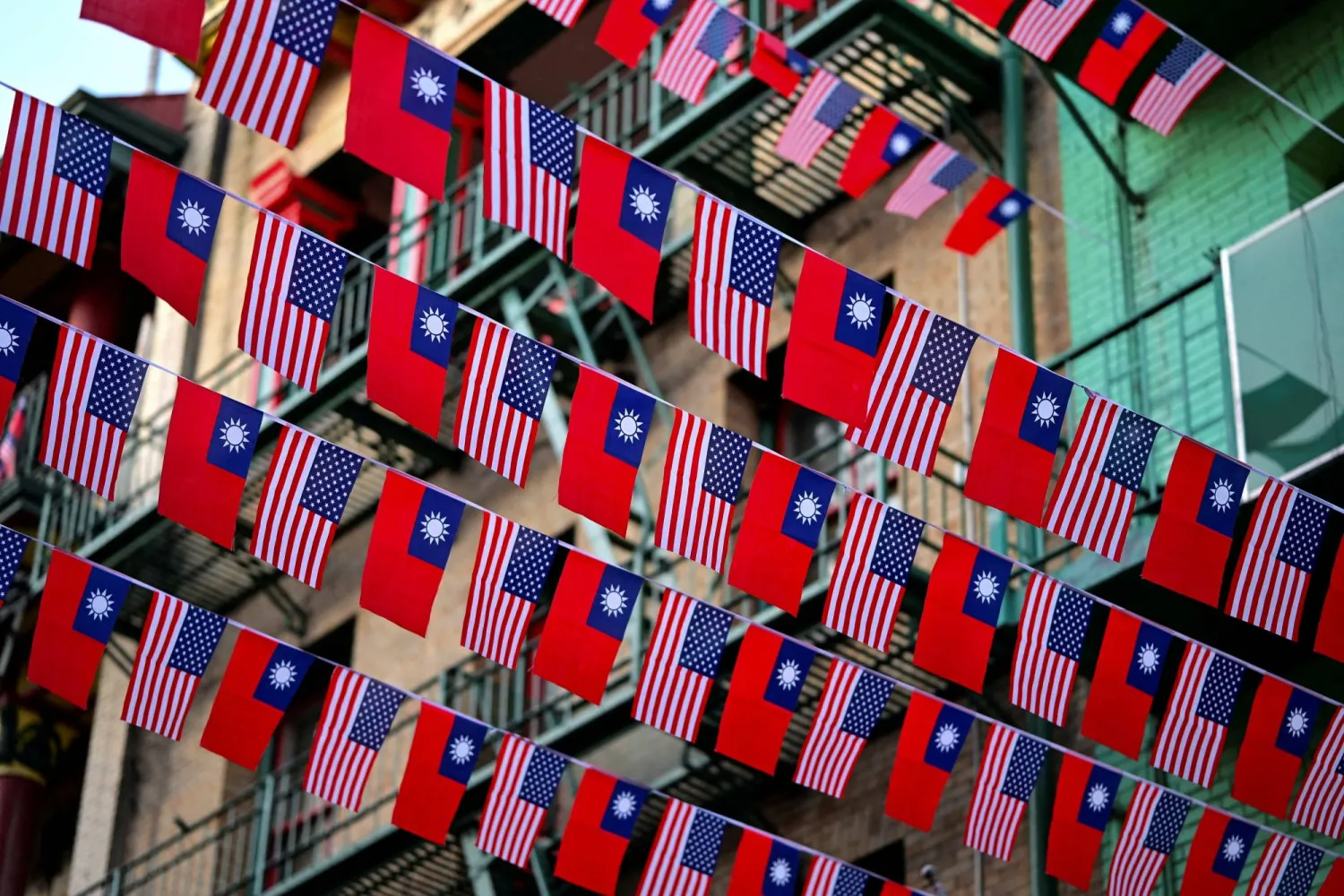
US and Taiwanese flags are seen in San Francisco, California, January 28, 2026. (Reuters)
TT

US-China Conflict Over Taiwan Risks a Nuclear Escalation, Study Finds

US and Taiwanese flags are seen in San Francisco, California, January 28, 2026. (Reuters)

A conflict between the US and China over Taiwan would risk a nuclear escalation with both militaries likely to stage sweeping operations targeting rival command and communications hubs, a leading defense research center said on Thursday.

In a strategic assessment ahead of Asia's biggest annual defense meeting in Singapore this weekend, the London-based International Institute for Strategic Studies (IISS) said the world was on the cusp of a new nuclear arms race "with the Asia-Pacific at its core".

"Regional states and those with strategic interests are expanding their nuclear arsenals, while non-nuclear weapons states pursue long-range conventional-strike capabilities: both challenging strategic stability," the IISS assessment said.

There was no immediate response from US or Chinese authorities.

Taiwan, the conflict in Iran and uncertainties about US commitments to the region, are expected to surface prominently at the IISS' ‌Shangri-La Dialogue.

The informal ‌conference runs from May 29 to 31, drawing an eclectic mix of ministers, ‌generals, ⁠intelligence chiefs, diplomats, analysts ⁠and weapons makers.

The event follows a summit between Chinese President Xi Jinping and his US counterpart Donald Trump in Beijing earlier this month, which led to some concern in Taipei about the US commitment to help the democratically ruled island defend itself.

Beijing has never ruled out the use of force to take control of Taiwan, but has also said it would prefer "peaceful reunification". Taiwan's government rejects Beijing's sovereignty claims.

China has ramped up pressure on Taiwan by increasing its military presence around the island, keeping Taipei on high alert for further Chinese moves following the summit.

LACK OF GUARD RAILS

Trump's ⁠Defense Secretary Pete Hegseth will be speaking at the Singapore conference on Saturday, ‌China has yet to confirm that its Defense Minister Dong Jun ‌will be attending.

The 156-page IISS assessment examines evolving military doctrines across the region as well as how a conflict over Taiwan ‌might play out.

While US and Chinese forces had different aims in a Taiwan scenario - the Chinese to ‌keep the US and its allies at bay while the US bolsters Taiwan's resilience - the two sides could be expected to launch vast operations across military domains.

"Conflict with China would risk escalation, potentially to a nuclear level, given the strategic importance of Taiwan to Beijing," the document says.

"There is currently little public evidence to suggest that both militaries understand the necessary guard ‌rails to prevent, or rules of engagement that would restrict, both sides potentially targeting each other's key command, control, communications, computers, intelligence, surveillance and reconnaissance nodes," the assessment ⁠says.

"The prospect of nuclear ⁠escalation will thus continue to loom large in a major US-China conflict."

IISS senior fellow Daniel Salisbury noted that there were no nuclear-specific conversations at the latest Trump-Xi summit, and that the relationship between the two superpowers was "quite difficult" on the nuclear front.

He said at a press conference that during the Cold War, the US had a long history of conversations with the Soviet Union about arms control and risk reduction measures. However, he said any conversation with China would be more complicated given how a lot of China's nuclear arsenal is concealed.

"That culture of discussion is just not there at the moment so there's far less to build on in that relationship," he said.

While both the US and Russian nuclear arsenals still dwarf China's stockpiles, US officials and arms control analysts say China is expanding and improving its atomic weapons capabilities faster than any other nuclear power.

A Pentagon report released in December said China was on track to field 1,000 warheads by 2030.

The Federation of American Scientists estimates that Russia and the US field 4,400 and 3,700 active warheads respectively while China has 620.



China Vows to Support Cuba Against ‘Power Politics and Bullying’

Chinese Foreign Minister Wang Yi speaks to reporters at United Nations headquarters, Tuesday, May 26, 2026. (AP)
TT

China Vows to Support Cuba Against ‘Power Politics and Bullying’

Chinese Foreign Minister Wang Yi speaks to reporters at United Nations headquarters, Tuesday, May 26, 2026. (AP)

China's foreign minister Wang Yi vowed to support Havana and confront "power politics and bullying" during talks with his Cuban counterpart in New York, state media reported Wednesday, as the Caribbean island faces mounting pressure from the United States.

Cuba is suffering under a US energy blockade, and President Donald Trump has openly mused about taking over the country.

China has close ties to the communist state and has promised to donate 60,000 tons of rice to help Cuba deal with shortages, the first batch of which arrived on Sunday.

"China will continue to uphold justice and speak out on Cuba's behalf, support the just cause of the Cuban people, and contribute to the development of Cuba's economy and the improvement of its people's livelihoods," Wang told Cuban foreign minister Bruno Rodriguez Parrilla, according to a Chinese readout of their meeting.

"It is essential to steadfastly respect the sovereignty and independence of all nations, and to oppose all forms of power politics and bullying," he added, in an apparent reference to the US.

The Trump administration cut off Cuba's supply of oil from Havana's ally Venezuela after it ousted Nicolas Maduro in a raid in January.

Washington tightened the screws last week by indicting former Cuban president Raul Castro over the downing of two civilian US planes in 1996, fueling fears that the US was seeking a pretext to overthrow the government in Havana.

China's foreign ministry urged the US to "stop brandishing... the judicial stick against Cuba and stop threatening force at every turn", in response to the indictment last week.

"China firmly supports Cuba in safeguarding its national sovereignty and national dignity and opposes external interference," spokesman Guo Jiakun said at the time.


US Jails Man Over Plot to Kill Iranian-American Journalist

Iranian-American journalist Masih Alinejad speaks outside Manhattan federal court after the sentencing of a man who admitted to agreeing to try to kill her on behalf of the Iranian government, Jan. 28, 2026, in New York. (AP)
TT

US Jails Man Over Plot to Kill Iranian-American Journalist

Iranian-American journalist Masih Alinejad speaks outside Manhattan federal court after the sentencing of a man who admitted to agreeing to try to kill her on behalf of the Iranian government, Jan. 28, 2026, in New York. (AP)

A man who admitted to taking part in a plot to kill an Iranian-American journalist who is a prominent critic of Tehran was sentenced Wednesday to 10 years in prison.

Jonathan Loadholt, 37, was arrested in November 2024 and pleaded guilty to conspiracy to commit stalking and money laundering in the plot targeting Masih Alinejad, who is 49.

He and another man, Carlisle Rivera, were charged with accepting $100,000 to kill Alinejad, who lives in the United States.

Rivera was sentenced to 15 years in prison in January after pleading guilty to a count of conspiracy to commit murder-for-hire.

The US Justice Department has said the plan to kill Alinejad was ordered by Iran's government.

"Tehran attempted to murder a US journalist in the United States simply because she exposed a few of that regime's many abuses," said Assistant Attorney General for National Security John Eisenberg.

Another suspect remains at large: Farhad Shakeri, an Afghan living in Iran who is accused of recruiting the other two men on behalf of the Iranian Revolutionary Guard Corps, the powerful ideological branch of Iran's military.

Alinejad is one of the most prominent dissident campaigners against Iranian authorities and for years has pushed for the abolition of the obligatory headscarf in Iran under the banner of "MyStealthyFreedom." She left Iran in 2009.

Alinejad was the target of another assassination attempt thwarted at the last moment in the summer of 2022.

She has nearly nine million followers on Instagram.


Talk to Russia? Europe First Seeks to Agree on Terms and Envoy

 Russia's President Vladimir Putin attends a welcoming ceremony before a meeting with Kazakhstan's President Kassym-Jomart Tokayev in Astana, Kazakhstan May 28, 2026. (Reuters)
Russia's President Vladimir Putin attends a welcoming ceremony before a meeting with Kazakhstan's President Kassym-Jomart Tokayev in Astana, Kazakhstan May 28, 2026. (Reuters)
TT

Talk to Russia? Europe First Seeks to Agree on Terms and Envoy

 Russia's President Vladimir Putin attends a welcoming ceremony before a meeting with Kazakhstan's President Kassym-Jomart Tokayev in Astana, Kazakhstan May 28, 2026. (Reuters)
Russia's President Vladimir Putin attends a welcoming ceremony before a meeting with Kazakhstan's President Kassym-Jomart Tokayev in Astana, Kazakhstan May 28, 2026. (Reuters)

With the United States distracted by Iran and Russian President Vladimir Putin appearing on the back foot, Europe is seriously weighing the possibility of talking to Moscow about ending the war in Ukraine.

But before they consider sitting down with the Kremlin, Kyiv's European backers are first looking to decide what they want to discuss with Putin -- and who could represent them.

Trying to get a better picture of those goals and determining if talking to Russia is even realistic now is top of the agenda at a meeting of European Union foreign ministers in Cyprus on Thursday.

"Before we talk to the Russians, we should agree and talk amongst ourselves what we want to talk to the Russians about," said EU foreign policy chief Kaja Kallas.

The debate on re-engaging with Moscow has been getting louder as US efforts to end the bloodshed have hit a dead end and President Donald Trump's attention has been consumed by Iran.

Ukraine is pushing for Europe -- sidelined until now by Washington -- to step in and play a bigger role.

"Europe must be involved in the negotiations. It is important for it to have a strong voice and presence in this process, and it is worth determining who will represent Europe specifically," Ukraine's President Volodymyr Zelensky wrote this month.

On the other side, Putin has also appeared to leave the door ajar, even if his suggestion that his long-time ally, former German chancellor Gerhard Schroeder, could represent Europe was roundly rejected.

- 'No willingness' -

Speculation over other potential envoys has picked up.

Another ex-German leader Angela Merkel -- one of the architects of an earlier flawed Ukraine peace deal with Putin -- poured cold water on speculation she could fit the bill.

There is intense wariness in Europe about talking to Putin after years of bitter enmity since the full-scale invasion of Ukraine in 2022.

Kallas, a hawkish former prime minister of Estonia, has pushed for months to set a series of red lines, seeking to bind countries together and avoid Moscow exploiting any gaps.

Among those is insisting that there has to be a ceasefire before talks happen, refusing to recognize Russian control over seized territories, and making sure Moscow is held accountable for its crimes.

EU officials said Ukraine's foreign minister this month floated the idea that Europe could as a first step help broker a ceasefire in strikes on key infrastructure, such as airports.

But there is a reluctance for Europe to take over the role of neutral mediator from Washington.

"It is hard to see how the EU could become a mediator or broker in the talks and step in for the US, given how much we have supported Ukraine," said one EU diplomat, talking on condition of anonymity.

EU officials say Putin appears weakened as Russia's economy sags, casualties climb and a long-range drone campaign by Ukraine takes its toll.

But there is widespread skepticism that he is serious about negotiating in good faith right now, with the Kremlin unleashing its nuclear-capable Oreshnik missile at Kyiv in recent days.

"Russia is showing at this point no willingness for peace, the bombardments of the last week speak for themselves," said European Commission chief Ursula von der Leyen.

- Chatter -

Diplomats said the discussions in Cyprus were not expected to yield a definitive EU position or come up with a name to talk to Putin.

Kallas has made her pitch for the role, saying she could see through Russia's "traps", but some believe she is too reviled by the Kremlin to be involved.

Several diplomats said that if the representative cannot be found among the EU's top officials, then it should be a head of state from one of the bloc's 27 countries.

One name suggested to AFP was Finnish President Alexander Stubb, who has forged good relations with Trump on the golf course and has expressed interest in the role.

Despite the chatter picking up, there remains deep caution about reaching out to the Kremlin.

"Are we going to move at some point to the diplomatic effort? I can't rule out anything, because things are changing," Latvian President Edgars Rinkevics said this week.

"Is this the right time? I doubt it. Is Russia ready? I doubt it."