


Report: China is Building Launch Pads near Its Nuclear Missile Silos

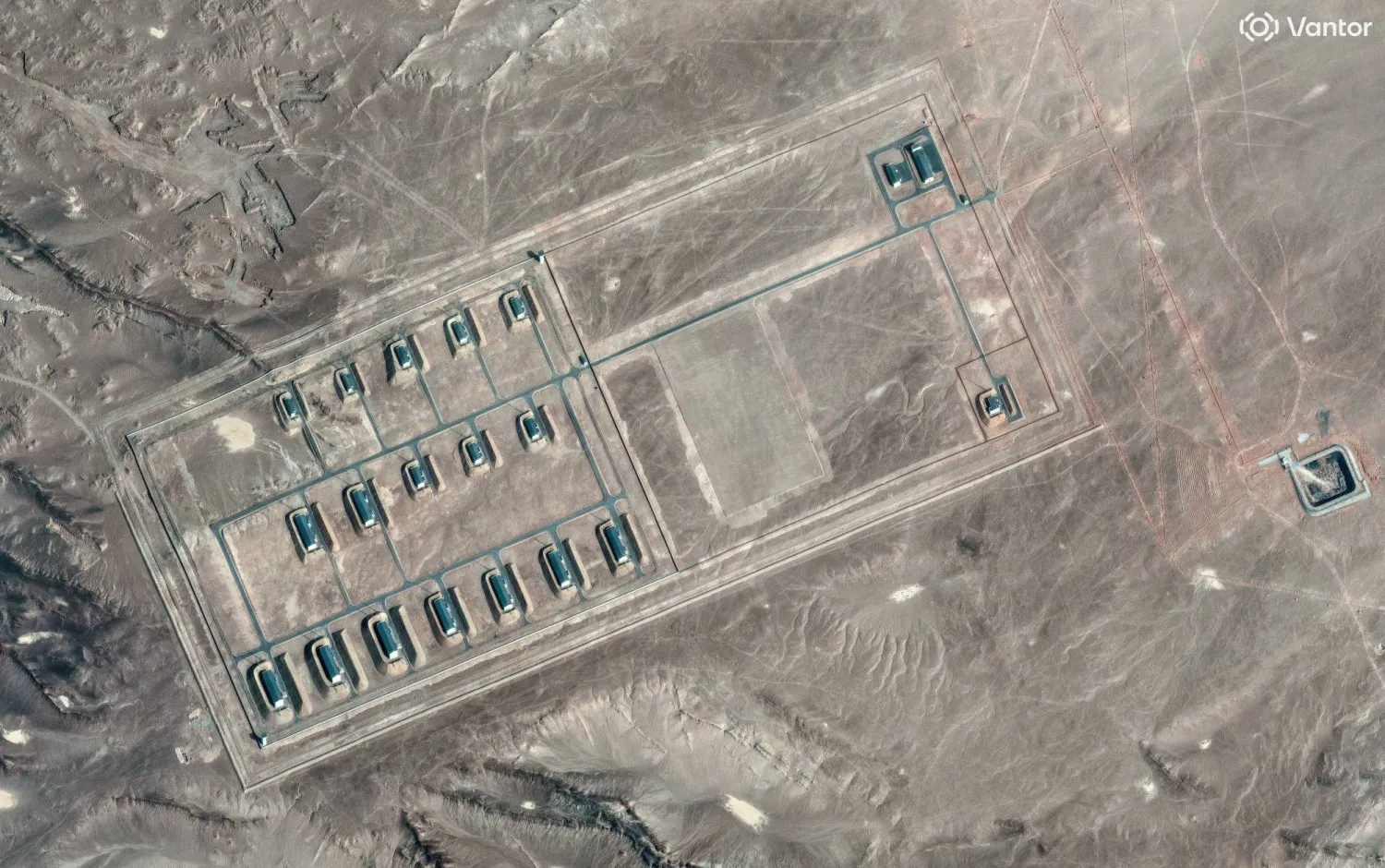
A satellite image shows what security analysts say is a fortified weapons storage installation, revealing revetments around the building, a perimeter wall and guard towers, in the Xinjiang Uyghur Autonomous Region, China, March 19, 2026. Vantor/Handout via REUTERS
TT

Report: China is Building Launch Pads near Its Nuclear Missile Silos

A satellite image shows what security analysts say is a fortified weapons storage installation, revealing revetments around the building, a perimeter wall and guard towers, in the Xinjiang Uyghur Autonomous Region, China, March 19, 2026. Vantor/Handout via REUTERS

In a remote Chinese desert, a vast military complex is taking shape that some security scholars say appears built to ensure no American first strike on China’s nuclear arsenal could reliably knock out Beijing’s ability to hit back.

China’s nuclear missiles can already reach any city in the United States. Now, satellite images reviewed by Reuters show Beijing is building a sprawling web of launch pads, bunkers and communications nodes near the isolated nuclear silos that hold the Chinese military’s longest-range missiles.

The images reveal more than 80 pads for possible use by China’s expanding fleet of mobile missile launchers and air-defense batteries. They also show facilities that may serve electronic warfare, satellite communications and command operations, according to three security analysts, who assessed the imagery for Reuters. (View the story on Reuters.com: )

The scale of the construction, which hasn’t been previously reported, points to a sweeping expansion of hardened infrastructure designed to protect and operate China’s land-based nuclear forces. Taken together, the network signals a significant upgrade in Beijing’s efforts to ensure second-strike capability, underscoring intensifying nuclear competition with the United States as tensions rise over issues such as Taiwan’s sovereignty.

“We can see this infrastructure is being built on a grand scale, covering thousands of square kilometers of desert beyond the silo fields," said Alexander Neill, an adjunct fellow at Hawaii’s Pacific Forum think tank. Depending on the precise capabilities, he said, “we're looking at a very considerable enhancement and diversification of China's strategic nuclear deterrent.” The ability to protect its desert silos is key to China’s stated goal of forging a minimal but credible nuclear deterrent — a policy grounded in the capacity to retaliate if it is struck first. While the People’s Liberation Army (PLA) can fire nuclear weapons from submarines and aircraft, ‌the silo fields in ‌the northwestern Xinjiang region and Gansu province are the core of its nuclear forces. China’s nuclear build-up is among the most scrutinized facets of President ‌Xi Jinping’s ⁠military modernization because ⁠of what some foreign diplomats describe as Beijing’s lack of transparency and failed efforts by the United States to engage the Chinese leadership on its evolving nuclear capabilities and intentions.

A cornerstone of China’s doctrine is its “no first use” policy, meaning its forces wouldn’t initiate a nuclear exchange. But some senior Western diplomats and analysts say China would possibly resort to nuclear coercion to limit outside involvement in a conflict over Taiwan. Xi this month warned US President Donald Trump that mishandling of their countries’ disagreements over Taiwan, which China claims as its territory, could lead them to a “dangerous place.” Taiwan’s government rejects China’s sovereignty claim.

China’s defense ministry didn’t respond to questions about its nuclear program and the developments revealed in the satellite imagery. The Pentagon said it wouldn’t comment on intelligence-related matters.

OCTAGONS IN THE DESERT

The new desert infrastructure is centered on two octagon-shaped installations built over the past six years in eastern Xinjiang. Both are southwest of the Hami nuclear silo fields – one is about 140 kilometers away, the other some 230 kilometers.

Satellite images show the octagon structures contain housing for personnel and large military vehicles. They are flanked by armored bunkers ⁠and fortified weapons-storage areas, as well as airfields and railheads that link the octagons to the Hami silos.

Exercises involving large military vehicles occurred around the ‌northern octagon this month and during April, the images show. Also evident in recent images are large tents and what two analysts said ‌appear to be camouflaged launch sites cut into the desert, some with air-defense missile batteries.

The existence of the octagons has been documented previously. But Reuters is the first to report the extent of the launch-pad network linked ‌to the octagons; recent military activity around one of the facilities; and analysts’ assessments that the pads could field mobile missile launchers and electronic-warfare operations.

Five security scholars interviewed by Reuters agreed the infrastructure broadly ‌could support China’s nuclear program, as well as other military purposes. But they cautioned that key details remain unknown — including the weapons China might deploy at the launch pads and whether the octagon structures house truck-mounted ballistic missiles or facilities for fitting nuclear warheads.

The PLA displayed nuclear-capable weapons during a parade in Beijing last September to mark the 80th anniversary of the end of the Second World War. These included silo-based and truck-mounted intercontinental ballistic missiles (ICBMs). US officials and arms-control analysts say China is expanding and improving its nuclear weapons capabilities faster than any other nation. The latest Pentagon report on China’s military modernization says the country’s warhead production has slowed but it is on track to field 1,000 warheads ‌by 2030. The December report estimated China is likely to have loaded 100 ICBMs across its three main silo fields.

China has also been strengthening its early-warning system, underpinned by its Huoyan-1 satellites, according to US officials. The system can detect an incoming ICBM within 90 seconds of launch ⁠and alert a command center within three to four ⁠minutes, according to the Pentagon — sufficient time for China to fire its own silo-based weapons before they are hit.

‘AN EXTRAORDINARY EFFORT’

Significantly, each octagon sits at the core of a network of dirt roads and conduits that stretch far into the desert. These routes connect to the concrete pads, which are nestled among rocky outcrops and dry creekbeds.

The pads could be used to deploy mobile air-defense missiles, electronic warfare nodes or, from some of the larger ones, road-mobile ICBM launchers, three security scholars said.

Hans Kristensen, director of the Federation of American Scientists’ Nuclear Information Project, said while it was difficult to conclude how the various installations would be used, “it is hard to rule anything out” given the scale of the infrastructure in such a hostile environment.

The conduits that link the pads to the octagon structures may contain fiber-optic cables for communications, Kristensen and Neill said.

At the northernmost octagon, a possible space or microwave communications facility is also under construction, three analysts said, pointing to satellite dishes and two large towers.

“Taken together, I think there is a real possibility that the octagonal structures and the strange towers are linked to C3 - command, control, and communications - as well as maintenance and storage activities related to China's nuclear operations at the Hami ICBM silo site,” said Tong Zhao, a senior fellow in nuclear policy at the Carnegie Endowment for International Peace.

A third octagon-shaped installation south of the Lop Nur nuclear test facilities is less developed. It appears to be used as a target range: Images show pock-marked earth, damaged buildings and what analysts at Vantor, a commercial provider of satellite imagery, said are mock-ups of Western jet fighters.

The extent of the defensive network near its silos potentially sets China apart from the other major nuclear powers. The US and Russia — whose warhead stockpiles and deployed weapons far exceed Beijing’s — rely on a combination of sheer numbers of silos, their relative isolation and hardened construction to deter a first strike, rather than extensive missile defense, Kristensen said.

The scale of what is emerging in China’s northwestern desert has left even seasoned analysts startled.

Trump to Make First Flight on Qatar-Gifted Jet This Week

(FILES) In this February 15, 2025 a Qatari Boeing 747 sits on the tarmac of Palm Beach International airport after US President Donald Trump toured the aircraft on February 15, 2025. (Photo by ROBERTO SCHMIDT / AFP)
TT

Trump to Make First Flight on Qatar-Gifted Jet This Week

(FILES) In this February 15, 2025 a Qatari Boeing 747 sits on the tarmac of Palm Beach International airport after US President Donald Trump toured the aircraft on February 15, 2025. (Photo by ROBERTO SCHMIDT / AFP)

US President Donald Trump will make his first flight on a new Air Force One plane gifted by Qatar later this week, the White House said Monday.

Trump will take the jet on Wednesday to North Dakota for an event marking the 250th anniversary of US independence, a White House official told AFP.

As he unveiled the plane earlier this month, Trump praised the Gulf emirate for being “so nice and providing” the modified Boeing 747, which previously served Qatar's head of state.

Trump has been obsessed since his first term with replacing the aging jets that serve as Air Force One, and he hand-picked the new plane's red, white and blue livery.

But critics have raised a host of ethical, constitutional and security concerns about the gifting of an aircraft worth hundreds of millions of dollars by a foreign power like Qatar.

The US Constitution prohibits presidents and other officeholders from receiving “any present, Emolument, Office, or Title, of any kind whatever, from any King, Prince, or foreign State” unless approved by Congress.

Trump's administration has said the plane is a direct gift to the US Department of Defense -- while stoking further concern by saying the plane would eventually be donated to Trump's presidential library.

The Qatari-gifted plane is meant to be a stopgap until US planemaker Boeing delivers two new 747-8 aircraft to serve as the presidential jet in a program plagued by delays and cost overruns.


Türkiye Must Be ‘Included’ in Europe Security Structures, Says Erdogan

Turkish President Recep Tayyip Erdogan speaks during the opening ceremony of Antalya Diplomacy Forum in Antalya, Türkiye, April 17, 2026. (Reuters)
TT

Türkiye Must Be ‘Included’ in Europe Security Structures, Says Erdogan

Turkish President Recep Tayyip Erdogan speaks during the opening ceremony of Antalya Diplomacy Forum in Antalya, Türkiye, April 17, 2026. (Reuters)

Türkiye must be included in all of Europe's defense structures and defence trade restrictions between NATO members must be removed, President Recep Tayyip Erdogan said Monday ahead of a key NATO summit.

His remarks come as Europe revamps its defenses to counter Russia and the risk of a US pullback from NATO, which is to hold a summit in the Turkish capital Ankara on July 7-8.

"Türkiye's indispensable contributions to European security are sometimes overlooked," Erdogan told parliamentary delegates from all 32 NATO member states in Istanbul. He said Türkiye wanted "to participate in all defense and security initiatives" on the continent.

At issue is Türkiye's access to the European Union's 150-billion-euro ($176-billion) Security Action for Europe (SAFE) initiative, intended to strengthen European defense capabilities.

"We expect your support, lawmakers, for Türkiye's inclusion in the defense and security initiatives announced by the European Union," Erdogan told them.

Within SAFE, firms from non-EU countries such as Türkiye, Britain and the United States can only supply up to 35 percent of the component costs of weaponry funded by the scheme.

If Türkiye wants its companies to be able to tap a bigger part of the funds Ankara needs to sign a security partnership with the EU and then negotiate special access with Brussels -- a process that would require approval from all 27 EU members. Greece has threatened to block such a move.

"Under SAFE, any third country can participate in a defense project up to a level of 35 percent. Any negotiations with a view to potentially increasing or lifting this 35 per cent cap ... would require a bilateral agreement," said Thomas Regnier, a European Commission spokesperson.

"For now, this is not an agreement we have concluded with Türkiye."

- 'Remove the obstacles' -

Erdogan also urged NATO to remove all barriers blocking defense industry trade between alliance members.

"If we want to overcome the challenges we face, we need to remove obstacles to defense industry trade while ensuring a balanced and fair burden-sharing among allies," he said.

Türkiye has the second-biggest army of the alliance after the United States and a burgeoning defense industry which has gone from strength to strength fueled by bilateral defense deals.

But its defense industry has been hit by US sanctions imposed over Ankara's purchase of an S-400 Russian surface-to-air missile defense system. Washington also booted Türkiye out of its F-35 program, in a move that has soured relations between the NATO allies.

Although Washington has expressed a desire to draw a line under the dispute, lifting the sanctions requires Congressional approval. Observers say there is little chance the showdown would be resolved before the summit.

US President Donald Trump has however pledged to give Erdogan something that would make him "very happy" when he flies in next week for the NATO gathering.

Analysts said it was likely to be a delivery of several dozen US-made F110 engines Türkiye needs for its fifth-generation KAAN fighter jets that are under development. Delivery of the engines had been blocked since the imposition of the US sanctions.


Trump Says Iran Requested Meeting to be Held in Doha Tuesday

US and Iran flags are seen in this illustration taken June 18, 2025. REUTERS/Dado Ruvic/Illustration/File Photo
TT

Trump Says Iran Requested Meeting to be Held in Doha Tuesday

US and Iran flags are seen in this illustration taken June 18, 2025. REUTERS/Dado Ruvic/Illustration/File Photo

US President Donald Trump said that Iran has requested a meeting that will be held in the Gulf state of Qatar on Tuesday, despite an earlier denial from Tehran that talks were planned.

"IRAN HAS REQUESTED A MEETING. IT WILL TAKE PLACE TOMORROW IN DOHA!" Trump posted on his Truth Social platform on Monday.

Shortly afterwards, White House spokesperson Karoline Leavitt said US negotiators Jared Kushner and Steve Witkoff would be "flying to Doha for high level meetings this week".

Iran's foreign ministry earlier on Monday denied reports that Iranian and American technical teams will meet this week to discuss the implementation of the deal to end the Middle East war.

Uncertainty over the talks followed renewed tit-for-tat attacks between the United States and Iran in recent days despite an April ceasefire and a memorandum of understanding, brokered by Pakistan and Qatar, aimed at permanently ending the war.

A diplomat with knowledge of the talks confirmed to AFP on Monday that officials from the US and Iran are to meet in Doha to discuss the accord.

"Technical teams working on the implementation of the MoU are scheduled to meet in Doha in the coming days," the diplomat said on condition of anonymity to discuss the sensitive talks.

The diplomat added "communications channels created to de-escalate any incidents are in place," following strikes between the US and Iran.