


‘We Need to Act Now’: Race to Develop Ebola Vaccine Heats Up

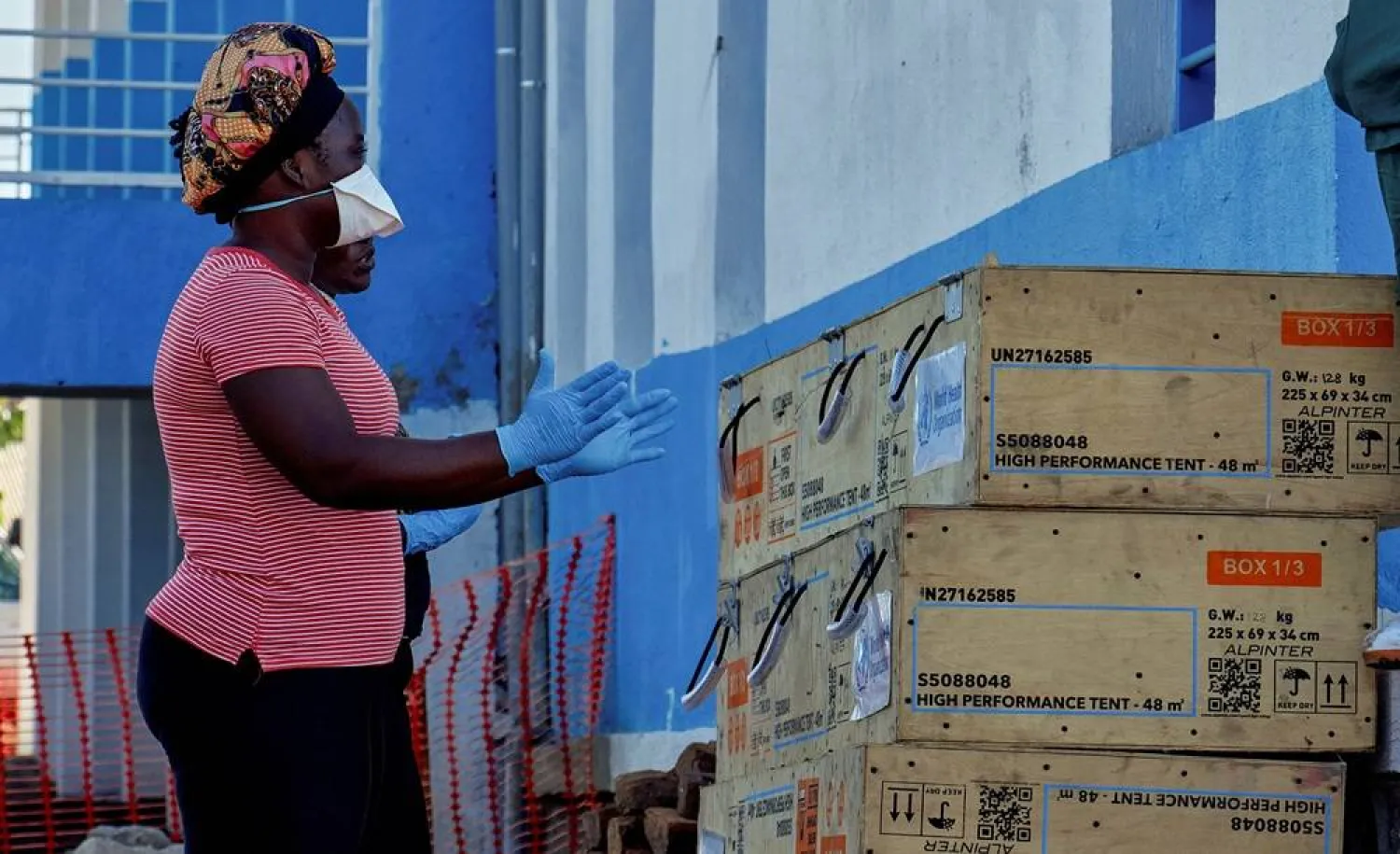
Health workers receive boxes of tents at the Evangelical Medical Center, one of the facilities at the forefront of the response to the Ebola outbreak, as agencies intensify efforts to contain a new Ebola outbreak caused by the Bundibugyo virus strain, in Bunia, Ituri province, Democratic Republic of Congo, May 31, 2026. (Reuters)
TT

‘We Need to Act Now’: Race to Develop Ebola Vaccine Heats Up

Health workers receive boxes of tents at the Evangelical Medical Center, one of the facilities at the forefront of the response to the Ebola outbreak, as agencies intensify efforts to contain a new Ebola outbreak caused by the Bundibugyo virus strain, in Bunia, Ituri province, Democratic Republic of Congo, May 31, 2026. (Reuters)

Several non-profit organizations announced Monday they are ramping up efforts to rapidly develop a vaccine for the rare strain of Ebola driving a deadly outbreak in the Democratic Republic of Congo.

Nearly 250 people are suspected to have died and more than 1,100 infected with the strain in the DRC and neighboring Uganda, though the true spread of the virus is feared to be much wider.

While it marks the 17th Ebola outbreak in the DRC, it is just the third caused by the Bundibugyo strain, for which there are no approved vaccines or treatments.

The escalating nature of the outbreak has sparked a race to find a vaccine that can be quickly developed, manufactured then tested in humans during clinical trials in the affected region.

The World Health Organization said on Saturday that its experts had determined "the most promising candidate vaccine" was a single-dose shot using the rVSV platform.

The only licensed Ebola vaccine, which targets the more common Zaire strain, uses the same platform.

The non-profit International AIDS Vaccine Initiative (IAVI) announced Monday it had reached a deal with the University of Texas Medical Branch to develop the rVSV candidate.

The university's Thomas Geisbert led work on both the Bundibugyo candidate and the licensed Zaire jab.

Geisbert told AFP last month that 2013 research demonstrated his jab provided very strong protection against Bundibugyo in monkeys.

However the vaccine "just sat there" for more than a decade because of a lack of interest, in particular from pharmaceutical firms, the virologist added.

The WHO estimated it would take seven to nine months before the rVSV vaccine is ready to be tested in humans.

- 'Fast-track' -

Also on Monday, the Coalition for Epidemic Preparedness Innovations (CEPI) announced funding to "fast-track" development of three Bundibugyo vaccine candidates, including $3.2 million towards the rVSV jab.

WHO chief Tedros Adhanom Ghebreyesus, who visited the epicenter of the outbreak in the DRC on the weekend, said in a statement the funding was "an important step forward".

Another vaccine candidate receiving CEPI funding was developed on the University of Oxford's ChAdOx1 platform, which also underpinned AstraZeneca's Covid vaccine.

This viral vector jab -- which will be manufactured by the huge Serum Institute of India -- could become available for clinical trials within two to three months, the WHO said.

CEPI also said it had committed $50 million to a vaccine candidate being developed by US pharma giant Moderna which uses the mRNA technology pioneered in its Covid vaccine.

In a preprint paper published online last week, researchers at France's INSERM institute called for trials to see if the licensed Zaire vaccine could also help fight Bundibugyo.

- $50 million pledge -

Also on Monday, the Gavi vaccine alliance announced it would make up to $50 million available for Bundibugyo vaccine efforts.

"We need to act now to ensure that, once one or more vaccine candidates are ready, manufacturers are in a position to start producing doses at scale," Gavi CEO Sania Nishtar said in a statement.

IAVI president Mark Feinberg told a press conference on Monday that Gavi's new commitment could fund the production of roughly 500,000 doses.

It also provided a "signal to manufacturers they can make this investment and not carry excessive risk," he added.

Even once doses for a trial are ready, there will be challenges in deploying them in a vast, remote area of the DRC that is already suffering crises including hunger, malaria and conflict.

Gaining the trust of communities where vaccines will be trialed will be crucial, the WHO emphasized.

And once a trial is finally carried out, there is no guarantee it will demonstrate the vaccine works.

"We have reasons to believe that we can generate effective vaccines, but we don't want to downplay at all that we have to treat them as investigational products," CEPI CEO Richard Hatchett said last week.

There are also several efforts to quickly trial several Bundibugyo treatments, including antivirals called remdesivir and obeldesivir, and the monoclonal antibody MBP134.



Trump's New Press Secretary Admits Failing Bar Exam

President Donald Trump speaks to the reporters as he walks to board Marine One on the South Lawn of the White House, Tuesday, Oct. 13, 2026, in Washington, as White House press secretary Katie Zacharia looks on. (AP Photo/Julia Demaree Nikhinson)
TT

Trump's New Press Secretary Admits Failing Bar Exam

President Donald Trump speaks to the reporters as he walks to board Marine One on the South Lawn of the White House, Tuesday, Oct. 13, 2026, in Washington, as White House press secretary Katie Zacharia looks on. (AP Photo/Julia Demaree Nikhinson)

New White House Press Secretary Katie Zacharia acknowledged on Thursday that she had failed the bar exam, a prerequisite for practicing law in the United States, as her credentials face scrutiny.

Zacharia has described herself as a lawyer during television appearances and on social media, and listed herself as general counsel of a California-based conservative nonprofit.

But the legal credentials of the press secretary, who President Donald Trump appointed last week, were called into question after she gave an inconclusive answer about where she had passed the bar exam.

The 41-year-old graduated from Pepperdine University's law school in 2011, but obtaining a law degree does not automatically qualify someone to practice law.

In a Fox News interview on Thursday, host Sean Hannity asked Zacharia: "You took the bar exam, but you didn't pass the bar exam, correct?"

"Yes," she responded.

In a separate interview with conservative media outlet Real America's Voice on Thursday, Zacharia said she had registered to take the bar exam but was "distracted and overwhelmed" by plans to move to China with her husband.

"The results are somewhat inconsequential because I knew I wouldn't need the bar in China," AFP quoted her as saying.

Foreign nationals cannot sit China's bar exam, although they can undertake certain legal work at Chinese law firms.

Hannity later asked Zacharia if she had ever taken the bar exam a second time, to which she said: "I did not."

"I had four kids in six years," she said. "It was never my intent to go into the practice of law."

Zacharia said on Real America's Voice that "many people in the field" had assured her that she could "label myself a lawyer," given her law degree and experience in business law gained in China, where she worked at a Beijing law firm.

She added that she could "provide legal analysis, not legal advice."

"I was very careful how I executed this."

The Campaign for Accountability, a political ethics organization, called on Wednesday for the California Bar Association to launch an investigation.

"In California, calling yourself a lawyer without a license isn't puffery; it's a crime," the organization said in a press release.

Zacharia held her first White House press briefing on Tuesday with an unusually short press conference, answering questions from only three journalists.

She succeeded Karoline Leavitt, a loyal Trump supporter and often combative press secretary, who stepped down in August to care for her young children.


Teen Sentenced to 20 Years for UK Murder Plot Tied to Iran-linked Group

A red double-decker bus rides past as a Union Jack flag flutters on the Victoria Tower at the Houses of Parliament in London, Britain, October 15, 2026. REUTERS/Isabel Infantes
TT

Teen Sentenced to 20 Years for UK Murder Plot Tied to Iran-linked Group

A red double-decker bus rides past as a Union Jack flag flutters on the Victoria Tower at the Houses of Parliament in London, Britain, October 15, 2026. REUTERS/Isabel Infantes

A Norwegian teenager who planned to commit murder in Britain after being recruited by a Swedish organized crime group linked to the Iranian government was on Friday sentenced to 20 years' detention.

Johannes Natland, now 19, was arrested in a hotel room in Huddersfield, northern England, in March ⁠2025 with two ⁠firearms and ammunition in his possession.

Natland was recruited by the Foxtrot Network, a Swedish organized crime group used by the Iranian state and sanctioned by ⁠both Britain and the United States, prosecutors said.

He admitted possessing a semi-automatic pistol, a revolver and ammunition, but denied conspiracy to murder and claimed he did not intend to carry out the plan.

But he was convicted in July after a retrial ⁠and ⁠was sentenced at London's Woolwich Crown Court to detention for 20 years.

Natland was the latest young adult to stand trial in Britain and elsewhere over serious criminal acts allegedly carried out after being recruited online for money, often as an unwitting proxy for a foreign state.


UN: Millions May Be Forced to Move as Climate Change Hits South Asia

International Organization for Migration (IOM) chief Amy Pope, seen here in 2023, warned of a lack of urgency globally about the risks that vulnerable communities are facing. Fabrice COFFRINI / AFP
TT

UN: Millions May Be Forced to Move as Climate Change Hits South Asia

International Organization for Migration (IOM) chief Amy Pope, seen here in 2023, warned of a lack of urgency globally about the risks that vulnerable communities are facing. Fabrice COFFRINI / AFP

Climate change is threatening livelihoods and forcing people from their homes across South Asia, but technology and government action could help limit the damage, the UN migration chief told AFP on Friday.

Rising seas, flooding and drought threaten homes and farmland, Amy Pope, Director General of the International Organization for Migration (IOM), said during a visit to New Delhi.

In the Himalayas, she pointed to Nepal's August 26 disaster, when a mountain and glacier collapse triggered deadly flooding, where IOM sent humanitarian aid to help.

In a worst-case scenario, up to 40.5 million people in South Asia may be forced to move by 2050, according to IOM.

"When they can't produce food, when they can't feed their livestock, it increases the likelihood of displacement," said Pope. "The first adaptation is often for people to move."

Pope said climate change was also accelerating urbanization in India.

"As people seek shelter from heat, they're going into urban centers," she said.

- 'Migration as a tool' -

The risks are particularly acute in South Asia, where vast populations and limited resources leave many communities vulnerable.

"There's a lack of urgency globally about the risks that vulnerable communities are facing," Pope said, warning that funding to help residents prepare for climate change remained inadequate.

"The cost of a humanitarian disaster is in the billions. The cost of investing in some of the resilience measures can be far less," she said.

Better data and artificial intelligence could help governments identify communities at risk before disaster strikes, Pope said.

"With the advancements in AI forecasting, you can now better anticipate those communities that are at high risk of displacement," Pope said.

By combining weather forecasts with information about local livelihoods, authorities can identify which communities most need help.

"If you know a community is at risk, we don't need to wait until they're displaced to respond," she said.

Measures could include improving farming methods, training people for other jobs and, where necessary, relocating communities repeatedly hit by floods or drought.

Finding the money for such programs is a major obstacle, Pope said, with governments often struggling to navigate the systems available to fund climate adaptation.

India's investments in early-warning systems, disaster response and technology offer grounds for optimism, she said. But no government can meet the scale of the challenge alone.

International migration can also help people earn a living while filling labor shortages abroad.

South Asia already has established migration routes, offering opportunities to build on existing links.

"Here we have government partners who recognize both the threats to their communities but they're also using migration as a tool for development," Pope said.

She warned that growing demand for workers must be matched by safe, legal routes to employment.

Otherwise, migrants risk exploitation by traffickers and smugglers, including through fraudulent overseas job offers.

India's technological capacity could also help its workers compete internationally as artificial intelligence reshapes employment, Pope said.

AI could threaten some jobs, particularly those involving routine analysis of documents and reports, but other sectors still rely heavily on human labor.

"If we can marry that capacity with the labor mobility, so that the workers are being skilled for those jobs as they're emerging, they will be ahead," Pope said.

"This is a place where I have more optimism than in places where we're dealing with the most acute crises," she said.