

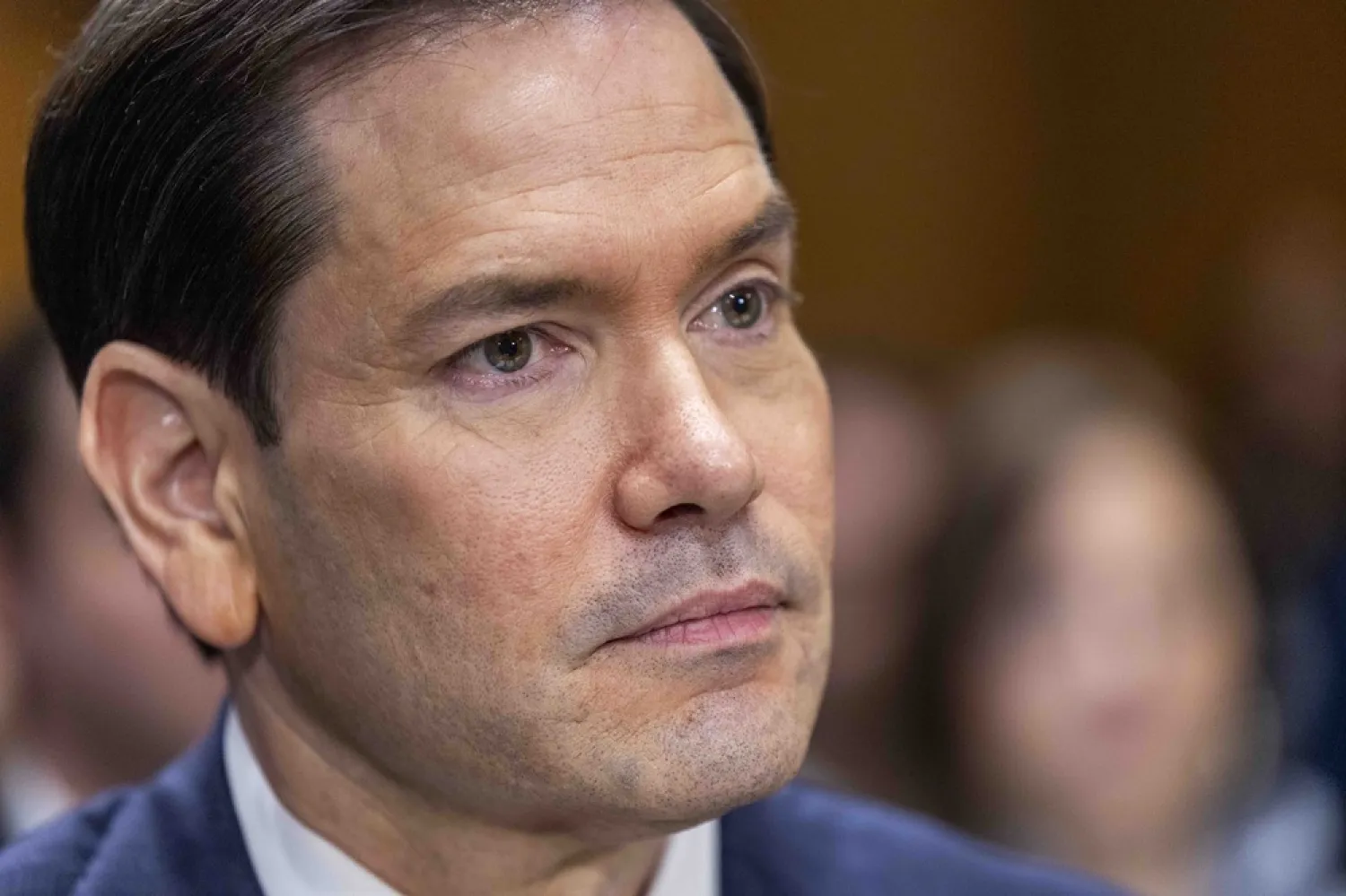

Rubio to Testify Before Congress for the First Time Since the Start of the Iran War

 Secretary of State Marco Rubio attends a Cabinet meeting at the White House, Wednesday, May 27, 2026, in Washington. (AP)
Secretary of State Marco Rubio attends a Cabinet meeting at the White House, Wednesday, May 27, 2026, in Washington. (AP)
TT

Rubio to Testify Before Congress for the First Time Since the Start of the Iran War

 Secretary of State Marco Rubio attends a Cabinet meeting at the White House, Wednesday, May 27, 2026, in Washington. (AP)
Secretary of State Marco Rubio attends a Cabinet meeting at the White House, Wednesday, May 27, 2026, in Washington. (AP)

Secretary of State Marco Rubio is set to face a litany of questions Tuesday about the Trump administration's fragile or stalling diplomatic efforts around the world when he appears for back-to-back hearings on Capitol Hill for the first time since the Iran war began.

The former Republican senator will sit before House and Senate committees to make the State Department's annual budget request. But the focus is likely to shift quickly to the already unsteady ceasefire between Washington and Tehran, which has been further tested in recent days by back-and-forth attacks.

Cabinet members, including Rubio, have defended President Donald Trump's decision to launch the conflict despite promises over the years not to engage in “forever wars” in the Middle East. That work has been made more difficult by Trump's shifting goals for the conflict.

While Rubio is testifying before Congress for the first time since the Iran war started on Feb. 28, he took part in a classified briefing for lawmakers days after the first US and Israeli strikes. He faced Democrats' anger over the lack of congressional approval but strong support from most Republicans for taking action against one of America's oldest adversaries.

In the two months since the war began, however, a small but growing faction of Republicans have joined Democrats in questioning the astronomical price tag and overall economic consequences of the conflict as they head into midterm elections in the fall.

Last month, the Senate managed to advance legislation for the first time that would have forced Trump to withdraw from the conflict after GOP Sen. Bill Cassidy — fresh off a primary election loss in which Trump endorsed his opponent — joined Democrats in pushing it forward.

The House also had scheduled a vote on a war powers resolution, but GOP leadership kept it from coming to the floor after it became clear that the majority party would not have the numbers to defeat it.

The actions show the GOP is struggling to maintain political backing for Trump's handling of the war as rank-and-file Republicans are increasingly willing to defy the president over the conflict.

Following his appearances Tuesday before the Senate Foreign Relations Committee and House Appropriations subcommittee responsible for the State Department, Rubio will return to the Hill on Wednesday to testify before the House Foreign Affairs Committee and equivalent Senate Appropriations subcommittee.

Rubio — the son of Cuban immigrants — also is likely to be questioned about the administration’s escalatory behavior toward Cuba, as Trump has hinted that the small island country could be the next US target after operations in Iran are wrapped up.

Despite a series of meetings between US and Cuban officials, Trump and Rubio have renewed threats against the island's government, which take on greater weight after the administration announced criminal charges against former President Raúl Castro.

Over his congressional career and now as America's top diplomat, Rubio has maintained that Cuba is a national security threat because of its ties to US adversaries and that Trump is intent on addressing it.


EU Strikes Migration Deal for More Deportations and Detention Centers Abroad

Migrants walk away from the beach after a failed attempt to cross the English Channel to reach Britain, from Petit-Fort-Philippe beach in Gravelines, near Calais, France, September 27, 2025. Abdul Saboor, Reuters
TT

EU Strikes Migration Deal for More Deportations and Detention Centers Abroad

Migrants walk away from the beach after a failed attempt to cross the English Channel to reach Britain, from Petit-Fort-Philippe beach in Gravelines, near Calais, France, September 27, 2025. Abdul Saboor, Reuters

The European Union has moved forward with a vast overhaul of its migration policy, aiming to ramp up deportations and ink controversial deals to build detention centers abroad, in what rights groups compare to the Trump administration's aggressive immigration policies.

“The new regulation will speed up the return process and increase returns of persons who have no legal right to stay in the EU,” said Nicholas Ioannides, deputy migration minister for Cyprus, which holds the rotating presidency of the 27-nation bloc, The Associated Press said.

The deal was struck between the EU's three main institutions — the European Commission, the European Council and European Parliament — during a so-called “trilogue” Monday evening.

Critics compared the regulation to the immigration strategy of the Trump administration, which has struck a series of secretive agreements with nations around the world to deport thousands of people to other countries. The United Kingdom also planned to deport migrants to Rwanda, but the plan was bogged down in legal red tape and the new government dropped the plan as soon as it came into power.

"The Regulation is going to create a draconian detention and deportation machine,” said Silvia Carter, spokesperson for the Brussels-based Platform for International Cooperation on Undocumented Migrants.

“Across the Atlantic, we see the violence and fear created by ICE’s brutal immigration enforcement. Europe should be learning from the harms of that model, not building its own version of it.”

The provisional agreement will now head to the EU lawmakers and heads of state, where approval will likely be swift.

EU member nations will soon be able to set up bilateral deals with countries outside the bloc to build deportation centers. At least five EU nations — Germany, Austria, the Netherlands, Denmark and Greece — are already in talks with third countries, mostly in Africa, to host “return hubs” on the model of Italy's detention deal with Albania.

The EU has continually tightened migration policies after right-wing parties took power in some countries in 2024. European Commission President Ursula von der Leyen, from the center-right European People’s Party coalition, has said that the new measures will prevent a repeat of the 2015 crisis caused by Syria’s civil war, when about 1 million people arrived to seek asylum.

Fueled by people fleeing conflict and poverty across Africa and the Middle East, the 2015 refugee crisis and successive years of irregular migration to Europe have driven a rightward shift in the bloc's politics not unlike the anti-immigrant sentiment that buoyed a “ red wave ” in the 2024 election in the United States.

Center-right political groups allied with the far-right to overcome opposition from centrist and left-wing parties, said Mélissa Camara, a French lawmaker and member of the Greens who called the deal “a historic setback” for human rights in the bloc.

“The legalization of return hubs outside the European Union, the green light for the detention of minors, home visits inspired by ICE practices: the legal arsenal serving a xenophobic ideology is now complete,” she said.

Activist groups warned the legislation would cut deep into the protections granted by the EU fundamental charter on human rights and expose people to risks outside the bloc.

“This deal will give governments much broader powers to detain and deport people," said Marta Welander, a spokesperson for the International Rescue Committee. "It looks set to normalize immigration raids, expand the use of detention in prison-like facilities outside EU territory that are essentially legal black holes, and increase the risk of people being deported to countries where they could face persecution, torture or worse.”


Congo Re-Opens Airport at Center of Ebola Outbreak

A staff member wears personal protective equipment at a building designed for the treatment of Ebola virus patients in Bunia, Ituri, Democratic Republic of Congo, 31 May 2026. (EPA)
TT

Congo Re-Opens Airport at Center of Ebola Outbreak

A staff member wears personal protective equipment at a building designed for the treatment of Ebola virus patients in Bunia, Ituri, Democratic Republic of Congo, 31 May 2026. (EPA)

Democratic Republic of Congo has re-opened the airport in the capital city of the province hit hardest by the ongoing Ebola outbreak, a government statement said, reversing a move that some residents said had cut them off from critical supplies.

The government in Kinshasa announced last month that it was suspending passenger flights to Bunia, the main airport in Ituri, where the first Ebola cases ‌were confirmed. Humanitarian and ‌medical flights continued subject to approvals.

In a ‌statement ⁠published late on Monday, ⁠Congo's transport ministry said conditions were now in place "to allow a gradual and safe resumption of air transport activities" and that the airport would re-open immediately.

The ministry said all passengers would have their body temperatures screened before boarding and on arrival, that passengers were required to wash their hands before boarding and that any passenger with a fever would not ⁠be allowed to board.

The Africa Centres for Disease ‌Control and Prevention announced the outbreak of ‌the Bundibugyo strain of Ebola, Congo's 17th Ebola outbreak, on May 15, ‌and the World Health Organization swiftly declared it a public health emergency ‌of international concern.

The outbreak, already the third-largest on record, persisted for weeks undetected, say health officials, who are now behind the curve and struggling to bring it under control.

CONFIRMED CASES RISE TO 321

The decision to re-open the airport ‌in Bunia followed a visit from WHO Director-General Tedros Adhanom Ghebreyesus, who told reporters on Monday he saw ⁠some encouraging ⁠signs in the response, including five certified recoveries.

But he also noted the need to ramp up testing and treatment capacity and promote trust in health workers.

There have been 321 confirmed Ebola cases including 48 confirmed deaths, according to the latest government figures on Monday.

Ebola has reached 15 of 36 health zones in Ituri, and cases have also been reported in North and South Kivu provinces and in neighboring Uganda.

The International Rescue Committee warned on Monday that the outbreak was probably significantly larger and more advanced than official figures suggested.

The aid agency said the virus might have been spreading for up to three months before the first official cases were detected in mid-May.


Senior Iranian Officer Says Renewed War with US 'Inevitable'

People walk on a street near a mural featuring an image of the late Supreme Leader of Iran, Ali Khamenei, in Tehran, Iran, June 1, 2026. Majid Asgaripour/WANA (West Asia News Agency) via REUTERS
TT

Senior Iranian Officer Says Renewed War with US 'Inevitable'

People walk on a street near a mural featuring an image of the late Supreme Leader of Iran, Ali Khamenei, in Tehran, Iran, June 1, 2026. Majid Asgaripour/WANA (West Asia News Agency) via REUTERS

A senior Iranian military officer said Tuesday that a resumption of hostilities with the United States was inevitable, as negotiations between Tehran and Washington appeared to stall, said AFP.

"The United States demands our total surrender, and the Iranian nation will never surrender," said Mohammad Jafar Assadi, deputy head of Iran's central military command, Khatam al-Anbiya. "Without surrender, war is inevitable."
