


Netanyahu’s Opponents Accuse him of Having Acquiesced to Trump on Issues of National Security

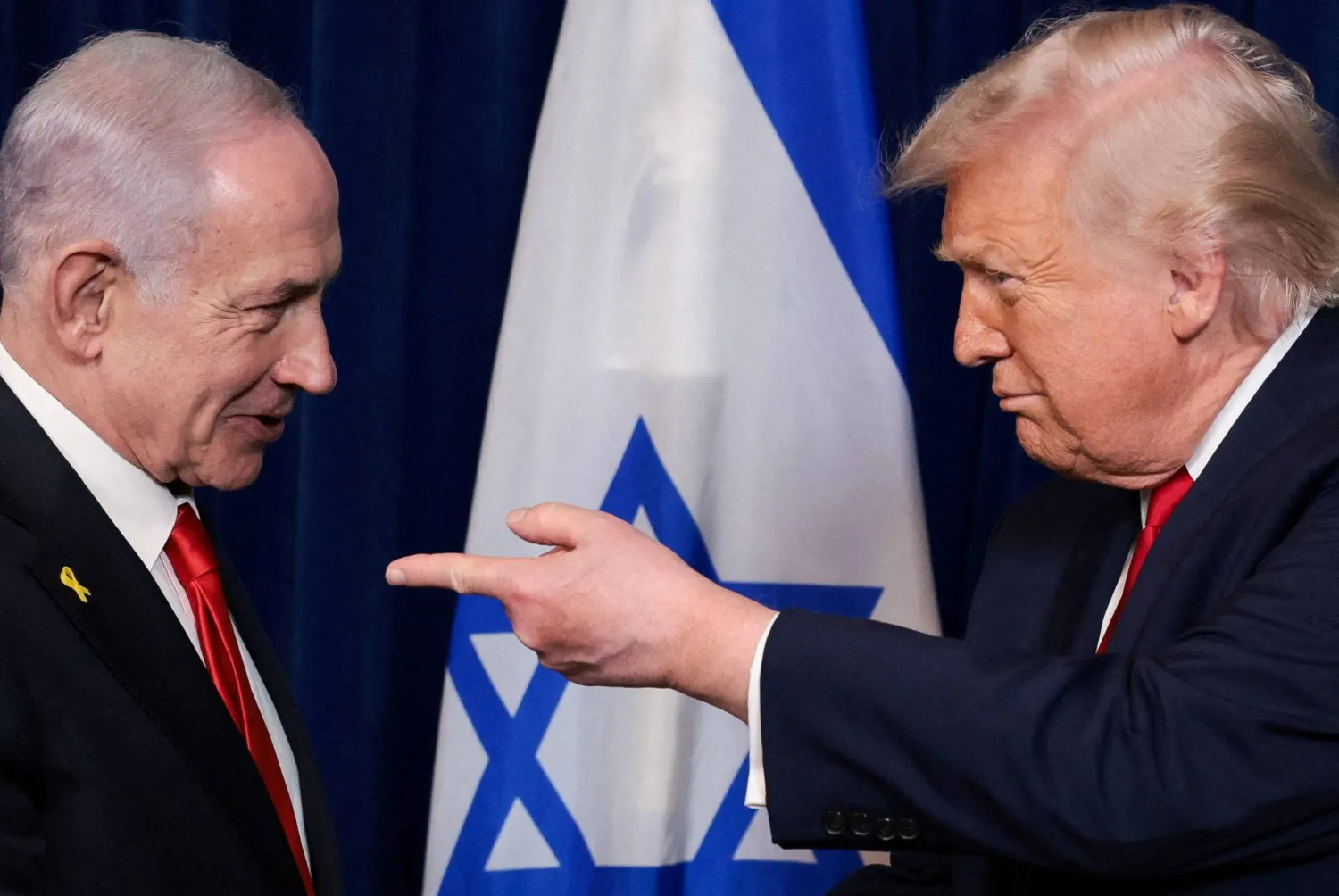
US President and Israeli Prime Minister during a press conference in Florida on December 29, 2025 (Reuters)
TT

Netanyahu’s Opponents Accuse him of Having Acquiesced to Trump on Issues of National Security

US President and Israeli Prime Minister during a press conference in Florida on December 29, 2025 (Reuters)

Israeli Prime Minister Benjamin Netanyahu is under criticism at home after US President Donald Trump declared Israel would halt plans to attack Iran ally Hezbollah in Beirut, highlighting pressure the Israeli leader faces ahead of an election polls show him losing.

Multiple reports on Monday spoke about a tense phone call between Trump and Netanyahu after the US President demanded the Israeli PM to immediately abandon plans to strike Beirut and avoid jeopardizing talks with Iran.

Trump said on Monday that Israel and Hezbollah had agreed to halt attacks on one another, hours after Netanyahu ordered new strikes on Beirut's southern suburbs, prompting a warning from Iran that Israel was jeopardizing Tehran’s talks with the US.

Lebanon's government later announced a new ceasefire between Israel and Hezbollah, under which Israel would halt strikes on southern Beirut and Hezbollah would stop attacks on Israel.

Netanyahu's challengers in elections due by October accused the prime minister of having acquiesced to Trump on issues of national security.

“The location is different, the story is the same,” said Naftali Bennett, a right-wing ⁠security hawk and former premier who also criticizes Netanyahu over Hamas militants' resurgence in Gaza.

“A government that has lost control of Israeli sovereignty,” Bennett said in an X post, according to Reuters.

Bennett and his coalition partner in the upcoming election, centrist Yair Lapid, have pressed for strikes against Hezbollah.

“A full protectorate,” Lapid said in an X post, in effect accusing Netanyahu of allowing the US to dictate Israeli military policy as if Israel was an American client state.

Israel and Hezbollah have continued to trade fire despite an April 16 US-brokered ceasefire. The latest conflict began on March 2 with Hezbollah firing into Israel in support of Iran.

Israel has since deepened its invasion of southern Lebanon, displacing over a million people and killing more than 3,400 as it bombards areas with attacks it says are aimed at rooting out Hezbollah. Hezbollah has not released figures on its war dead.

Also, the criticisms came while the US President lashed out at Netanyahu over Israel's escalation in Lebanon in an expletive-laden call on Monday, two US officials and a third source briefed on the call told Axios.

Earlier on Monday, Iran threatened to abandon the negotiations with the US over Israel's actions in Lebanon. On the call, Trump called Netanyahu “crazy” and accused him of ingratitude, according to two of the sources. He also put the brakes on Israel’s plan to strike Beirut.

One US official said Trump told Netanyahu that following through on his threats to bomb the Lebanese capital would further isolate Israel around the world, Axios said.

Two of the sources said the US President claimed he'd helped keep Netanyahu out of jail — a reference to his support during Netanyahu's corruption trial.

Summarizing Trump's remarks to Netanyahu, the US official said: “You're...crazy. You'd be in prison if it weren't for me. I'm saving your ass. Everybody hates you now. Everybody hates Israel because of this.”

A second source briefed on the call said Trump was “pissed” and at one point yelled at Netanyahu: “What the fuck are you doing?”

The US official said Trump knew Hezbollah had been shooting at Israel and that Israel needed to defend itself, but felt in recent days that Netanyahu was escalating in a disproportionate way.

Another US official said Trump was concerned by the fact that Israel had killed so many civilians in Lebanon, and objected to the Israelis knocking down buildings to take out a single Hezbollah commander.

Also, Israel no longer plans to strike Hezbollah targets in Beirut, an Israeli official told Axios.
Trump and Netanyahu have had several tense calls in the past but have still coordinated closely on Iran and other issues.

One official said this was one of Trump's worst calls with Netanyahu since he returned to office.

Trump's anger appeared to be driven by the fact that Netanyahu's decision to escalate in Lebanon was threatening to implode his negotiations with Iran.

After the call, Trump posted on Truth Social that the Iran talks were “continuing, at a rapid pace.”

The second US official claimed that, in reality, Trump had “steamrolled” Netanyahu on the call. “Bibi said, 'OK, OK, just make sure everything is taken care of,’” according to the official.
Netanyahu's office did not respond to a request for comment.



Facing Uproar, Netanyahu Announces ‘Mega-Plan’ for Israel’s Battered North

People react while attending the funeral of an Israeli soldier Captain Doctor Ori Yosef Silvester, a 30-year-old army doctor for the Givati Brigade's Shaked Battalion, who was killed in southern Lebanon, at the Segula Cemetery in Petah Tikva on June 2, 2026. (AFP)
TT

Facing Uproar, Netanyahu Announces ‘Mega-Plan’ for Israel’s Battered North

People react while attending the funeral of an Israeli soldier Captain Doctor Ori Yosef Silvester, a 30-year-old army doctor for the Givati Brigade's Shaked Battalion, who was killed in southern Lebanon, at the Segula Cemetery in Petah Tikva on June 2, 2026. (AFP)

Israeli Prime Minister Benjamin Netanyahu announced on Tuesday allocations of 13 billion shekels (more than $4.5 billion) to secure and develop northern communities along the Lebanon border, battered by weeks of fire from Iran-backed Hezbollah.

"The government made dramatic decisions today to strengthen the north. We are investing more than 13 billion shekels today, in addition to the seven billion we have already provided -- a total of 20 billion shekels going to the communities of the north," Netanyahu said following the government's approval of the measure.

The package, dubbed a "mega-plan" by Netanyahu's office, consists of three separate decisions.

The first will see the deployment of 1,800 new protective shelters in public spaces such as bus stops, shopping centers and parks, as well as the renovation of around 500 existing shelters, to shield residents from incoming rockets and drones.

The second decision allocates subsidies for the construction of safe rooms inside homes for residents living within nine kilometers (5.6 miles) of the Lebanon border, while the third aims to develop the area in order to attract 100,000 new residents, by improving health, transport, education and tourism infrastructure as well as job opportunities.

"People will flock to the north. I said the same about the south," Netanyahu said, referring to areas close to Gaza that were attacked by Hamas on October 7, 2023.

"Today there is very strong demand there; there is tremendous growth and flourishing -- and that is what will happen here as well."

The government has taken flak from opposition figures who accuse it of neglecting areas along the Lebanon border.

Opposition party leaders Yair Lapid, Gadi Eisenkot and Naftali Bennett took to X on Monday night to point out that only three government ministers attended the cabinet meeting to discuss the situation in the north.

"The residents of the north deserve leadership that will see them and take care of them," Eisenkot wrote on X.


Iraqi National Pleads Not Guilty in 18 Attacks in Europe, Calling Himself a ‘Prisoner of War’

Mohammad Baqer Saad Dawood Al-Saadi, an Iraqi man accused of helping Iran-backed faction's plans for attacks in the United States and Europe, stands with his defense attorney Andrew Dalack before US District Judge Colleen McMahon during his arraignment in Manhattan federal court in New York City, US, June 1, 2026 in a courtroom sketch. (Reuters)
TT

Iraqi National Pleads Not Guilty in 18 Attacks in Europe, Calling Himself a ‘Prisoner of War’

Mohammad Baqer Saad Dawood Al-Saadi, an Iraqi man accused of helping Iran-backed faction's plans for attacks in the United States and Europe, stands with his defense attorney Andrew Dalack before US District Judge Colleen McMahon during his arraignment in Manhattan federal court in New York City, US, June 1, 2026 in a courtroom sketch. (Reuters)

An Iraqi national accused of plotting at least 18 attacks in Europe in retaliation for the US and Israel’s war with Iran pleaded not guilty on Monday before calling himself a “prisoner of war” and telling a judge that children and women were being killed “by your rockets.”

Mohammad Baqer Saad Dawood Al-Saadi finally was persuaded to sit down in Manhattan federal court as two marshals approached him at a judge's urging. One marshal put his hand on his shoulder to guide him into his seat.

Al-Saadi did not appear to be trying to be disruptive as he commented beyond his response to the charges. The charges say he conspired to provide material support to Kataib Hizballah, an Iran-backed Iraqi armed group, and Iran’s Revolutionary Guard Corps.

“I'm not guilty in a war situation,” Al-Saadi responded, before adding through an Arabic translator: “I'm a prisoner of war. I'm not a threat. Children and women are being killed by your rockets.”

Judge Colleen McMahon responded by saying: “The defendant will be seated please,” which prompted the marshals behind Al-Saadi to move up to where he was seated.

Both Kataib Hizballah and the Revolutionary Guard Corps. have been designated by the US government as foreign terrorist organizations. US prosecutors say Al-Saadi was a Kataib Hizballah commander.

But his lawyer, Andrew Dalack, told the judge that his client worked for the Iraqi government, though he did not specify what position.

The lawyer said Al-Saadi was held at an underground Turkish prison for two weeks before he was turned over to the FBI.

“I'm sure it was unpleasant, to say the least,” the judge said.

Dalack said Al-Saadi has been held in solitary confinement at a federal lockup in Brooklyn but was hoping to communicate with a diplomatic counsel from Iraq and his mother and siblings, although he expects the US government to severely limit his communications.

Last month when the charges against Al-Saadi were announced, Dalack told reporters that his client believed he was being persecuted for his relationship with Qasem Soleimani, the Revolutionary Guard leader who was killed in a US drone strike in 2020.

Among the 18 attacks in Europe, Al-Saadi is charged in the firebombing of a bank in Amsterdam and with stabbing Jewish men in London.

Federal authorities also said in court papers that he sought to attack a New York City synagogue last month and provided an undercover law enforcement officer with photos and maps of Jewish centers in Los Angeles and Scottsdale, Arizona, that he planned to target.

Al-Saadi is also accused of involvement in two recent attacks in Canada: an attack on a synagogue and a shooting at the US consulate in Toronto in March. US prosecutors said he directed and urged other people to attack US and Israeli interests, including by killing Americans and Jews.

Al-Saadi posted about the attacks on Snapchat and Telegram and spoke about them in phone calls recorded by an FBI informant whose help he solicited in planning attacks in the US, according to court papers.


Iran Fires Missiles and US Strikes Iran Facility After Reports of Faltering Peace Talks

 An Iranian woman walks past a residential building, destroyed by previous US-Israeli airstrikes, in Tehran, Iran, 02 June 2026. (EPA)
An Iranian woman walks past a residential building, destroyed by previous US-Israeli airstrikes, in Tehran, Iran, 02 June 2026. (EPA)
TT

Iran Fires Missiles and US Strikes Iran Facility After Reports of Faltering Peace Talks

 An Iranian woman walks past a residential building, destroyed by previous US-Israeli airstrikes, in Tehran, Iran, 02 June 2026. (EPA)
An Iranian woman walks past a residential building, destroyed by previous US-Israeli airstrikes, in Tehran, Iran, 02 June 2026. (EPA)

The US military said Tuesday that Iran fired missiles at Kuwait and Bahrain that failed or were shot down, and that the US launched strikes on an Iranian facility in response.

Iran fired missiles toward Kuwait and Bahrain, but failed to hit their targets, the US said. The two fired at Kuwait fell apart en route, while US and Bahraini forces intercepted the missiles aimed at Bahrain.

US Central Command said it responded with strikes on an Iranian military ground control station on Qeshm Island in the Strait of Hormuz.

Iran's paramilitary Revolutionary Guard said it had targeted the headquarters of the US Navy's 5th Fleet in Bahrain and another country in its attack, without naming Kuwait. It said it launched its attack in response to the US firing a missile into the engine room of another oil tanker trying to reach Iran despite the US blockade.

“We had previously warned that in case of aggression, the response would be different and more severe, and we acted accordingly," the Guard said in its statement.

Central Command also said it “downed multiple drones” launched by Iran targeting American forces in Kuwait.

The attacks happened after Iran stopped communicating with mediators about extending a ceasefire in the war with the US and Israel, according to reports Tuesday from two semiofficial Iranian news agencies. President Donald Trump disputed the claim and said talks were continuing.

The reports by the Fars and Tasnim news agencies, both believed to be close to the Guard, came as tensions flared in Israel’s separate-but-related fight against the Iranian-backed Hezbollah group in Lebanon.

A regional official involved in the mediation, speaking on condition of anonymity to discuss the talks, told The Associated Press that Iran had not communicated at all on Tuesday after saying that a ceasefire needed to be enforced in Lebanon for negotiations to continue.

Trump says talks ‘going on continuously’

Trump called reports of a cessation in talks “false and erroneous.”

“The conversations between us have been going on continuously, including four days ago, three days ago, two days ago, one day ago and today,” Trump said in a social media post. "Where they lead, one never knows, but as I told Iran, ‘It’s time, one way or another, for you to make a Deal."

US Secretary of State Marco Rubio did not address the reported cutoff in communications as he testified at a congressional hearing in Washington. Instead, he sounded an optimistic note about the nuclear dimension of the negotiations, while cautioning that there’s no guarantee of reaching “a deal that’s acceptable.”

Iran has been trying to increase pressure on Trump over negotiations on the Iran war ceasefire and loosening the Islamic Republic's chokehold on the Strait of Hormuz and the oil, gas and other commodities that normally pass through it.

Trump then could potentially push Israeli Prime Minister Benjamin Netanyahu to halt or slow the advance of his forces, which have moved deeper into Lebanon than at any time in over a quarter of a century.

The conflicts have increasingly become conjoined, as Iran insists that any potential truce in the war there must also quell the fighting in Lebanon.

Israel and the US maintain the fighting in Lebanon is separate from the Iran war talks.

Inflation takes an economic toll on Iran

Meanwhile, year-on-year inflation in Iran reached a level in May unseen since World War II, underlining the economic pain average Iranians are facing. While the US is eager to ease Tehran’s grip on the strait — through which a fifth of all traded oil and natural gas passed in peacetime — Iran faces economic challenges as its oil-backed economy remains under a US naval blockade.

Economic pressure touched off nationwide protests in Iran in 2017 into 2018, when rising food prices sparked demonstrations that killed over 20 people and saw hundreds arrested. The next year, an increase in government-subsidized gasoline prices caused protests that saw over 300 people reportedly killed.

Then came the protests over the collapsing value of Iran's currency, the rial, at the start of this year. They were the most intense demonstrations to shake the regime since its 1979 revolution and the chaotic years that followed. Iran's theocracy met January's protests with a crackdown on demonstrators in January that killed over 7,000 people, according to activists' estimates.

Now, even as hard-liners hold gun-handling workshops and organize marriages under the shadow of a ballistic missile to bolster spirits, experts note there could be new demonstrations if people find themselves priced out of feeding their families.

“I have no doubt that if Trump leaves (Iran without a formal peace deal) ... most probably, we will see something like January by the end of summer because of the economic and social situations," analyst Mohsen Jalilvand said in a video published by Iran's Fararu news website.

Iran faces skyrocketing inflation

Iran's Central Bank said the consumer price index, which measures a basket of goods and services, reached 77.2% in May compared with the year before. The rate is 8.5% higher than in April, the bank added. Inflation in daily and general needs — like medicine, taxi fares, tobacco and communication fees — rose 113.8% from the year before.

A private economic think tank in Iran, the Bamdad Institute of Economic Studies, described the current figures as “an unprecedented rate since World War II.” Iran’s Central Bank did not acknowledge the significance of the figures.

The previous record came in 1942. During the war, the British and Soviets invaded Iran and took over its railway, disrupting food supplies. The lack of food, worsened by a poor harvest, sparked hyperinflation and a famine. Hunger and a typhus outbreak killed many.

Airstrikes this year have greatly damaged Iran's businesses and its oil industry. Meanwhile, the US blockade has been targeting Iranian crude oil shipments trying to reach the international market, a key source of hard revenue. Tax revenues have been depressed by businesses struggling even after the fighting paused.

The rial, which traded at 32,000 to $1 in 2015, now trades at over 1.7 million to $1.

“We will definitely have higher prices," Iranian President Masoud Pezeshkian warned in May. "We are fighting, and we must accept this hardship.”

Tehran-based economist Saeed Leilaz, speaking to the AP, warned that annual inflation in Iran could reach 80%.

"Iran’s society cannot tolerate above 25%” annual inflation, he said.