


North Korean, Chinese Leaders Agree to Boost Ties at Pyongyang Summit

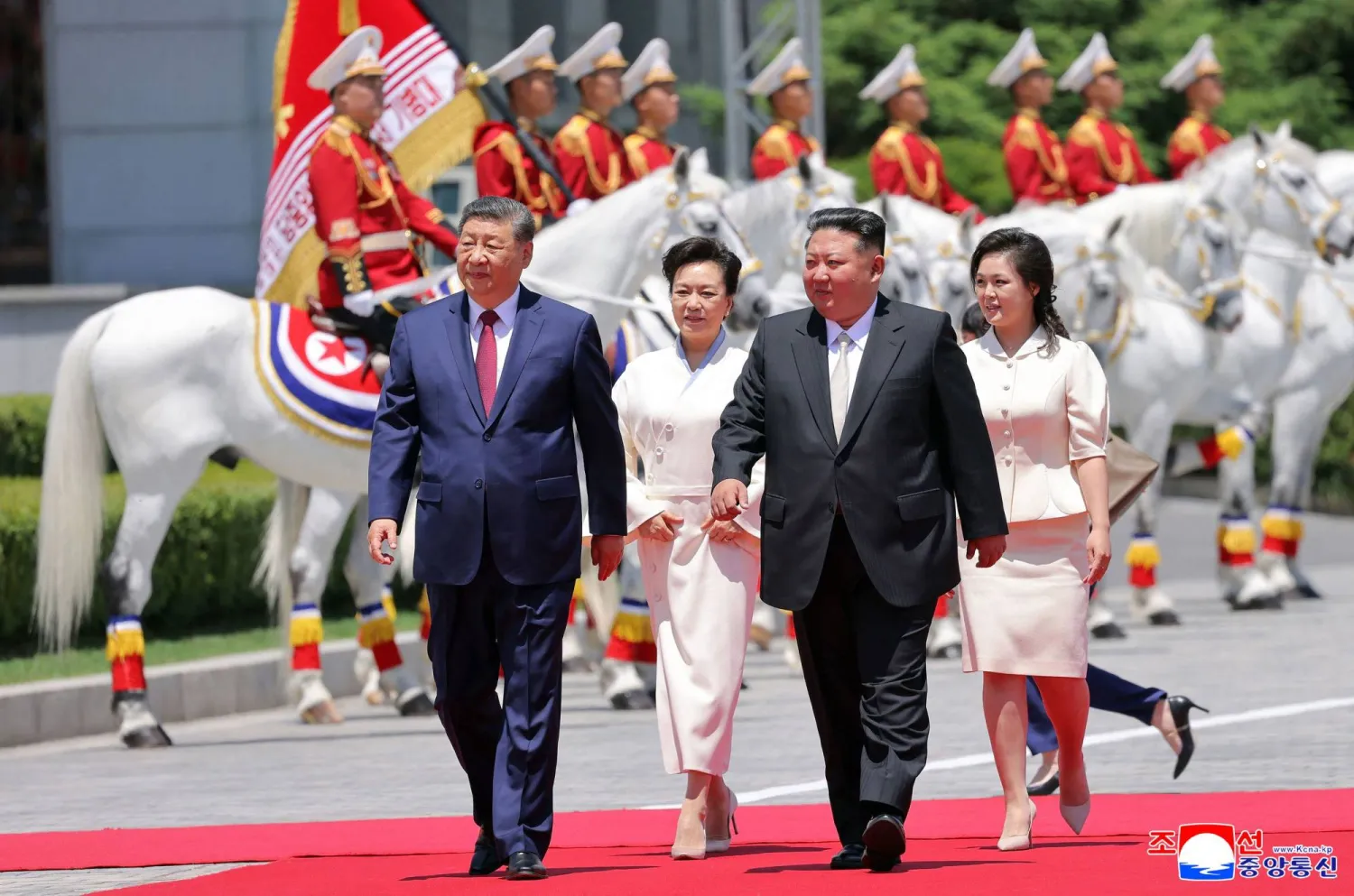
This picture taken on June 8, 2026 and released by North Korea's official Korean Central News Agency (KCNA) on June 9, 2026 shows North Korean leader Kim Jong Un (2nd R) with his wife Ri Sol Ju (R) and China's President Xi Jinping (L)} and his wife Peng Liyuan (2nd L) attending a welcoming ceremony at Kim Il Sung Square in Pyongyang. (KCNA via KNS / AFP)
TT

North Korean, Chinese Leaders Agree to Boost Ties at Pyongyang Summit

This picture taken on June 8, 2026 and released by North Korea's official Korean Central News Agency (KCNA) on June 9, 2026 shows North Korean leader Kim Jong Un (2nd R) with his wife Ri Sol Ju (R) and China's President Xi Jinping (L)} and his wife Peng Liyuan (2nd L) attending a welcoming ceremony at Kim Il Sung Square in Pyongyang. (KCNA via KNS / AFP)

North Korean leader Kim Jong Un and China's Xi Jinping agreed to expand cooperation in the areas of politics, economy and culture at a summit in Pyongyang that opened a new chapter in ties, the North's official KCNA news agency said on Tuesday.

Making his first visit in seven years to China's only formal treaty ally, Xi told Kim he aimed to drive progress in ties, and both agreed to strive for closer strategic communication through visits by high-level officials, KCNA said.

Kim told Xi he would fully support the "One China principle," which Beijing views as meaning that both sides of the Taiwan Strait belong to one country, regardless of changes in the international situation, it added.

China views democratically governed Taiwan as its own territory and has never renounced the use of force to bring the island under Beijing's control, although Taipei ‌rejects the sovereignty claims.

On ‌Tuesday, Xi visited Pyongyang's Sino-Korean Friendship Tower that commemorates Chinese soldiers who died in the ‌Korean War, China's ⁠official Xinhua news ⁠agency said.

It was not immediately clear if the leaders planned further talks, but they jointly planted a fir tree in the grounds of a key political training school for party cadres, which Xinhua said symbolized "ever-renewing friendship".

ANALYSTS SEE CONTRASTING PRIORITIES

Despite the expressions of goodwill, however, analysts saw contrasting priorities in the official summaries of the visit.

While Xinhua detailed proposals ranging from high-level exchanges to trade and agriculture, along with restoration of transport links, KCNA cast the summit more broadly as a pact of equal partners, the analysts said.

Pyongyang stressed regime dignity and the neighbors' "special relationship," added Lim Eul-chul, a professor at South Korea's Kyungnam University, while Beijing emphasized practical state-to-state ties and its initiatives for international order.

"North ⁠Korea removed elements that could make it look like a subordinate, dependent or beneficiary party, ‌and rewrote the relationship as one between equals," said Hong Min, a senior research ‌fellow at the Korea Institute for National Unification.

"It amplified signals of solidarity, such as anti-US and Taiwan-related messages, while erasing signals of dependence ‌or subordination."

China is North Korea's biggest trade partner and analysts have said Xi's trip could focus on trade and tourism.

"There are certainly ‌good hopes for China-North Korea relations," said Zhu, a 43-year-old doctor in Beijing who felt a gap still remains to be bridged, however.

"I feel that sometimes the two countries may appear quite friendly on the surface, but in reality, there are still many issues," added Zhu who declined to give her full name.

PATRIOTIC SONGS

Xi and first lady Peng Liyuan attended a performance of Chinese and North Korean songs, accompanied by Kim and ‌his wife, Ri Sol Ju, along with high-ranking officials.

The songs highlighted "the value and closeness of DPRK-China friendship," KCNA said, referring to the North's official name, the Democratic People's Republic of Korea.

Kim ⁠also hosted a banquet for ⁠Xi and his delegation, at which Xi voiced his desire to "share friendship" with Kim, the news agency said.

Chinese-North Korean relations had reached a "new historical starting point," Xi said at the event marking the 65th anniversary of the neighbors' friendship treaty, KCNA added.

Xi vowed that Beijing would not swerve from its commitment to safeguard common interests, Xinhua said on Monday.

But North Korean media did not say if Pyongyang's nuclear weapons program or relations with the United States figured in the talks.

The absence of such mentions suggests Beijing would like the visit cast in terms of the ties between the two countries, said Ja Ian Chong, a political science professor at the National University of Singapore.

During his first term, US President Donald Trump met Kim three times, before the unprecedented diplomatic effort broke down over US demands for North Korea to give up nuclear weapons. Trump has said he would be willing to restart talks.

"While it is highly likely that the leaders of China and North Korea would confer before Kim might meet Trump again, it is doubtful that Xi will serve as a catalyst for US-North Korea talks," said Leif-Eric Easley, professor of international studies at Ewha Womans University in Seoul.

Xi is set to return to China on Tuesday afternoon, the Yonhap news agency said.


Russian Strikes Kill 3 Near Ukraine’s Kharkiv

This handout taken and released by the State Emergency Service of Ukraine on June 9, 2026 shows smoke rising from a fire following Russian strikes in the Kharkiv region, amid the Russian invasion of Ukraine. (Photo by Handout / State Emergency Service of Ukraine / AFP)
TT

Russian Strikes Kill 3 Near Ukraine’s Kharkiv

This handout taken and released by the State Emergency Service of Ukraine on June 9, 2026 shows smoke rising from a fire following Russian strikes in the Kharkiv region, amid the Russian invasion of Ukraine. (Photo by Handout / State Emergency Service of Ukraine / AFP)

Russian strikes killed three people and wounded 10 others in Ukraine's northeastern Kharkiv region, its governor said early Tuesday.

"The enemy has hit the city of Chuguiv," Kharkiv regional governor Oleg Synegubov wrote on Telegram, adding that three people had been killed.

"The strikes caused fires and damaged at least 18 vehicles; windows were blown out and building facades damaged in residential multi-storey buildings," Synegubov said.

Separately, Kharkiv mayor Igor Terekhov reported 10 people were wounded in his city.

Daily Russian attacks that claim civilian lives have intensified in recent months, and Ukraine has hit back with its own drone strikes further into Russian territory, saying these are mainly against military and energy facilities.

According to a UN estimate published in April, at least 15,850 civilians have been killed in Ukrainian zones since Russia launched its invasion in February 2022.

More than 2,800 civilians have died in Russian-controlled zones, according to the UN toll, which added that more than 44,800 have been wounded in Ukrainian and Russian-occupied zones.


Congo’s Ebola Outbreak Rises to 100 Deaths out of 550 Cases as Conflict Slows Response

A health worker wearing a face mask as part of his personal protection equipment (PPE) looks on at the Mulago National Referral Hospital isolation unit in Kampala, Uganda, on July 8, 2026. (AFP)
TT

Congo’s Ebola Outbreak Rises to 100 Deaths out of 550 Cases as Conflict Slows Response

A health worker wearing a face mask as part of his personal protection equipment (PPE) looks on at the Mulago National Referral Hospital isolation unit in Kampala, Uganda, on July 8, 2026. (AFP)

At least 100 people have died from Ebola less than a month after authorities declared an outbreak of the disease in eastern Congo, authorities said.

Attacks on health workers from angry residents, skepticism among some locals and armed conflict in hot spots continue to challenge efforts to stop the outbreak declared on May 15.

Out of the 550 cases of the disease confirmed as of Sunday, there have been 101 deaths and 19 recoveries, according to the latest situation report late Monday.

The outbreak is concentrated in Congo’s eastern province of Ituri, which accounts for more than 90% of the cases. Cases have also been recorded in the North Kivu and South Kivu provinces, and has spread across the border to Uganda.

The number of cases in Congo is believed to be higher because the outbreak was confirmed weeks late, and the response has been challenging also because the virus has no approved vaccine or treatment.

The latest Ebola disease outbreak is caused by the rare Bundibugyo virus, which does not have an approved vaccine or treatment unlike the “Zaire virus,” another name for the Ebola virus, responsible for most of Congo’s past 16 outbreaks of the disease.

The rapid increase in the number of cases is in part due to the scale up of diagnostic capacities, enabling testing of the backlog of previously collected samples, authorities said.

Frontline health workers, with little pay or rest, have been attacked multiple times by angry residents and have not been able to reach some communities due conflict involving armed rebel groups.

Eastern Congo has for years seen attacks by dozens of separate rebel and militant groups, some of them with links to foreign countries or to the extremist Islamic State group.

Conflict is “constraining access for the response, disrupting surveillance and response activities, and increasing the risk of undetected transmission,” the World Health Organization said Monday.

“Such incidents underline the challenges of the context and the importance of working closely with local leaders and communities,” it added.


Report: US Leads Record Rise in Spending on Nuclear Arsenals in 2025

The United States spent $69.2 billion on nuclear weapons (archival - Reuters)
TT

Report: US Leads Record Rise in Spending on Nuclear Arsenals in 2025

The United States spent $69.2 billion on nuclear weapons (archival - Reuters)

Spending on nuclear weapons by the world's nine nuclear-armed states rose ‌by almost a fifth in 2025 to $119 billion, a report by the International Campaign to Abolish Nuclear Weapons said on Tuesday.

The 19% increase from 2024 ⁠produced the highest expenditure on nuclear weapons since the campaign group began tracking the annual nuclear arms expenditure of the US, Russia, China, France, Britain, India, Pakistan, North Korea and Israel in 2020.

The United States spent $69.2 billion, more than all other nuclear-armed states combined, and recorded the largest increase, with spending rising by 22 percent.

The campaign said the increase reflects broader growth in US military spending alongside efforts to modernize and expand its nuclear arsenal.

China ranked second, increasing its nuclear weapons spending by seven percent to $13.5 billion.

The United Kingdom overtook Russia to become the third-largest spender, with expenditures rising 17 percent to $12.6 billion. Russia spent $9.5 billion, up six percent from the previous year.

The campaign, which was awarded the Nobel Peace Prize in 2017, advocates for the complete elimination of nuclear weapons.
