

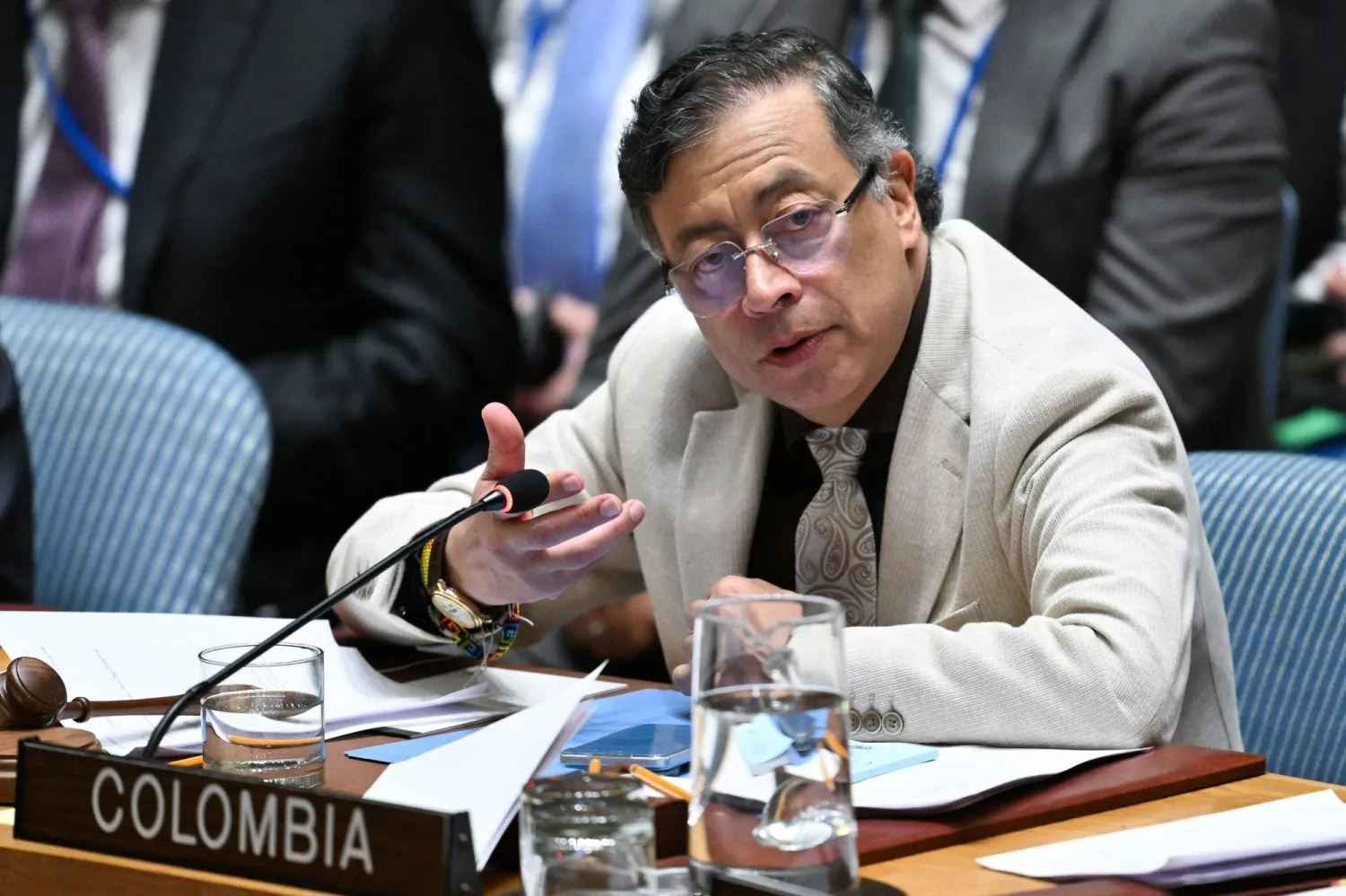

Colombian Leader Says US Prevented Him from Meeting Mamdani

President of Colombia Gustavo Petro speaks during a United Nations Security Council meeting on the Middle East, at UN Headquarters in New York, on June 10, 2026. (Photo by ANGELA WEISS / AFP)
TT

Colombian Leader Says US Prevented Him from Meeting Mamdani

President of Colombia Gustavo Petro speaks during a United Nations Security Council meeting on the Middle East, at UN Headquarters in New York, on June 10, 2026. (Photo by ANGELA WEISS / AFP)

Colombian President Gustavo Petro accused the United States of trampling his freedom by preventing him from meeting New York Mayor Zohran Mamdani, a fellow critic of US President Donald Trump.

The Washington Post reported Wednesday that Petro was scheduled to meet with Mamdani while in New York for meetings at the United Nations, AFP said.

But Bogota canceled the encounter after US officials warned it would violate the visa ban imposed on Petro last year during a row with Trump, anonymous sources told the Post.

Petro can currently only enter the United States with a diplomatic visa for official business only.

He said on Thursday that he was never informed that he would face restrictions on his movements.

"I consider it undemocratic that my freedom to speak with the mayor of New York was restricted...and that my freedom of thought was restricted by not allowing me to give a lecture to which I was invited in Boston," he wrote on X.

Democrat Mamdani was elected mayor in November on a "socialist," migrant-inclusive platform seen as a repudiation of Trump's hardline policies.

Petro, Colombia's first left-wing president, has repeatedly crossed swords with Trump on issues ranging from migrant deportations to deadly US strikes on suspected drug boats to Petro's own record on combatting cocaine trafficking.

In an interview with AFP last week the Colombian leader, who is in his last weeks in office, accused Washington of allying itself with the very drug traffickers it claims to combat by supporting right-wing lawyer Abelardo de la Espriella to succeed Petro.

De la Espriella, who is tipped to beat Petro's preferred candidate, left-wing senator Ivan Cepeda in a June 21 presidential runoff, made his name representing drug traffickers, paramilitaries and a pyramid scheme kingpin.

He has promised to deepen ties with the United States "like never before" if elected.


NYT Reports: US Plans Major Cut to Fighter Jets, Warships for NATO Operations in Europe

(FILES) This photograph taken on April 27, 2026, shows Rafale fighter aircraft parked on the flight deck of the French aircraft carrier Charles de Gaulle during the NATO military exercise Neptune Strike 26-2, off the coast of the Greek island of Crete. (Photo by Angelos TZORTZINIS / AFP)
TT

NYT Reports: US Plans Major Cut to Fighter Jets, Warships for NATO Operations in Europe

(FILES) This photograph taken on April 27, 2026, shows Rafale fighter aircraft parked on the flight deck of the French aircraft carrier Charles de Gaulle during the NATO military exercise Neptune Strike 26-2, off the coast of the Greek island of Crete. (Photo by Angelos TZORTZINIS / AFP)

The United States plans to significantly reduce the aircraft and warships that it makes available for NATO operations in Europe, the New York Times reported on Friday, citing two senior European officials.

The decision would limit NATO's ability to launch long-range strikes and conduct surveillance, the report said.

The US plan includes cutting the number of F-16 and F-15E fighter jets ‌from roughly ‌150 to 100, as well ‌as ⁠reducing maritime reconnaissance aircraft ⁠from 26 to 15 and removing all eight aerial refueling tanker jets it previously made available to Europe, the report said.

It also aims to redeploy a missile-launching submarine and an aircraft carrier, along with several warships and ⁠scores of jets that join the ‌carrier’s missions, the New ‌York Times said, adding that one of two ‌groups of bombers previously assigned for Europe’s defense ‌may also be reallocated.

Reuters could not immediately verify the report. NATO and the US Department of Defense did not immediately respond to requests for comment.

The ‌US Eastern Command said in a statement last week that it would "rightsize" its ⁠contributions ⁠to the NATO Force Model, without providing further details.

Reuters reported in May that the US planned to scale back the military capabilities it would make available to its alliance allies during a major crisis.

US President Donald Trump's administration has repeatedly accused European governments of underinvesting in their militaries and relying too heavily on US protection, while urging both Europe and Asian allies to boost defense spending to 3.5% of GDP.


NATO Will Gradually Adjust Strength of Peace Support Mission in Kosovo over Next Year

Kosovo Security Forces parade during celebrations to mark the 18th anniversary of independence, in Pristina, Kosovo, Feb. 17, 2026. (AP)
TT

NATO Will Gradually Adjust Strength of Peace Support Mission in Kosovo over Next Year

Kosovo Security Forces parade during celebrations to mark the 18th anniversary of independence, in Pristina, Kosovo, Feb. 17, 2026. (AP)

NATO will gradually adjust the strength of its peace support mission in Kosovo, which has been in place since 1999, over the next year due to the steady security situation in the country, ‌it said ‌on Friday.

"NATO and ‌KFOR ⁠are fully committed ⁠to safety and security in Kosovo," said US Air Force General Alexus G. Grynkewich, Supreme Allied Commander Europe (SACEUR) in a ⁠statement according to Reuters.

"It is this commitment ‌that ‌has led to increased stability as ‌the security organizations in ‌Kosovo have become more capable. The current conditions provide an opportunity to optimize KFOR's size ‌and posture further," he added.

Calibrated reductions are ⁠expected ⁠to follow national rotational deployment and redeployment cycles between now and next year, NATO said.

The changes will occur gradually and in line with conditions on the ground, and could be reversed if needed, NATO said.


Disaster Drills Helped Prevent More Deaths When Powerful Quake Hit the Southern Philippines

 Residents pass by a collapsed structure after an earthquake in General Santos, Philippines on Monday, June 8, 2026. (AP)
Residents pass by a collapsed structure after an earthquake in General Santos, Philippines on Monday, June 8, 2026. (AP)
TT

Disaster Drills Helped Prevent More Deaths When Powerful Quake Hit the Southern Philippines

 Residents pass by a collapsed structure after an earthquake in General Santos, Philippines on Monday, June 8, 2026. (AP)
Residents pass by a collapsed structure after an earthquake in General Santos, Philippines on Monday, June 8, 2026. (AP)

Philippine officials said Friday that years of disaster-preparedness drills helped prevent a larger casualty toll when one of the strongest earthquakes in 50 years struck the south and left 55 people dead with 31 others missing.

The 7.8 magnitude offshore quake, which struck Monday off Sarangani province, injured about 1,120 people and displaced more than 45,000 people, about half of them still in emergency shelters, after the quake damaged more than 12,600 houses across farming towns and cities.

Many were still too traumatized to return home because of strong aftershocks, officials said.

Days after the earthquake hit, more videos of the chaotic moments have been posted on social media showing horrified crowds witnessing the collapse of small buildings, and flag-raising ceremonies turning chaotic when the ground started to shake on the first day of school after a long summer break.

Students are seen on videos screaming in panic, but staying seated or standing still outside school buildings, with some covering their heads with their hands as teachers admonished them to calm down.

One video, which has gone viral on Facebook with millions of views, showed dozens of grade-schoolers screaming and breaking into tears as they sat on a tree-ringed school ground, which visibly swayed them from side to side. A tin roof shed nearby later collapsed with a loud thud, prompting many to dash away, but were asked by teachers to return and stay seated.

The grade school in the coastal town of Malita in Davao Occidental province reported no injuries from the quake.

“This incident serves as a reminder of the importance of earthquake preparedness and the value of regular disaster response drills,” the Mahayahay elementary school said in a statement.

Teresito Bacolcol, director of the Philippine Institute of Volcanology and Seismology, said years of disaster-preparedness drills helped people anticipate and brace for extreme events like Monday’s quake, one of the strongest to hit the archipelago in a half-century.

He said that it was also fortunate that the quake hit at 7:37 a.m., a few minutes before work and classes were to start indoors.

“It’s good that our efforts to educate people on what to do when earthquakes hit somehow paid off,” Bacolcol told The Associated Press.

He expressed concern, however, over the collapse of some buildings that he said should have withstood the powerful quake, if construction standards based on the country’s building code were followed.

Ednar Dayanghirang, director of the Office of Civil Defense in a quake-hit region of about 5 million people, said that regular disaster-preparedness drills helped reduce casualties in many ways, including by preventing deadly stampedes.

“We required all school principals to take one-day courses on incident management, then they appointed disaster-response teams among teachers to deal with earthquakes, tsunamis,” Dayanghirang said. “They listened and they learned.”

The Philippines, one of the world’s most disaster-prone countries, is often hit by earthquakes and volcanic eruptions because of its location on the Pacific “Ring of Fire,” an arc of seismic faults around the ocean.
