


Israel Launches Fresh Airstrikes in Lebanon; Trump Says He Could Still Restart War

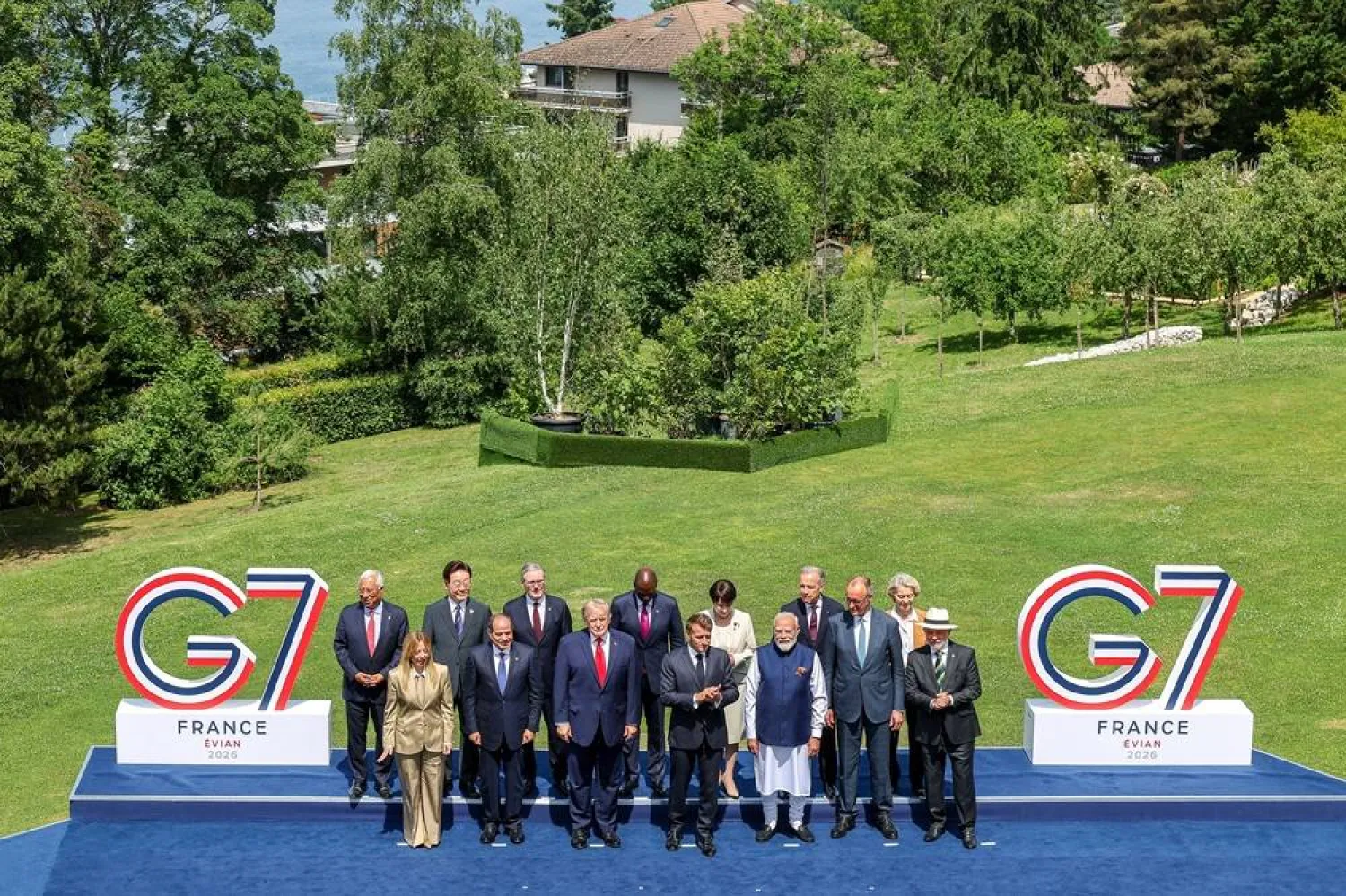
US President Donald Trump, French President Emmanuel Macron, Canadian Prime Minister Mark Carney, Italian Prime Minister Giorgia Meloni, Japanese Prime Minister Sanae Takaichi, European Commission President Ursula von der Leyen, European Council President Antonio Costa, German Chancellor Friedrich Merz, Egyptian President Abdel Fattah al-Sisi, South Korea's President Lee Jae Myung, India's Prime Minister Narendra Modi, Brazilian President Luiz Inacio Lula da Silva, Kenya's President William Ruto and British Prime Minister Keir Starmer pose during a family photo at the G7 summit in Evian, France, on Tuesday June 16, 2026. (Pool via Reuters)
TT

Israel Launches Fresh Airstrikes in Lebanon; Trump Says He Could Still Restart War

US President Donald Trump, French President Emmanuel Macron, Canadian Prime Minister Mark Carney, Italian Prime Minister Giorgia Meloni, Japanese Prime Minister Sanae Takaichi, European Commission President Ursula von der Leyen, European Council President Antonio Costa, German Chancellor Friedrich Merz, Egyptian President Abdel Fattah al-Sisi, South Korea's President Lee Jae Myung, India's Prime Minister Narendra Modi, Brazilian President Luiz Inacio Lula da Silva, Kenya's President William Ruto and British Prime Minister Keir Starmer pose during a family photo at the G7 summit in Evian, France, on Tuesday June 16, 2026. (Pool via Reuters)

US President Donald Trump said on Wednesday his new ceasefire agreement with Iran was not final and he could resume the war if he is unsatisfied, even as Israel launched fresh airstrikes in Lebanon where fighting threatens the wider truce. 

"It's a memorandum of understanding. And if I don't like it, we'll go back to shooting at them, dropping bombs on their head," Trump said at a G7 summit in France of the agreement, reached three days ago. 

"If I don't like it, if they don't behave, we'll go right back to dropping bombs right smack in the middle of their head, OK?" 

Leaders hailed the agreement at the summit, held in the French town of Evian-les-Bains, an hour's drive along the shore of Lake Geneva from where the Iran ceasefire memorandum is due to be signed at a ceremony across the Swiss border on ‌Friday. 

The leaders also demanded ‌an immediate ceasefire in Lebanon, where the memorandum calls for a halt to hostilities between Israel and ‌the ⁠Iran-backed Hezbollah group ⁠that have displaced more than a million people. 

Fighting there has abated but not ceased since the agreement was reached on Sunday, and Israel, which was not part of the negotiations, says it retains the right to use force. 

Lebanese state media reported fresh Israeli air strikes and artillery fire in several southern towns throughout Wednesday. Lebanese security sources said Hezbollah had also launched two drone attacks on Israeli forces in the south. The group did not publicly claim the attacks. 

Israel later said five of its soldiers had been injured in two Hezbollah drone attacks in southern Lebanon. 

Inside the southern Lebanese city of Nabatieh, below a mediaeval castle seized by Israeli forces, buildings had been blasted to ruins resembling the Gaza Strip. 

Khodr Kodeih, a member of the town council, told Reuters that some ⁠displaced residents had come back to check on their homes in recent days, but that the fresh ‌strikes were again keeping them away. 

"The city of Nabatieh emptied out again. We hope that ‌a safe environment can be secured so people can return, because the basic necessities of life are still not available," Kodeih said. 

The memorandum of understanding, yet ‌to be made public three days after it was signed by Washington and Tehran, extends a ceasefire announced in April by another 60 ‌days to allow them to negotiate a permanent truce. 

G7 LEADERS BACK DEAL 

The G7 summit gave Trump a chance to present his deal with Iran to allies Britain, Canada, France, Germany, Italy and Japan. 

They share Washington's concerns about Iran's nuclear program and other issues, but never endorsed his decision to go to war, and worry Tehran has gained leverage by withstanding the onslaught and asserting control over the strait. 

"We underline the need for the negotiation ... to address the threats posed by Iran in ‌the region and beyond and ensure that they never obtain a nuclear weapon," the G7 leaders said in a statement. 

They said they were ready to contribute to implementing the accord, with a coalition led ⁠by Britain and France set ⁠to help secure shipping once the Strait of Hormuz reopens. 

Oil prices fell again on Wednesday on prospects for the reopening of the Strait of Hormuz, with Brent crude futures below $80, at their lowest level since the opening salvos of the US-Iran conflict. 

MOST IRANIANS 'ARE IN SURVIVAL MODE' 

Trump appears to have achieved little of what he said he wanted at the outset of the war. Iran's theocratic government remains in place, its stockpile of highly enriched uranium has not been surrendered, its ballistic missile capabilities have not been destroyed and it has not ended its support for anti-Israel armed groups like Hezbollah in Lebanon. 

Trump says the agreement states that Iran will not have a nuclear weapon - a restatement of Iran's official position since the 1970s. US officials say further discussions will lead to the removal or destruction of its enriched uranium stockpile. 

But ending the war on such terms could still expose Trump to criticism, including from hawks within his own Republican party, ahead of midterm elections in November. 

The mood among ordinary Iranians, grappling with economic woes further exacerbated by months of war, remained grim, even as their leaders declared this week's interim deal a diplomatic victory for Tehran over Washington. 

"I think 99% of people are in survival mode and just living day by day," said Amir, 34, a media production company owner in Isfahan in central Iran, who declined to give his surname. 

"I don’t think anybody has any hopes anymore. I don’t think anybody has any visions of what the future might look like." 


Trump, Iran's President Sign Deal to End Mideast War

17 June 2026, France, Paris: US President Donald Trump arrives at the Palace of Versailles to attend an event marking the 250th anniversary of US independence. Photo: Julien Mattia/Le Pictorium via ZUMA Press/dpa
TT

Trump, Iran's President Sign Deal to End Mideast War

17 June 2026, France, Paris: US President Donald Trump arrives at the Palace of Versailles to attend an event marking the 250th anniversary of US independence. Photo: Julien Mattia/Le Pictorium via ZUMA Press/dpa

US President Donald Trump and Iran's president signed a deal Wednesday meant to end the Middle East war, with Tehran agreeing to dilute its enriched uranium in return for large-scale economic relief.

Trump put his signature to the memorandum of understanding during a candlelit dinner at the Palace of Versailles following a G7 summit, as host French President Emmanuel Macron and other guests applauded, a video posted by a Trump aide showed, AFP reported.

"Just signed it," Trump told reporters as he emerged from the palace.

Iranian Foreign Ministry spokesman Esmaeil Baqaei, quoted by the state news agency IRNA, said the document "was finalized with the signatures of the presidents."

Prime Minister Shehbaz Sharif of Pakistan, which mediated the agreement, said on X that it "shall enter into force with immediate effect."

The deal aims to draw a line under the war launched February 28 by the United States and Israel, prompting Iran to counterattack with missile and drone salvos across the region -- and effectively shutting down the Strait of Hormuz, a crucial waterway for the world economy. The US responded by blocking shipping to and from Iranian ports.

"As a first step, Islamic Republic of Iran will instantly reopen the Strait of Hormuz and the United States of America will immediately lift the naval blockade," Sharif wrote.

Under the text, Washington also commits to immediately waive oil sanctions crippling Iran's economy.

And once a final agreement is reached on the Iranina republic's nuclear program, the United States will also facilitate the release of a $300 billion reconstruction fund supported by regional nations, the deal says.

The agreement had earlier been slated for signatures by Iran's chief negotiator and parliament speaker, Mohammad Bagher Ghalibaf, and US Vice President JD Vance. Iran said an in-person ceremony was no longer needed.

But Sharif said an official ceremony will take place Friday in Switzerland and technical talks will commence.

- 'Great victory' -

Iran insisted the deal represented a US "failure."

"People will see it and judge," Ghalibaf said on state television late Wednesday, after the text was released by both sides.

Highlighting the global impact of any deal, China said Wednesday that its top diplomat had impressed on Tehran that it was "key" for all sides to "genuinely implement" their commitments.

But Trump's decision to pull the plug on the war, in which 13 US service members were killed and vast amounts of US ammunition stockpiles were used up, has unsettled some of his own allies at home.

The agreement is only a temporary arrangement meant to give time for starting detailed negotiations on the far more complex issue of long-term control over Iran's nuclear power ambitions, which Washington has long suspected of harboring a secret bomb-making program.

Trump said earlier Wednesday that he was prepared to "bomb the hell" out of Iran if they violated the agreement.

But US Senator Bill Cassidy from Trump's own Republican Party was scathing.

"Iran's nuclear ambitions were not curbed, and they have learned that threatening the Strait of Hormuz works," he said. "Sanctions will be lifted, and the bombing has stopped. This is the worst foreign policy blunder in decades."

The head of the pro-Tehran Lebanese Shiite movement Hezbollah, Naim Qassem, on Wednesday described the deal as a "great victory" for Iran.

He thanked Tehran for insisting that the truce cover Lebanon, which was drawn into the conflict when Hezbollah fired rockets at Israel on March 2 in support of Iran.

- Negotiations to begin -

A two-month negotiating period now begins, with the much-anticipated reopening of the Strait of Hormuz as the first step.

Under the terms of the deal released by US officials, Iran will dilute its enriched uranium stocks, possibly by "down-blending on site under the supervision of the IAEA" -- the UN's nuclear watchdog.

This would lead to more far-reaching economic assistance for Iran.

But a US official said Washington would not be required to contribute financially.

Oil prices have tumbled in recent days as optimism grew of a lasting Middle East peace agreement, but reversed course on Wednesday.

Prices briefly jumped five percent as uncertainty spread about the signing, before stabilizing later in the day.

- Lebanese front -

While violence declined in Lebanon following the announcement of the deal, Israeli strikes on the south have killed at least five people since then, according to state media, which also reported Israeli raids on south Lebanon on Wednesday.

Israel's army said five soldiers were wounded on Wednesday, one of them severely, "as a result of an explosive drone impact in southern Lebanon", the first such announcement since the US-Iran deal.

The Israeli military also said its air force intercepted "several rockets" launched toward soldiers operating in south Lebanon, without reporting casualties.


US Official Says Parties Can Still Walk Away from Iran Deal, Sequencing Will Be Key

Men ride their mopeds past a map of Iran with the images of some of those killed in the Israeli-US war against the nation, erected on a wall along the highway in Tehran on June 17, 2026. (AFP)
TT

US Official Says Parties Can Still Walk Away from Iran Deal, Sequencing Will Be Key

Men ride their mopeds past a map of Iran with the images of some of those killed in the Israeli-US war against the nation, erected on a wall along the highway in Tehran on June 17, 2026. (AFP)

Both Iran and the US can walk away from the memorandum of understanding they are set to sign on Friday, and upcoming talks are likely to focus on ‌the precise sequencing ‌of the steps ‌previewed ⁠in the preliminary accord, ⁠a senior US official told reporters on Wednesday.

Speaking on condition of anonymity, the official read out the 14-point memorandum that is due ⁠to be formally ‌signed in Switzerland. ‌

They said the upcoming meeting ‌there will be "critical" for ‌ensuring that the memorandum of understanding can evolve into a comprehensive agreement.

"I think the meeting in ‌Switzerland will be quite critical in order to really ⁠see ⁠how we get to the next phase," a senior US official said.

The document, as read out by the official, was similar to the 14-point memorandum that various media outlets had already reported on earlier in the day.

According to the official, the draft agreement includes a new “minimum” standard for downblending of highly enriched Iranian uranium and has provisions to ensure the “territorial integrity” of Lebanon after Israel’s latest attacks against Hezbollah in Lebanese territory.

In return, the US will move to waive, but not eliminate, some wide-ranging sanctions against Iran once the deal is signed.

The US draft of the agreement also secures toll-free passage of the Strait of Hormuz for only 60 days, and it does not preclude fees in future, the officials said.


Trump Says Iran Accord to Be Signed ‘Shortly’, ‘Maybe’ Thursday or Friday

US President Donald Trump attends a press conference at the Hotel Royal during the G7 summit in Evian-les-Bains, France, 17 June 2026. (EPA)
TT

Trump Says Iran Accord to Be Signed ‘Shortly’, ‘Maybe’ Thursday or Friday

US President Donald Trump attends a press conference at the Hotel Royal during the G7 summit in Evian-les-Bains, France, 17 June 2026. (EPA)

US President Donald Trump on Wednesday said he expected the accord with Iran ending the Middle East war to be signed "shortly" but added uncertainty over the exact date. 

"The deal we reached with Iran on Sunday will be signed shortly, tomorrow (Thursday), maybe the next day (Friday)," Trump said at the G7 summit, after previous announcements that it would be signed Friday in Switzerland. 

"We are going to most likely sign a deal," he added. 

Trump told reporters at the final press conference of the G7 that he was prepared to "bomb the hell" out of Iran if they violated the agreement. 

"If they are not behaving they will be hit again," he said. 

But he added: "They don't want to get bombed, they don't want to get hit". 

In a long succession of comments on his dealings with Iran, Trump recalled at length how he had in 2020 issued the order to kill Qassem Soleimani, the head of foreign operations for the Revolutionary Guards. 

Trump also recalled the February 28 air strike that killed supreme leader Ali Khamenei and other senior figures, who he said were "having breakfast" at the time. 

Trump said Washington "did send a copy" of its accord with Iran to end the Middle East war, following reports of tensions with Prime Minister Benjamin Netanyahu.  

Insisting he maintains a good relationship with Netanyahu, Trump reaffirmed his criticism at the G7 summit of Israel's campaign against Hezbollah in Lebanon, saying "they (Israel) could do a much better job". 

Trump was also asked about the deadly strike on an Iranian school in Minab on the first day of the war, which left 155 dead, according to the Iranian authorities. 

Initially describing the question as "strange", Trump said: "Nobody did it on purpose. Mistakes are made, war is nasty." 

"I know it is under investigation," he said, telling the reporter to address the question to Defense Secretary Pete Hegseth instead. 

A US Tomahawk cruise missile hit the elementary school due to a targeting mistake, according to the preliminary findings of a US military investigation reported by The New York Times. 

Trump also thanked China's Xi Jinping and Russia's Vladimir ‌Putin for ‌what he ‌called ⁠their neutrality during the ⁠war with Iran.  

"I just want to thank ⁠them because ‌they ‌made it ‌a lot better," ‌Trump said, adding that both leaders had been "neutral."
