


IOM Chief: Foreign Aid Cuts Push Up Migrant Flows

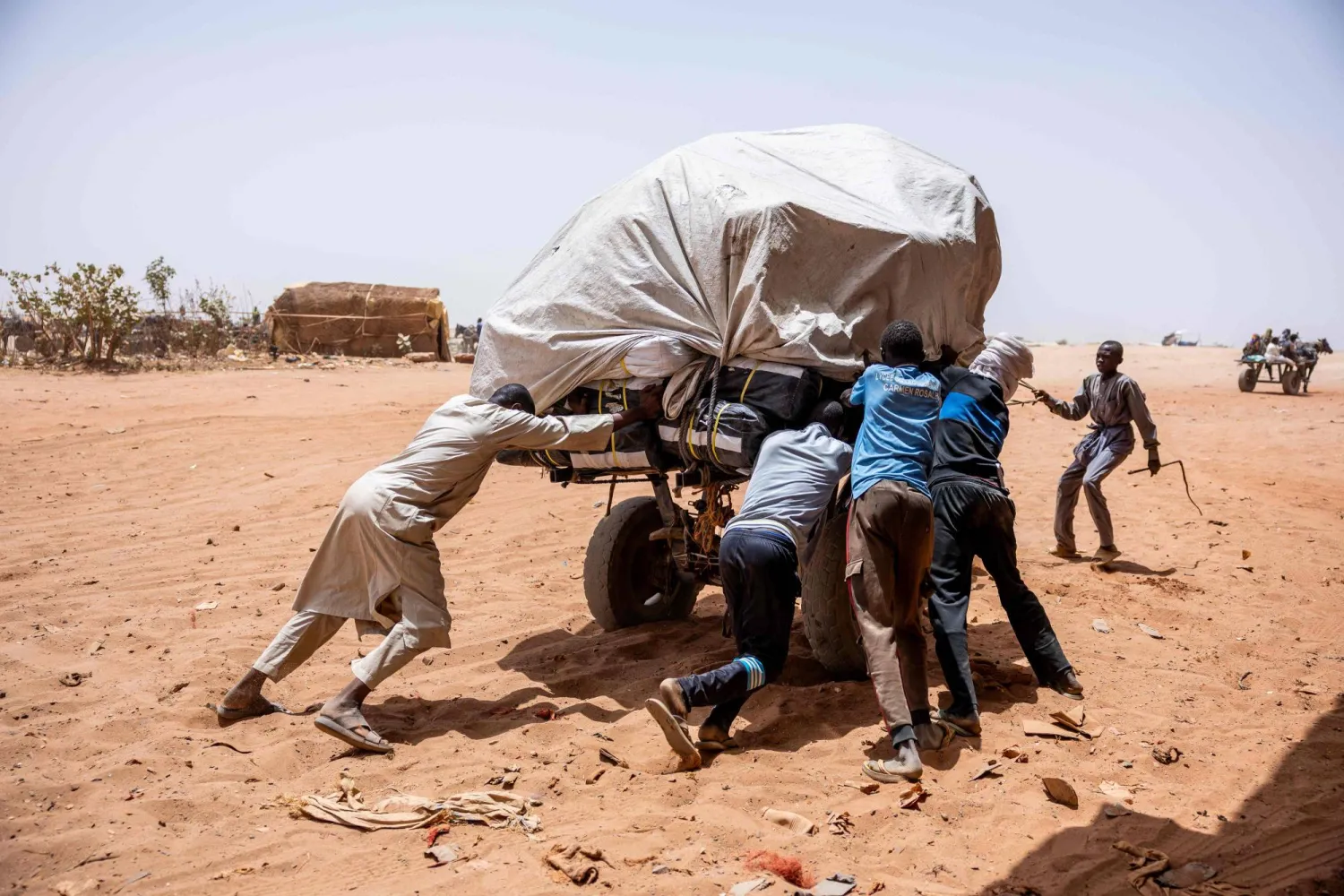
Men push a stuck cart toward Sudan at the Adre border post on June 8, 2026. (Photo by Joris Bolomey / AFP)
TT

IOM Chief: Foreign Aid Cuts Push Up Migrant Flows

Men push a stuck cart toward Sudan at the Adre border post on June 8, 2026. (Photo by Joris Bolomey / AFP)

Cuts in development aid by wealthy countries tend to drive up displacement away from the world's poorest regions, the head of the UN's International Organization for Migration warned in an interview with AFP on Thursday.

"When we see cuts in development assistance, we're actually just making the likelihood that people will have to leave in search of safety, in search of stability, so much higher," Amy Pope said.

"We've seen it in places like Sudan, which is the world's largest displacement crisis as a result of the war there," she added.

"With decreasing support for humanitarian assistance, we then see more Sudanese look for safety, look for opportunity further afield."

Several rich Western countries -- particularly the United States but also many European nations -- have cut their development aid budgets in recent years, while also tightening migration policies and strengthening border controls.

Pope was speaking on the sidelines of the Berlin Climate Mobility Forum.

"In order to respond to domestic political pressures", many countries are making "short-term decisions... that may not ultimately serve (them) in the long term", he said.

"The more we can connect assistance to the movement of people in ways that are humane and dignified, ways that give people agency and opportunity, the less likely we're going to see large patterns of movement," she said.

Shortly after entering the White House for a second time, US President Donald Trump cut 83 percent of the programs run by USAID. Before the cuts, the US development agency managed some 42 percent of global government humanitarian aid.

Germany has slashed its development budget under successive governments to just over 10 billion euros this year from nearly 14 billion in 2022.

Climate change is having an "enormous impact on migration around the world", Pope said.

Small Pacific island states such as Tuvalu are threatened by rising sea levels, while some 10 million people are estimated to have been displaced because of storms in the Philippines, the IOM chief said.

Several regions of Africa have been affected by prolonged drought.

Pope called on policymakers in the wealthiest countries, which bear the greatest responsibility for climate change, to offer more help for people forced to leave their homes.

"What are they willing to invest now to ensure more stability, more options, less likely occurrence of unplanned migration in the future?" she said.

"Let's not wait for the emergency... Let's make the investments now."

Contrary to the narratives being pushed by some political leaders about migration, most displacement happens within countries rather than across borders, Pope said.

By mid-2024 there were an estimated 304 million international migrants, according to the IOM, and more than 700 million internal migrants worldwide.

"In the first instance, people will stay in their country. They will go somewhere in their country if they can find resources or safety. Then they move in the neighboring countries," Pope said.

Providing support within the countries most affected "actually is a lot less expensive... and will have a more stabilizing effect", she added.

"Really, as policymakers, we should be looking at the issue in terms of where can we provide the most support in a way that saves the most lives."



US Will Halt $4 Billion in Aid to Israel, Trump Says

US President Donald Trump points his finger towards Israeli Prime Minister Benjamin Netanyahu as they shake hands during a press conference after meeting at Trump’s Mar-a-Lago club in Palm Beach, Florida, US, December 29, 2025. (Reuters)
TT

US Will Halt $4 Billion in Aid to Israel, Trump Says

US President Donald Trump points his finger towards Israeli Prime Minister Benjamin Netanyahu as they shake hands during a press conference after meeting at Trump’s Mar-a-Lago club in Palm Beach, Florida, US, December 29, 2025. (Reuters)

The United States will stop providing $4 billion in aid each year to Israel in 2027 but will sell arms to its closest ally in the Middle East, President Donald Trump said on Tuesday.

The Republican president told Fox News Channel during a phone call on Election Day for the midterms that Israeli Prime Minister Benjamin Netanyahu had approached him about the idea and that they have been talking about it for a couple of years.

Trump said Israel doesn’t need the aid and it’s a lot of money for the US to spend. But Trump also said that US aid to Israel has become a Democratic talking point for candidates such as Michigan US Senate candidate Abdul El-Sayed, a vocal critic of Israel.

Even far-right conservatives, who have supported Trump in the past, have taken issue with US support for Israel, with prominent commentators like Tucker Carlson openly questioning the value of the relationship.

“You can consider it barter. You can consider military aid or cash,” Trump said. “Look, we give them $4 billion of things and money, and they don’t need it. And I was approached by Bibi Netanyahu, and we’ve been talking about it for a couple of years because it’s a lot of money.”

There was no immediate comment from Netanyahu’s office. But at least some of his political opponents were cautious.

Opposition candidate Gadi Eisenkot said the announcement showed that Netanyahu must go.

"The fact that Israel's defense establishment is learning of a shift in our strategic relationship through the media, at the same time as the Israeli public, shows just how dangerous Benjamin Netanyahu's conduct is. He can no longer be trusted and must be replaced," Eisenkot said in a statement.

Yair Golan, a leader in Israel’s opposition bloc, said an end to US military aid would deal a “severe blow to Israel’s security” at a time when the country is fighting wars on multiple fronts.

“The burden of funding defense needs at such a critical juncture will fall entirely upon the Israeli public,” Golan, a former deputy military chief, said in a statement.

The United States has sent tens of billions of dollars in military aid to Israel over the last few years.

In 2016, President Barack Obama, a Democrat, signed an unprecedented security agreement with Israel to give its military $38 billion over 10 years, amounting to $3.8 billion a year. Under the agreement, Israel’s ability to spend part of the funds on Israeli military products was to be phased out and eventually all of the money would be spent on American military industries.

Netanyahu has talked about the need to wean Israel off the aid in the past and has said that the American aid would end at some point.

He told The Economist in January that he wanted to “taper off” US military aid in the next 10 years and that such a change was “in the works.”

But the optics of the aid had also become an issue, according to Trump, who singled out El-Sayed for using it as a talking point.

“The left uses the $4 billion payment — that everybody knows about, it’s no secret — as a signal of unfairness,” Trump said Tuesday on Fox. “And we can’t allow that to happen. I don’t like that, because it’s too easy. It’s almost too easy a target. And Bibi and I have been talking, and we’ve agreed. He was very understanding of it.”

Phasing out direct military and economic aid to Israel has long been a subject of debate in both countries and has gained traction in the last several years.

There are several issues that complicate it, though, not least of which are obligations the US has to Israel under the terms of the Camp David peace accords with Egypt, which require the United States to support Israel and Egypt with security assistance.

In addition, much of the assistance the US provides Israel comes in the form of foreign military financing, or FMF, that gives Israel the money but requires it to spend the money on American-produced weaponry, meaning the funds are plowed back into the US economy.

Unless Israel plans to spend the same amount on purchasing American materiel, US defense contractors may see an impact.

An academic study published last year showed the US under the administrations of President Joe Biden, a Democrat, and Trump provided at least $21.7 billion in military assistance to Israel after the start of the Gaza war in 2023. The study was published on the second anniversary of the Oct. 7, 2023, Hamas attacks in Israel that provoked the conflict.

Another study, also published last year by the Costs of War project at Brown University’s Watson School of International and Public Affairs, said the US had spent roughly $10 billion more on security aid and operations in the broader Middle East in the previous two years.

While the reports relied on open source material for most of their findings, they offered some of the most comprehensive accountings of US military aid to close ally Israel and estimated costs of direct American military involvement in the Middle East.


EU to Host Talks on Ukraine with United States and Others on Wednesday

 Ukrainian rescuers clear rubble from a destroyed residential building following an air attack in Dnipro on November 3, 2026, amid the Russian invasion of Ukraine. (AFP)
Ukrainian rescuers clear rubble from a destroyed residential building following an air attack in Dnipro on November 3, 2026, amid the Russian invasion of Ukraine. (AFP)
TT

EU to Host Talks on Ukraine with United States and Others on Wednesday

 Ukrainian rescuers clear rubble from a destroyed residential building following an air attack in Dnipro on November 3, 2026, amid the Russian invasion of Ukraine. (AFP)
Ukrainian rescuers clear rubble from a destroyed residential building following an air attack in Dnipro on November 3, 2026, amid the Russian invasion of Ukraine. (AFP)

The European Commission will host a meeting on Ukraine on Wednesday with representatives of the United States, Ukraine, NATO and European allies, the European Union's executive body said on Tuesday.

"So tomorrow the European Commission will host a meeting with representatives from Ukraine, from the United ‌States, France, Germany, the ‌UK, NATO and the ‌World ⁠Bank and this meeting ⁠will build on earlier talks that took place in Miami," Commission spokeswoman Paula Pinho told reporters in Brussels.

The delegations will discuss a "prosperity plan" and security guarantees for Ukraine, a ⁠source familiar with the plans told ‌Reuters.

US envoy ‌Steve Witkoff had said earlier that the ‌meeting would take place in Brussels.

NATO ‌will host further talks on Thursday, according to Allison Hart, a spokesperson for the military alliance.

She said representatives from France, ‌Germany, Britain and the United States would "discuss the way forward on ⁠bringing about ⁠a just and sustainable end to the war in Ukraine".

The United States will then bring together delegations from Ukraine and Russia in Abu Dhabi on November 10-11 to discuss ending Moscow's war in Ukraine, post-war security agreements and de-escalation, Witkoff said earlier in a post on social media platform X.


Israeli Opposition Bloc Gathers to See How to Oust Netanyahu

Former military chief Gadi Eisenkot, leader of the Yashar party, speaks following the exit poll at his party headquarters, on the evening of Israel's national election, in Tel Aviv, Israel October 28, 2026. (Reuters)
TT

Israeli Opposition Bloc Gathers to See How to Oust Netanyahu

Former military chief Gadi Eisenkot, leader of the Yashar party, speaks following the exit poll at his party headquarters, on the evening of Israel's national election, in Tel Aviv, Israel October 28, 2026. (Reuters)

The Israeli opposition bloc led by Gadi Eisenkot gathered on Tuesday for the first time since elections as they strategize how to oust Prime Minister Benjamin Netanyahu, with divisions on whether to ally with Arab lawmakers.

Opposition party heads gathered in Herzliya, the tech industry hub north of Tel Aviv where former military chief Eisenkot lives, a week after the election produced an inconclusive result.

Yair Lapid, a centrist former prime minister who headed the opposition in the outgoing parliament, said as he entered that Netanyahu was backing an "extreme and dangerous attempt to invalidate the elections".

"What we need to do now is go and form a government, because the conduct of recent days is just a reminder that we must remove Netanyahu and his people from the Prime Minister's Office," Lapid told reporters.

"They have already caused enough damage to the State of Israel and to the people of Israel," he said.

Netanyahu and his allies have repeatedly alleged major fraud or malfeasance by Arab-majority parties which made historic gains last week, winning 19 seats in the 120-member parliament on the back of anger over the hard-right government's rhetoric towards Arab citizens of Israel.

No side won a majority. Eisenkot's diverse opposition bloc won 48 seats while Netanyahu's camp secured 53, of which 27 are from his Likud party.

The Arab parties could bring Eisenkot to a majority but the opposition is divided on whether to ally with them, and Arab politicians did not join the talks in Herzliya.

Despite their diverging views on various issues, including the role of Arab lawmakers, all the party leaders in Eisenkot's bloc have said they would back him to form the next government.

Public opinion polls conducted before the election showed that Jewish Israeli opposition supporters are divided over including Arab parties in government while right-wing Israelis are adamantly opposed.

- 'Political reality' -

Yousef Jabareen, the head of the largest Arab-majority party in the next parliament, told AFP that the opposition needed to accept "political reality" and team up to remove Netanyahu.

Arab-Israelis are descendants of Palestinians who remained after Israel's creation in 1948 and account for around 20 percent of the population today.

On the campaign trail, most of the main Jewish opposition parties rejected partnering with the Arab-majority lists citing a lack of common values, particularly around security and national identity.

The notable exception was Yair Golan, head of the left-wing party The Democrats, who said it was racist to exclude working with the Arab minority.

Netanyahu spent the campaign painting Arab parties as untrustworthy and stoking fears of a Palestinian state.

Avigdor Liberman, a right-wing member of Eisenkot's bloc who heads the Yisrael Beiteinu party, on Tuesday stressed that another election must be avoided but said that the Arab lists should not be included in the government.

"Given the political situation that has emerged, there is enough room to maneuver, and with proper navigation it is possible to quickly establish a functioning and stable government without Raam and the Joint List," he wrote on X, referring to the two Arab-majority lists.

On Monday, Netanyahu called for a "broad national government" without the Arab parties and said that as his Likud was the largest single party, he should lead the next coalition.

No opposition leader has voiced any openness to a unity government with Netanyahu, Israel's longest-serving prime minister, pointing to his divisiveness, the corruption charges against him and his failure to prevent the October 7, 2023 attack by Hamas.

"We seek to establish a broad government with our partners and with any party that wishes to join and does not support terrorism," Netanyahu said in a Telegram post.

He ruled out a coalition with Arab-majority lists, alleging that the parties "support terrorism and deny the existence of the Jewish state".

Leaders of Arab-Israeli parties have unanimously condemned the October 7 attack by Hamas without describing the Palestinian movement as a terror group.

Although the leader of the Raam party has recognized Israel as a "Jewish state", other leaders have rejected that definition.