


US-Iran Negotiations End, Technical Talks Will Continue after Trump Shakes Talks with Threats

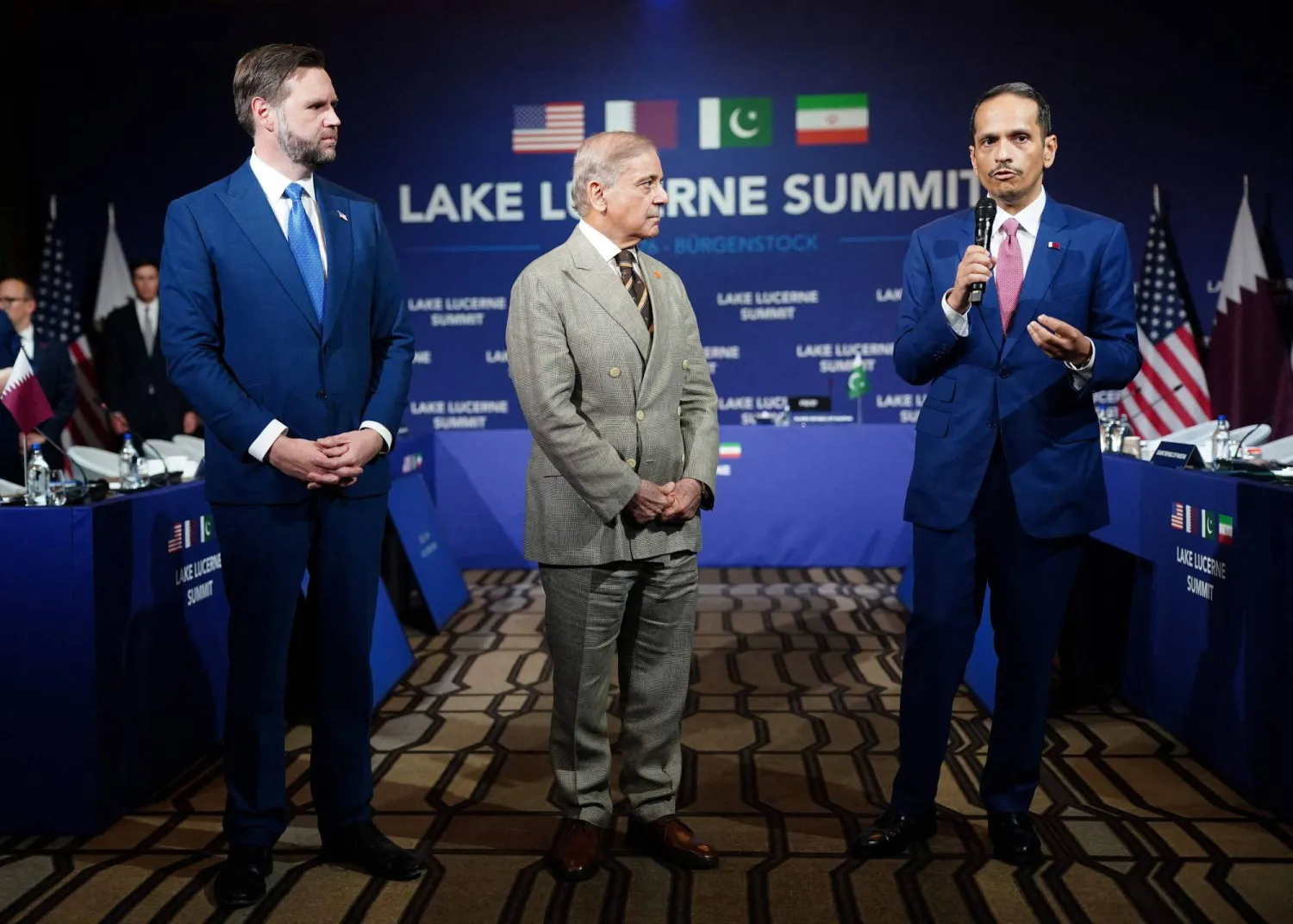
US Vice President JD Vance (L), Pakistan's Prime Minister Shehbaz Sharif and Qatar's Prime Minister Sheikh Mohammed bin Abdulrahman bin Jassim al-Thani attend a quadrilateral meeting between the United States, Iran, Pakistan and Qatar at the Burgenstock luxury hotel complex overlooking Lake Lucerne, Switzerland, on June 21, 2026, as part of high-level talks aimed at advancing a deal to end the Middle East conflict.  (Photo by Nathan Howard / POOL / AFP)
US Vice President JD Vance (L), Pakistan's Prime Minister Shehbaz Sharif and Qatar's Prime Minister Sheikh Mohammed bin Abdulrahman bin Jassim al-Thani attend a quadrilateral meeting between the United States, Iran, Pakistan and Qatar at the Burgenstock luxury hotel complex overlooking Lake Lucerne, Switzerland, on June 21, 2026, as part of high-level talks aimed at advancing a deal to end the Middle East conflict. (Photo by Nathan Howard / POOL / AFP)
TT

US-Iran Negotiations End, Technical Talks Will Continue after Trump Shakes Talks with Threats

US Vice President JD Vance (L), Pakistan's Prime Minister Shehbaz Sharif and Qatar's Prime Minister Sheikh Mohammed bin Abdulrahman bin Jassim al-Thani attend a quadrilateral meeting between the United States, Iran, Pakistan and Qatar at the Burgenstock luxury hotel complex overlooking Lake Lucerne, Switzerland, on June 21, 2026, as part of high-level talks aimed at advancing a deal to end the Middle East conflict.  (Photo by Nathan Howard / POOL / AFP)
US Vice President JD Vance (L), Pakistan's Prime Minister Shehbaz Sharif and Qatar's Prime Minister Sheikh Mohammed bin Abdulrahman bin Jassim al-Thani attend a quadrilateral meeting between the United States, Iran, Pakistan and Qatar at the Burgenstock luxury hotel complex overlooking Lake Lucerne, Switzerland, on June 21, 2026, as part of high-level talks aimed at advancing a deal to end the Middle East conflict. (Photo by Nathan Howard / POOL / AFP)

High-level negotiations in Switzerland seeking a permanent end to the Iran war concluded early Monday, with lower-level talks planned for the rest of the week as Iran and the United States agreed to create a “de-confliction cell” to address the fighting in Lebanon.

A statement from mediators Pakistan and Qatar said the cell would include the Lebanese government and would “ensure the adherence of the termination of military operations in Lebanon." But it remains unclear whether that will be enough to stop fighting between the Iranian-backed militia Hezbollah and Israel, which occupies Lebanon and insists it must maintain a free hand to attack militants who are launching attacks into northern Israel.

The US offered no immediate comment, while Iran praised the meditators' work, The Associated Press said.

The talks marked the start of a 60-day diplomatic process that seeks to reach a permanent deal to end the Iran war. But the fighting in Lebanon remains one of the key sticking points.

Meanwhile, Iran insisted it had again shut the Strait of Hormuz over the weekend, the narrow mouth of the Arabian Gulf crucial to energy shipments, while the US said traffic continued.

Tense start to talks

The negotiations had a tense start Sunday in Switzerland, when Tehran took offense at US President Donald Trump's threat to attack and his warning that Iran's president should watch what he says.

“Iran must immediately stop their highly paid PROXIES in Lebanon from causing trouble,” Trump said on social media. “If they don’t, we’ll hit Iran very hard again, just like we did last week, only harder!!!”

The comments from afar — on social media and to news outlets — complicated efforts by Vice President JD Vance and mediators Pakistan and Qatar to keep Iran engaged in discussions.

“They would do better to be careful about their statements," Iran's lead negotiator, Mohammad Bagher Qalibaf, said on X after Trump's comments. "Our armed forces are prepared to respond to them in a different manner. They may keep talking, it is we who act.”

But later, Iranian Foreign Minister Abbas Araghchi wrote on X that “tireless Pakistani and Qatari mediation has delivered major progress to end Lebanon War.” He said the first “real test” of negotiations would be whether the deconfliction cell succeeded in halting the fighting in Lebanon.

Vance and US negotiators including Steve Witkoff and Jared Kushner, Trump’s son-in-law, met with Qalibaf and Araghchi for what Iranian state media said was about 80 minutes. One released photo showed Vance on a laptop, working with Qatar's prime minister and Kushner over his shoulder, a coffee machine visible in the background.

Pakistan and Qatar after the meeting said lower-level technical talks would continue in Switzerland for the rest of the week. Such talks aim at producing the breakthroughs needed for high-level officials to return and sign agreements.

A senior US diplomat engaged in the talks, speaking on condition of anonymity to describe private discussions, said the talks Sunday included clarifying what Iran meant by recent statements about the Strait of Hormuz. Negotiators also discussed “mechanisms” to ensure the strait remains open and that a ceasefire in southern Lebanon is enforced, along with “robust” discussions on the nuclear issue.

Iran first wants to focus on Israeli strikes in Lebanon Negotiators are in a 60-day sprint to reach an agreement on the technical details that hold massive implications for the world economy and global security.

“The question before us now is how much more can we accomplish together? Can we turn over a new leaf?” Vance said as the talks began, and asked whether they could “change relations in the Middle East permanently.”

The Iranian delegation did not take part in speaking to assembled Western journalists ahead of the talks.

The US wants Iran locked into negotiations over its nuclear program amid concerns it may be used for military purposes, which Iran denies. Vance also wants Tehran to commit to keeping open the Strait of Hormuz, which Iran on Saturday claimed to close. The US has disputed that, saying shipping traffic continued Sunday.

A renewed ceasefire in Lebanon, brokered on Saturday, appeared to be holding, and Israel's military said it would lift movement restrictions for residents near the border with Lebanon on Monday morning — another sign of calm.

But neither Israel nor Hezbollah is a signatory to the US-Iran deal, and Israeli Prime Minister Benjamin Netanyahu has vowed to keep his forces in southern Lebanon until any threat to Israel is eliminated. Hezbollah has refused to halt attacks unless Israel commits to withdrawing.

Sharp words are exchanged over Iran's nuclear program The agreement signed by Trump and Iranian President Masoud Pezeshkian immediately allows Tehran to sell its oil freely and paves the way for Iran to tap into billions of dollars in assets that are currently frozen. A member of Iran's negotiating team told state television that draft wording was reached about “temporary sanctions waivers for oil and petroleum derivatives."

The agreement also calls for Iran to dilute its stockpile of highly enriched uranium, believed to be buried under nuclear sites that were targeted in US strikes a year ago.

Pezeshkian, however, declared Sunday that "we will never back down from the right to enrich uranium, and the other side is also forced to accept it,” according to Iran’s state media.

Trump, in a telephone interview with Fox News, later warned that the Iranian president should watch what he says and threatened to take over Iran, in comments relayed by a Fox correspondent.

Iran had cautiously approached the talks given its previous experience with US negotiations on the nuclear issue, which twice in the past year were interrupted by military strikes.

The deal has stirred controversy

Trump and Vance have come under searing criticism from parts of their own party for the deal, with Republican hard-liners unfavorably likening it to the nuclear agreement signed by the Obama administration that Trump and Republicans have insisted did nothing to terminate Iran’s nuclear program.

The new agreement says commercial vessels can pass through the Strait of Hormuz for 60 days without charge, but does not preclude future fees imposed by Iran. Trump made his own threat Saturday to levy US tolls if there is no deal with Iran in 60 days, insisting that the money would be for “services rendered as the Guardian Angel to the countries of the Middle East.”

The Trump administration has been working to reassure global markets that the war has been merely a blip on oil prices, as Americans complain about high gasoline prices ahead of peak summer travel. After the deal was announced, oil futures dropped almost 8%.



US Says It Issued Sanctions to Disrupt Iran’s Weapon Procurement

The American flag flies over the US Treasury building in Washington, US, January 20, 2023. (Reuters)
TT

US Says It Issued Sanctions to Disrupt Iran’s Weapon Procurement

The American flag flies over the US Treasury building in Washington, US, January 20, 2023. (Reuters)

The US government issued sanctions on Wednesday targeting individuals and entities that it said were a part of an international network helping Iran procure weapons.

The sanction targets include Iranian and Russian nationals, as well as entities bases ‌in Iran, ‌Russia and Nigeria, the ‌US Treasury ⁠Department said in ⁠a statement.

The move comes amid heightened tensions between Washington and Tehran, including recent hostilities over control of the Strait of Hormuz, and as the Trump administration ⁠ramps up pressure on Iran ‌through a ‌series of sanctions measures.

Wednesday's sanctions targets "exemplify ‌Iran's use of foreign aviation and ‌transport firms, financial conduits, and travel coordinators to obscure the Iranian Revolutionary Guards Corps (IRGC) role in illicit procurement and to move material ‌and personnel globally," the Treasury said in a statement.

They ⁠add ⁠to US actions in May against individuals and companies, including several in China and Hong Kong, over accusations of aiding Iran's weapons sector.

In June, the US imposed sanctions against 11 people and entities for helping weapons procurement by the IRGC and the Iranian military.


Ukraine, EU Aim for Weapons Production Partnership as War with Russia Grinds on

 Ukrainian President Volodymyr Zelenskyy and EU officials attend a summit in Kyiv, Ukraine, Wednesday, July 15, 2026. (AP)
Ukrainian President Volodymyr Zelenskyy and EU officials attend a summit in Kyiv, Ukraine, Wednesday, July 15, 2026. (AP)
TT

Ukraine, EU Aim for Weapons Production Partnership as War with Russia Grinds on

 Ukrainian President Volodymyr Zelenskyy and EU officials attend a summit in Kyiv, Ukraine, Wednesday, July 15, 2026. (AP)
Ukrainian President Volodymyr Zelenskyy and EU officials attend a summit in Kyiv, Ukraine, Wednesday, July 15, 2026. (AP)

The European Union’s top official signed an agreement Wednesday to move forward on joint weapons production with Ukraine, saying Kyiv's fight against Russia’s four-year-old invasion is a key part of the continent’s defense.

Over the course of the war, Ukraine has gone from pleading for foreign military support to providing its cutting-edge and battle-tested weapons know-how to Europe, the United States and Middle East countries. But it still needs help expanding its domestic production, especially sophisticated air defenses that can stop Russia’s ballistic missiles.

European Commission President Ursula von der Leyen, attending ceremonies marking Ukraine’s Statehood Day, and President Volodymyr Zelenskyy launched a new EU-Ukraine Defense Industrial Partnership.

The move reflects European worries about Russia’s broader intentions on the continent.

“Today, Ukraine’s fight is not only a fight for your own freedom. It is an existential fight for Europe’s freedoms — for its values, its self-determination,” Von der Leyen said in a speech in Kyiv's St. Michaels’ Square, where she received Ukraine's Order of Europe, a state honor.

“You are not only fighting for your own future but for the security of our entire continent,” she told a crowd.

The EU and Ukraine signed a letter of intent that aims to establish joint drone and anti-drone production by the end of this year and joint anti-ballistic missile production by 2028, as well as broader support for defense manufacturing.

Ukraine wants to bolster its security by joining the EU. It has started that process, which could take years to complete.

US President Donald Trump said at the NATO summit last week that the US will give Ukraine a license to build its own Patriot air defense systems, essential to countering ballistic missiles.

Zelenskyy said Wednesday he expects Ukraine will have the technical capability to produce the sophisticated missiles by the end of the year, even though experts say it could take years.

Ukraine celebrates its sovereignty amid Russia war

Von der Leyen and other dignitaries, including the presidents of Moldova and Romania, marked Ukraine’s Statehood Day, which celebrates the country’s sovereignty and is a public holiday.

Ukraine has been under threat since Russian forces illegally annexed the Crimean Peninsula in 2014, followed eight years later by the all-out invasion in 2022. Statehood Day, celebrating the country’s self-determination, is a public holiday in Ukraine.

The war has killed thousands of soldiers and civilians, forced millions to flee their homes, reduced some Ukrainian cities to rubble, and has fueled fears the confrontation could slide into an open conflict between Russia and NATO, whose member nations have supported Kyiv. No peace settlement is in sight.

Senior officials from southeastern European countries also were in Kyiv for a gathering focused on Black Sea and regional security. Last year’s meeting in the southern city of Odesa reaffirmed their support for Ukraine’s sovereignty and territorial integrity.

Zelenskyy has recently won important pledges of further support, including from the Group of Seven leading industrialized nations and the so-called Coalition of the Willing countries.

EU official says the ‘tide is turning’ in the war

Von der Leyen said her trip to the Ukrainian capital was her 11th in wartime. The EU has provided billions of euros to Ukraine as well as diplomatic support.

She promised EU help in preparing Ukraine's air defenses for the colder months. That's when Russia, often launching ballistic missiles, usually tries to knock out essential services like electricity and heat in what Kyiv officials call “weaponizing winter.”

"Energy remains an unwavering priority,” Zelenskyy said.

Western officials and analysts say Ukraine’s drone and missile attacks are hitting high-profile targets deep inside Russia, severely disrupting Moscow's supply lines and causing civilian fuel shortages.

“It’s a special moment,” Von der Leyen said on social media. “Ukraine has built a strong military momentum. The tide is turning.”

Washington appeared poised to increase economic pressure on Moscow as a proposed Russia sanctions bill was unveiled in the US Senate following Saturday’s death of Sen. Lindsey Graham, one of its chief backers.

The bill, which its authors had hoped to pass last summer but was held up by White House reservations, would impose steep tariffs on goods from countries that continue to buy Russian oil, gas and other exports.

Wednesday's official ceremonies came at a delicate political moment for Zelenskyy as he manages a major government reshuffle.

Meanwhile, Serbia’s Moscow-friendly president, Aleksandar Vucic, was taking part in the Southeast Europe Summit in Kyiv. Serbia, which relies almost fully on Russia for its energy supplies, has refused to join Western sanctions on Moscow, although it officially supports Ukraine’s territorial integrity.

Russian attacks kill 9 Ukrainian civilians

Ukrainian officials said Wednesday that at least nine civilians were killed and 13 others were injured in Russian aerial attacks.

Russian forces dropped six glide bombs mostly targeting infrastructure in the Sumy region of northern Ukraine, killing three people and wounding seven, said Oleh Hryhorov, head of the regional military administration.

Three people were killed and three others wounded in a Russian attack on Odesa, according to Serhii Lysak, the head of the city’s military administration.

In the Chernihiv region of northern Ukraine, Russian drones killed two people and seriously wounded an 18-year-old, while one person was killed and two injured in the southern Zaporizhzhia region, officials said.

The Russian Defense Ministry said its air defenses overnight intercepted 93 Ukrainian drones over several Russian regions, as well as over Crimea and the Sea of Azov and the Black Sea.


Starmer Bids UK MPs ‘Goodbye’, Vows to Support Burnham

 Britain's Prime Minister Keir Starmer speaks with people whose lives are said to have been improved by the Labour Government, during a meeting inside 10 Downing Street in central London, Britain, on July 15, 2026. (Reuters)
Britain's Prime Minister Keir Starmer speaks with people whose lives are said to have been improved by the Labour Government, during a meeting inside 10 Downing Street in central London, Britain, on July 15, 2026. (Reuters)
TT

Starmer Bids UK MPs ‘Goodbye’, Vows to Support Burnham

 Britain's Prime Minister Keir Starmer speaks with people whose lives are said to have been improved by the Labour Government, during a meeting inside 10 Downing Street in central London, Britain, on July 15, 2026. (Reuters)
Britain's Prime Minister Keir Starmer speaks with people whose lives are said to have been improved by the Labour Government, during a meeting inside 10 Downing Street in central London, Britain, on July 15, 2026. (Reuters)

Outgoing UK Prime Minister Keir Starmer on Wednesday pledged his "wholehearted support" to his successor as he prepares to hand over to premier-in-waiting Andy Burnham.

Facing his last weekly grilling from MPs in parliament, Starmer said he wanted to see the next leader of his center-left Labour party succeed.

"I will give my wholehearted support to my successor. I want this Labour government to be a success," he said, when asked what advice he had for his successor.

"I want our country to be a success. I shall give my support privately if asked for, not publicly when not asked for."

Starmer announced his resignation last month, bowing to months of pressure to step down after a series of scandals, missteps and policy U-turns. They blighted his two-year tenure, after he led his party to victory in 2024 elections following 14 years in opposition.

Burnham is expected to be crowned Labour's leader on Friday after securing overwhelming support from the party's 403 MPs and the backing of major trade unions.

The party's comfortable majority in the 650-seat House of Commons means he will automatically become the next prime minister.

On Wednesday, the usual bad-tempered jibes and angry exchanges witnessed in the political theater of the weekly Prime Minister's Questions, were replaced by gentle ribbing. Starmer was also relaxed, joking with his political foes.

MPs from all parties wished Starmer well, thanking him for his public service and calling on him to ensure that England wins Wednesday's World Cup semifinal showdown against Argentina and go on to beat Spain in the final on Sunday.

- No silver bullet -

Even opposition party Conservative leader Kemi Badenoch softened her tone, but could not stop herself from remarking: "He spent a long time laughing that I'd lost control of my party. I think he should have been paying attention to his backbenchers instead of mine."

But she warned: "Changing prime minister is not a silver bullet. Indeed, it may be that the Labour Party's troubles are only just beginning."

"Solving the fundamental problems in this country will require difficult decisions," she added.

Burnham is to replace Starmer on Monday, shortly after he is expected to meet King Charles III to be asked to form the next government.

He will become Britain's seventh prime minister in a decade.

MPs broke into a loud round of applause as fervent football fan Starmer wished them an emphatic "Goodbye" from the dispatch box in the middle of the parliament floor, saying he had a date with his television at 8:00pm (1900 GMT) for the World Cup match.

"This is the end of my political journey," he said, although he plans to stay on as an MP for the time being.

"In two years in government, I leave the country in better shape than I found it. I am proud of everything that we have achieved."

Sitting next to him finance minister Rachel Reeves, who seems set to lose her job in the next cabinet, was in tears.