


US-Iran Deal May Leave Netanyahu as Biggest Casualty

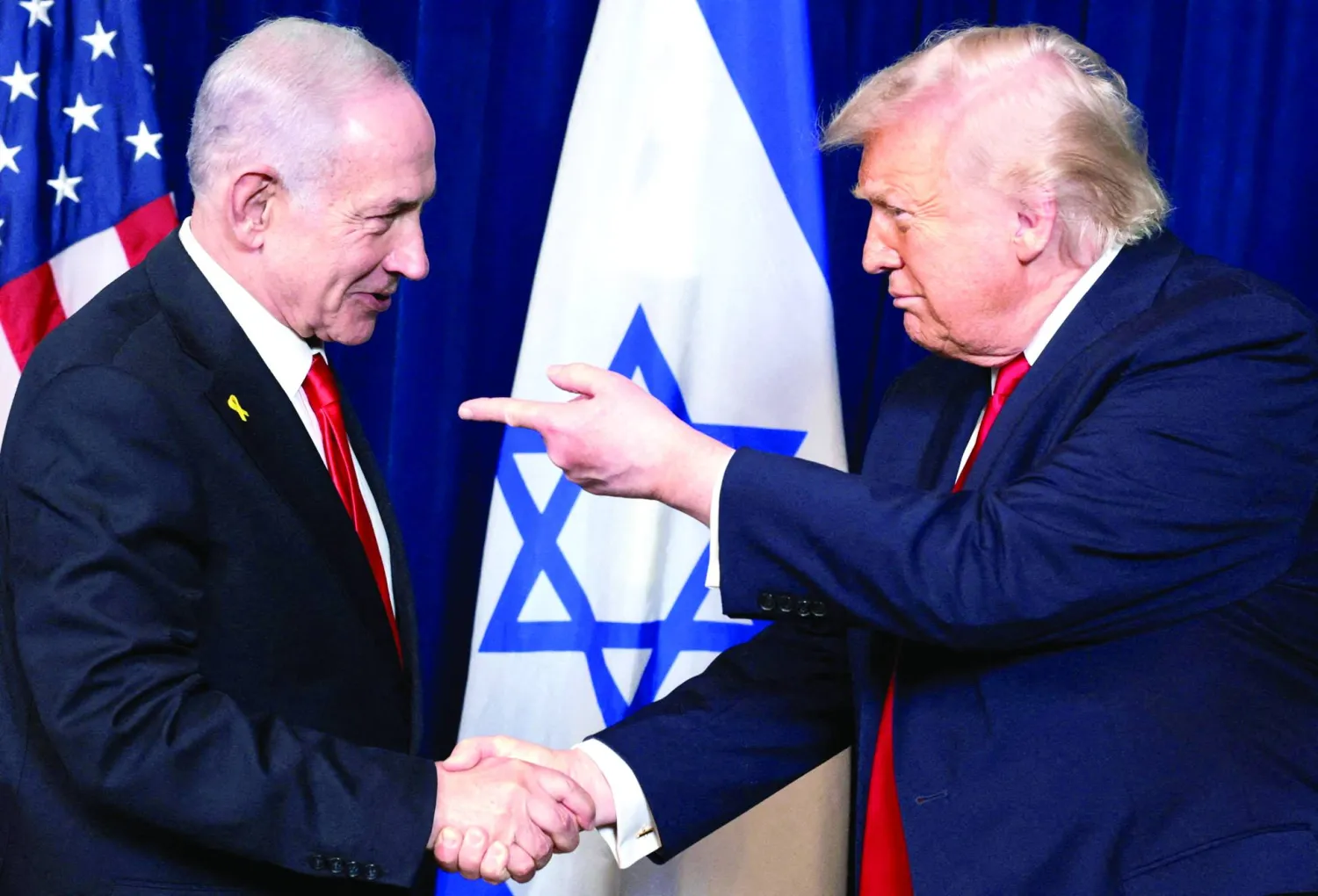
FILE PHOTO: US President Donald Trump points his finger towards Israeli Prime Minister Benjamin Netanyahu as they shake hands during a press conference after meeting at Trump’s Mar-a-Lago club in Palm Beach, Florida, US, December 29, 2025. REUTERS/Jonathan Ernst/File Photo
TT

US-Iran Deal May Leave Netanyahu as Biggest Casualty

FILE PHOTO: US President Donald Trump points his finger towards Israeli Prime Minister Benjamin Netanyahu as they shake hands during a press conference after meeting at Trump’s Mar-a-Lago club in Palm Beach, Florida, US, December 29, 2025. REUTERS/Jonathan Ernst/File Photo

The biggest casualty of the US-Iran deal may not be Israel's Iran strategy, but the political brand Benjamin Netanyahu spent decades building as the Israeli leader who could uniquely bend Washington to his will on Iran, analysts, former US officials and diplomats say.

Netanyahu shaped his political identity on an audacious assertion: that he alone could keep the US and Israel in strategic lockstep on Iran. Cultivating Republican support, he cast himself as the only Israeli leader capable of influencing successive US presidents and insisted that only sustained military pressure could contain Tehran.

At the height of his power, he was described by diplomats as the "American whisperer" — the Israeli leader who could pick up the phone and ensure Washington’s strategic calculus aligned with that of Israel.

No other Israeli prime minister, they note, addressed Congress as often or built such enduring political capital across the American political system. But analysts say Washington and Tehran's interim pact to end the war that the US and Israel launched in February shows how that narrative has been reversed.

Rather than shaping Washington’s Iran policy, Netanyahu is now forced to accept it, as US President Donald Trump pursues a settlement that increasingly treats Israeli objections as constraints, Reuters reported.

At home, the reckoning is equally stark, said former US official Dennis Ross. Netanyahu is increasingly boxed in between a US president intent on ending the conflict and a domestic base resistant to concessions, particularly in Lebanon, he said.

Withdrawal risks political backlash while escalation risks confrontation with Washington. The war Netanyahu hoped would cement his legacy as the leader who confronted Iran may instead be remembered as the conflict that dismantled a central source ⁠of his power. ⁠Isolated abroad, constrained by his closest ally and vulnerable ahead of an autumn election, he now finds the political asset on which he built his career has become his greatest liability.

At the outset of the war with Iran, Netanyahu promised ultimate victory. He delivered neither the collapse of Iran’s ruling system, nor the defeat of Lebanon's Hezbollah, nor safe return for residents of northern Israel.

“The US-Iran deal is a decisive blow to Netanyahu,” said Aviv Bushinsky, a former Netanyahu adviser. “Not only did he lose the war with Iran, he has also lost Trump as a friend. He is now isolated not only internationally, but locked in a major dispute with Trump,” he said.

Netanyahu's office did not respond to a request for comment. In a press conference this month, the Israeli premier described his relationship with Trump as one between partners who "agree many times and sometimes disagree.”

There had been a systematic campaign to diminish Israel's "huge achievements" against Iran and its proxies, he said.

A White House official said Trump and Netanyahu had a strong relationship and that Israel's ⁠military forces had been "incredible partners" in a war that had "decimated the Iranian regime's military capabilities.”

A State Department official said the United States maintains an “iron-clad” commitment to Israel’s security, stressing that “this is not changing.”

The official added that Israel retains the right to defend itself, particularly against Hezbollah, “a terrorist organization that threatens its citizens and undermines the Lebanese government,” and cannot be expected to withdraw from Lebanon until that threat is addressed.

Normalization and regional integration remain a top priority for the Trump administration, added the official.

The disagreement between the US and Israeli leaders, analysts say, extends beyond personal ties to a growing divergence in goals: Trump seeks to disengage from another Middle East war, while Netanyahu views continued pressure on Iran and its ally Hezbollah as essential to Israel’s security.

Washington has negotiated directly with Tehran, folded Lebanon’s conflict between Israel and Iran-backed Hezbollah into a broader framework, and created mechanisms to manage ceasefire disputes — moves that, according to three regional diplomatic sources, have increasingly sidelined Israel from key decisions.

The country that once viewed Netanyahu as an indispensable interlocutor is now, the regional sources say, treating him as an obstacle to an agreement it is determined to protect.

Trump has publicly rebuked Israel’s military conduct in Lebanon, while Vice President JD Vance has underscored the conditional nature of the relationship, warning Israeli critics of the deal against “attacking the only powerful ally they have left in the world.”

Two Israeli officials familiar with Netanyahu’s thinking said he was not concerned that public remarks by Trump and Vance would translate into meaningful shifts in US policy toward Israel, such as delays ⁠in arms deliveries, even if Israel continues military operations ⁠in Lebanon.

Trump has signaled that he is prepared to override Israeli priorities in pursuit of US interests. In a TV interview this month, he said that if he tells Netanyahu “to do something, he does it.”

Iran will seek to widen the emerging gap between the US and Israel by portraying any Israeli military action in Lebanon as an attempt to sabotage Trump’s diplomacy, forcing the White House to choose between backing its ally or preserving the deal, said Ali Vaez of the International Crisis Group.

What makes Netanyahu’s position so precarious, US analysts say, is the loss of his safety net.

For years, he cultivated Republican backing, using it as a counterweight to offset tensions with Democratic administrations, and openly denouncing former President Barack Obama’s 2015 Iran nuclear deal from a congressional podium. But Republicans will not break with Trump for Netanyahu, they said.



UN Approves Resolution in Support of Map that Shows Africa's True Size

FILE PHOTO: A vendor sells a map of Africa along the streets of Bujumbura, Burundi April 24, 2015. REUTERS/Thomas Mukoya/File Photo
TT

UN Approves Resolution in Support of Map that Shows Africa's True Size

FILE PHOTO: A vendor sells a map of Africa along the streets of Bujumbura, Burundi April 24, 2015. REUTERS/Thomas Mukoya/File Photo

The United Nations on Friday voted for a shift away from the 16th-century Mercator global map towards one more accurately reflecting countries' true size, a resolution sponsored by African states to counter perceptions that the continent is peripheral.

Togo led the initiative to further the African Union campaign to limit use of the Mercator map, which distorts the relative size of land masses by expanding those nearer the poles. It makes Greenland appear roughly the same size ⁠as Africa, though Africa ⁠is about 14 times larger.

"A fair world begins with a fair map," Togo's Foreign Minister Robert Dussey told Reuters ahead of Friday's vote.

The resolution promotes the Equal Earth projection, which more accurately portrays the size of the continents.

It is not legally binding and it "in no way challenges the use of the Mercator projection for maritime and aerial navigation, for which it remains fully suited," the Togolese ministry ⁠said in a statement.

The resolution passed in the UN General Assembly by a vote of 164 to 1 with 6 abstentions.

The United States, the only country to vote against the resolution, said it promoted an "ideological agenda" and was a distraction from the "genuine problems of international peace, prosperity or good relations".

The Mercator map remains widely used in classrooms, but Togo hopes to change its school geography materials by the end of the year, Dussey told Reuters.

"Togo will be the first country to change our own geography books," Dussey said.

"In the classroom, we need to change it ⁠to give an ⁠example to all the countries in the world."

Togo will press other governments, schools, international organizations and technology companies to move away from the centuries-old Mercator projection, Dussey said, adding that Equal Earth offers "the best perception" of the world.

Togo plans to meet African Union member states and supporters from other regions within the next six months to agree on how to promote wider adoption, Dussey said.

Dussey said the discussion about next steps would need to include companies operating mapping, GPS and other location-based technologies.

Dussey linked the campaign to adopt the map to wider African efforts to confront colonial-era legacies, while saying it was not an attack on Europe or any other civilization.

The Mercator map's widespread use is a consequence of colonization, he said.

"The world is changing. Africa also is changing."


Philippine VP is Ordered Arrested for Threats Against the President

FILE -Philippine Vice President Sara Duterte gestures as she speaks during a press conference in Manila, Philippines on Friday, Feb. 7, 2025. (AP Photo/Basilio Sepe, File)
TT

Philippine VP is Ordered Arrested for Threats Against the President

FILE -Philippine Vice President Sara Duterte gestures as she speaks during a press conference in Manila, Philippines on Friday, Feb. 7, 2025. (AP Photo/Basilio Sepe, File)

A Philippine court ordered the arrest of Vice President Sara Duterte on Friday over charges that she publicly threatened to have the president and two other people assassinated.

Duterte was already impeached by the House of Representatives in May on the same charges as well as alleged financial anomalies, The Associated Press reported. Her troubles are part of a high-stakes political showdown pitting her against her rival, President Ferdinand Marcos Jr. A conviction could derail her plans to seek the presidency in 2028, when Marcos' six-year term ends.

A lawyer of the vice president, who has denied the charges, suggested she will post bail to avoid detention while facing trial by the Quezon City Regional Trial Court.

“She has no intention of evading the law and will continue to exercise all her legal remedies,” Paul Lawrence Lim said in a statement, without elaborating.

The charges stem from a threat made by Duterte in a 2024 online news conference to have Marcos, his wife and then-House of Representatives Speaker Martin Romualdez killed by an assassin if she herself was killed, as their political disputes escalated. The vice president then warned that her threat wasn’t a joke.

She later said she wasn’t threatening Marcos but was expressing concern for her own safety. Her remarks set off a criminal investigation and national security concerns.

Marcos and Duterte were running mates in the 2022 elections in a whirlwind alliance that combined the vote-getting power of two of the country’s most formidable political dynasties, but the union rapidly fell apart.

The vice president is the daughter of former President Rodrigo Duterte, Marcos’ predecessor. Rodrigo Duterte was arrested last year on orders of the International Criminal Court and detained in The Hague, where he is scheduled to face trial over alleged crimes against humanity on Nov. 30.

The charges are in connection with brutal anti-drugs crackdowns that left thousands of mostly poor suspects dead while Duterte was in power. He has denied authorizing extrajudicial killings but repeatedly threatened suspects with death while in office.

Last May, the House of Representatives, which is dominated by Marcos’ allies, voted overwhelmingly to impeach the vice president over alleged unexplained wealth, misuse of confidential state funds and her threats against Marcos, his wife and Romualdez.

The Philippine Senate, acting as an impeachment court, opened her televised trial in July.

If convicted of the charges, Duterte may be permanently disqualified from holding public office and will prohibit her from seeking the presidency in 2028.

Marcos and the Dutertes have contrasting geopolitical leanings. Marcos has expanded defense engagements with the United States, his country’s treaty ally, as his administration stood up to China’s increasingly aggressive actions in the disputed South China Sea.

Rodrigo Duterte had nurtured cozy ties with Chinese President Xi Jinping and Russian leader Vladimir Putin while threatening to sever ties with Washington. The vice president has come under fire for not condemning China’s assaults, including with the use of powerful water cannons, against Filipino forces and fishermen in the disputed waters.


US, Allies Want IAEA Board to Report Iran to UN Security Council

The logo of the International Atomic Energy Agency (IAEA) at the organization's headquarters in Vienna, Austria, March 6, 2023 (Reuters)
TT

US, Allies Want IAEA Board to Report Iran to UN Security Council

The logo of the International Atomic Energy Agency (IAEA) at the organization's headquarters in Vienna, Austria, March 6, 2023 (Reuters)

The US and its allies Britain, France and Germany are pushing other countries on the UN nuclear watchdog's board to pass a resolution next week reporting Iran to the UN Security Council for the first time in 20 years, diplomats said on Friday.

If passed, the resolution would follow up on one adopted on June 12 of last year declaring Iran in breach of its non-proliferation obligations for not fully cooperating with an investigation into uranium traces found at undeclared sites, Reuters reported.

Israel started bombing Iran's nuclear facilities the next day, soon joined by the United States, destroying or badly damaging Iran's uranium-enrichment plants.

Iran has not let International Atomic Energy Agency (IAEA) inspectors return to the bombed sites since then or verify what remains of its stocks of enriched uranium, some of which was enriched to up to 60% purity, a short step from weapons grade.

A resolution by the IAEA's 35-nation board reporting Iran to the Security Council would also be the culmination of a standoff over IAEA access to those sites, since the board has passed two resolutions in the past year demanding Iran declare its enriched uranium stocks and grant the IAEA full access to verify them.

A draft text for the resolution has yet to be formally submitted to the board and negotiations between countries over the exact wording are ongoing, diplomats said. A draft is usually formally submitted early in the week of a board meeting.

As a party to the nuclear Non-Proliferation Treaty (NPT), Iran has the right to develop nuclear technology, including enrichment, for peaceful purposes. Iran says it would never produce nuclear weapons.

It is, however, the only country to enrich to 60% without making a bomb. The amount it has enriched to that level is "a matter of serious concern" to the IAEA.

The IAEA believes well over 200 kg of that highly enriched uranium has survived the bombardments and is held in a tunnel complex at Isfahan and at the Natanz facility.