
After Trump’s Outburst, Senate Republicans Reverse Course on Iran

Republican Senator Bill Cassidy of Louisiana (EPA)
TT

After Trump’s Outburst, Senate Republicans Reverse Course on Iran

Republican Senator Bill Cassidy of Louisiana (EPA)

Washington: Robert Jimison and Michael Gold

The confrontation came over lunch. The cleanup began after dinner.

Hours after US President Donald Trump angrily confronted Senate Republicans for joining Democrats to approve a war powers resolution rebuking his handling of the war in Iran, Republican leaders brought another, nearly identical measure to the floor.

In a 50-to-47 vote, with one senator voting “present,” they defeated the measure in a largely symbolic move that did nothing to change the resolution the Senate had narrowly approved a day earlier. Instead, it served as an unmistakable gesture to mollify a furious president who had just berated them.

Of the Republican senators who voted to adopt a resolution on Tuesday that instructed him to end the war with Iran or seek Congress’s approval to continue, two shifted their votes: Senators Bill Cassidy of Louisiana and Rand Paul of Kentucky.

Cassidy, who hours earlier angrily confronted Trump over a lack of transparency on the status of the war, said that he changed his vote after a meeting with Vice President JD Vance and Steve Witkoff, the president’s special envoy, at the White House.

“I was going to vote yes, but I had a briefing this evening, and it was complete,” he said moments after voting against the measure, adding: “I am reassured.”

Paul, who voted “present,” said that Trump’s remarks in his lunch meeting with senators had affected his vote, though not his views on the conflict and Congress’s role in declaring war.

“I did listen to the president today, and the president feels like it reduces his leverage to find a deal, and I do think it is important that we have peace negotiations,” Paul said.

Trump celebrated Wednesday’s late-night vote, thanking Republican leaders in a social media post that falsely claimed that the Senate had “changed its vote on Iran.”

Trump said that the new vote “puts Iran on notice.”

Ultimately, the maneuver did not undo Tuesday’s vote, which was the first war powers measure approved by both chambers since the war began and remains adopted. Wednesday’s vote neither rescinded nor superseded it.

Still, Republicans sought to characterize the procedural move as a chance to “re-vote,” even though the initial action cannot simply be erased through a subsequent vote on different legislation.

“That train has left the station,” said Senator Tim Kaine, Democrat of Virginia, whose resolution was called up by Republican leaders.

He noted that because of the rules surrounding the procedural tool used to call up the vote Wednesday’s vote to defeat the so-called “motion to proceed” does not prevent him from forcing another vote on the same resolution at another point, it simply prevents the chamber from taking up a final vote to consider it.

“My bill is in exactly the same position as it was before they did this vote,” he said.

The remarkable sequence underscored the lengths Republican leaders were willing to go to contain the latest clash between Senate Republicans skeptical of the war and Trump, which unfolded during a closed-door lunch earlier in the day.

The vote was the last one senators took before leaving for a planned recess that is set to last until July 13.

It capped off a turbulent day on Capitol Hill that began after Trump abruptly called off the ceremonial signing of a bipartisan housing bill that Republicans had already started championing as a major accomplishment ahead of the midterm elections.

Dismissing that legislation as “minor,” Trump instead urged Republicans to swiftly pass an elections bill that Republicans have acknowledged does not have the votes to advance.

But at his lunch meeting, Trump made clear that he was equally furious about the Senate adopting a resolution on Tuesday that instructed him to end the war with Iran or seek Congress’s approval to continue it. In that vote, four Republican senators joined Democrats, and it succeeded because two other Republican senators were absent.

According to lawmakers who attended Wednesday’s lunch, the president berated Republicans who had voted with Democrats and singled out several senators by name. The meeting then erupted into a shouting match between Trump and Cassidy, who has become an increasingly outspoken critic of the president after losing his primary race to a challenger backed by Trump.

Among Cassidy’s complaints was that senators had yet to receive a comprehensive briefing on the Iran war. Hours later, the senator went to the White House for a briefing on the Iran war with Vance and Witkoff.

In a social media post, Cassidy said that the meeting addressed “many of my concerns” on the Iran war.

Republican leaders were also helped in their effort to defeat the resolution by the presence of Senator Dave McCormick of Pennsylvania, who missed Tuesday’s vote because he was traveling with Trump at the time.

Tensions with lawmakers over the war were likely to continue, however, as Trump asked Wednesday to approve $87.6 billion in extra spending this year for the war and several unrelated programs — a request that appeared all but dead on arrival in the Senate.

The New York Times


Russian Strikes Kill 8 in Ukraine, Damage Maternity Clinic

A woman walks in front of a house destroyed in a Russian strike on a residential neighbourhood in Kyiv, Ukraine, Thursday, Sept. 24, 2026. (AP Photo/Evgeniy Maloletka)
TT

Russian Strikes Kill 8 in Ukraine, Damage Maternity Clinic

A woman walks in front of a house destroyed in a Russian strike on a residential neighbourhood in Kyiv, Ukraine, Thursday, Sept. 24, 2026. (AP Photo/Evgeniy Maloletka)

Russian drone and missile strikes on Ukraine's capital Kyiv and its northeast killed eight people on Thursday in attacks that included a maternity hospital and a farm, officials said.

Moscow has stepped up its air war in recent months, deploying more of its faster and harder-to-stop drones while Ukraine is short of interceptors to down ballistic missiles.

Two people died in the latest assault on Kyiv, according to President Volodymyr Zelenskiy, who was in New York for the UN General Assembly.

"As people were sleeping, flashes from explosions ⁠lit up the sky," ⁠Zelenskiy said on Telegram.

"Once again, the main targets of their strike were Kyiv and civilian infrastructure, residential buildings, a maternity hospital, energy infrastructure, and logistics."

Police said nine homes, a post office, warehouses and dozens of cars were also damaged in Kyiv.

A separate Russian attack on a vegetable storage facility at a farm in a village of the northeastern Kharkiv region killed six people and injured a further ⁠12, prosecutors said.

The overnight barrage around Ukraine included an unspecified number of hypersonic and ballistic missiles, 282 drones and other weapons, Ukraine's air force said.

In Kyiv, eight people were injured as well as the two fatalities, one of whom was in the parking lot of the maternity hospital, Reuters quoted city mayor Vitali Klitschko as saying.

Part of the hospital's facade, windows and doors were damaged, officials said, adding that no patients or medics were injured.

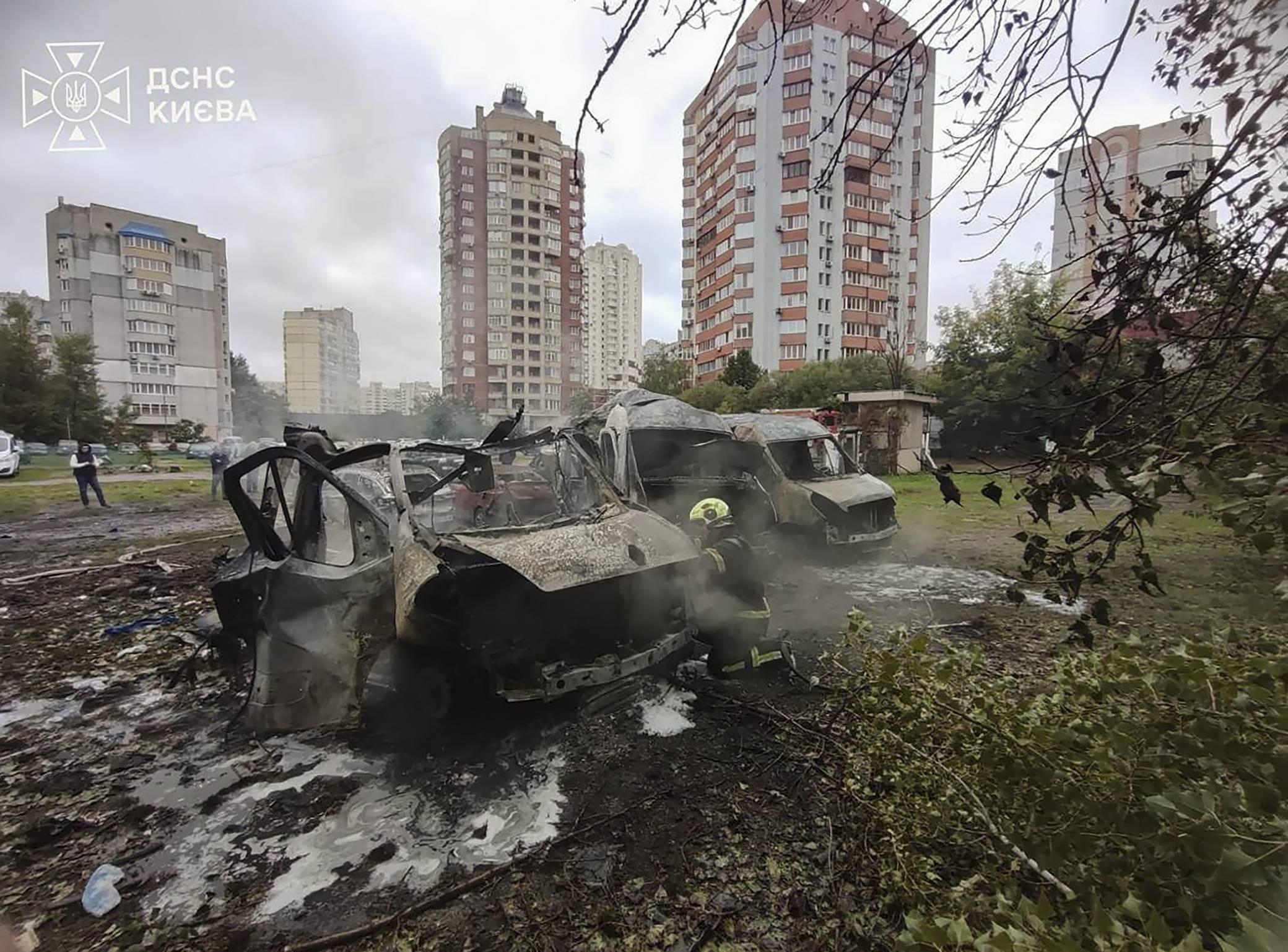
A handout photo made available by the State Emergency Service (SES) shows Ukrainian rescuers working at the site of an overnight Russian attack on a residential area in Kyiv, Ukraine, 24 September 2026, amid the Russian invasion. EPA/STATE EMERGENCY SERVICE / HANDOUT

Authorities in the northwestern region of Rivne said infrastructure was damaged in overnight strikes that continued into Thursday morning, without providing further details. Volyn region bordering Poland also came under attack.

Insufficient pressure on Moscow ⁠was allowing ⁠it to launch repeated strikes, said Zelenskiy.

"Right now, the United States has the opportunity to respond strongly," he said. "We need ballistic interceptors to protect lives."

Russia's defense ministry said its forces hit Ukrainian defense facilities, logistics and telecoms centers, as well as vessels used by the military.

In the Black Sea port of Odesa, military administration head Serhiy Lysak said overnight Russian strikes damaged a medical facility and shattered windows in nearby houses and a school.

Moldova's President Maia Sandu said four Russian drones crossed into its airspace and at least one exploded, while Romania said a drone also crashed in its territory.

NATO alliance member Poland said it deployed aviation twice on Thursday due to Russian attacks on Ukraine.


Quake Rattles Southeastern Türkiye

Image of earthquake monitoring (Reuters)
TT

Quake Rattles Southeastern Türkiye

Image of earthquake monitoring (Reuters)

An earthquake of 5.4 magnitude rattled cities in southeastern Türkiye on Thursday but there were no immediate reports of damage or injuries, the disaster agency said.

The quake, which occurred at 10:40 am (0740 GMT) was centered just north of the city of Sanliurfa, Türkiye's AFAD disaster agency said, adding "there are currently no reports of adverse effects".

Hasan Silda, governor of Sanliurfa province, said the quake had been felt "intensely", AFP reported.

"According to initial reports, there are no casualties or injuries. There is no destruction. There may be some partial damage to buildings," he told NTV private television.

Türkiye is crisscrossed by several geological fault lines that have previously caused catastrophes in the country.

A massive quake in February 2023 killed at least 53,000 people in southeastern Türkiye and around 7,000 others in Syria, that also caused damage and more than 300 deaths in Sanliurfa.


For Pope Leo, the Risk of an AI Apocalypse is a Major Concern

Pope Leo XIV leads the weekly Angelus prayer from a window at the Vatican, August 9, 2026. Vatican Media/Mario Tomassetti/­Handout via REUTERS
TT

For Pope Leo, the Risk of an AI Apocalypse is a Major Concern

Pope Leo XIV leads the weekly Angelus prayer from a window at the Vatican, August 9, 2026. Vatican Media/Mario Tomassetti/­Handout via REUTERS

The Vatican warned about the risk of an apocalypse spurred by artificial intelligence years before major American firms sounded the alarm at the United Nations Security Council on Wednesday - a concern that Pope Leo is placing at the heart of his papacy.

Leo, who in May called on world leaders for global rules to oversee the industry, is expected to warn about AI again on Friday in a speech at the Paris headquarters of the UN's culture and education body, UNESCO.

"This is not happening on day zero for the Holy See," Rev. Paolo Benanti, a leading Vatican advisor on AI issues, told Reuters, referring to recent calls for a slowdown that has been endorsed by the CEOs of AI firms Anthropic, OpenAI and xAI, among others.

"The transformative power of AI ... ‌could produce a magnitude ‌of societal changes that are very hard to predict," said Benanti, an Italian academic ‌who ⁠recently took part ⁠in the AI summit hosted by Britain's King Charles.

The priest said he could not reveal details about the contents of the summit's confidential discussions.

CARDINAL: THE FUTURE OF HUMANITY IS AT STAKE

Leo, the first US-born pope, has raised the possible dangers of AI development frequently throughout his 16-month-old papacy and first discussed the issue publicly on his third day in office.

In his May appeal, released as his first major document, Leo warned that AI systems spread misinformation, prioritize conflict and could lead the world down a path of unending war.

Cardinal Pietro Parolin, the Vatican's top diplomat, reiterated Leo's call for international regulation of ⁠the industry at an event in Rome last week, warning that countries cannot "go it alone" ‌on the technology.

"The future of humanity is really at stake here," ‌Parolin said. The world, he said, needs "everyone's involvement in establishing some common rules that can genuinely govern this phenomenon."

Anthropic co-founder Chris Olah ‌spoke at the Vatican's launch event for the pope's May document, known as an encyclical.

Asked if the Vatican is ‌in ongoing dialogue with any AI firms, Benanti stressed the decentralized nature of the global church and said some discussions are being led by local bishops.

On September 16, the US bishops' conference said it had created a new AI taskforce after several of its leaders met with executives that day.

"The dialogue focused on ways to keep any system of artificial intelligence at the service of ‌humanity and the urgent need to address the real and present dangers such technology presents," a statement said.

LEO WARNS ABOUT AUTONOMOUS WEAPONS

The Vatican began warning about the ⁠risks of AI in 2019, hosting ⁠two conferences that year on the possible dangers of the technology. The late Pope Francis warned attendees at one of the events that misinformation spread by AI could spark a world war.

The Vatican also teamed with Microsoft, IBM , the UN's Food and Agriculture Organization and the Italian government in 2020 to issue a call for AI development that "does not have as its sole goal greater profit or the gradual replacement of people in the workplace."

Leo has urged oversight especially for the development of weapons systems, such as those being used in the Russia-Ukraine war. He said in his encyclical that such weapons have advanced "practically beyond any human reach to govern them."

The Vatican's advocacy on the global stage against autonomous weaponry goes back decades, Benanti said, likening AI-powered drones to landmines that are indiscriminate with their targets.

The priest compared the Vatican's warnings about the risks of AI to how popes have long called for nuclear disarmament.

"If nuclear weapons can destroy humanity ... the manipulation of generative AI content in social spaces can destroy the capabilities of people to stay together as a society," he said.

"Nuclear weapons have to be stocked inside facilities and you can count and control them. AI is not this visible."