

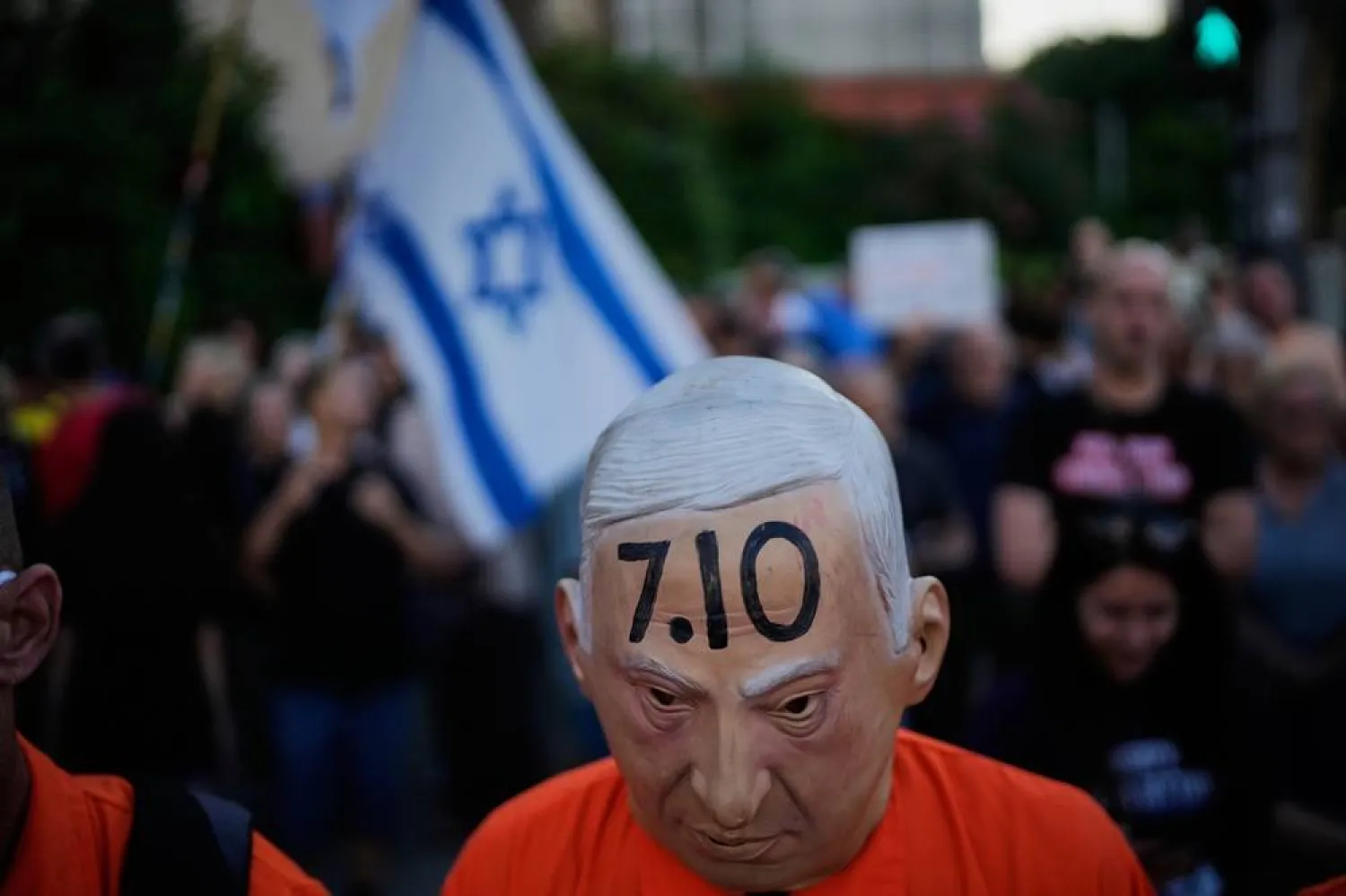

Calls for State Inquiry as Israel Marks 1,000 Days Since Oct. 7

A demonstrator wears a mask depicting Israeli Prime Minister Benjamin Netanyahu during a rally marking 1,000 days to the deadly Oct. 7, 2023, (AP)
TT

Calls for State Inquiry as Israel Marks 1,000 Days Since Oct. 7

A demonstrator wears a mask depicting Israeli Prime Minister Benjamin Netanyahu during a rally marking 1,000 days to the deadly Oct. 7, 2023, (AP)

Israelis called on Thursday for a state commission of inquiry into Hamas's October 7, 2023 attack, as the country marked 1,000 days since the deadliest event in its history, which triggered the war in Gaza.

A series of somber commemorations were being held across the country, as well as protests against the government's handling of events during and after the attack.

The first began at 6:29 am (0329 GMT) -- the exact time at which the Palestinian movement Hamas launched its assault on Israel.

"What weighs on me most is the fact that even now, 1,000 days after the event, we are still in the middle of it, and what could have been done to reach some kind of closure has not been done," Jerusalem resident Dina Hertz told AFP.

"I mean a genuine commission of inquiry, genuine taking of responsibility, drawing real conclusions, and a true sense of shame and pain by those who were at the head of the system on October 7."

The Hamas-led attack resulted in the deaths of 1,221 people, according to an AFP tally based on official Israeli figures. Gunmen also took 251 hostages to Gaza.

Israel's retaliatory military campaign in Gaza has killed more than 73,000 people, according to the territory's health ministry, which operates under Hamas authority and whose figures are considered reliable by the United Nations.

Since a ceasefire took effect on October 10 last year, at least 1,059 Palestinians have been killed in Gaza, according to the health ministry, and the Israeli military says it has lost five soldiers and one contractor over the same period.

Israeli forces occupy nearly 70 percent of the territory.

- 'Day of rage' -

Meeting with a group of bereaved families, President Isaac Herzog said the day was "a reminder of Israel's capacity to grow out of crisis and unbearable pain: to remember, and never to forget".

The "October Council", founded by the families of victims and hostages taken on October 7, is one of the main organizers of Thursday's events.

Gatherings are scheduled in front of the Israeli parliament and near the homes of government members.

"The families of the hostages and the bereaved families are demanding the establishment of a state commission of inquiry now!" the October Council said on X.

The "Hostages Square" plaza in Tel Aviv, which became a focal point for the struggle to release the captives during the Gaza war, has been renamed "Memory Square" for the day.

In the square under the beating sun, a girl played a piano plastered with stickers paying tribute to victims and soldiers who fell in battle.

"The thousandth day is the day of weeping, a day of rage, a day of anger and above all, a day of mourning," said Eyal Eshel, whose daughter, a soldier, was killed on October 7.

"For a thousand days, we have continued counting, and we will keep counting until a state commission of inquiry is established and until this government is no longer in power," he added.

A memorial event was also scheduled for 8:00 pm at Tel Aviv's Yarkon Park, bringing together victims' families and leading figures of the protest movement against the Israeli authorities and their handling of events.

Israel's military chief, Lieutenant General Eyal Zamir, on Monday said: "This day reminds us of our overall responsibility and the weight that rests on our shoulders".

Gadi Eizenkot, former army chief and now a leading candidate to succeed Prime Minister Benjamin Netanyahu in the elections due to be held in October, marked the day in a short X post.

"1,000 days. We will still prove ourselves worthy. I promise," he wrote.

According to polls, a large number of Israelis across the political spectrum support the establishment of a body to determine who is responsible for the authorities' failure to prevent the deadliest-ever attack on Israel.

Netanyahu's government, however, has long refused to establish such a commission, the likes of which Israel has commonly set up in the past to investigate major state-level failings.



Trump Says ‘Ridiculous’ for US to Maintain Current Support for NATO

 A paper collector pulls his handcart past billboards displayed along the boulevard on the protocol route ahead of the NATO Summit in Ankara, on July 2, 2026. (AFP)
A paper collector pulls his handcart past billboards displayed along the boulevard on the protocol route ahead of the NATO Summit in Ankara, on July 2, 2026. (AFP)
TT

Trump Says ‘Ridiculous’ for US to Maintain Current Support for NATO

 A paper collector pulls his handcart past billboards displayed along the boulevard on the protocol route ahead of the NATO Summit in Ankara, on July 2, 2026. (AFP)
A paper collector pulls his handcart past billboards displayed along the boulevard on the protocol route ahead of the NATO Summit in Ankara, on July 2, 2026. (AFP)

President Donald Trump said Thursday it is "ridiculous" for the United States to continue its "one sided" relationship with NATO, less than a week before a NATO summit in Ankara.

Trump wrote on his Truth Social platform: "They were not there for us!!!" and Washington's relationship with NATO "is not reciprocal."

Trump has repeatedly lashed out at European allies over their response to the war in Iran, as several countries restricted the use of bases for US forces.

Trump also insists he wants Europe to take the lead role for its own defense, and Washington has already moved to scale back commitments.

His Truth Social post on Thursday included a chart displaying the amount of NATO spending, with the United States investing vastly more than a few other member states depicted.

Under pressure from Trump, NATO leaders had agreed at a gathering last year to boost defense-related spending to five percent of GDP by 2035.

The upcoming NATO summit, which will bring together 32 member states, will be held in the Turkish capital on July 7-8.

The alliance, founded in 1949, became a US-led defense force credited with maintaining stability in Europe, keeping the Soviet Union at bay and solidifying Washington as a world power for decades to come.


Venezuela’s Interim Leader Angrily Defends Earthquake Response

This photograph taken on July 2, 2026 in Caraballeda in the state of La Guaira shows volunteers looking for survivors in a collapsed building following the June 24 twin earthquakes. (AFP)
TT

Venezuela’s Interim Leader Angrily Defends Earthquake Response

This photograph taken on July 2, 2026 in Caraballeda in the state of La Guaira shows volunteers looking for survivors in a collapsed building following the June 24 twin earthquakes. (AFP)

Venezuela's US-backed acting President Delcy Rodríguez on Thursday issued a fiery defense of her government's response to last week's devastating earthquakes, lashing out at critics who say authorities reacted too slowly, pushing back on suggestions that the true death toll is far higher than the government has acknowledged and rejecting accusations that the nation's shoddily constructed social housing exacerbated the disaster.

The self-described socialist government of Rodríguez, striving for legitimacy months after the United States removed former President Nicolás Maduro from power in January, has come under fire for what residents have described as a sluggish and haphazard response to the quakes.

Residents of the hardest-hit state, La Guaira, have complained that the initial absence of a serious government search-and-rescue operation left them alone to scour for neighbors and loved ones with their bare hands. Rescuers have lamented the country's shortages of specialized equipment.

Experts have warned that substandard construction of social housing projects — a hallmark policy of former President Hugo Chávez — left neighborhoods vulnerable to quakes.

At a press conference for foreign journalists in the capital of Caracas late Thursday, Rodríguez, wearing a black ribbon as a symbol of mourning, refused to accept the criticism.

“We did not wait one day, two days or three days. We activated immediately,” she said, lacing into media outlets that she accused of spreading misinformation. “To politicize a humanitarian tragedy like this — when the Venezuelan government and its authorities have spared no effort, public, private, national, or international — is disgraceful."

Authorities have counted at least 2,295 people killed by the earthquake as of Wednesday — a number that’s expected to rise. They did not offer an updated death toll on Thursday, and have maintained tight control over public communications and relief efforts.

A rare bright spot in the misery

The stench of decomposition hung heavy over streets of flattened buildings as rescue missions to find survivors of Venezuela’s devastating earthquakes increasingly turned to the recovery of corpses.

Desperate for good news, Venezuelan and international emergency workers celebrated the near-miraculous rescue of a 43-year-old security guard found alive after nearly eight days under the rubble — five days beyond the critical 72-hour mark following a quake when experts say finding survivors is most likely.

National broadcasters reran footage of the exuberant moment he was pried free from the collapsed mall and lifted onto a stretcher as crowds cheered. Trapped in an air pocket beneath the concrete, Hernán Alberto Gil Flores survived on the food and water that rescuers managed to pass him through crevices.

Elsewhere across La Guaira, an air of hopelessness was setting in. The port city of Catia La Mar teemed with officials carrying body bags and stacking wooden coffins.

More than 38,000 reports of missing people — many of them likely buried beneath the rubble — have been sent to a website set up by the Venezuelan opposition, as the government has not given official figures for those missing.

When one journalist asked Rodríguez about the true, still-unknown toll of the disaster, citing reports that the United Nations is procuring 10,000 body bags, Rodríguez defended the government's tally.

“We do not want to speculate," she said. “The numbers we provide are rigorously verified.”

In La Guaira, several of Chávez's signature social housing projects were razed by the earthquakes, prompting suspicions of flawed construction. Rodriguez deflected the accusations, claiming on Thursday that about 80% of the collapsed buildings were privately developed. She did not offer evidence.

Rodríguez’s denies a slow government response

Pressed on reports that residents were on their own in the first 48 hours after the quakes, with heavy machinery and official aid scarce, Rodríguez acknowledged that “naturally, at the sites where the building collapsed, the first people to arrive were survivors of the collapse itself, relatives and neighbors."

But she railed against what she called “narratives manufactured in propaganda laboratories" and claimed that a day after the quakes, “We had already mobilized the full capacity of the Venezuelan state together with the private sector.”

The disaster has evolved into the biggest test of competence yet for Rodríguez, who served as deputy to Maduro until his ouster and became interim leader with the backing of the Trump administration.

Her comments Thursday came a day before the extension of her 180-day mandate as acting leader was set to expire. It was unclear what would happen once the deadline passes Friday.

Under Venezuela’s constitution, temporary absences are to be filled by the vice president — which was Rodríguez’s former role — for up to 90 days. These interim appointments can be extended by the national assembly for an additional 90 days. The National Assembly, controlled by Rodríguez’s party, can trigger a snap election if lawmakers declare the post permanently vacant.

US support of a government under fire

In contrast to the aftermath of Venezuela's catastrophic 1999 landslides, when then-President Chávez rejected offers of assistance from an adversarial US, Rodríguez has publicly welcomed aid and rescue teams from governments across the political spectrum — including the Trump administration and its regional allies.

In expressing thanks for the foreign help, Rodríguez singled out Israel, which has no diplomatic relations with Venezuela. She praised President Donald Trump and Secretary State of Marco Rubio, saying they “remained constantly attentive and offered support.”

Washington has thrown its support behind Rodríguez in its bid to open up Venezuela’s lucrative energy industry and largely turned its back on opposition leader and Nobel Peace Prize winner María Corina Machado, who this week accused Rodríguez’s government of blocking her return to the country.

The US has committed over $300 million and deployed some 900 military personnel to support rescue operations. On top of that, John M. Barrett, the US chargé d’affaires to Venezuela, said the US would make revenue from Venezuelan oil production, controlled by the US Treasury since Maduro’s seizure, available for relief efforts. That promise has made demands for more transparency in US management of Venezuelan oil sales all the more urgent, analysts say.

“Venezuelans really need that money to be used for the protection of Venezuelans,” said Laura Cristina Dib, Venezuela program director at the independent human rights organization Washington Office on Latin America.


Death Toll From Massive Strikes on Kyiv Rises to 30

A woman with a bicycle walks by a residential building damaged following a Russian air attack on the Ukrainian capital of Kyiv on July 2, 2026, (AFP)
TT

Death Toll From Massive Strikes on Kyiv Rises to 30

A woman with a bicycle walks by a residential building damaged following a Russian air attack on the Ukrainian capital of Kyiv on July 2, 2026, (AFP)

Ukraine said on Friday that the death toll from a massive barrage on its capital had risen to at least 30 people, as both Kyiv and Moscow vowed fresh assaults.

Ukrainian President Volodymyr Zelensky said his forces would "definitely" retaliate for the Wednesday to Thursday overnight pummeling, as he inspected an apartment block that was partially destroyed.

The European Union's top diplomat proposed new sanctions on Moscow, as Zelensky pressed the United States for licenses to manufacture Patriot air-defense missiles.

UN chief Secretary-General Antonio Guterres condemned Russia's barrage and repeated a ceasefire call.

"Attacks against civilians and civilian infrastructure wherever they occur are a clear violation of international humanitarian law and must stop immediately," said his spokesman Stephane Dujarric.

But the Kremlin vowed to further ramp up "pressure" on Kyiv, sticking to its no-compromise rhetoric.

- 'Most massive attack' -

Russia has routinely launched waves of missiles and drones during its invasion, Europe's deadliest conflict since World War II.

AFP journalists in central and eastern Kyiv heard more than a dozen explosions and saw residents rushing to shelter in metro stations.

In the morning, locals stood on the rubble of destroyed apartment blocks ripped apart by the barrage, as smoke poured over the Kyiv skyline.

Blasts started echoing out late on Wednesday, lasting into the early hours of Thursday as Russian missiles and drones rained down on residential areas in the city center.

Mayor Vitali Klitschko described it as the "enemy's most massive attack on the capital".

Ukraine's state emergency service said that the strikes had killed 30 people, increasing an earlier toll after three more bodies were pulled from the rubble.

The head of the city's military administration Tymur Tkachenko said 91 people were wounded.

The Ukrainian branch of the Red Cross said its key warehouse had been destroyed and around $2 million worth of humanitarian aid lost.

Debris also damaged a building "hosting a number of diplomats", EU spokeswoman Anitta Hipper told AFP, adding that the EU diplomats were safe.

And in Kryvyi Rig, two people were wounded when a missile struck a densely populated area, the head of the central city's military administration said early Friday.

Kyiv urged its allies to send more air defense.

"We also very much count on a decision by the United States regarding licenses for Patriots," Zelensky said in a post on Facebook on Thursday.

Later, after talks with Finland's President Alexander Stubb, he added: "Defending against ballistic missiles is impossible without a sufficient number of missiles for Patriot systems."

Ukraine wants to manufacture munitions for the US-made missile interceptor system, but defense experts say it would take time to set up production domestically.

A US official told AFP President Donald Trump wanted a peace deal to end the "senseless killing" in Ukraine.

- Struggling to sleep -

Russia fired 496 drones and 74 missiles, including hard-to-intercept ballistic projectiles, Ukraine's air force said.

It said it shot down 48 of the missiles and 476 drones.

AFP reporters met several Kyiv residents outside an apartment building largely destroyed in the attack.

"Half the building has been destroyed. The roof is gone," said 32-year-old factory worker Sabina Mambetova, standing outside the rubble of her home in the eastern Darnytskyi district.

"I've been left without an apartment, alone with my child. I don't know what to do now."

Some 52,000 people, including 4,500 children packed into underground stations to shelter from the barrage -- the highest number in recent years, according to the Kyiv metro.

Others hunkered down in basements or corridors through the night as blasts shook buildings across the city.

"It's hard," 32-year-old doctor Kateryna Kucheryava told AFP from the metro as the attack was unfolding. "My child is used to sleeping in complete silence and darkness.

"I picked her up and carried her down. She woke up and now she's not sleeping anymore."

Along station platforms, locals set up tents and lay on air mattresses and camping chairs, while mothers tried to sleep clutching babies to their chests.

- Zelensky cuts short visit -

The EU's top diplomat Kaja Kallas said she would propose new sanctions on Moscow over the attack.

The attack came hours after Zelensky cut short a visit to Dublin on Wednesday, citing intelligence reports of an impending Russian strike.

Zelensky said Russian President Vladimir Putin "has been preparing this massive strike against Ukraine for some time now".

Ukraine has stepped up long-range drone attacks inside Russia in recent weeks, targeting energy infrastructure and military targets.

Russian officials have reported repeated strikes in border regions, while Moscow has said its air defenses have intercepted hundreds of drones from Ukraine in recent days.