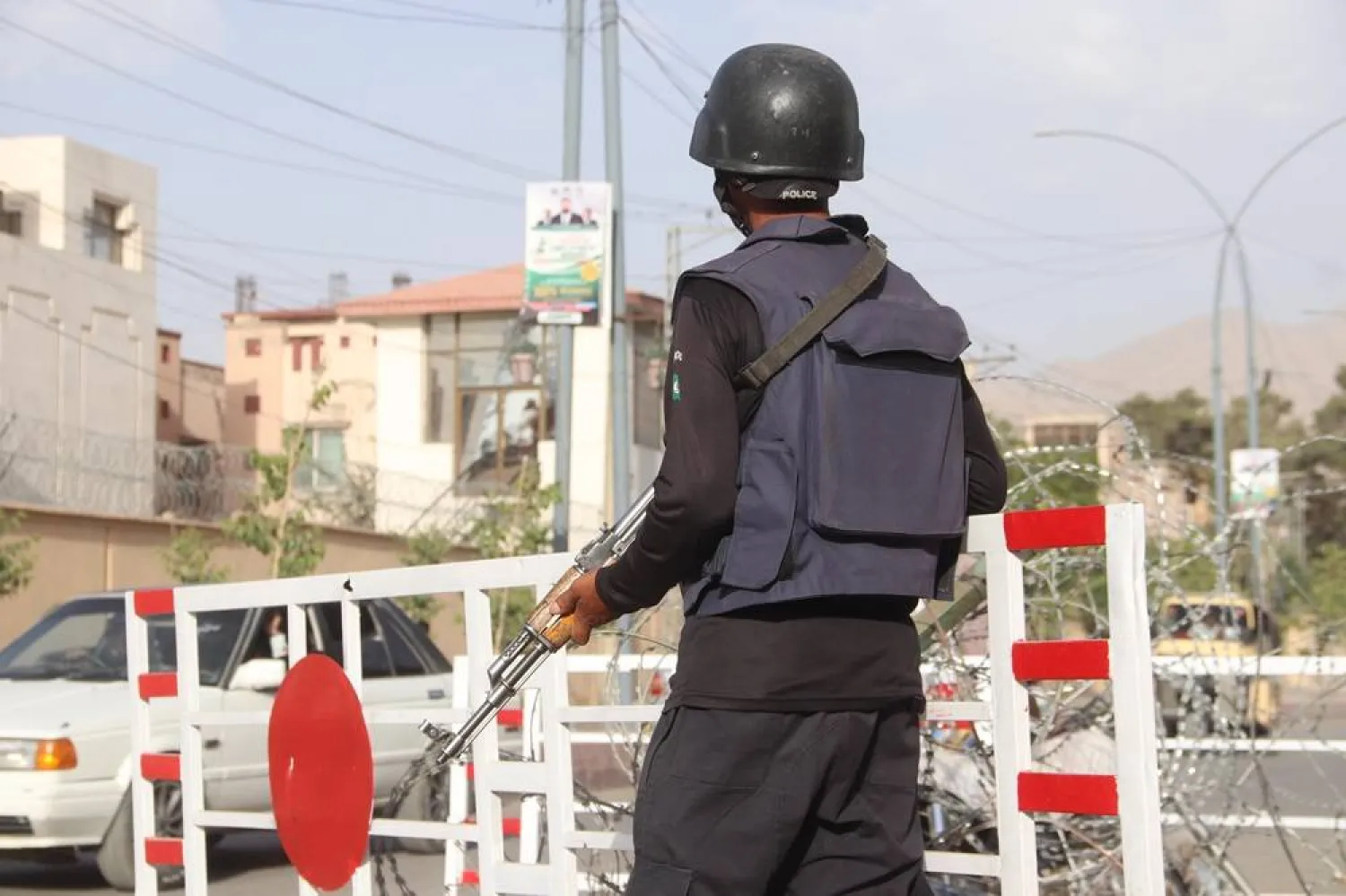
At Least 40 Dead After Bus Falls into Ravine in Pakistan

A Pakistani security official stands guard in Quetta, Pakistan, 01 July 2026. (EPA)
TT

At Least 40 Dead After Bus Falls into Ravine in Pakistan

A Pakistani security official stands guard in Quetta, Pakistan, 01 July 2026. (EPA)

A bus veered off a road and fell more than 20 meters into a ravine in western Pakistan on Friday, killing at least 40 people, officials said.

"A passenger bus travelling from Quetta to Peshawar plunged into a deep ravine in the mountainous Dana Sar area... 40 people have been confirmed dead and 11 others injured," said Sanaullah Sherani, the head of Zhob district's emergency center.

Sherani said the injured passengers had been taken to hospital, three of them in critical condition.

"The bus fell approximately 70 to 80 feet (21 to 24 meters) into the ravine," Sherani added.

"As the accident occurred in a rugged mountainous area, rescue teams faced significant difficulties during the initial phase of the operation," he said.

Shahid Rind, the spokesperson for the southwestern province of Balochistan's chief minister, also said the bus had been travelling from the provincial capital Quetta to the city of Peshawar in northwestern Khyber Pakhtunkhwa province.

Rescue teams from both provinces were at the scene, he added.

Road accidents are common in Pakistan due to weak enforcement of traffic laws, speeding, poor road safety standards and reckless driving.


Researchers Say EU Lawmaker Who Investigated Surveillance Was Hacked by Israeli Spyware

Logo of Israel's NSO Group, owner of the Pegasus spyware, on a smartphone placed on a keyboard. (Reuters)
TT

Researchers Say EU Lawmaker Who Investigated Surveillance Was Hacked by Israeli Spyware

Logo of Israel's NSO Group, owner of the Pegasus spyware, on a smartphone placed on a keyboard. (Reuters)

A former member of the European Parliament who served on a committee investigating abusive surveillance was himself hacked using an Israeli-made spy tool, a Canadian tech watchdog group said on Friday.

Citizen Lab said in a report that the phone of Stelios Kouloglou, a Greek television journalist-turned-lawmaker, was hacked at least three times between October 2022 and March 2023 using Pegasus spyware, a tool distributed by the Israeli company NSO Group.

At the time of the targeting, Kouloglou was serving on the European Parliament's PEGA Committee, which was set up in 2022 to examine the use of illegal phone hacking across the European Union. The committee focused mainly on ‌the use of ‌Pegasus and similar tools, finding that governments across the EU likely used spyware, "in ‌one ⁠way or another, ⁠some legitimate, some illegitimate."

Kouloglou said he was astonished at the audacity of whoever was behind the hacking.

"I was not expecting that a PEGA member would be spied on by Pegasus," he told Reuters. "I was not expecting that they would be as reckless as that."

NSO did not return messages seeking comment.

In a statement to Reuters, the European Parliament did not directly address Kouloglou's case but said its IT security services "constantly monitor cybersecurity threats as well as potential cyberattacks against its working environment."

It said spyware screening tools ⁠had been available to all lawmakers since 2022 and that a report ‌adopted last month called for their extension to all devices ‌used for parliamentary business.

The European Commission, the European Union's executive branch, did not immediately return messages seeking comment.

NSO has ‌said its spy tools are used to police serious crime and to protect national security, ‌but the company has repeatedly been accused of facilitating intrusive surveillance of journalists, political opponents, civil rights activists and religious figures around the world. NSO was blacklisted by the US government in 2021 over human rights and national security concerns.

Last year, WhatsApp owner Meta Platforms won a $168 million damages award against NSO for unlawfully hacking the ‌platform, although the award was significantly reduced. Last month, Meta accused NSO of violating the court's injunction on targeting its services and filed for ⁠a contempt order.

Citizen Lab ⁠said it believed that Kouloglou had been hacked through a vulnerability in Apple software that was not known at the time. It said Kouloglou received repeated warnings about state-sponsored hacking attempts from Apple in 2023 and 2024. Citizen Lab did not identify who actually used Pegasus to target the former lawmaker, but it linked some of the hacking activity to earlier discoveries that Pegasus was used to spy on Russian- and Belarusian-speaking journalists and activists in exile. Apple did not directly address questions about Kouloglu, but said the vulnerability referred to in the Citizen Lab report had since been patched and that it regularly issued alerts to hacking targets.

Sophie in 't Veld, a former EU lawmaker who championed the PEGA committee's creation, said the hacking of Kouloglou's phone showed how the spread of mercenary spyware had created a surveillance free-for-all.

"We're in a situation where anybody could spy on anyone and they're spying on citizens, they're spying on journalists, they're spying on NGOs, on lawyers, on politicians, and nobody knows who's behind it," she said.


Man Dies after Setting Self Ablaze Outside UN in New York

A man self-immolates outside the United Nations headquarters in New York (Reuters)
TT

Man Dies after Setting Self Ablaze Outside UN in New York

A man self-immolates outside the United Nations headquarters in New York (Reuters)

A man died after setting himself on fire outside the UN's headquarters in New York on Thursday, police said, with activists and reports identifying him as a pro-Tibet campaigner.

The New York Police Department told AFP that "at 1832 (2232 GMT) NYPD received a call... a male set himself on fire at First Avenue and 42nd Street. He was pronounced dead at Bellevue Hospital. Investigations ongoing." No motive was given.

A spokesperson for United Nations Secretary-General Antonio Guterres said in a statement to AFP: "We are saddened by this tragic and horrific incident, and offer our condolences to his family."

US media and a pro-Tibet activist said the individual was a pro-Tibet campaigner, though investigators did not confirm this claim.

Tencho Gyatso, President of the International Campaign for Tibet, named the deceased man as Lobga Rangzen.

"Lobga was a tireless advocate for Tibet who devoted himself to peacefully raising awareness of the human rights crisis in Tibet," Gyatso said in a statement to AFP.


France’s Le Pen Faces Crunch Verdict Before Presidential Vote

 President of Rassemblement National parliamentary group Marine Le Pen poses poses ahead of a television interview entitled "Le Grand Entretien" broadcast on French news channel LCI, in Boulogne-Billancourt, southern of Paris on July 1, 2026. (AFP)
President of Rassemblement National parliamentary group Marine Le Pen poses poses ahead of a television interview entitled "Le Grand Entretien" broadcast on French news channel LCI, in Boulogne-Billancourt, southern of Paris on July 1, 2026. (AFP)
TT

France’s Le Pen Faces Crunch Verdict Before Presidential Vote

 President of Rassemblement National parliamentary group Marine Le Pen poses poses ahead of a television interview entitled "Le Grand Entretien" broadcast on French news channel LCI, in Boulogne-Billancourt, southern of Paris on July 1, 2026. (AFP)
President of Rassemblement National parliamentary group Marine Le Pen poses poses ahead of a television interview entitled "Le Grand Entretien" broadcast on French news channel LCI, in Boulogne-Billancourt, southern of Paris on July 1, 2026. (AFP)

France's far-right chief Marine Le Pen faces a key ruling next week that will determine if she can run in the 2027 presidential elections, in what is seen as her best chance at the top job.

A lower court handed the 57-year-old politician a five-year ban from public office last year and a two-year sentence over a fake jobs scam at the European Parliament, dashing her ambition to head the EU state.

If the appeals court on July 7 upholds last year's bombshell ruling, the three-time presidential candidate from the National Rally (RN) party will be banned from vying to replace outgoing centrist President Emmanuel Macron.

Le Pen came third in the 2012 polls, then twice made the runoffs against Macron in 2017 and 2022.

She has said she will decide whether to compete next year after the appeal court ruling, which also includes a shorter ban from public office and some form of house arrest.

"I'm not scared," she said this week in the run-up to the verdict.

"If I can run, I will -- as long as I can campaign."

Le Pen has suggested that her lieutenant, 30-year-old RN party leader Jordan Bardella, could stand instead if she has to step down.

- 'Witch hunt' -

The first trial found Le Pen -- along with 24 former European lawmakers, assistants and accountants as well as the anti-immigration party itself -- guilty of operating a system from 2004 to 2016 to use European parliament funds to employ RN staff in France.

The lower court also sentenced Le Pen to four years in jail, with two suspended.

Le Pen claimed her party was the victim of a "witch hunt" and some supporters sent the judges death threats.

The presidential candidate, the party and 11 others appealed.

During the appeal trial, she denied that the RN had any system to embezzle European Parliament funds and has said her party acted in "complete good faith".

But prosecutors allege she "professionalized" a way to divert EU funds first introduced haphazardly by her father Jean-Marie Le Pen after she took over its leadership from him in 2011.

They have demanded the court maintain a five-year ban and sought a four-year term, with three years suspended, for Le Pen over the embezzlement of what the EU institution says were several million euros.

- 'Need to be free' -

If Le Pen is handed a ban from office of several years, she will not be able to run for president in time for the first round on April 18 next year.

Similarly, if she is condemned to serve a one-year term on house arrest with an ankle tag, crippling her ability to campaign, she will likely decide to hand over to Bardella.

"When you're a presidential candidate, you need to be completely free to move around," she said on Wednesday in an interview on the LCI television channel.

"I can't depend on a magistrate to allow me to go to a rally."

Opinion polls in recent months have largely suggested the far right will lead in the first round of next year's vote, but are divided on the outcome of the second round.

An opinion poll in late May suggested Le Pen could win the runoffs next year if she is allowed to compete.

The Harris Interactive Toluna survey of more than 1,700 registered voters projected her winning, against hard-left leader Jean-Luc Melenchon as well as centrist former prime ministers Gabriel Attal and Edouard Philippe.

Other polls have however suggested Philippe -- who is also courting right-wing voters -- could emerge victorious in a runoff against the far right.