


US Offers Tehran a Trade-Off: Frozen Funds in Exchange for Abandoning Hormuz Toll Payments

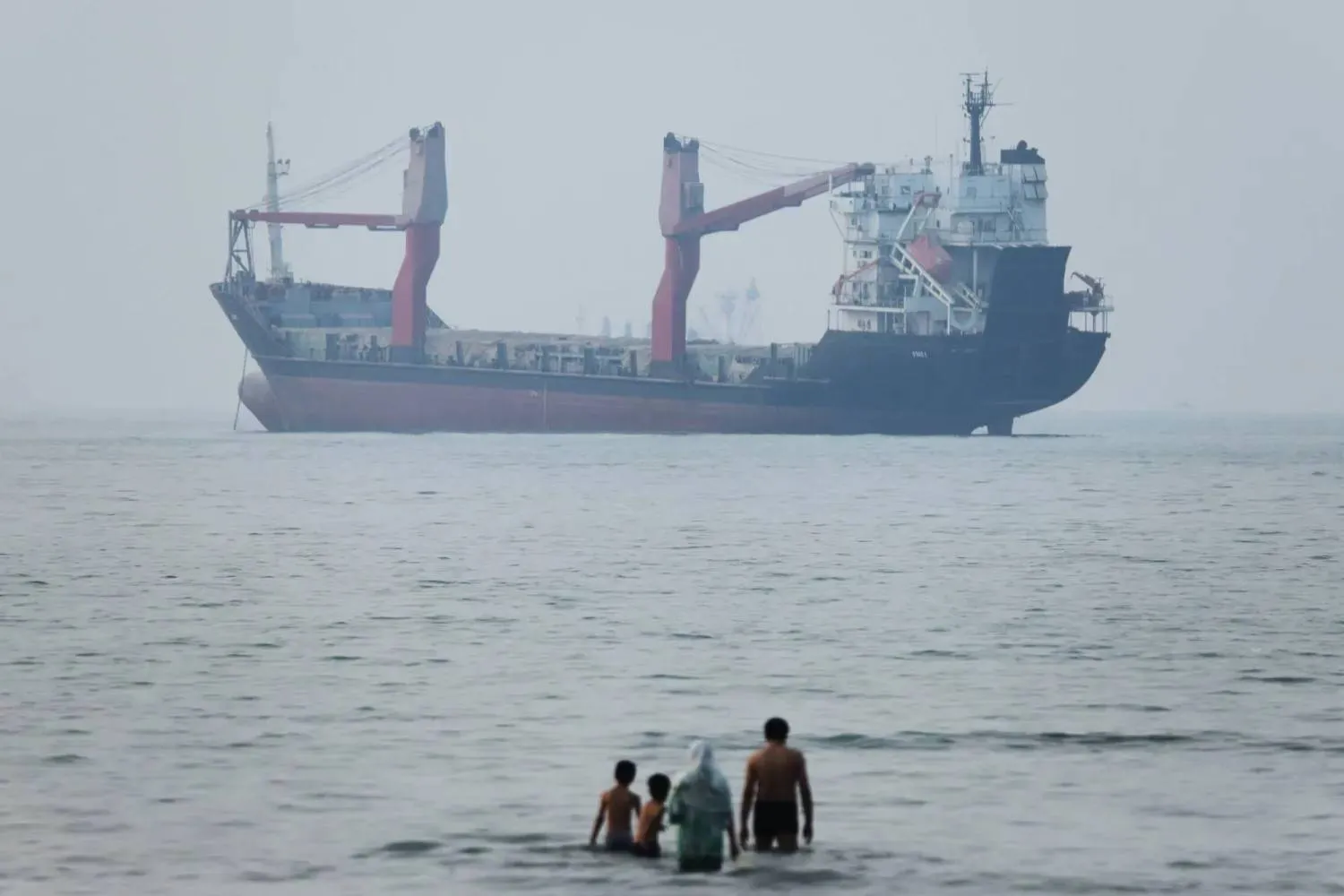
A group of people stands in shallow water as a cargo ship appears anchored in the Strait of Hormuz off Bandar Abbas, Iran, Tuesday, June 30, 2026. (Amirhosein Khorgooi/ISNA via AP)
TT

US Offers Tehran a Trade-Off: Frozen Funds in Exchange for Abandoning Hormuz Toll Payments

A group of people stands in shallow water as a cargo ship appears anchored in the Strait of Hormuz off Bandar Abbas, Iran, Tuesday, June 30, 2026. (Amirhosein Khorgooi/ISNA via AP)

Iran has insisted on managing the Strait of Hormuz in coordination with Oman, with a plan to impose a service fee on ships passing through the Strait, despite US opposition.

According to The Wall Street Journal, the US and Oman are looking for ways to break Iran’s insistence on charging tolls for ships to pass through the Strait. Their chief lever in indirect talks was a promise to unfreeze some of the $100 billion in Iranian funds held overseas.

On Friday, Axios said US President Donald Trump's envoys Steve Witkoff and Jared Kushner, who visited Doha last Tuesday, have been trying to convey to the Iranians that their demand for tolls could blow up a US-Iran deal that would ultimately be far more lucrative for Iran.
“The US message to Iran was 'Think bigger,’” a US official told Axios.

The official claimed the sums Iran could generate from developing and selling oil and other resources freely — if the US lifted all sanctions under a deal — “would be 100 times more valuable to them than using a gangster tactic to try and charge a toll.”

Also citing people familiar with the talks, WSJ said the US and Doha are looking for ways to break Iran’s insistence on charging tolls for ships to pass through the Strait of Hormuz, with Washington offering to unfreeze some of the $100 billion in Iranian funds held overseas.

The US diplomats offered Iran a trade-off: relinquish its claim to control the strait and renounce toll payments in exchange for billions of dollars of unfrozen funds, the newspaper wrote.

Talks had initially been progressing toward the release of $6 billion held in Qatar, but Iran’s decision to block the strait set back the release, it added.

In return, Tehran estimates that charging for security, safety and environmental services in the strait would bring in $40 billion a year in revenue for states involved. The idea was rejected by Washington.

The Iranians are insisting they have joint sovereignty over the strait, along with Oman, and that both countries will administer it and request passage fees after the 60-day term of the MOU ends.

Iranian Deputy Foreign Minister Kazem Gharibabadi stressed that the Strait of Hormuz is defined under Iran’s command.

“Hormuz is defined under Iran’s command, not CENTCOM,” Gharibabadi wrote in a post on his X account early Thursday, following his return from Doha.

Iran's military command has also threatened ships that attempt to cross the Strait of Hormuz using unapproved routes with a “forceful response.”

Omani Proposal

Meanwhile, negotiators from the US and Iran are actively discussing a recent Omani proposal regarding the management and transit of the Strait of Hormuz after Muscat proposed a voluntary maritime fund as a compromise.

The proposal, under which shipping companies would pay service fees to use the strait, mentions voluntary fees rather than a mandatory toll.

Sources said Oman has already made contacts with oil and shipping companies to explore their willingness to contribute to the maritime fund, but Tehran insists on controlling traffic and collecting transit fees.

An informed source said the plan was recently handed over to US negotiators, who had some reservations about the proposal but intend to discuss it with the Omani side.

Another source added that the proposal would eventually be an indirect form of the toll system that Iran benefits from.

Maritime traffic in the Strait of Hormuz, through which a fifth of the world's oil and liquefied natural gas supplies travel, have been largely blocked since the war broke out with US-Israeli strikes on Iran on February 28.

Galibaf: We Will Not Allow US Interference

Iranian Parliament Speaker Mohammad Bagher Ghalibaf said his country is resolved that the United States would not be allowed to interfere in the management of the Strait of Hormuz.

During a meeting with He WeiHe, Vice Chairman of the Standing Committee of China's National People's Congress, Ghalibaf said Iran and Oman have come to an agreement regarding the regulation of traffic in the Strait of Hormuz, based on Article V of the Memorandum of Understanding with the United States.

Article V of the memorandum commits Iran to work with Oman and the other Gulf littoral states to determine the future administration of navigation and maritime services in the Strait of Hormuz in accordance with international law and the sovereign rights of the states bordering the waterway.

The Speaker said Iran is actively moving forward with the implementation of this new maritime framework and intends to hold further consultations with other countries bordering the Gulf.



Iran Negotiator Ghalibaf Says Hormuz Will Not Open until US Meets Demands

Iran's parliamentary Speaker Mohammad Bagher Qalibaf speaks during a news conference in Beirut on Oct. 12, 2024. (AP)
TT

Iran Negotiator Ghalibaf Says Hormuz Will Not Open until US Meets Demands

Iran's parliamentary Speaker Mohammad Bagher Qalibaf speaks during a news conference in Beirut on Oct. 12, 2024. (AP)

Iran's top negotiator Mohammad Bagher Ghalibaf said on Tuesday that the strategic Strait of Hormuz will not be opened until the United States meets Tehran's demands, including lifting a naval blockade.

"I want to state clearly that the Strait of Hormuz will not be opened until the American commitments stipulated in the memorandum of understanding... are implemented," Ghalibaf said in a speech broadcast on state television.

He listed the removal of the blockade, the lifting of oil sanctions and unfreezing of Iran's assets abroad among the demands, which were included in an Iran-US truce in June that later collapsed, reported AFP.

War between Iran and the United States broke out on February 28 after US-Israeli attacks on the Iranian republic, triggering a conflict across the region.

Diplomatic efforts have since April 8 put an end to intense bombardments, but sporadic clashes have persisted, especially in and around the Strait of Hormuz.

Iran has kept control of the strait, a vital global energy conduit, since the war broke out, requiring vessels to seek permission and pay transit service fees -- a move opposed by Washington and several regional countries.

Iran and Oman, both coastal states on Hormuz, have for weeks been discussing the future of navigation through the strait, with Tehran saying the geographical coordinates of the route envisaged by both countries "have been agreed upon".

On Monday, Iran said that talks were "continuing in a serious manner" and views were being exchanged on the text of a "joint statement".

US President Donald Trump called for Tehran to surrender in a war that has become a growing political burden at home.

Ghalibaf during his speech said Iran was "ready to inflict an even more crushing defeat on the enemy, proportionate to its actions and advances".


Firefighters Push to ‘Encircle’ Belgian Wildfire

 Belgian firefighters work in a forest affected by a wildfire in Waimes, in the High Fens (Hautes Fagnes) region, Belgium, August 18, 2026. (Reuters)
Belgian firefighters work in a forest affected by a wildfire in Waimes, in the High Fens (Hautes Fagnes) region, Belgium, August 18, 2026. (Reuters)
TT

Firefighters Push to ‘Encircle’ Belgian Wildfire

 Belgian firefighters work in a forest affected by a wildfire in Waimes, in the High Fens (Hautes Fagnes) region, Belgium, August 18, 2026. (Reuters)
Belgian firefighters work in a forest affected by a wildfire in Waimes, in the High Fens (Hautes Fagnes) region, Belgium, August 18, 2026. (Reuters)

Firefighters launched a potentially decisive push Tuesday to encircle Belgium's largest wildfire in a century, despite wind and rain hampering air support operations over the High Fens nature reserve.

The blaze charring the vast expanse of boggy peatlands, pine trees and hiking trails grew over the weekend to half the size of Manhattan -- 3,000 hectares (7,500 acres) -- with hundreds of firefighters working night and day to wrestle it under control.

"We are trying to definitively encircle the fire today," regional government spokesperson Nicolas Yernaux told AFP.

In areas where firefighters could operate, he confirmed the fire was "under control and contained."

But a hard-to-access front towards the German border remains a concern -- with residents in the border town of Monschau already under evacuation orders due to the smoke hazard.

Firefighters worked through the night to make a crucial link-up between the eastern and northern fronts, under very difficult access conditions.

"We're talking about one or two kilometers, and we're on the verge of achieving it," Yernaux told AFP, despite "sustained winds" blowing towards the German border.

Water-bombing aircraft from several countries have been deployed -- with two Norwegian helicopters the latest to fly in on Monday night -- but they have been repeatedly grounded by low cloud and rain. There are also aircraft from Germany, Sweden and the Netherlands.

Yernaux said it was unclear given weather conditions when they would be able to take off again.

"There may be windows of opportunity this morning, but it may not be before tonight."

A huge area has been blanketed by a thick plume of yellowish smoke, with fumes detected as far as eastern France, where authorities issued an air-pollution alert.

The smoke triggered evacuations in one Belgian village and two hamlets of a second -- with residents of the hamlet of Sourbrodt given the green light to return home on Monday night.

- As long as it takes -

Europe has been swept by weeks of devastating wildfires fueled by dry conditions and a historically hot summer, with France, Greece, Portugal and Spain also battling major fires.

The High Fens blaze broke out in an area that was ravaged by massive fires in 1911, during a similar period of heatwaves.

It is the country's largest wildfire since.

During a visit on site with King Philippe on Monday, Belgium's interior minister Bernard Quintin told media it could take "several weeks" of soaking and dousing the area to prevent the fire from reigniting -- even once brought under control.

On-site operations have been made much harder by the fens' terrain -- a patchwork of heath, peat bogs and raised wooden boardwalks where heavy vehicles risk sinking into the ground -- and firefighters struggle to tackle the fire at close range.

They have been counting heavily on aerial assistance to bring the situation under control.

Local farmers have also poured in to help, working shifts to oversee a ballet of tractors pulling in tankers of water from a nearby lake.

"We'll take it in turns as long as it needs -- the team is all set," a farmer from nearby Waremme, told AFP Monday. "We'll keep going until the finish line."

Like much of Europe, Belgium has experienced a new spell of intense heat and drought in recent days.

Temperatures reached as high as 37C in some parts of the country last week, creating conditions conducive to wildfire outbreaks.


Japan's Defense Minister Says Cooperation with US, S.Korea 'Critical' for Region

Japan's Defense Minister Shinjiro Koizumi (C) reacts as he talks with Australian Deputy Prime Minister and Defense Minister Richard Marles (L) during a meeting at Parliament House in Canberra on August 18, 2026. (Photo by HILARY WARDAUGH / AFP)
TT

Japan's Defense Minister Says Cooperation with US, S.Korea 'Critical' for Region

Japan's Defense Minister Shinjiro Koizumi (C) reacts as he talks with Australian Deputy Prime Minister and Defense Minister Richard Marles (L) during a meeting at Parliament House in Canberra on August 18, 2026. (Photo by HILARY WARDAUGH / AFP)

Japan's defense minister said Tuesday that cooperation between his country, the United States and South Korea was "critical", after US President Donald Trump scaled back military drills with Seoul, said AFP.

"As Japan faces the most severe and complicated security environment in the post-war era, the cooperation among Japan, the United States and South Korea is critical to the peace and stability of the region," Shinjiro Koizumi said in Australia after talks with his counterpart Richard Marles.