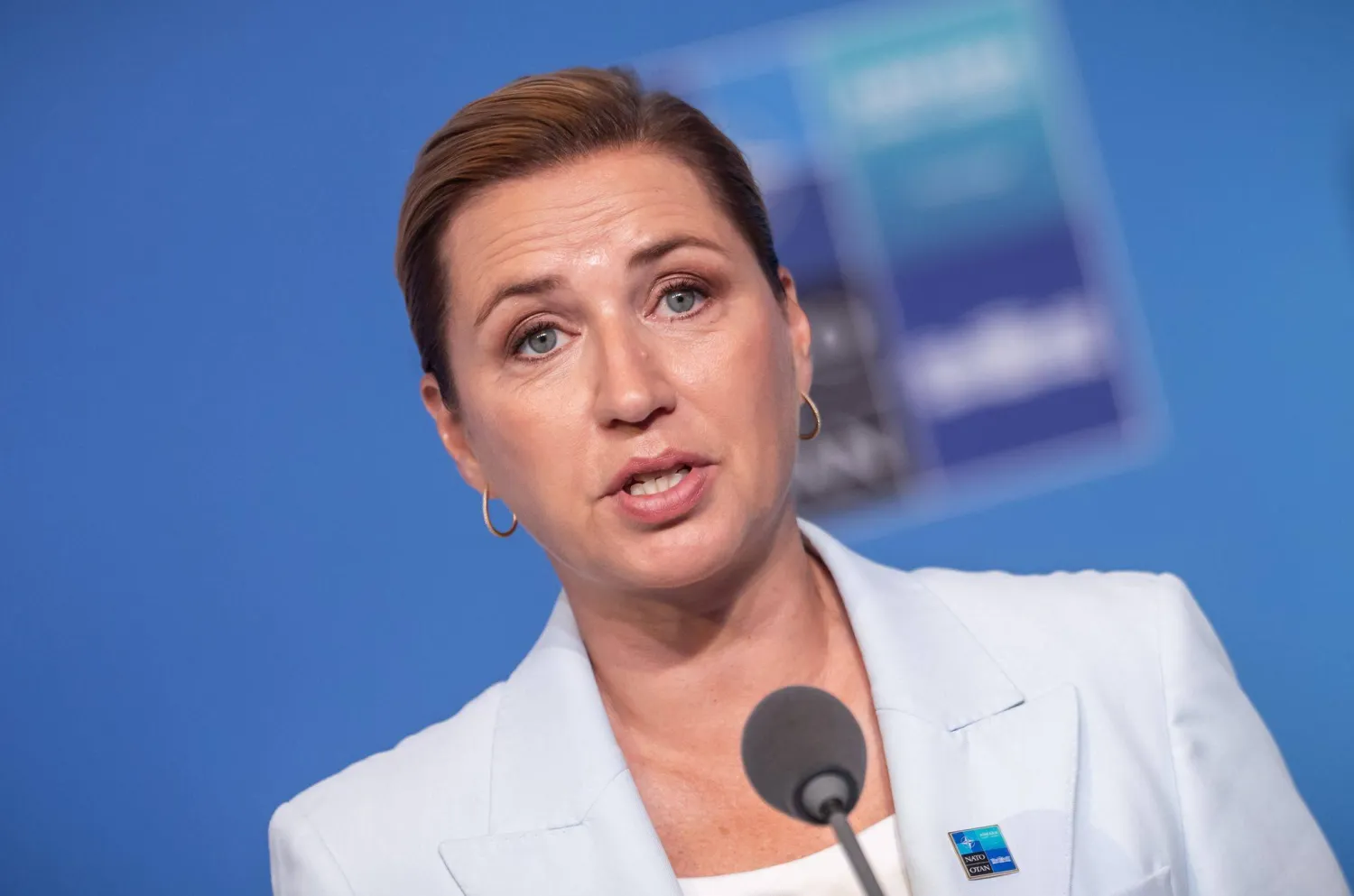
Denmark Says Ready to Defend ‘Every Inch of NATO', Including Danish Kingdom

08 July 2026, Türkiye, Ankara: Mette Frederiksen, Prime Minister of Denmark, speaks to the press ahead of the NATO Summit and the meeting of the North Atlantic Council in Ankara. Photo: Michael Kappeler/dpa
TT

Denmark Says Ready to Defend ‘Every Inch of NATO', Including Danish Kingdom

08 July 2026, Türkiye, Ankara: Mette Frederiksen, Prime Minister of Denmark, speaks to the press ahead of the NATO Summit and the meeting of the North Atlantic Council in Ankara. Photo: Michael Kappeler/dpa

Denmark is ready to defend every inch of NATO, including the kingdom of Denmark, Danish Prime Minister Mette Frederiksen said in Ankara on Wednesday, a day after President Donald Trump reiterated that Greenland should be controlled ⁠by the US.

Trump's ⁠assertions that the US must acquire or control Greenland, a semi-autonomous Danish territory, have long strained relations between Washington and Copenhagen — ⁠both founding NATO members — and more broadly US ties with Europe. The issue has since moved to a diplomatic track.

"We are ready to defend every inch of NATO, including our own territory ... Of course we will defend the kingdom ⁠of Denmark," ⁠Frederiksen said, reiterating that Greenland was not for sale.

"One of the reasons why we have built NATO many, many years ago, is if anything happens to one of us, then everybody should stand up for each other," she said.


Pakistan Expands Search for Missing Cargo Plane as Rough Seas Hamper Rescue Efforts

People watch as an ambulance arrive with the bodies of police officers who were killed in an militants overnight attack, at a hospital in Ziarat, a district in Pakistan's southwetern Balochistan province, Tuesday, July 7, 2026. (AP Photo)
TT

Pakistan Expands Search for Missing Cargo Plane as Rough Seas Hamper Rescue Efforts

People watch as an ambulance arrive with the bodies of police officers who were killed in an militants overnight attack, at a hospital in Ziarat, a district in Pakistan's southwetern Balochistan province, Tuesday, July 7, 2026. (AP Photo)

Pakistan’s Navy and civilian authorities on Wednesday expanded the search for a cargo plane feared to have crashed after it disappeared from radar and lost contact with air traffic control en route to the southern port city of Karachi.

Officials said the Karachi-bound aircraft, operated by the private carrier K2 Airways, reported a navigational system issue while flying from Sharjah in the United Arab Emirates with five people on board. The search is still ongoing, according to three officials familiar with the rescue operation.

The officials spoke on the condition of anonymity because of the sensitive nature of the possible crash.

They added that the vast search area in the Arabian Sea and rough monsoon seas were posing significant challenges to the search-and-rescue operation.

There has been no official confirmation of the aircraft’s fate. In a statement, K2 Airways said search and rescue operations are still being conducted by Pakistani authorities and the company was fully cooperating with the aviation authorities.

“We continue to pray earnestly for the safety of our colleagues,” The Associated Press quoted it as saying.

Earlier, Pakistan’s Airports Authority said on X that radar data showed the aircraft making a sharp change in heading and rapidly descending before radar and radio contact were lost at about 9:21 p.m., approximately 155 nautical miles (287 kilometers, 178 miles) west of Karachi.

According to the authority, Pakistan’s military and civilian agencies activated the Rescue Coordination Center and launched search-and-rescue operations at sea shortly after the aircraft went missing.

According to the officials, Pakistan Navy frigate PNS Zulfiqar was dispatched to the area where contact with the aircraft was lost. The Pakistan Air Force also deployed aircraft to assist in the search, while a Pakistan Navy ATR aircraft took off from the southwestern city of Turbat.

A merchant vessel operated by the Pakistan National Shipping Corp. also joined the operation, officials said.

Aviation expert Imran Aslam told local broadcaster ARY News late Tuesday that it remained unclear what caused the aircraft to disappear from radar. He said that even if an aircraft suffered an engine failure, it would normally continue gliding rather than plunge suddenly. He said the exact cause would become clear only after investigators gathered more evidence.

In May 2020, a Pakistan International Airlines flight carrying 98 people crashed into a densely populated neighborhood near Karachi airport while attempting to land. All but one of the 99 people on board were killed. A government investigation later concluded that human error by the pilots and air traffic controllers caused the crash.


Iraqi Cities Host Funeral Processions for Khamenei

Security personnel stand guard on the day of a funeral procession for Iran's late Supreme Leader Ali Khamenei, who was killed on February 28 in Israeli and US airstrikes, in Najaf, Iraq, July 8, 2026. (Reuters)
TT

Iraqi Cities Host Funeral Processions for Khamenei

Security personnel stand guard on the day of a funeral procession for Iran's late Supreme Leader Ali Khamenei, who was killed on February 28 in Israeli and US airstrikes, in Najaf, Iraq, July 8, 2026. (Reuters)

Crowds thronged the streets of Najaf on Wednesday as the coffin of Iran's supreme leader Ali Khamenei moved through the city in a procession devoted to Iraq.

Iran began six days of public funeral ceremonies for Khamenei on Saturday, including a dedicated day to neighboring Iraq, which has close ties to Tehran.

Tehran hopes the marathon ceremonies will project strength and unity after the Middle East war, which started with US-Israeli strikes that killed Khamenei and several relatives on February 28.

The procession in Najaf came as the United States and Iran renewed hostilities in the Strait of Hormuz, putting more pressure on a deal to end the war.

The US military said it had struck dozens of Iranian targets in response to Tehran's attacks on three ships in Hormuz, with Iran's Revolutionary Guards later saying they had hit US military facilities in Bahrain and Kuwait.

After a massive procession in Iran's city of Qom, Iraqi officials and senior politicians received the remains of Khamenei on Tuesday night at Najaf international airport in the presence of Iranian President Masoud Pezeshkian and one of the late leader's sons.

Iraqi authorities declared Wednesday a public holiday, with procession ceremonies starting at at 6:00 am (0300 GMT) in Najaf.

A heavy security deployment was in place as the crowds swelled, with some people pushing close to touch Khamenei's coffin as it rode in the back of a truck en route to the shrine of Imam Ali, the Prophet Mohammed's son-in-law.

At the shrine, dozens of clerics stood ready to pray over the coffin before it was carried on to the city of Karbala.

Khamenei's final burial will take place on Thursday in his hometown of Mashhad in northeast Iran.

His eldest son Mostafa Khamenei was present at the airport on Tuesday, but his successor Mojtaba Khamenei, named supreme leader shortly after his father's killing, has not appeared in public and has only communicated through written statements since his nomination.

Iraqi Mohammed al-Bayati, 30, who travelled for hours to Najaf, said it was "an opportunity not to be missed to participate in the funeral of the person who challenged the power of America and Israel".

Najaf is the main center of Shiite religious seminaries, and is also home to Ali Sistani, Iraq's top Shiite religious authority.

Many senior Shiite clerics have studied, taught or lived there, including Khamenei's predecessor Khomeini.

After Najaf, Khamenei's body will be flown to Karbala, about 60 kilometers north, for another procession.

In Karbala, one banner read "we bid you farewell" and another displayed Khamenei's photo with the caption, "the one who humiliated America".

In both cities, hundreds of volunteer-run stalls serving food and drinks to mourners lined the procession routes.

Iranian state media quoted Esmail Qaani, head of the Guards' Quds Force, as saying: "The extensive planning for this historical event by the Iraqi government and people show the depth of the spiritual bond between the two great nations of Iraq and Iran to the whole world."


Protests Break Out in Havana as Cuba Struggles to Restore Electricity

People protest against power outages in Havana, Cuba, 07 July 2026.  EPA/Ernesto Mastrascusa
People protest against power outages in Havana, Cuba, 07 July 2026. EPA/Ernesto Mastrascusa
TT

Protests Break Out in Havana as Cuba Struggles to Restore Electricity

People protest against power outages in Havana, Cuba, 07 July 2026.  EPA/Ernesto Mastrascusa
People protest against power outages in Havana, Cuba, 07 July 2026. EPA/Ernesto Mastrascusa

Scattered protests broke out across Havana on Tuesday evening, with residents banging pots, honking horns and shouting "turn on the lights" as millions of Cubans remained without power amid a six-month-long US fuel blockade.

Cuba experienced a nationwide outage on Monday — its third this year — but while authorities said most of the country had been reconnected to the island's grid by late Tuesday, many remained in the dark and without electricity as the island doesn't have enough fuel, Reuters reported.

The country's grid operator UNE said ⁠it had reconnected ⁠the grid from Pinar del Rio, in far western Cuba, to Holguin in the east. Santiago de Cuba, the island's second-largest city, remained disconnected and without power, authorities said.

The US in January cut off Cuba's fuel supply, then imposed fresh sanctions that have prompted an exodus of foreign businesses and a near-complete collapse of tourism in a bid to force the island's government to the negotiating table.

The US is seeking ⁠to upend Cuba's communist-run government and has called for democratic elections and the release of "political" prisoners.

Cuba and the United Nations say US President Donald Trump's sanctions are a violation of international law and the human rights of the island's residents.

Hundreds of exhausted residents in the outlying Havana neighborhoods of Jaimanitas and Santa Fe took to the streets while others sat on doorsteps and sidewalks during the hot night, playing dominoes or chatting with neighbors while waiting for power to be restored.

Many, now accustomed to blackouts spanning 30 hours or more, had largely resigned themselves to another night of swatting mosquitoes and little sleep.

"I don't see a quick fix to this ⁠problem," said Amauri Gonzalez, ⁠a local resident who had stepped outside his home for a bit of fresh air. "Our power plants are obsolete and there's no fuel."

In some areas of Santa Fe, the power returned shortly after the pot-banging began, sending protesters scurrying to their homes to take advantage.

According to both Cuban and US officials, talks between the two nations have stagnated.

US Ambassador to the United Nations Michael Waltz told a Tuesday debate on US sanctions at the UN General Assembly that Cuba's government was to blame for the electricity shortfalls.

"Change your ways and turn the lights back on for your people," he said.

The vast majority of countries that spoke during the debate, however, called on Washington to end the blockade and reverse the sanctions that have crippled the island's economy.