


US Citizen Is Found Guilty of Helping Export Tech to Iran in Violation of Sanctions

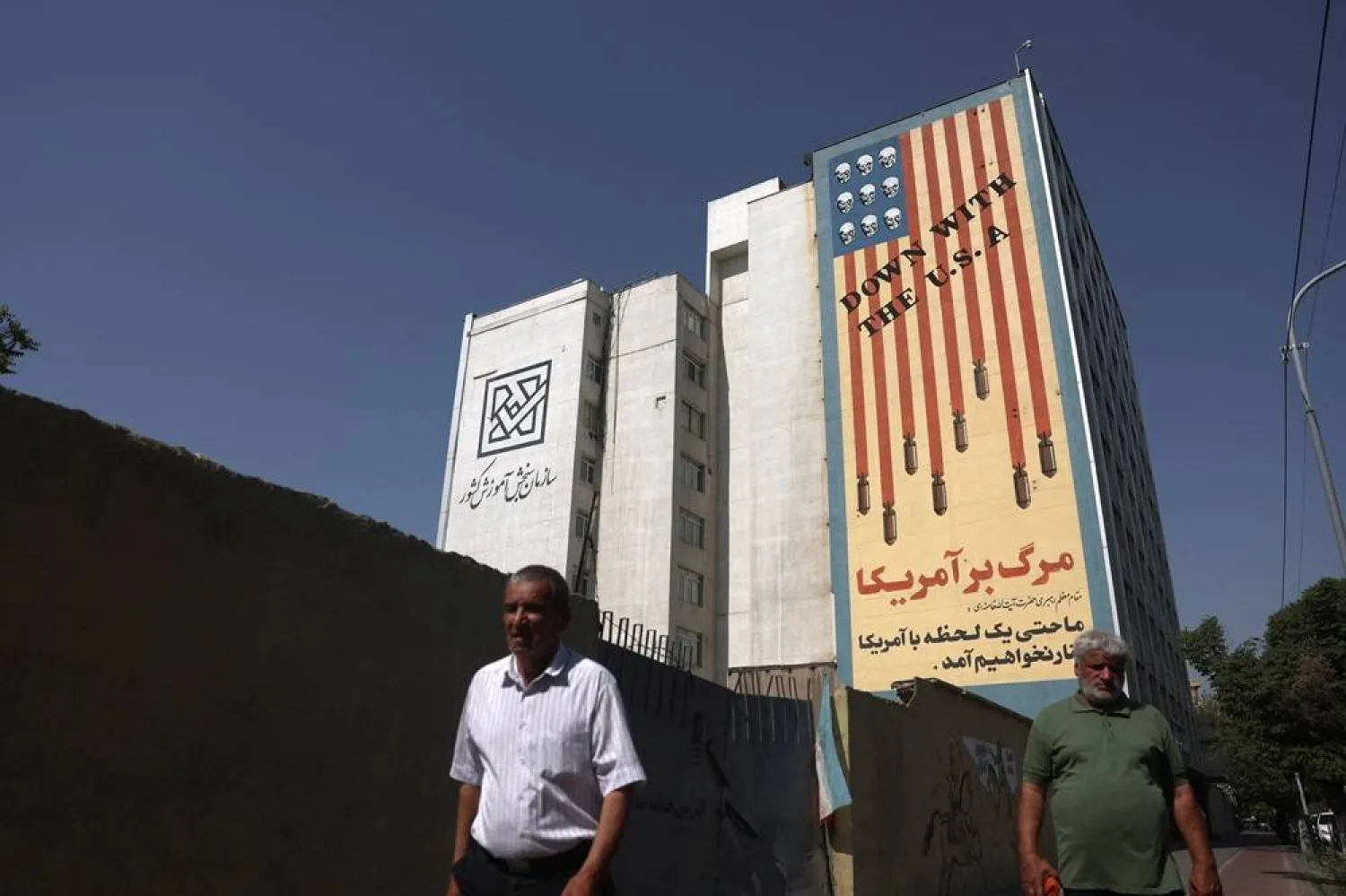
People walk near an anti-US mural in Tehran, Iran, July 13, 2026. Majid Asgaripour/WANA (West Asia News Agency) via Reuters
TT

US Citizen Is Found Guilty of Helping Export Tech to Iran in Violation of Sanctions

People walk near an anti-US mural in Tehran, Iran, July 13, 2026. Majid Asgaripour/WANA (West Asia News Agency) via Reuters

A Massachusetts man was found guilty Monday of conspiring to unlawfully export electronic components to Iran in violation of US sanctions.

Mahdi Mohammad Sadeghi, who worked at the global electronics company Analog Devices, was accused of helping an Iranian business associate get around American export control laws. US prosecutors say the business associate’s Tehran-based company makes navigation systems for the military drone program of Iran’s Revolutionary Guard. Authorities say the scheme included the creation of a front company in Switzerland.

The second defendant, Mohammad Abedininajafabadi, called Abedini in court documents, was not on trial. He is believed to be in Iran after an apparent prisoner exchange for an Italian journalist.

Sadeghi was found guilty on three of the five charges. He showed no visible reaction to the verdict, which came early in the fourth day of jury deliberations. He and his lawyers did not comment as they left court, and he will remain free until sentencing Oct. 13.

Sadeghi, a 43-year-old naturalized US citizen, chose not to testify. A father of two, he lost his job at Analog Devices due to the charges. Although he was arrested in December 2024, long before the current war with Iran, his trial has unfolded during the conflict.

“At its core, this case is straightforward. You cannot send goods, especially the goods at issue in this case, to Iran. Period. Full stop,” Assistant US Attorney Alathea Porter told the jury. “The defendant knew that, and conspired with Mr. Abedini to do that.”

Assistant U.S. Attorney Jared Dolan, in his closing remarks, said documents, text messages and photos proved that the illegal acts were the “fruits of this relationship” between Sadeghi and Abedini.

“The evidence established that he knew what Abedini was doing because he told him in writing,” Dolan said. “He helped him anyway.”

Sadeghi's attorney, William Fick, told jurors that the scheme laid out by the prosecution “makes no sense” and was full of holes. He said Sadeghi was only offering advice to a longtime friend about how to get business with the semiconductor company, and wasn’t responsible for procuring the parts for Abedini.

Fick said there was no proof the parts ended up in Iran, and he disputed that the Swiss company was a front.

“If you look at the world through dirty glasses, everything looks dirty,” Fick said. “That is fundamentally what the prosecution is asking you to do here.”

Fick also said prosecutors hadn't shown Sadeghi gained anything from the alleged plan — although the prosecution pointed out that they didn't need to prove a motive.

“He had nothing to gain and everything to lose,” Fick said. “He has lived in the country for decades. He was a well-regarded, respected employee on his way up in the company.”

Prosecutors had hoped to introduce evidence during the trial related to an Iranian drone used in a 2024 attack that killed three US troops at a remote base in Jordan.

However, before the trial, defense attorneys sought to exclude any evidence related to Abedini’s role in drone manufacturing or attacks on American troops.

The judge agreed, ruling that prosecutors could only give general evidence about Abedini’s Iranian company and how its technology had potential military applications, including for drones. During a hearing in February, prosecutors acknowledged they didn’t have evidence that Sadeghi “knew anything” about the technology he was accused of exporting was allegedly used on the drone involved in the Jordan attack.

Both defendants have been charged with export control violations. Abedini is separately charged with conspiring to provide material support to a foreign terrorist organization that resulted in the deaths of three service members.

Abedini was arrested at an airport in Italy on a US warrant in December 2024, but was released a month later and returned to Iran. Three days after his arrest, Italian journalist Cecilia Sala was detained while reporting in Iran. Sala, who was believed held as a bargaining chip for Abedini’s release, returned home in January 2025.



US: Pro-Palestinian Protesters Sentenced over Blocking Golden Gate Bridge Traffic in 2024

The Golden Gate Bridge during sunrise seen from Marin Headlands viewpoint in Marin County, California, US October 5, 2024. REUTERS/Manuel Orbegozo/File Photo
TT

US: Pro-Palestinian Protesters Sentenced over Blocking Golden Gate Bridge Traffic in 2024

The Golden Gate Bridge during sunrise seen from Marin Headlands viewpoint in Marin County, California, US October 5, 2024. REUTERS/Manuel Orbegozo/File Photo

Seven protesters who blocked traffic on the Golden Gate Bridge in a 2024 pro-Palestinian protest against Israel's assault on Gaza have been sentenced to 30 days, with credit for time already served.

They were convicted in July of misdemeanor charges by a San Francisco jury that remained deadlocked on the more serious charge of felony conspiracy.

Defense attorneys said demonstrators acted out of a moral responsibility to oppose the devastation from Israeli strikes on Gaza and Washington's support for its ally.

San Francisco District Attorney Brooke Jenkins said the protest caused ⁠a safety risk ⁠for those stuck in traffic and there should be consequences when laws are broken.

"Throughout history, civil disobedience has mostly involved accepting legal consequences," Superior Court Judge Teresa Caffese was quoted as saying by KQED.

"In that spirit, those who blocked the bridge and disrupted the lives of hundreds of ⁠commuters should be treated respectfully, but should also be prepared to accept the consequences of their actions."

The sentences included half the time in county jail while the remaining days can be served at a work release program operated by the San Francisco Sheriff's Office. There will be four days' credit for previous time already served. The sentencing also included six months of probation, and fines and restitution of over $1,000, Reuters reported.

The defendants will remain free while the case is appealed, SFGate ⁠reported.

Defense ⁠attorneys argued that protesters resorted to blocking the bridge after writing letters and appealing to congressional representatives produced no result.

The jury convicted the seven protesters on misdemeanor counts including false imprisonment, obstruction of thoroughfare, unlawful assembly and in one defendant's case refusal to disperse.

The jury did not reach a verdict on the most serious charge of felony conspiracy, an agreement between two or more people to commit a crime coupled with an overt act, which could have had a sentence of up to 15 years. Prosecutors said they will not retry the charges.


Landfill Collapse Kills 30 in Guinea

Residents and rescuers use an excavator to search for bodies after a landslide struck the Dar es Salaam dumpsite overnight in Conakry on August 23, 2026. (Photo by AFP)
TT

Landfill Collapse Kills 30 in Guinea

Residents and rescuers use an excavator to search for bodies after a landslide struck the Dar es Salaam dumpsite overnight in Conakry on August 23, 2026. (Photo by AFP)

Thirty people died in Guinea's capital Conakry on Sunday when a mound of rubbish in a landfill collapsed before dawn onto neighboring homes following heavy rains, the government said.

Six others were seriously injured in the 2:00 am (0200 GMT) incident in the Bbessia district's Dar-es-salam neighborhood on the capital's outskirts, a government statement said.

Neighborhood leader Lancine Sylla had previously told AFP that he feared a heavy toll.

"We have pulled out 18 bodies that were taken to the morgue," he told AFP.

Guinea's minister for territorial administration Djenabou Toure went to the scene of the accident, where AFP photographers saw excavators take part in a search-and-rescue operation through the collapsed landfill under the gaze of a crowd of onlookers.

In recent days, the government had ordered the expulsion of people and safety measures around the site because of fears of a collapse.


French Ambassador to Asharq Al-Awsat: Mohammed bin Salman’s Visit Paves Way for New Phase of Strategic Partnership

Patrick Maisonnave, French Ambassador to Saudi Arabia (Asharq Al-Awsat).
TT

French Ambassador to Asharq Al-Awsat: Mohammed bin Salman’s Visit Paves Way for New Phase of Strategic Partnership

Patrick Maisonnave, French Ambassador to Saudi Arabia (Asharq Al-Awsat).

A senior French official stressed that Saudi Crown Prince Mohammed bin Salman’s visit to France on Sunday means, in short, that Riyadh and Paris are entering a new phase of a genuine strategic partnership. He said the visit will address diplomacy, security, defense, investment, energy, culture, technology, and education.

Patrick Maisonnave, the French ambassador to Saudi Arabia, told Asharq Al-Awsat that the momentum is now being further strengthened through the visit of Crown Prince and Prime Minister Mohammed bin Salman to France and the first meeting of the French-Saudi Strategic Partnership Council.

According to Maisonnave, the council is particularly important because it provides a permanent institutional framework for this political ambition, allowing both countries to set priorities, measure progress, and develop long-term cooperation across the main pillars of the relationship.

He added that as the two countries seek to keep pace with profound geopolitical, economic, and technological changes, Mohammed bin Salman’s visit demonstrates a shared determination to move from a very strong bilateral partnership to a comprehensive strategic partnership.

He continued by saying that the readiness of the two leaderships to work together is not limited to bilateral issues, but also extends to regional stability, global challenges, and the major transformations shaping their societies, as the partnership enters a new phase with this visit.

He explained that the transformation Saudi Arabia is undergoing under Vision 2030, together with France’s strengths in sectors such as energy, infrastructure, culture, innovation, artificial intelligence, education, and creative industries, is creating new areas for convergence.

He stressed that the strategic dimension of the partnership lies precisely in this development, moving from a relationship based on strong cooperation to one increasingly grounded in shared objectives, long-term planning, and joint initiatives.

A Convergence Resilient to Challenges

Maisonnave affirmed that Riyadh and Paris have a well-established partnership and mutual trust that enable them to overcome the geopolitical challenges facing the region. He noted that the bilateral convergence translates into close coordination on the region’s most prominent crises.

He added that Paris and Riyadh are working together to support a two-state solution for Israelis and Palestinians and create the necessary political conditions for lasting peace. The two countries also share an interest in Yemen’s stability and in protecting freedom of navigation and the security of strategic maritime routes.

According to Maisonnave, the two countries support efforts to end the devastating war in Sudan and preserve the country’s unity and institutions. They also support Syria’s sovereignty, unity, and recovery, as well as the establishment of a stronger Lebanese state capable of exercising its authority, while reducing external interference and the influence of non-state armed groups.

He continued by saying that France and Saudi Arabia naturally have their own interests and perspectives, but have developed the ability to engage in frank dialogue, particularly during periods of regional tension and profound international changes. This has enabled the relationship not only to endure, but also to continually reinvent itself.

Ambassador Maisonnave said the distinctive nature of the Saudi-French relationship lies in its rare combination of historical depth, political trust, and a shared ability to look to the future. Over the past century, he explained, the two countries have built a relationship based on mutual respect, continuous dialogue, and, most importantly, strategic autonomy.

He added that the relationship is no longer defined solely by its history or traditional areas of cooperation. Instead, it is increasingly focused on what the two countries can build together over the coming decades. French President Emmanuel Macron’s visit to Saudi Arabia in December 2024 was a landmark moment that gave new political momentum to bilateral relations.

He attributed the resilience of bilateral relations since their establishment in 1926 to the fact that their strength lies in a century of accumulated trust, sustained political engagement at the highest levels, and a determination to adapt the partnership to each new historical period, despite some turning points along the way.

Maisonnave added that since diplomatic relations were established in 1926, France and Saudi Arabia have steadily expanded the scope of their cooperation. The relationship has accompanied the transformation of the Kingdom itself while responding at the same time to successive regional and international challenges. After 100 years, he said, the relationship is broader and deeper than at any previous stage in its history.

He continued by saying that this continuity is particularly evident today in diplomatic cooperation. At a time when the Middle East is going through one of its most significant periods of transformation, France and Saudi Arabia share a fundamental objective: preventing instability from becoming permanent and restoring the priority of diplomacy, state sovereignty, and international law.

Of particular importance, according to Maisonnave, is that this diplomatic coordination is developing alongside an equally deep economic and societal partnership. France is accompanying the transformation taking place in Saudi Arabia under Vision 2030 in areas ranging from investment and energy to culture, tourism, technology, education, and human capital development.

In his view, this gives the relationship an unprecedented scope, noting that strategic dialogue at the highest political levels is reinforced by growing ties between the two countries’ economies, institutions, and societies.

He also noted that the centenary of the establishment of diplomatic relations represents more than a commemoration of the past. It symbolizes the transition from one chapter to another in the history of the relationship.

Maisonnave explained that the first 100 years established and laid the foundations for a relationship based on trust. He stressed that the next 100 years must build on this legacy, making France and Saudi Arabia not merely partners in a changing world, but partners in shaping the future.