


Ukraine's Parliament to Elect New Government amid Outcry over Defense Chief

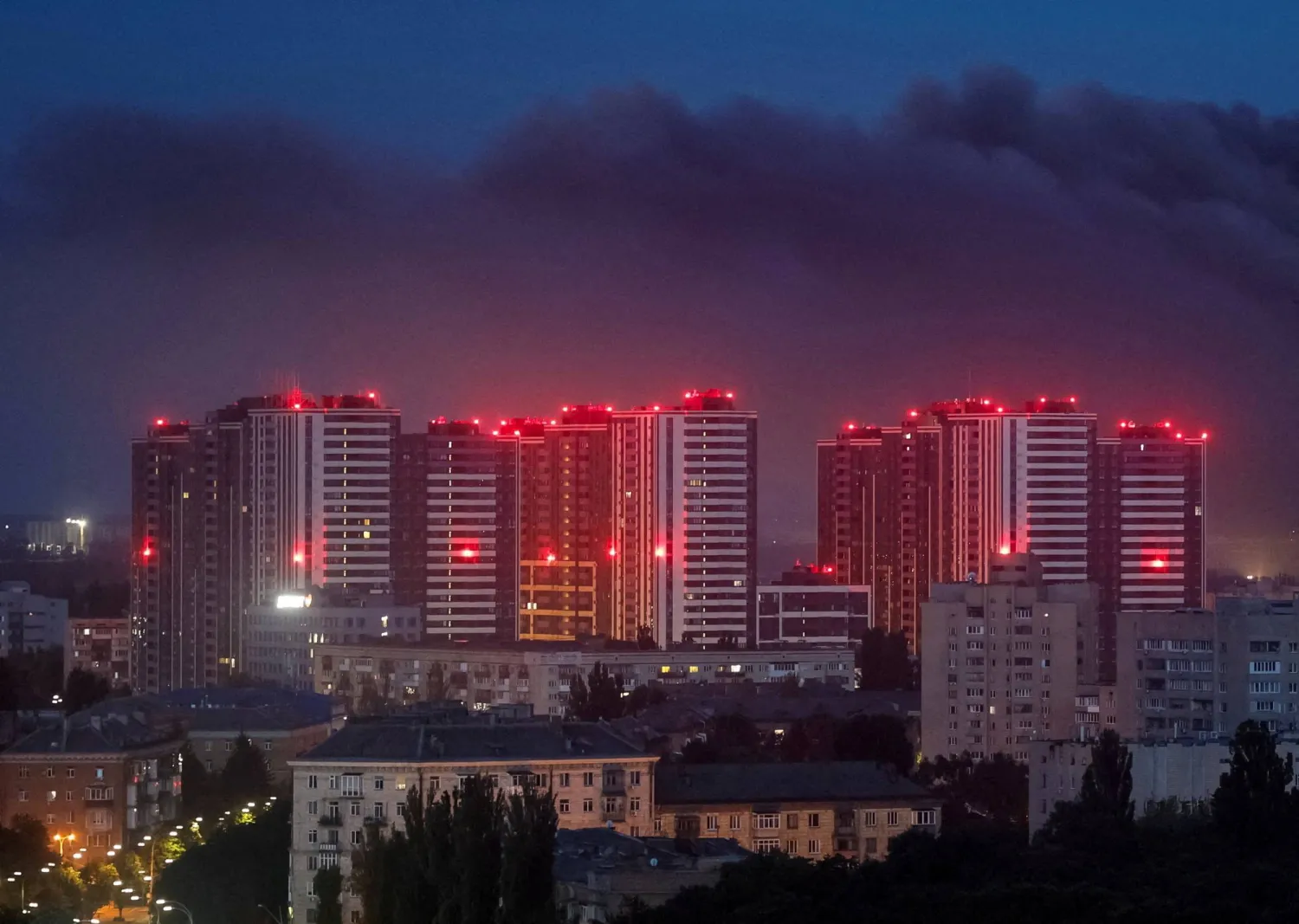
FILE PHOTO: Smoke rises in the city during a Russian missile strike, amid Russia's attack on Ukraine, in Kyiv, Ukraine July 11, 2026. REUTERS/Gleb Garanich/File Photo
TT

Ukraine's Parliament to Elect New Government amid Outcry over Defense Chief

FILE PHOTO: Smoke rises in the city during a Russian missile strike, amid Russia's attack on Ukraine, in Kyiv, Ukraine July 11, 2026. REUTERS/Gleb Garanich/File Photo

Ukrainian lawmakers will vote on a new wartime government on Thursday amid popular protests over the dismissal of reformist Defense Minister Mykhailo Fedorov at a critical point in Kyiv's conflict with Moscow.

President Volodymyr Zelenskiy's second cabinet shake-up in a year has focused public anger over his exclusion of Fedorov, a 35-year-old tech expert who has aimed to reshape Kyiv's outmanned army into a more efficient fighting force, said Reuters.

A proposed new government under energy executive Sergii Koretskyi would see current Interior Minister Ihor Klymenko replace ‌Fedorov, lawmakers said, ‌a move that has rattled faith in Zelenskiy's wartime ‌leadership.

Fedorov ⁠confirmed on X ⁠late on Wednesday that his tenure was ending, but Zelenskiy has not yet publicly commented on the move.

Ukraine is in its best battlefield position since late 2022, striking Russia's oil sector and military logistics in drone and missile attacks that have weakened Moscow's war machine.

But Kyiv's forces still face grinding Russian advances in the east amid a critical shortage of ground troops, as well as a lack ⁠of air defenses as Moscow steps up strikes with ‌ballistic missiles.

"In difficult moments, Zelensky behaves like ‌a hero," wrote Vitalii Sych, chief editor of Ukrainian outlet NV. "But we should not forget that ‌difficult moments are often caused by his idiotic decisions."

Pavlo Yelizarov, a deputy ‌commander of Ukraine's air force and a key leader in drone warfare, announced his resignation on Thursday in response to Fedorov's dismissal — calling it "a great evil" for Ukraine's defense.

PROTESTS NEAR PRESIDENT'S OFFICE

In Kyiv, more than a thousand protesters rallied outside Zelenskiy's office to ‌chants of "Shame!" and carrying placards with phrases like, "The Russians are celebrating".

The scene was reminiscent of major protests last July, ⁠when a public ⁠outcry forced Zelenskiy to reverse an unpopular measure stripping anti-corruption agencies of their independence.

Fedorov, who had previously served as Ukraine's first digital transformation minister, has been credited with cutting bureaucracy, boosting drone warfare and pursuing a data-driven strategy to exhaust Russian forces.

But supporters say his attempts to clean up defense procurement have angered parts of the establishment. He has also been criticized for failing to deliver quickly enough on his pledge to reform recruitment.

Zelenskiy announced his latest shake-up to widespread shock on Sunday, arguing the government and law enforcement agencies needed "renewal".

On Wednesday, he told reporters that he expected the defense ministry and military leaders to work with greater unity — appearing to confirm speculation that tensions had developed between Fedorov and top generals.

It was not immediately clear whether Fedorov would be offered another government job.


Trump Hails Release of US Citizen Held in Iran as 'Goodwill' Gesture

President Donald Trump speaks in the Oval Office of the White House, Monday, July 13, 2026, in Washington, as he signs executive orders. (AP Photo/Julia Demaree Nikhinson)
TT

Trump Hails Release of US Citizen Held in Iran as 'Goodwill' Gesture

President Donald Trump speaks in the Oval Office of the White House, Monday, July 13, 2026, in Washington, as he signs executive orders. (AP Photo/Julia Demaree Nikhinson)

US President Donald ‌Trump has called the release of a US citizen held in Iran a "gesture of goodwill", even as conflict raged for a fifth night across the Middle East.

Trump said in a post on Truth Social on Wednesday that an American who was "wrongfully detained" under the Biden administration in 2024 had been allowed to leave Iran, Reuters reported.

"She is now safely outside of Iran, and ‌in good ‌condition. The United States of America ‌appreciates ⁠this gesture of Goodwill ⁠by Iran," Trump wrote.

Human rights attorney Jared Genser identified the American as Dena Karari.

"Dena is now safe and traveling back to the United States," Genser wrote on X, thanking Trump for his efforts to free her.

Iran has ⁠neither confirmed nor denied that ‌Karari has been released.

The ‌release came despite US military strikes across Iran aimed at ‌reopening the vital Strait of Hormuz ‌shipping lane, and amid escalating threats from Trump that he will bomb Iran's power plants, bridges and energy infrastructure.

Three US officials told Reuters that US ‌strikes aimed at forcing open the strait are also targeting Iranian military capabilities the ⁠US ⁠would want to destroy before executing more complex operations.

Iran has hit back with what it said were strikes targeting US bases in Kuwait and Jordan.

According to the New York Times, Karari, 53, is a resident of California. She had her passport seized as she visited relatives in the southwestern city of Shiraz in December 2024.

She was not detained, but was interrogated on various occasions by the authorities, the newspaper said, citing her lawyer, Genser.


Mediator Pakistan Says Encouraging US, Iran to Resume Talks

TOPSHOT - A woman crosses Tehran's Enghelab Square on July 15, 2026, past a giant anti-US billboard featuring US president Donald Trump in a coffin with text in Persian reading "We Kill Trump".  (Photo by AFP)
TOPSHOT - A woman crosses Tehran's Enghelab Square on July 15, 2026, past a giant anti-US billboard featuring US president Donald Trump in a coffin with text in Persian reading "We Kill Trump". (Photo by AFP)
TT

Mediator Pakistan Says Encouraging US, Iran to Resume Talks

TOPSHOT - A woman crosses Tehran's Enghelab Square on July 15, 2026, past a giant anti-US billboard featuring US president Donald Trump in a coffin with text in Persian reading "We Kill Trump".  (Photo by AFP)
TOPSHOT - A woman crosses Tehran's Enghelab Square on July 15, 2026, past a giant anti-US billboard featuring US president Donald Trump in a coffin with text in Persian reading "We Kill Trump". (Photo by AFP)

Pakistan said on Thursday it would encourage the United States and Iran to stop violence and resume talks under a memorandum of understanding (MoU) it helped mediate last month.

"While the implementation of the MoU is facing challenges, Pakistan will continue to encourage all sides to end violence and resume technical-level talks in accordance with the MoU," Tahir Andrabi, Pakistan's foreign office spokesman, told reporters in Islamabad.

"We express the hope for an early normalization of the situation in Strait of Hormuz and underscore the importance of ensuring the continued safety, security and freedom of maritime navigation," he added.

The United States has this week been striking Iran, drawing retaliatory Iranian attacks on US interest in the Gulf as they battle over the strategic Hormuz shipping route.

That sent global oil prices soaring and led to concerns of spikes in inflation even in nations far from the conflict.

The key oil and gas artery, which Iran insists it controls, is central to the rekindled fighting that has entered its sixth day despite a preliminary deal in June aiming to end the war.

"Pakistan recognizes the urgent need to address the impact of the current situation on global energy supplies and other economic commodities including trade and food security," Andrabi said.


US War Against Iran Enters a New Phase

The US deploys two aircraft carriers and more than 20 US Navy warships across the Middle East (CENTCOM)
TT

US War Against Iran Enters a New Phase

The US deploys two aircraft carriers and more than 20 US Navy warships across the Middle East (CENTCOM)

By: Julian E. BarnesEric Schmitt and David E. Sanger


The Trump administration has lurched back into a war against Iran that had never really ended.

When the war started more than four months ago, US forces targeted Iranian military bases, missile launchers, ships and naval facilities. Israel, fighting alongside the United States, hit leadership targets, hoping to bring down Iran’s hard-line government.

Their record of success has been mixed, at best. Israel killed the supreme leader, Ali Khamenei, but the leaders who succeeded him were even more hard-line. US forces struck thousands of targets, but did not destroy Iran’s ability to control the Strait of Hormuz, the waterway through which about 20% of the world’s oil typically flows.

For roughly 90 days beginning in April, an on-again-off-again cease-fire prevailed. And then it was over.

The United States now appears to be entering Round 2 of its military campaign. This round has a new focus — but not necessarily a clearer strategy.

Iran’s ability to control the strait, despite the pummeling its navy took, is by far the most important lesson of the first phase of the war. So it is no surprise that the Trump administration is focused on trying to loosen Iran’s grip on it.

Last Tuesday, in retaliation for attacks on tankers, Trump ordered airstrikes on dozens of targets in Iran, including coastal radars, anti-ship missile launchers and a fleet of small Iranian attack boats.

After a short lull, the United States hit 140 military targets in the first of three consecutive days of heavy bombing this week.

US forces carried out new rounds of attacks on Iran throughout Tuesday and resumed a naval blockade of Iranian ports, a strategy that showed some success in the earlier phase.

The strikes are intended to open the waterway to shipping. The purpose of the naval blockade is to put economic pressure on Iran by choking off its trade and to flex American military might.

Trump was quick to declare success.

“The Strait of Hormuz is open to ALL Ship traffic except for Iran — and that is because of their lying, violent, malicious leadership, which is taking them down the path of TOTAL DESTRUCTION,” Trump wrote on Truth Social on Tuesday morning.

But exactly what the US military will do to enforce the blockade, and how far it will go to exert control of the strait, is not clear.

Round 1 of the war came at a high cost. Tehran has estimated that at least 3,500 Iranians have died in the war, including 175 at an elementary school.

Thirteen US service members have been killed. And the war has cost tens of billions of dollars already, and the new round could drive those financial costs up substantially.

A critical question for the next phase is whether Trump will consider an operation to take Kharg Island, a key export hub for Iran’s oil in the northern Arabian Gulf.

Trump publicly mused about ordering the Marines to take control of the island during the first phase of the war, but ultimately abandoned those plans for fear of high US casualties.

Such an operation would be a far bigger escalation than Trump has undertaken so far. But it would be difficult, and lives could be lost in either taking or holding the island.

The United States continues to have a fearsome arsenal in the region, including two aircraft carriers, and dozens of carrier- and land-based attack and surveillance planes.

“There are currently more than 20 US Navy warships and hundreds of military aircraft operating across the Middle East,” Central Command said in a statement announcing the resumption of the blockade. “American forces remain vigilant, lethal, and ready.”

In the strikes last week, US forces hit more than 170 Iranian military targets. In three consecutive days of heavy bombing this week, the United States has hit 140 military targets.

Analysts said the Trump administration was sending a pointed message to the government in Tehran that the United States was willing to broaden its mission again and hit sites that have both military and civilian uses.

But senior US officials said the real focus of the current phase is undoubtedly the strait.

So far, Trump had not ordered resumption of such an all-out conflict, in part because that could prompt Iran to target not only US military bases in the region, but also energy infrastructure in those nations.

Attacks on those facilities could send oil and natural gas prices skyrocketing even higher.

Senior officials said the goal of the new military campaign is to force Iran to allow tankers and other commercial cargo ships to pass freely through the strait, and ultimately to return to the bargaining table to resume nascent talks on more difficult, long-term issues like the fate of Iran’s highly enriched uranium.

Administration officials acknowledge that the military strategy is not without risks. Iran has shown it has an asymmetric advantage. Iranian forces do not have to hit every ship passing through the strait, or sink any of them. They only have to cause enough damage and issue enough threats to scare shipping companies and insurers.

This week, Iranian missiles struck two crude oil carriers that were transiting the southern part of the strait. The attack killed an Indian crew member. Another tanker, carrying liquefied natural gas, was also hit and caught fire near the Omani coast.

Senior US officials said time remains on the American side as Iran’s economy collapses.

During the uneasy peace, Iran was able to get many of its tankers out, and to empty storage tanks that were overflowing with oil.

The resumed blockade will cause that oil to back up once more, and the money Iran has made from its oil exports will begin to dry up.

But the real question is: Can Iran’s hard-line leadership outlast Trump’s anxiety over rising oil prices?


*The New York Times
